After the two previous posts about off-season hockey development, it’s clear that every player needs to follow a good training program!

Off-Season Hockey Leads You to Surgery?

Off-Season Hockey Training

With all the people/companies out there offering training programs, I thought I’d give you a list of things to ask about when considering your off-season training options. A quality hockey training program should include:

1) Soft-tissue work (foam roller, lacrosse/tennis ball, medicine ball) for the muscles around the hips, shoulder blades, and chest
2) Static stretching for specific hockey-related “tight” spots
3) A well-designed dynamic warm-up with multi-planar mobility exercises for the ankle, hip, and thoracic spine.
4) Linear and lateral speed work
5) Double-leg, single-leg, and full body power work
6) Strength training, including single-leg exercise, dissociated upper body exercises, and dynamic core exercises (in linear, rotational, diagonal, and anti-movement patterns)
7) Hockey-specific conditioning, using various implements (e.g. shuttle runs, slideboards, sleds, etc.), and following an interval training progression (avoid steady state aerobic exercise!)

If the training program you’re following has ALL of these things, you’re probably on the right track. If it doesn’t, sign in to HockeyStrengthandConditioning.com and ask everyone if they know of a good hockey training center in your area.

Keep training hard!

Kevin Neeld

Please enter your first name and email below to sign up for my FREE Athletic Development and Hockey Training Newsletter!

If you missed, Monday’s post, check it out before reading this one.

Off-Season Hockey Leads You to Surgery?

The idea that being on the ice year-round could actually impair your development shocks a lot of people. For whatever reason, it’s been DRILLED into our minds that we need to skate, hard, year-round. This mentality has really exploded over the last 10-15 years. It’s no coincidence that we hip flexor and adductor (“groin”) strains, and sports hernias are at an all-time high now at the more elite levels of hockey.

Let me clear things up about what hockey players should be doing in their off-season to maximize their development.

Should Hockey Players Skate in the Off-Season?

Many hockey players make the fatal mistake of spending the entire off-season on the ice. Most players are on the ice for 4+ hours per week during the increasingly long season. It is ABSOLUTELY crucial that they start their off-season by taking a break and doing some things to reverse the physical adaptations that result from so much skating (e.g. foam rolling and stretching the glutes and hip flexors). After a month or so of NO ice time, players can skate within this context:

1) Power Skating Instruction: Avoid the coaches that just run you through drills and watch. Find a coach that will actually teach you technique and actively help you improve your mechanics. There should also be a focus on edge control, not just overspeed work.

2) Skill Instruction:
While I don’t think it’s completely necessary to be on the ice to do this, many players can make huge improvements in their hands in an off-season by spending some time practicing handling a puck on all sides of their body and with specific footwork/bursts of speed (which is why skating instruction is so crucial!).

3) Specific Summer Leagues: Many players feel stale if they don’t play some sort of game for 6 months. If you can find a decent league (competition equal to or better than what you’re used to) that plays a 6-10 game schedule toward the end of the Summer, then hop right in. Playing in a showcase tournament or two throughout the Summer isn’t going to kill you, but you should not be playing tournaments ALL off-season!

The mistake players (and parents) make is that they finish their season, then immediately register for spring and summer league and as many clinics as they can. It’s too much. Think QUALITY here, not quantity.

The adverse effects of this are becoming increasingly clear: As the year-round hockey craze infects younger players, we see high level hockey injuries spreading to all age levels. There is NO reason why peewees and bantams should have chronic groin and hip flexor pain! I’m not preaching here. I made all the mistakes myself, and I have the double hernia surgery and inevitable hip arthritis to prove it!

Off-Season Training

Following a structured, well-designed training program during the off-season can completely transform a player’s career, especially at the youth levels. There is a critical time period during development when the body is highly “malleable”. If you create the right training stimulus, your body is primed for a long career of explosive movement. Unfortunately, creating the wrong training stimulus will prime your body to stay slow and weak.

A good off-season hockey training program serves three major purposes:

1) Improve performance
2) Decrease injury risk
3) Improve stress handling capacity

Players should leave the Summer faster, stronger, and better conditioned than they’ve ever been in the past and eager to get on the ice. THAT is how every player should enter the season!

To your success,

Kevin Neeld

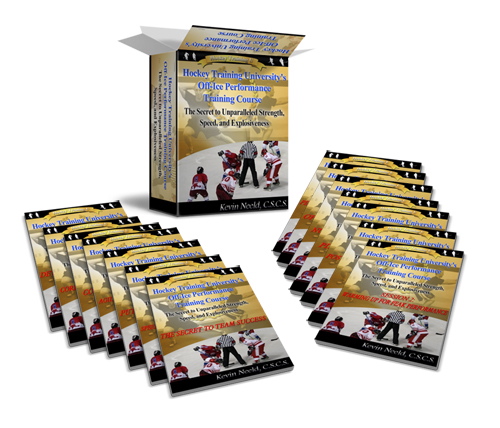
P.S. Last week I was fortunate to speak with Jim Snider, the Wisconsin Hockey Strength and Conditioning Coach, for a few minutes. To my surprise, he mentioned he’s been using a lot of the hip mobility drills in my Off-Ice Performance Training Course! He mentioned, and I agree, that hockey players should use those specific exercises to help maintain the range of motion around their hips they need to be successful on the ice and to decrease their injury risk. If you haven’t yet, check it out now!

Please enter your first name and email below to sign up for my FREE Athletic Development and Hockey Training Newsletter!
This was a post from Endeavor’s website that got such a great response that I wanted to share it with you.

As you know, I’ve recently teamed up with Michael Boyle (Boston University), Sean Skahan (Anaheim Ducks) and Mike Potenza (San Jose Sharks) to launch an incredible hockey training website: HockeyStrengthandConditioning.com.

Hockey Strength and Conditioning

On the site, U of Minnesota Strength Coach Cal Dietz shared an interesting article with us. The article outlined research with groundbreaking results. If you value your hockey career, you’ll read carefully!

This article outlined a study that took MRI’s of the hips of 39 NHL and NCAA Division I hockey players. Of the 39 players, twenty-one (54%) had labral tears, twelve (31%) had muscle strains, and 2 (5%) had tendinosis (degeneration of the tendon) of the hips. Overall, 70% of the players had irregular findings on their MRIs. Interestingly, the majority of these players were considered “healthy” at the time of the study, meaning they were okay to play.

As shocking as these results may appear, I wasn’t at all surprised. Similar results have been found in the shoulders of baseball players, and hockey players completely abuse their hips. Most players spend no time doing the stretches they need to (because they’re either too lazy or don’t know which ones they should do), have poor motor control of muscles around the hips (which tears up the joint and labrum!), and spend WAY too much time on the ice.

A couple weeks ago, I was on the phone with Mike Potenza (San Jose Sharks); he mentioned that in over 90% of cases, the players he sees that have sports hernias do little to nothing in terms of training. Everyone at the collegiate and professional strength and conditioning levels understand that good training can improve a player’s performance, lengthen their career, and keep them out of the surgeon’s office. Hopefully youth players and parents will get the message.

To your continued health and success,

Kevin Neeld

P.S. If you’re looking for a step-by-step training system to use this off-season, check out my Off-Ice Performance Training course. I continue to get incredible feedback about the exercises and progressions in the course, from NCAA D1 Strength and Conditioning Coaches down through parents of youth players (e.g. peewees). Download your copy today!

Off-Ice Performance Training

Please enter your first name and email below to sign up for my FREE Athletic Development and Hockey Training Newsletter!
Last day to save 25% on all hockey training products at Ice-Hockey-Training.com!

If you missed the details, check out why I want you to save money:

http://www.KevinNeeld.com/2010/birthday-sale-25-off-all-ice-hockey-training-products

Another great post from Endeavor’s newest addition David Lasnier. Forgive his grammar. He is French.

Enter David:

This post would be for those looking to make it in the strength and conditioning world in the first place.  I know that from an outside perspective, it might look like a cool job to work with athletes on a daily basis and helping them get to the next level; and believe me it is.  I know a lot of people who want to make it in this industry when they first get into College in Exercise science or kinesiology.  But the truth is a lot of them don’t know that it takes a lot of dedication and the process takes a certain time.

Beside from having good grades in College and pursuing continuing education, there is a lot more one needs to do to make it in this industry.  Here are a few tips to help you make it in the strength and conditioning business.

– Make contacts. Go out there in seminars and introduce yourself to other strength coaches and trainers. Make sure that the successful guys out there know who you are and that you trying to make it as strength coach.  These are the ones who might help you get an internship; they might refer you some athletes/clients if you live in a different region; they might even let you know about job opportunities.

– These same guys know a lot. There is a reason why they are so successful.  They know a lot about strength and conditioning, but they also know a lot about the business itself.  So don’t be shy to pick their brain and ask questions.  They have been around for a while, so they probably know a lot more than you do.

– Internships.  That is a key to making it in this industry.  Most of the time you won’t get paid for them, but you need to let everyone know that you are dedicated to getting more experience and making a name for yourself.  This is a necessary process if you wish to make it someday.  Go out there, bust your balls and someday you’ll be rewarded.

– On a related note, when doing internships, never forget that the goal is to gain experience. It is not to let others know how much you know because quite frankly they probably don’t care. I’ve seen too much people getting out of College without any experience and thinking they know everything.  You need to realize that theoretical knowledge will only get you so far.  Years under the trenches are worth so much more knowledge than what you will ever learn in College. So do me a favour and respect that.  So the next time you go on an internship or chat with a knowledgeable Strength coach, listen. Stop talking and listen to what he has to say, because he knows a lot more than you do.

– Be kind and polite.  It may sound obvious for some, but unfortunately not enough people get that.  People will always help out more somebody who’s kind and polite and they will be more willing to give out some of their time and answer questions.  And I’m not only talking about the strength and conditioning business here….this would apply in general in a thing called Life!

Hopefully, I’ve helped some of you out there who wish to make it as Strength and conditioning coach.  Be patient, listen, don’t be afraid to give some of your time and be polite and you will sure be rewarded someday.

David Lasnier

Enter Kevin:

I couldn’t have said it better myself. Top 5 ways to get on my good side:

1) Read everything I write, even if it sucks.
2) Email me from a computer, not a blackberry, ipod, iphone, ihome, icar, irobot, etc.
3) Take time to learn about my system before impressing your own thoughts.
4) Be humble.
5) Be coachable.

At the risk of sounding “preachy”, I expect the same from myself. Before I interned at Cressey Performance, I read EVERY single article Eric wrote. Every one. Since Eric writes in his sleep, his collection of articles was in the triple digits. It goes a long way in understanding why a coach does what he/she does and shows you’re serious about your career/education.

To your continued success,

Kevin Neeld

Please enter your first name and email below to sign up for my FREE Athletic Development and Hockey Training Newsletter!
A quick reminder that today is THE LAST DAY to get access to all the incredible hockey training information at HockeyStrengthandConditioning.com for $1!

Hockey Strength and Conditioning

Everyday at Endeavor I see people doing “rotator cuff” exercises. I’m not against doing some cuff work, but people often make a fatal mistake-they load too heavily!

Your body has amazing adaptive powers. If you use heavier weights, you’ll recruit larger muscles often at the expense of the muscles you’re targeting. Consider these two examples:

1) Exercises involving glenohumeral (“shoulder”) external rotation are usually performed to the rotator cuff muscles that assist in external rotation (teres minor, infraspinatus). If the load is too heavy your posterior deltoid will take over and imbalances around your shoulder are exacerbated.

2) High load core exercises (e.g. rollouts) can become very rectus abdominis (the “6-pack” muscle) dominant, sometimes at the expense of the transverse abdominis. The same is true for teaching people to “fill up their belly” with air to stabilize their spine without teaching them to pre-tension their core first. The problem with this is that the rectus doesn’t attach to the spine or share the lumbodorsal fascia connections that the transverse abdominis and obliques do, meaning your core strength may not create the spinal stability you’re looking for.

One of the things I’m starting to include in more programs these days is intentional low load exercises like:

-Alternate DB Row (intention: stimulate spinal stabilizers)
-Standing Belly Press (intention: stimulate “inner core” in anti-rotation pattern)
-Alligator Breathing (intention: teach diaphragm breathing)

I love helping people get strong, but I think low load training is necessary to improve stability and overall movement quality. After all, if stabilizers aren’t doing their jobs the larger surrounding muscles need to split attention between creating stability and demonstrating strength/power. The key to strong, powerful, efficient movement is appropriate joint stability.

Keep training smart!

Kevin Neeld

Please enter your first name and email below to sign up for my FREE Athletic Development and Hockey Training Newsletter!

Use CODE: "Neeld15" to save 15%