I’ve been outspoken about the importance of achieving and maintaining optimal hip mobility (read: range of motion) as a means of improving rotational power (important for skating fast and shooting hard) and preventing hip-related injuries like groin and hip flexor strains, sports hernias, and low back pain.

This is one of my favorite hip mobility exercises that has found it’s way into the warm-up of every hockey training program I write. This is another great exercise that I’ve borrowed from my friend and colleague Nick Tumminello. It emphasizes all three planes of hip movement in diagonal patterns. This is a must for all hockey players.

Diagonal Hip Rock -> Step

To your continued success,

Kevin Neeld

P.S. I’m on my way to the 2nd Annual Boston Hockey Conference. Stay tuned, on Monday I’ll be revealing the hockey development project I’ve spent the last several months working on!

Please enter your first name and email below to sign up for my FREE Athletic Development and Hockey Training Newsletter!

Between writing the blogs and newsletters for my site AND Endeavor’s site, I’ve been doing a lot of writing recently. Usually when I write, I try to not rehash on things I’ve already talked about. I’d hate for anyone to ever refer to me as monotonous. The other day I was rereading a few articles I had read before and it hit me that it’s helpful to hear QUALITY information over and over. It helps make it more concrete in your mind.

With that said, I’ve created a list of a few articles and interviews that I’ve been a part of that I think EVERYONE should read. These articles outline much of the scientific foundation that I base my hockey training programs on. Spend a day or two re-reading these articles and post your comments below!

Maximal Force: Cracking the Nervous System Code

3 Tricks to Increase Maximal Strength

Fight the Injury Blues: Keep Lifting

Rethinking Bilateral Training

Dissecting the Sports Hernia

Battling Anatomy: Implications for Effective Squatting

Rapid Rate of Force Development

To your success,

Kevin Neeld

P.S. In the next week, I’ll be announcing the official launch of my Ultimate Hockey Development Coaching Program. Stay tuned!

Please enter your first name and email below to sign up for my FREE Athletic Development and Hockey Training Newsletter!
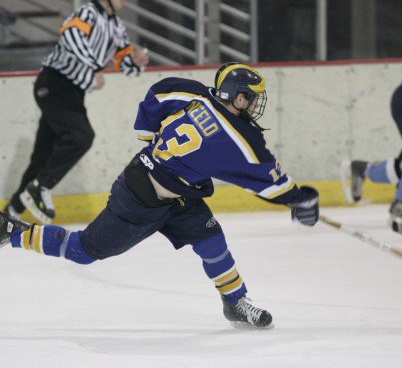
A couple weeks ago, my colleague Dr. Jeff Cubos told me to check out a relatively new assessment protocol called the Bunkie Test. I had never heard of it before so I took a look and found some interesting stuff. We haven’t integrated these “tests” into our assessment protcol at Endeavor, but I am integrating a few of the concepts into our hockey training programs.

The whole idea behind the Bunkie Tests is to assess the performance of different functional lines within the body. As an example, there is a well established connection between the external obliques and contralateral (opposite side) hip adductors (“groin” muscles). They frequently serve integrated functions in athletic movements. If you look at this picture of me taking a slap shot while at Delaware, you’ll see that my upper body is turning to the left, while my right leg extends and external rotates. This means that my left external oblique and right hip adductors are decelerating the movement. On the opposite side of things, my right external oblique and left hip adductors are both shortening.

Slapshot

This is just one illustration of this connection between the trunk and hip “core” musculature. Below is a video of an advanced core training exercise we’ve been using with a lot of our athletes recently.

There is also a lateral connection between the obliques and same side hip abductors. A great core training exercise to strengthen this functional path is:

To your continued success,

Kevin Neeld

Ice Hockey Training
Hockey Strength and Conditioning

Please enter your first name and email below to sign up for my FREE Athletic Development and Hockey Training Newsletter!
Hockey conditioning is all about training your body to work at a high intensity for extended periods of time and then recover rapidly. Basically, conditioning in any sport comes down to delaying or minimizing fatigue.

Fatigue is truly an amazing thing. Few people realize how complex fatigue can be. To really wrap your mind around what causes fatigue, it’s important to understand that fatigue is movement specific (direction, involved musculature, type of contraction, intensity, etc.) and involves every major body system: nervous, muscular, endocrine, and cardiorespiratory.

Over the weekend I spent some time reading Neuromechanics of Human Movement by Roger Enoka.

Static Contraction Fatigue

One of the things that stuck out in my mind is how different the cause of fatigue can be between isometric and dynamic contractions. For instance, during isometric contractions fatigue can result from occlusion of blood flow to the working muscle, that results from an activity-induced increase in intramuscular pressure. This both impedes nutrient delivery, and activates Group III-IV afferents (muscle receptors) which can decrease motor neuron excitability (think less force production).

Dynamic Contraction Fatigue

This differs from dynamic contractions, which do not result in the same amount of occlusion of blood flow as isometric contractions.  Compared to isometric contractions, dynamic contractions result in a more significant depletion of energy substrates such as Phosphocreatine and ATP, lower blood pH to a greater degree and produce more blood lactate.

Hockey Conditioning

If you’re not interested in the underlying science, stay with me. The take home message here is that fatigue mechanisms are different for static (isometric) and dynamic (concenctric/eccentric) contractions. Hockey involves both. Even when players aren’t actively skating, many times they’re gliding with their knees and hips flexed. Goalies can sometimes spend minutes in a “crouched” position. While nothing in hockey is as cut and dry as the strictly dynamic or strictly static contractions that are used in neuroscience labs, we can still learn from the light those studies have shed on our understanding of fatigue mechanisms.

In order to improve your capacity, you need to create an overload. Regarding “dynamic conditioning”, hockey players should use a mix of shuttle runs, slideboards, and sled drag variations. What many programs lack is an integration of “static conditioning”. This can be done in the form of squat, split squat, or back leg raised split squat iso-holds, progressing both in time and with weight.  As your training progresses, you can begin to combine the two forms of conditioning by alternating static holds with explosive actions.

For example, a goalie could stand by the edge of a slideboard and hold a squat for 15 seconds. Maintaining a good squat position, they would then explode back and forth on the slideboard 10 times, then return immediately to the static hold positions for another 15 seconds. Cycling through this 3 times (15s hold, 10 rep slideboard, 15s hold, 10 rep slideboard, 15s hold, 10 rep slideboard), would constitute one repetition. As your off-season progresses, start to add static contraction conditioning to your ice hockey training program. You’ll be thankful you did when the season starts!

To your success,

Kevin Neeld

Please enter your first name and email below to sign up for my FREE Athletic Development and Hockey Training Newsletter!

I wanted to share one of my new favorite exercises with you that I’m using in my hockey training programs. This is a TRUE rotator cuff exercise, that emphasizes the collective role of the rotator cuff musculature in creating dynamic stability of the humeral head in the glenoid cavity. Because you’re leaning forward into the ball, there’s a pretty significant core stability component as well.

You can progress this exercise by moving the ball lower on the wall, moving the ball to the ground, or by adding a perturbation (as demonstrated at the end of the vide0) to any of the above positions.

1-Arm Wall Stability Ball Hold


-Kevin Neeld

Please enter your first name and email below to sign up for my FREE Athletic Development and Hockey Training Newsletter!

Use CODE: "Neeld15" to save 15%