As you know, the adductors “groin” present a lot of problems for hockey players. Some are tight; some are weak, some are injured. The more time players spend on the ice, the more of an issue this becomes.

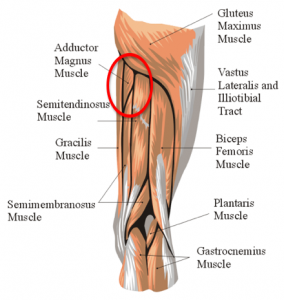
One area that hockey players are frequently locked up is in the area of the posterior adductor magnus and medial hamstrings. Adhesions can form in this area and almost “glue” these muscles together.

Restrictions in this area can affect both hip and knee joint motion. More specifically, hockey players with restrictions in this area will have a difficult time achieving full hip flexion, which will affect their ability to do exercises like reverse lunges and back leg raised split squats correctly.

A great manual therapist can help alleviate this problem by re-creating separation and smooth movement of these muscles. With that said, we don’t all have a great manual therapist waiting to help our players address these problems. My colleague David Lasnier recently posted a great video on an adductor soft tissue technique that we use at Endeavor. Check out the video here: Soft Tissue Work For Groin Pain

To your continued success,

Kevin Neeld

Please enter your first name and email below to sign up for my FREE Athletic Development and Hockey Training Newsletter!

Interdisciplinary learning is a hot topic in the human performance industry right now. Many strength and conditioning coaches will argue that we don’t need to study physical therapy or athletic training. Others swear by it.

Frankly, I find it hard to imagine doing my job without knowing a bit about physical therapy and athletic training. I understand it’s not my job to diagnose injuries or do initial rehab. I also understand that athletes with persistent pain need to get it looked at by the appropriate professional.

With that said, I rarely see a completely pain-free athlete without injury complications. Take a look at one of the elite level hockey training groups we had last Summer at Endeavor:

  • Posterior shoulder dislocation
  • Chronic groin pain
  • Thumb surgery and knee “giving way” at angles >90°
  • Sports hernia
  • 2 players with shoulder labral repair

6 high level players; 5 significant problems. Unfortunately, groups like this are becoming the norm. With the increased emphasis on year-round hockey, it’s becoming almost inevitable for older players to have some sort of hip dysfunction. With the horrible rounded over posture that most hockey players carry themselves with, it’s becoming almost inevitable for older players to have some sort of shoulder dysfunction.

Not every strength coach or “trainer” needs to be a licensed PT or AT, but we should have, at a minimum, a profound understanding of functional anatomy. There are dozens of great resources out there, but many are pretty hard to digest.

The one resource that I couldn’t live without (and reference on a pretty regular basis) is Building the Efficient Athlete with Mike Robertson and Eric Cressey.

Building the Efficient Athlete

This DVD set is truely timeless. I liken it to taking a functional anatomy course in college, with one major exception. I paid over $3,000 out-of-pocket to take a 4-credit functional anatomy class as part of a Doctorate of Physical Therapy program at a reputable university. I can honestly say I learned less implementable information from that course than I did from watching and re-watching Building the Efficient Athlete (and it’s a hell of a lot cheaper!).

Recognizing dysfunction and abnormal movement patterns can prevent injuries, but you can’t do that if you don’t know what you’re looking for.

Step 1: Watch Building the Efficient Athlete

Step 2: Repeat Step 1

Step 3: Recognize dysfunction in your athletes and help them prevent future injuries

-Kevin Neeld

Please enter your first name and email below to sign up for my FREE Athletic Development and Hockey Training Newsletter!
Several weeks ago I put up a post about some of the NHL Combine Testing Results. If you missed it, you can check it out here:

NHL Combine Testing Results

Sadly, this was BY FAR the most highly read post I’ve ever had. In general, I think the readers could be categorized into one of three groups:

1) Curious about how probable future NHLers are performing on these tests

2) Angry about the comparison of my testing results in college vs their testing results as younger prospects

3) Actually read the post and understand the message

I fully understand that I was further along in my development in college/grad school then these kids are (although my bench press numbers were comparable in high school…gotta love chest day mondays!). That wasn’t the point.

My point was that it is ABSOLUTELY MORONIC to compare player’s based on off-ice testing scores!

I realize it’s a widely utilized practices amongst extremely high level coaches and scouts, but that doesn’t make it any less stupid.

If Daniel Carcillo has a higher vertical jump, bench press, and better 40-time than Sidney Crosby, did the Penguins miss out?

The only thing that matters on the ice is how good you are at hockey. Testing is important, but not to compare players (which is moronic…absolutely…incredibly…moronic). Testing is important to guage progress WITHIN a player. If a player is training and they aren’t getting stronger, faster, leaner, and/or adding muscle (depending on their goals and needs), then the hockey training program should be adapated or a closer look into the players dietary and recovery strategies is warranted.

Especially in youth programs, we need to stop emphasizing testing as a form of player evaluation. Everyone grows up at different rates. Players that grow up (read: develop) faster are probably going to test stronger and faster than their teammates. We’re rewarding development opposed to quality training. Even doing pre- and post-testing with young athletes doesn’t make a ton of sense. Avery Faigenbaum’s research has shown very clearly that adolescence that do NOTHING in the form of structured training will test stronger and faster as times goes by.

Intuitively, we all know that, but as Stephen Covey says, “To know and not do do is to not know at all.” If you’re a coach and you feel the need to test your players for accountability reasons, make sure you emphasize that you are testing to guage progress within each player, not to compare players (and do not compare players…ever). If you’re a parent, stop putting any emphasis on testing at all. The craziness around testing needs to stop. Now.

To your success,

Kevin Neeld

Please enter your first name and email below to sign up for my FREE Athletic Development and Hockey Training Newsletter!

Today officially starts the second week of my Hockey Development Coaching Program. Since this is the first time I’ve done anything like this, I’m pretty excited that the first week went so smoothly. There was one small error (An incorrect link that I quickly fixed), but other than that smooth sailing. If you haven’t signed up yet, click the link below to do so now. Eric Cressey’s Coaching Call is coming up tomorrow and you won’t want to miss that!

=> Hockey Development Coaching Program <=

Speaking of Eric, he was nice enough to send me over a few interesting articles last week on the effect of muscle damage on range of motion (ROM). I asked for the articles in reference to the idea that specific static stretches immediately following activity may help restore adequate joint ROM.

The thought process here is two fold:

1) Short-term activity-related reductions in joint ROM may increase injury risk until the ROM is recovered back to baseline levels

2) Given that ROM limitations are still present 96 hours later (see Jamurtas et al., 2005), and that most hockey players (and all athletes for that matter) are skating/playing on a daily basis, it’s probable that ROM doesn’t ever fully recover. With this in mind, static stretching following activity may help accelerate the joint ROM recovery and therefore minimize accumulative shortening of muscles and consequent quasi-permanent reduction in ROM.

I know that’s a mouthful, but it’s a simple concept. Take a little ROM away each day (by not allowing full recovery) and eventually you lose a lot of ROM.

The take homes from these papers were that repeated eccentric (muscle lengthening) muscle actions can lead to muscle damage that results in a subsequent reduction in ROM. In hockey, the waters get muddy when you start to identify which muscles groups have a high eccentric emphasis and which have a shared concentric (muscle shortening) and eccentric emphasis.

Regarding hockey (and hockey training), I think we can extend this concept a bit and just look at what feels “tight” following playing on the ice or training and spend a few minutes doing specific stretches to address that.

For instance, after playing on the ice hockey players should perform the following stretches:

1) Seated Glute Stretch (pull knee to opposite shoulder)

2) 1/2 Kneeling Hip Flexor Stretch (with glute contraction)

3) 1/2 Kneeling Rectus Femoris Stretch

4) Wide Stance Quadruped Stretch

5) Standing Lateral Hamstrings Stretch

6) Prone Abdominal Stretch

7) Pec Stretch

This may seem like a lot, and it is, but it’s worth it. Your body needs to recover to rebuild. Spending a few minutes after most practices and games going through this circuit will likely ward off some of the hip flexor, groin, and lower abdominal injuries that keep you out of play for weeks and months.

To your continued success,

Kevin Neeld

References:

Jamurtas, A., Theocharis, V., Tofas, T., et al. (2005). Comparison between leg and arm eccentric exercises of the same relative intensity on indices of muscle damage. European Journal of Applied Physiology, 95, 179-185.

Reinold, M., Wilk, K,., Macrina, L., et al. (2008). Changes in Shoulder and Elbow Passive Range of Motion After Pitching in Professional Baseball Players. The American Journal of Sports Medicine, 36(3), 523-527.

Please enter your first name and email below to sign up for my FREE Athletic Development and Hockey Training Newsletter!

Last weekend, I was fortunate to be able to attend the 2nd Annual Boston Hockey Summit. If you’re in the hockey world and didn’t make the trip, you really missed out. The presenter list was incredible, and included people from all aspects of hockey training and development (power skating, conditioning, recovery, strength training, etc.).

My friend and colleague Maria Mountain recently posted a question on the HockeySC.com forum asking what the major take home was.

Hockey Strength and Conditioning

It would be impossible for me to identify one major take home, but there were a few things that stood out:

1) Everyone’s coaching situation (facility size, equipment availability, management/sport coach influence, clientele, staff, etc.) is different and programs reflect that highly. People should examine others’ programs with this in mind. I don’t think there is a such thing as a “perfect program”, only a “perfect program for that situation”. As an example, even if you write a highly individualized program for every athlete you have, something will be lost in the camaraderie of working through the same program with a group of similarly motivated athletes/teammates. There are pros and cons to everything.

2) A few people brought up the importance of teaching and reinforcing proper breathing patterns and emphasizing proper diaphragm function. If nothing else, I think some “diaphragm focused” breathing will work it’s way into some of my exercise tri-sets in future programs (e.g. A1: Reverse Lunge, B1: Lying Belly Breathing, B3: Stability Ball Front Plank). There is also now research supporting the use of off-ice resisted breathing devices to improve on-ice conditioning. Neat stuff.

3) As we all know, hockey frequently involves acyclic upper body movements in concert with cyclic and acylic lower body movements. In the past, I’ve always coached my players to use an arm swing similar to how they would skate while they’re slideboarding. Taking a step back to recognize the need of dissociated movement between the upper and lower body during many hockey movements, I’m considering at least mixing in some intentionally backward, still, or otherwise different upper body movements during our slideboard conditioning.

4) Lastly, recovery is crucial to adaptation. Two major areas to emphasize are proper nutrition (especially around practice, game, training times) and getting adequate QUALITY sleep at night. These are probably the two most overlooked aspects of a comprehensive hockey development program.

Keep training hard. Keep training smart.

To your success,

Kevin Neeld

Please enter your first name and email below to sign up for my FREE Athletic Development and Hockey Training Newsletter!
Use CODE: "Neeld15" to save 15%