Tuesday, March 30th, is my 25th birthday. It seems like just yesterday I was stickhandling and playing one on one with my brother in my garage for hours everyday. How times flies.

Anyway, I can’t think of a better way to celebrate a birthday than giving you some presents to help fulfill your hockey potential!

I’ve made a special coupon for you so you can get 25% off EVERYTHING at my hockey training website.

Ice Hockey Training

Until Friday, April 2nd, you can save 25% on:

Hockey Training U’s Off-Ice Performance Training Course

Hockey Training U’s Hockey Training Programs

Breakaway Hockey Speed

Hockey Training Exercise Videos Membership

Just enter the coupon code “25bday” at checkout and the savings will pop right up.

…I know what you’re thinking, but I wouldn’t recommend waiting until my 100th birthday.

To another great year of hockey training!

Kevin Neeld

P.S. Don’t forget, you only have until March 31st to get access to all incredible information at HockeyStrengthandConditioning.com for $1!

Please enter your first name and email below to sign up for my FREE Athletic Development and Hockey Training Newsletter!

On Monday I mentioned that myofascial restrictions may prevent your stretching from being effective. If you missed the post, check it out here:

3 Reasons Not to Stretch Tight Muscles

Through my work at Endeavor, I’ve found that most people still aren’t familiar with foam rolling.


When they ask me what it does, I use the same explanation I’ve heard Michael Boyle use:

Your muscles have similar elastic properties as a rubber band. Think about tying a knot in a rubber band. What happens when you pull it from both sides (stretch it)? If you actually take a rubber band and do this, you’ll notice that the knot will get tighter and the areas on both sides of the knot will become thinner/weaker.  In other words, the whole thing will elongate, but the knot gets worse and the areas on both sides of the knot become damaged.

If you simply remove the knot (untie the band), the overall length of the band will increase and it will extend much more efficiently. This is a more desirable alternative, and the reason we foam roll.

Rolling out knots/myofascial restrictions will improve the length and extensibility of the muscle without stretching it in the traditional sense.  It will also cause you to respond better to stretching.

Seems like a win-win to me!

To your success,

Kevin Neeld

P.S. Are you still not a member to HockeyStrengthandConditioning.com? What are you waiting for!  The 30-day trial offer for $1 ends March 31st! If you’re serious about training for hockey, you NEED
to be a part of the site!

P.S.S. Please forward this along to anyone you know that will
benefit from better hockey speed training information!

Please enter your first name and email below to sign up for my FREE Athletic Development and Hockey Training Newsletter!

Our interns at Endeavor have been firing questions at me the last couple weeks. They’re definitely keeping the gears grinding as I try to think back to all the things I read as a student, and explain why so much of the information we’re taught in school is only partially true (at least in my setting).

Book Collection

Recently, one of my interns brought up when it is and isn’t appropriate to stretch muscles that feel tight. As I mentioned in my presentation “Innovative Practices in Strength and Conditioning” for SCWebinars.com, I think static stretch has some validity in training programs and is necessary for almost all athletes. Having said that, it’s not always the best solution for “tightness”.

Consider these examples:

Muscular Deficiency

Psoas deficiency will increase the workload of other hip flexors (e.g. tensor fascia lata and rectus femoris) to flex the hip past 90°. Because these muscles are required to perform extra work while they’re in a shortened position, it’s likely they’ll feel tight afterwards. Stretching may help short-term, but if the psoas deficiency isn’t addressed, you’ll keep stretching/tightening yourself in circles. Address the cause, not the symptom.

Sub-Threshold Injury
All of us suffer bumps, bruises, aches, and pains throughout the course of our lifetimes. Some of these injuries necessitate medical attention, others may be “sub-threshold”, meaning they aren’t severe enough to require medical attention, and will hopefully resolve on their own.

As a hypothetical example, consider an athlete with a very slight medial meniscus tear. The body could naturally compensate by shifting weight off of this meniscus. As a result, muscles that cross the lateral aspect of the knee (e.g. TFL-> IT Band) and prevent genu varum may feel tight. Stretching could alleviate this tightness, increase the load to the medial meniscus, and increase the severity of the tear. Oops.

Myofascial Restriction

Some people just don’t respond to stretching. They stretch and stretch, but always feel tight and the muscle never seems to improve its extensibility. Many times, this has to do with myofascial restrictions that are better addressed through soft-tissue manipulation through foam rolling, Active Release (A.R.T.) or graston. On a personal note, I’ve gained more range of motion from a single A.R.T. session that I have from hours of stretching.

Stretching can help, but it’s not always the BEST solution. If you aren’t responding well to stretching, consider looking into some of the other possibilities presented here.

To your success,

Kevin Neeld

P.S. The 30-day trial offer for $1 at HockeyStrengthandConditioning.com ends March 31st! The feedback we’ve gotten about the site has been incredible. Don’t drag your feet on this. If you’re serious about training for hockey, you NEED to be a part of the site!

P.S.S. Please forward this along to anyone you know that will benefit from better hockey speed training information!

Follow me on Twitter!
Follow me on Facebook!
Follow me on YouTube!
Connect with me on LinkedIn!

Please enter your first name and email below to sign up for my FREE Athletic Development and Hockey Training Newsletter!

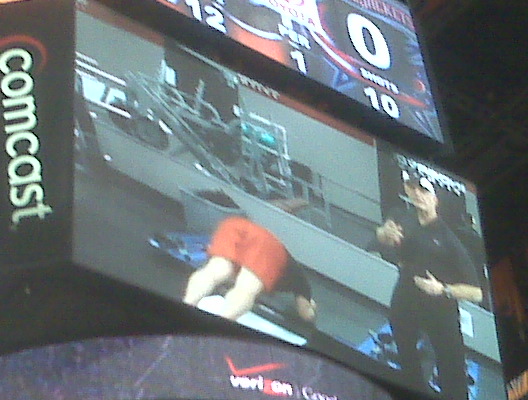
Last Tuesday I got a picture message from a friend of mine at the Flyer’s game. The Flyer’s were airing another one of the “Fit as a Flyer” video segments I filmed with their Strength and Conditioning Coach Jim McCrossin.

Coach McCrossin and I filmed 12 video segments of common exercises or exercise progressions that we use with our hockey players. This wasn’t the first time a friend sent me a picture. Check this one out from the first segment they ever played!

Philadephia Flyers Fit as a Flyer Hockey Training-1

You guessed it. That’s my big red ass sticking up in the air. Flattering, I know.

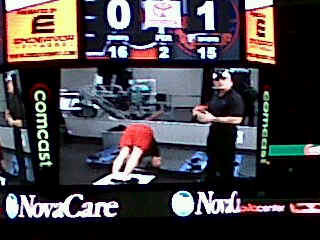
Needless to say, I was somewhat surprised when I got THIS picture on Tuesday:

Philadelphia Flyers Fit as a Flyer Hockey Training-2

The fans have spoken. Years of glute bridges and deadlifting has won over an entire city of hockey fans:

Philadelphia Flyers Fit as a Flyer Hockey Training 3

Yep. That’s the ONLY explanation.

Every time I post videos I get a great response from you. Videos are a great way for you to learn new exercises and watch how they’re supposed to be performed. I have videos over 230 hockey training videos up at my Ice Hockey Training site that you can get access to for only $4.99/month. Let’s be honest here: they’re basically free. $5/month is nothing. Many of the exercises I have videos of I’ve spent thousand of dollars and countless hours on books, DVDs, seminars, and volunteering to learn. Some I’ve never seen anyone do except us at Endeavor. Since my new hockey training expert site has officially merged with HockeyStrengthandConditioning.com (and the videos haven’t been transferred yet), the ONLY place you can get access to these incredible videos is here: Hockey Training Videos

Go subscribe to my Hockey Training Videos section now. If you don’t feel like you’re stealing from me by getting so much info for some cheap, then just cancel. You can cancel at any time, no questions asked!

To your continued success,

Kevin Neeld

Please enter your first name and email below to sign up for my FREE Athletic Development and Hockey Training Newsletter!

Before reading this post, check out the two preceding posts on hockey conditioning:

Hockey Conditioning: To Bike or Not to Bike!

Hockey Conditioning: Shuttle Runs and Slideboards

As you may have noticed, I’m not a huge supporter of hockey players riding exercise bikes, but I am a huge supporter of slideboarding.

My opinion changes slightly when hockey players are in-season.

When players are on the ice for hours a week, they probably don’t need as much work in lateral and diagonal movement patterns because they get enough of that on the ice. To this extent, slideboarding consistently throughout the season could over-stress (or not allow for sufficient recovery) the hip adductors (“groin”) and lead to overuse (or under-recovery) injuries.

If Not Slideboards, Then What?

I generally think shuttle runs are a better alternative than exercise bikes if players NEED to condition (read below). With that said, one of the Hockey Strength and Conditioning Coaches I’ve learned the most from is Michael Boyle. He has his players ride exercise bikes in-season to decrease the risk of hip overuse injuries, as described above. However, he uses Schwinn Airdyne Exercise Bikes, which allow upper body movement and a more upright posture. These bike design changes remove many of the downsides of using exercise bikes for conditioning hockey players.


Do Hockey Players Need to Condition In-Season At All?

The amount of in-season conditioning players need depends on the amount of ice time they get and the composition of that ice time. There is nothing more hockey-specific than skating intervals. If coaches build conditioning-type drills into their practice or go through familiar drills at a high tempo, it’s likely that many players won’t need ANY off-ice conditioning.

Train Hard. Train Smart.

Kevin Neeld

P.S. If you want to use a PROVEN ice hockey training system this off-season to guarantee you enter tryouts and next season at your best, check out my Off-Ice Training course.

Please enter your first name and email below to sign up for my FREE Athletic Development and Hockey Training Newsletter!

Use CODE: "Neeld15" to save 15%