

Mar
10
A couple days ago, I wrote a post on why hockey players shouldn’t use exercise bikes to condition.
If you missed it, check it out here: Hockey Conditioning: To Bike or Not to Bike!
So if you aren’t going to bike, what should you do?
The main two conditioning modalities that I recommend are:
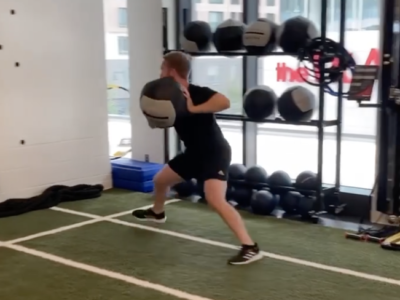
Shuttle Runs
Pros:
This full body high intensity movement requires similar energy system characteristics as skating.
Shuttle runs require direction changes, which are inevitable on the ice.
Hockey players will produce force into the ground in a free movement pattern in order to accelerate, decelerate, and change direction.
Sprinting involves full hip extension and core control of this extended posture, which helps reverse the hunched over posture that hockey players spend too much time in.
Sprinting necessitates single-leg stability, just like skating.
Cons:
Shuttle runs minimally stress lateral movement patterns and the involved hip musculature that is used in skating.
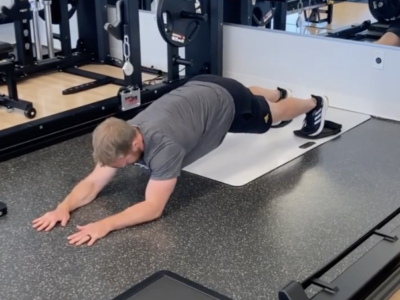
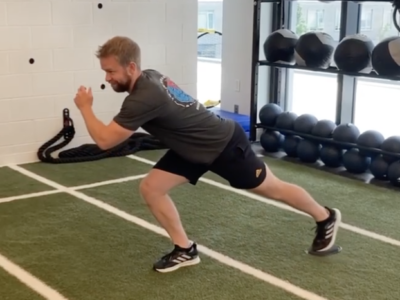
Slideboards
Pros:
Slideboarding is a high intensity movement that requires similar energy system characteristics as skating.
Slideboarding involves constant lateral loading and direction changes, which reinforces the direction changes hockey players perform on the ice and strengthens the muscles on the lateral and medial (outside and inside) aspects of the hip. This helps decrease skating-related injuries (hip flexor and groin strains), while improving single-leg stability.
Slideboarding can easily be progressed to wearing a weight vest without interfering with the pattern, which mimics the loading and thermoregulatory changes that upper body equipment places on hockey players.
On-ice stride patterns can be improved off the ice using a slideboard. Specifically, hockey players can groove a proper skating posture and recovery mechanics on a slideboard. I’ve helped many players alleviate back pain from skating due to excessive rotation at the lower back simply by bringing it to their attention while they are on a slideboard.
Slideboards are awesome.
Cons:
Slideboards can be expensive and aren’t available at common gyms. If you’re lucky enough to be around Endeavor Fitness, we have slideboards AND a skating treadmill. If you’re not, you can build a slideboard for less than $50. Actually, I built two when I was younger for less than $50. It took about 2 hours and was a great father-son bonding experience. Nothing says family togetherness time like building high intensity hockey training equipment!
Reread the above paragraph. There are no cons.
Check back in the next couple days to learn how these rules change based on whether you’re in-season or out of season.
To your continued success,
Kevin Neeld
P.S. If you want to use a PROVEN ice hockey training system this off-season to guarantee you enter tryouts and next season at your best, check out my Off-Ice Training course.
Mar
8
In an interview I did with Maria Mountain, I told her that I never have my hockey players ride bikes.
If you missed the interview, you can listen here: Hockey Training Interview with Maria Mountain
Given traditional hockey training practices, this comes as a pretty big surprise to most players and coaches.
Let’s take a second to compare three commonly used hockey conditioning tools. Quick side note: All three of these modalities would be used in an interval training fashion only. I don’t think traditional steady-state aerobic training has any merit for hockey players at all. This includes “recovery rides”, which may have a mental benefit for hockey players, but probably lack any physiological benefit in light of the long known fact that nearly ALL lactic acid is processed within about an hour of ceasing activity (1,2,3). I realize this may offend some of my European Hockey Friends. I apologize in advance.
Exercise Bike
Pros:
Leads to similar “burning” feeling of the legs as a long shift. Improves local muscular endurance of thigh musculature.
Cons:
Biking involves MORE time in an unwanted hunched over posture (same as sitting in a desk or in a car). One of the main goals of our training programs is to REVERSE this terrible posture as it leads to range of motion limitations, undesired compensations, decreased performance and increased injury risk.
The upper body is relatively still while biking. Aside from the obvious fact that your arms move while playing hockey, because biking only uses your lower body it is more difficult to get your heart rate up to the near-max levels characteristic of a high intensity shift. Interval failure is more likely to result from localized muscular fatigue in the legs than from a more global energy delivery failure.
When players get tired on a bike, they begin to pull up on the foot straps, which puts more stress on their hip flexors. Sitting on a bike and pulling repetitively with your hip flexors reinforces the hip flexor tightness that too many hockey players already suffer from.
Biking involves putting force downward into floating pedals with a pre-determined range of motion. Skating involves putting force into the ice in a free range of motion. The force production and joint stabilization characteristics of biking and skating are completely different.
Should hockey players bike? I don’t think so. If you need a good leg burn, do split squat iso-holds. If you want good conditioning, use the modalities I’ll explain in my next post. Check back soon!
To your success,
Kevin Neeld
P.S. If you want to use a PROVEN ice hockey training system this off-season to guarantee you enter tryouts and next season at your best, check out my Off-Ice Training course.
References:
1) Gollnick PD, Bayly WM, & Hodgson DR. (1986). Exercise intensity, training, diet, and lactate concentration in muscle and blood. Med Sci Sports Exerc, 18(3): 334-40
2) Hermansen L, & Stensvold I. (1972). Production and removal of lactate during exercise in man. Acta Physiol Scand,86(2): 191-201
3) Freund H, & Gendry P. (1978). Lactate kinetics after short strenuous exercise in man. Eur J Appl Physiol Occup Physiol, 39(2): 123-35
Mar
5
Hockey Training Expert Uncovered
Filed Under Hockey Player Development, Must-Have Resources | Leave a Comment
If you’ve been reading my posts and newsletters or talked to me at all in the last month, you know I’m VERY excited about the launch of my new site: Hockey Training Expert
If you’re new to the site, you probably have some questions about what’s included and why you should join. To save you time, I’ve put together a list of posts that you should check out. If you still have questions about the site, post them as a comment below and I’ll get back to you as soon as possible.
HockeyTrainingExpert.com is Live!
Top 3 Reasons to Join Hockey Training Expert
Three Keys to Ice Hockey Success
Is Hockey Training Expert for Me?
150+ Elite Hockey Commitments in 5 Years
-Kevin Neeld
Mar
3
I just wanted to let you know that my presentation “Innovative Practices in Strength and Conditioning” is now available for you to watch at Strength and Conditioning Webinars. The presentation is jammed with great hockey training information that you won’t find anywhere else. I was all hopped up on caffeine and Olympic Hockey, so I was able to squeeze a ton of great info into my hour slot.
As you’ve heard me say before, I think Strength and Conditioning Webinars is the best Strength and Conditioning resource on the internet. I watch and re-watch presentations on that site weekly and frequently make changes to my programs based on what I learn from the presentations. You really owe it to yourself to check it out. If you don’t like it after the first month, just quit. It’ll cost you less than $20 and you can watch as many of the archived presentations (every single presentation since the site was launched is still available!) for next to nothing.
-Kevin Neeld
P.S. After you register for a membership at Strength and Conditioning Webinars if you have any questions about “Innovative Practices in Strength and Conditioning”, post them as comments to this page. I’ll be happy to answer them!
Check out these other posts about Strength and Conditioning Webinars:
Present Ideas for Athletes, Coaches, and Strength Coaches
Stronger, Faster, Smarter…Guaranteed!
Learn From the Best, Wherever You Are
Mar
2
Sunday’s Olympic Gold Medal battle between the U.S. and Canada was one of the best hockey games I’ve ever seen. I was disappointed that the Americans couldn’t pull it out, but it’s hard to complain about a game like that. Hopefully the excitement will drive more deserved attention to the greatest sport on Earth (and most other planets too…).
I was fortunate to watch at least part of every hockey game during these Olympics. Hopefully hockey players and coaches around the world were just as fortunate because there were a TON of great hockey lessons to be learned.
1) Hunger Eats Talent. Two of the best games I saw during the Olympics were the Czech Republic vs. Latvia, and Slovakia vs. Norway. Both games had one thing in common, one team was DRASTICALLY outmatched by the other. Norway had 1 NHL player on its roster. Latvia had two. I’d be surprised if you’ve heard of any of them. Despite the lopsided rosters, Norway and Latvia battled to the end and almost pulled out INCREDIBLE upsets. They were hungry. They wanted to win more. To be more patriotic, this is the same reason that the U.S. beat Canada in the preliminaries AND the 1980 USSR team (the greatest sporting event ever). Never give up on a game. Be a “hungry” player every shift of every game. That type of attitude is contagious. Hungry teams win championships. You want that.
2) Throw everything on net. The announcers said early that Luongo didn’t look steady. He didn’t. Every shot had a rebound. The U.S. scored two suspect goals that resulted from just throwing pucks at the net. Of more interest to my Canadian friends, look at Crosby’s last goal! Ryan Miller was the Olympic MVP. He was almost unbeatable on first shots. Crosby threw a quick, but generally unimpressive shot on net and won a Gold Medal for his country. Too many players try to get too fancy around the net. Wayne Gretzky wisely pointed out that you miss 100% of the shots you don’t take. Throw it on net, especially in big games and towards the end of the game. Nerves are high. Goalies are tired. A goal is a goal. Don’t miss an opportunity to score.
3) Speed dominates. Zach Parise stood out every shift he was on the ice. He wasn’t the biggest player. He didn’t have the hardest shot. He stood out because he was ridiculously fast. I don’t want to under-emphasize other skills like having good hands and being able to read the play, but if you’re too slow to create enough time to use your good hands, it won’t matter. To compete at the highest levels of hockey, you need to be fast. To dominate at those levels, you need to be faster.
Play fast. Play smart. Play hungry. Win.
-Kevin Neeld
P.S. If you want to follow a specific training program to help you develop game-changing speed, register for a membership with Hockey Training Expert. It’s only $9.95/month and has training programs you can start to follow immediately, straight through until next season.
Feb
27
On Thursday I did an interview with Maria Mountain. Among other things, we talked about hockey training mistakes, my favorite exercise for hockey players, a couple great core exercises, and whether hockey players should use exercise bikes for conditioning or not.
You can listen to the interview here: Hockey Training Interview
…Ignore the end of the interview when I predict that the US Women’s Olympic Team will beat Canada…
In the interview I described one of my favorite core exercises: Rotational Cable Lift
This is an incredible exercise for improving rotational power, which has direct benefits for shooting power on the ice. Because of the complexity of the movement, it’s pretty difficult to explain.
Check out the video below:
-Kevin Neeld
P.S. In the last week I’ve added a 1-hour audio interview I did with Joe Heiler, an article on how I quickly help hockey players get rid of groin pain forever, and an article on neck training to prevent concussions from Jeff Cubos to Hockey Training Expert. If you register now, you can still download Breakaway Hockey Speed, Hockey Nutrition 101, and Hockey Training Expert’s Mental Performance Package! What are you waiting for? Click here to join the site that is changing hockey training forever!
Feb
24
Hockey Training Presentation
Filed Under Hockey Player Development, Must-Have Resources | Leave a Comment
I just wanted to give you a quick heads up to let you know I’ll be giving a hockey training presentation for Anthony Renna’s site Strength and Conditioning Webinars this Saturday (2/27) at 2pm est.
As you know, I’m a HUGE supporter of the site. It gives you access to dozens of presentations from some of the smartest and experienced Strength and Conditioning Coaches in the world. The information is incredible; it’s up-to-date and effective. I’ve made significant changes to my training programs after listening to some of the presentations on the site.
In my presentation “Innovative Practices in Strength and Conditioning”, I’ll discuss:
-A new way of designing dynamic warm-ups
-A few mobility exercises that I’ve started using recently
-Why I don’t do any “agility” training at all
-The single-leg vs. double-leg training controversy
-An interval-based conditioning progression
-Hip flexor and groin strain prevention
I’m really excited about the presentation because I think I’ll be introducing topics that other people aren’t talking about. Hopefully it’ll generate some great discussion.
I may be a little biased (just a little), but I HIGHLY recommend you join the site to watch this presentation (and to watch the dozens of other presentations!). I look forward to answering your questions on the forum afterward. Click the link below to join now.
To your continued success,
Kevin Neeld
P.S. Thank you to all of you that have joined Hockey Training Expert and for all the kind words you’ve had about the site. Your feedback goes a long way toward improving the site. I’m really excited about the direction the site is heading. Together we can change hockey player development forever!
Feb
22
I’m still pumped up from USA’s win over Canada yesterday. When Ryan Kesler dove to score that empty net goal, I dove across the couch onto my girlfriend Emily in celebration (Amazingly, no Emilys were harmed in the making of that celebration). What a game.
The good news for Canada fans: I think the US just woke up a sleeping beast. I’d be surprised if Canada didn’t rebound with an incredible performance in their next game.
Even if they don’t, YOU can still win. Watching good hockey puts me in a good mood. I’ve decided to extend my 3 free bonuses giveaway for new Hockey Training Expert members. Sign up for a membership and you can instantly download a copy of Breakaway Hockey Speed, Hockey Nutrition 101, and Hockey Training Expert’s Mental Performance Package.
I’m in, sign me up!
I’m obviously a huge proponent of off-ice training to improve a hockey player’s performance. Having said that, it would be irresponsible and…well…stupid of me to say that a good training program is ALL you need.
Dominant hockey players aren’t just fast, or strong, or well-conditioned. They see the ice well. They read the play. They create time and space for themselves.
See the Ice Better
One of the single most effective habits a hockey player can have is to take a quick scan of the ice BEFORE they get the puck. As a pass is on its way, pick your head up and get an idea of your surroundings. Is someone from the other team bearing down on you? Do you have time to collect the pass and make a play or do you need to just tip the puck to a safe area? Has one of your teammates slipped behind the other team, looking for a quick pass from you?
Scanning the ice before you get the puck will help you make smarter, quicker decisions.
Read the Play Better
Reading the play comes down to knowing the game of hockey. You need to be able to anticipate the developing play so you can make the smartest decision, with or without the puck. As I mentioned in a previous post, one of the best ways to become better at reading the play is to WATCH a lot of hockey. Pick a team around your age but at a higher level, and an older team at an elite level and follow a single player around that plays your position. Watch how he/she responds to certain plays and anticipates others.
Learning from players at higher levels will allow you to become more familiar/comfortable with a variety of game situations and respond faster on the ice.
Create More Time and Space
Creating time and space gives you the freedom to make better passes and take better shots. It decreases the pressure on you. Knowing your surroundings and reading the play are paramount to creating time and space for yourself (that’s why this is the last of the three). One easy way to create time and space for yourself WITH the puck is to take 2-3 quick strides immediately after receiving a pass. Naturally this will somewhat depend on your positioning on the ice and your surroundings, but in general this is an effective habit to develop.
Taking 2-3 quick strides after receiving a pass will help create separation between you and your opponent, allowing you the time and space to make a better play.
Train Hard. Play Smart.
Kevin Neeld
Feb
19
As a quick reminder, this is the last day to get a FREE copy of Breakaway Hockey Speed, Hockey Nutrition 101, and The Mental Performance Package for joining our Hockey Training Expert community!
The other day I got an email from a parent that went like this:
“This package sounds amazing but I think for my soon to be 12 year old son – I was looking for something that may help him with positioning and where to go and how to read/anticipate plays better – since he not the fastest shaker it’s even more important he understands where and when to go. He’s working so hard out there but not a big threat for the opposing team. Could this package help with any of those things.”
This is a GREAT email, and I encourage those of you with similar questions to email me.
I responded:
“A lot of the information on the site will definitely help your son become a faster skater. At 12 years old, he still has PLENTY of time to develop speed to compete at higher levels. As of now, the site is more geared toward off-ice aspects of player development. While I do have big plans for including more on-ice skill work, there isn’t currently anything on there that would assist your son’s ability to read the play.
I agree that this ability is incredibly important for hockey players though! One of the ways I learned while I was playing was by watching players at the next level (either higher levels at my age or older players). It’s helpful to follow a single player on the ice (pick a good one!) and watch how he reacts to certain situations. If he’s receptive to it, you may be able to point out a couple things you notice about good plays (around or away from the puck) that other players are making.”
I’m sure many of you are thinking, “Is Hockey Training Expert for Me?”
If you’re looking for PROVEN exercises, drills, and information to significantly improve your speed: YES, Hockey Training Expert is for you!
If you’re looking for PROVEN exercises and training programs to improve your strength and decrease your injury risk: YES, Hockey Training Expert is for you!
If you’re looking for innovative conditioning progressions to help you become the best conditioned player on the ice: YES, Hockey Training Expert is for you!
If you’re looking for quality nutrition and supplementation information to help give your body the fuel you need to succeed ALL season long: YES, Hockey Training Expert is for you!
If you’re looking for specific techniques to build the mental toughness you need to lead yourself and your team through the inevitable adversity you face during the season: YES, Hockey Training Expert is for you!
Lastly, if you’re looking to become a part of the most rapidly growing hockey development resource EVER, then yes, Hockey Training Expert is for you!
As we enter the off-season, the information on the site gives you EVERYTHING you need to make huge leaps prior to next season. Articles continue to pour in with great information on how to improve your performance and how to prevent injuries.
I just wrote/posted an article on a new technique I’m using to help players QUICKLY recover from groin strains because I got a question about it on our forum this week!
If you’re still unsure about whether Hockey Training Expert is for you, consider the previous sentence. I got a question about groin strains on the forum and within 3 days posted an article with specific steps on how to deal with them (with exercise pictures).
For $9.95/month, you can only win. If you get inside and find the information isn’t quite what you’re looking for, ask a specific question on the forum and I, or another member of the Hockey Training Expert team, will get an article up ASAP to give you all the information you want!
Click here to sign up now!
See you on the inside,
Kevin Neeld
P.S. This is your LAST DAY to get THREE incredible bonuses for signing up for Hockey Training Expert: Breakaway Hockey Speed, Hockey Nutrition 101, and The Mental Performance Package. These resources will give you INSTANT tips you can use immediately to help improve your performance.

P.S.S. A couple days ago I extended a special offer to my newsletter list that I’d now like to extend to you, as a loyal reader of my site. If you sign-up for Hockey Training Expert by Saturday 2/20, I’ll send you a FREE download link to my Off-Ice Performance Training Course. All you have to do is register for the site, copy the text of this post, and click here to send me an email requesting the information. Stop dragging your feet. Get all your free stuff now!
Click here to sign up now!
Feb
17
Wow! What an incredible day to start the Olympics. USA won. Canada won. Russia won. Results as expected so far. I’m really interested to see how Sweden looks today against Germany. Peter Forsberg has always been one of my favorite players; we’ll see if he’s still got it!
As I alluded to in a previous post, I’ve officially added THREE incredible experts (Jeff Cubos, Mark Cardillo, and Jared Beach) to our team at Hockey Training Expert.
Among them, Jared beach fills a much needed gap in the world of youth hockey. Check out this excerpt from his bio:
“Jared combines his personal experiences playing Prep and Junior hockey with the knowledge gained from his extensive network of Division I Prep, Junior, NCAA, and National and International Pro Hockey Coaches to provide hockey players with advice on how to maximize their potential. Over the last 5 years, Jared’s guidance, training and mentorship, has helped over 150 players advance to compete at the prep, junior, college and professional levels.”
Over 150 players in 5 years! That’s truly amazing. Jared and I spoke for an hour yesterday about how misinformed players are about how to approach elite level coaches and how making the wrong moves (such as constantly emailing the coach) turns coaches off, even if the player is qualified for that level! Jared and I also discussed a future project we’re going to work on outlining EXACTLY how players and parents should go about connecting with high level hockey programs. I’m really excited about it.
In the meantime, I’m going to pick Jared’s brain about a few of the BIG things players should know and put together a mini-interview in the couple weeks.
Dr. Cubos sent me a great article on neck exercises for hockey players. Admittedly, this is not my strong point, so I was really interested to see what he had to say about the topic and to test out the exercises he recommends. He’s going to send me some pictures in the next couple days then that’ll be up at Hockey Training Expert too!
Effective programs. Innovative exercises. Great information. Updated constantly.
YOU NEED TO JOIN THE HOCKEY TRAINING EXPERT COMMUNITY TODAY!
Give it a test run for $9.95. If you don’t think getting access to dozens of training programs and hundreds of exercises are worth less than $10, then cancel. It’s that easy. Of course, as an intelligent person, I know you’ll see the incredible value of this site. But you have to become a member before you can start enjoying all the incredible benefits!
Click the link below!
I’m ready to join Hockey Training Expert!
To your continued success,
Kevin Neeld
P.S. Your opportunity to get a FREE copy of Breakaway Hockey Speed, Hockey Nutrition 101, and Hockey Training Expert’s Mental Performance Package is rapidly dwindling. These FREE bonuses will only be available until Friday! Click here to become a Hockey Training Expert member today and get instant access to these three incredible bonuses!