Last week I posted two discussions on the status of youth hockey development that pointed out some commonly held misconceptions, areas that need revamping (or at least have room for improvement) and some of the barriers that the hockey community will face in pursuing a more effective model. If you missed those posts, I highly encourage you to go back and read them before continuing on here today. Check out the links below:

Hockey Development Post 1 –>> The State of Youth Hockey

Hockey Development Post 2 –>> Hockey Development Resistance

Those discussions were primarily inspired by my experiences in learning more about USA Hockey’s American Development Model. If you haven’t yet, I recommend heading over to their site and reading more about it: ADM Kids

Somewhat to my surprise (I thought I’d get more hate mail), both posts were really well received and a few people responded with great comments. One in particular had to do with the apparent discrepancy between the recommendation that youth players participate in multiple sports and activities in order to achieve elite level status later down the road, and the idea that players need to spend a substantial amount of time developing their sport-specific skills in order to perfect their abilities. This latter idea is referred to as the 10,000 hour rule, as some research has shown that it generally takes about 10 years and 10,000 hours of purposeful practice for an individual in ANY field to achieve expert mastery.

It’s easy to interpret the 10,000 hour rule as meaning that hockey players should focus ALL of their athletic time on the game of hockey to accumulate as many “practice hours” as possible at younger ages. Unfortunately, this idea is often misunderstood because “practice” is never adequately defined, and the idea of progressions and age-/developmental stage specificity is often lost. Briefly, I think it’s important to note that taking a young kid and submerging them into a single activity with the intention of making them one of the world’s elite has TREMENDOUSLY negative physical and psychological consequences. For our purposes today, however, I want to focus on what constitutes practice within the 10,000 hour rule paradigm.

In order to understand what counts as practice, we need to have an understanding of what drives performance. At a minimum, it’s important to understand that there are physical and psychological components. The lists below are slight expansions on these ideas.

Physical Components of Performance

  1. Technical Skill
  2. Athletic Ability
  3. Durability

Psychological Components of Performance

  1. Hockey Sense
  2. Mental Preparation
  3. Grit

Again, these lists are far from exhaustive, but are meant to start directing your thoughts as to lesser recognized components of performance and therefore of lesser recognized necessities of practice. So for a young hockey player looking to accumulate as much practice time as possible, what should they do?

10,000 Hours of Hockey Practice

  1. Structured hockey practice
  2. Unstructured hockey (pick-up)
  3. Watching game film of personal performances
  4. Watching practices, games, and/or film of players at the next level up
  5. Playing other sports
  6. Off-ice training

This is a pretty short list, but can be branched out to a wide variety of activities. Structured practice will help players develop technical skills, hockey sense and, at the appropriate age, their tactical awareness. It’s important to recognize that having 100 hours of practice won’t lead to 100 hours of benefit if the players spend the majority of their time standing in lines or staring at the ceiling while the coach draws on the whiteboard. This is one of the strongest points of USA Hockey’s recommendations for players at younger levels and one of the primary benefits of unstructured play-the kids actually get to touch a puck and move around on the ice! Unstructured play will also help develop technical skills and hockey sense, but increases the emphasis on fun (this doesn’t mean not COMPETING, it just means that the competition is for pride instead of the mixed emotions of pride, not letting your coach down, and not getting “Vince Lombardied” by your parents on the ride home from the rink), and ultimately fuels a kid’s passion for the game. Watching game film and next-level hockey will help players develop hockey sense, tactical skills, and components of technical abilities secondary to visualization. In other words, hockey players can improve their performance simply by analytically WATCHING players at the level above theirs.

Playing other sports and off-ice training serve some common and quite supplementary purposes. First, playing other sports exposes kids to different coaching methods, different social groups, different physical stresses, and emphasizes different athletic components. This helps develop highly coachable athletes with lots of friends, that are further from injury threshold and have more advanced athletic capacity. Simply, there is NO wrong here. To provide an athletic ability example (because that’s all the crazy parents and coaches will care about), playing baseball is “hockey-specific training” at younger ages. It teaches rotational power, hand-eye coordination, first step quickness, rapid reaction, and athletic body positions, all things that transfer. Similar arguments could be made for the benefits of soccer, lacrosse, basketball, football, and tennis for hockey. These other sports also provide more opportunities for young athletes to experience success, which is a primary driver in confidence. Also, simply because the “hockey player” is NOT playing hockey, they are maintaining a safe distance from their injury threshold due to overuse/under recovery (e.g. my stress overflow “theory”). Playing competitive hockey year-round is making old men out of young players; the insane number of players we see with chronic hip flexor and adductor (groin) injuries is evidence of a flawed development system. These nagging injuries become career limiting/ending for some, and experience/potential fulfillment limiting in everyone. Referring back to the lists above, it COMPROMISES durability.

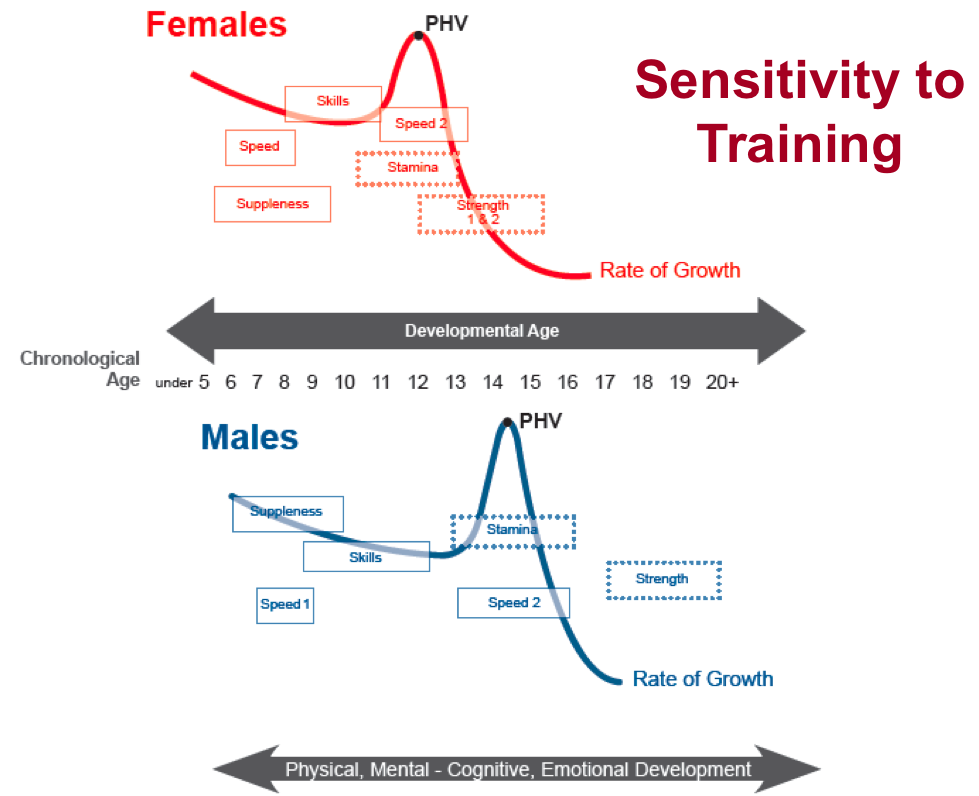
Regarding off-ice training, even BASIC off-ice activities like skipping, hopping, holding single-leg stance, etc. will help improve coordination, rythmicity, balance, and other motor qualities that will positively influence hockey. The nature of the off-ice training should develop in accordance with the physical quality sensitive periods.
Take Home Message
The 10,000 hour rule holds merit in long-term hockey development. If the goal is to achieve elite level status, it’s going to take time and hard work. Throughout this process, it’s important to broaden our horizons on what is considered practice and not ignore age-specific recommendations. 1,000 hours of practice for a 10-year old should NOT look like 1,000 hours of practice for a 20-year old. Seeking to build advanced hockey-specific skill sets on a narrow foundation of proper movement is a recipe for disaster. They call it long-term player development for a reason. Follow age-appropriate recommendations and be patient; excellence is inevitable.

To your success,

Kevin Neeld

P.S. I have a really special announcement later this week so make sure you check back!

P.S.2. If you think other players, parents, coaches, friends, family members, or co-workers would benefit from this information, please pass it along!

Please enter your first name and email below to sign up for my FREE Athletic Development and Hockey Training Newsletter!
A couple days ago, I wrote a long post highlighting three of the major problems in our current youth hockey player development systems. If you missed it, you can check it out here: The State of Youth Hockey

That post was largely inspired by USA Hockey’s American Development Model Symposium, which I attended a couple weekends ago. Today I want to follow up on that post with a discussion on the most prominent barriers that USA Hockey will face in attempting to revamp the youth hockey development programs in our country.

It was interesting to hear speakers with backgrounds in basketball in the U.S., tennis in the U.S., hockey in the U.S., hockey in Canada, hockey in Sweden, and hockey in Finland ALL allude to the idea that parents are one of the largest problems in trying to do the right thing for youth athletes. In other words, it appears that the “parent problem” permeates all sports and all countries.

The Parent Problem Paradox
The idea that parents create an obstacle to doing what is in a kid’s best interest is a bit strange. Why would a parent NOT want the best for their kid? My guess is that not a single parent, not one, would admit that they’re purposely doing something to harm their child’s development. In fact, I would bet that a large proportion of parents would defend their attitudes and behaviors as HELPING their kids, if anything (the rest would probably admit to not really knowing what the best course is and just following the trend around them). In other words, it’s not that parents are consciously out to impair their kids’ development, but simply that there is a disconnect between intention and outcome. The paradox lies in the collective parents’ demands for what they view as best for their kids PREVENTING organizations from implementing what is actually best for their kids.

Of particular interest is where the disconnect originates. In other words, where has the misinformation regarding youth athletic development stemmed from and how has it permeated such a large audience? In this regard, the three largest culprits might be:

  1. Entrepreneurs
  2. Tiger Woods
  3. “This is what I did as an athlete” thinkers

Each of these could be the subject of an entire post, but in brief:

  1. Entrepreneurs, very wisely, have marketed year-round sports participation as the key to development and exposure. NEITHER of these is remotely accurate, but the people responsible for running “off-season” camps, select teams and tournaments make an incredible amount of money preying on the fears of youth athlete families.
  2. In April 1997, Tiger Woods won the Master’s at the age of 21, the youngest golfer to ever win. Shortly after, commercials were aired showing a very young Tiger hitting golf balls with his dad. This may have marked the official death of long-term athletic development and the birth of short-term athletic development. On a subconscious level, these commercials set the stage for a push toward early specialization. As Tiger continued to excel, so did the early specialization movement. Unfortunately, the model that produced Tiger is the same model that drives many potential world-class athletes out of sport altogether, and invariably leads to reduced peak performance and injuries in those that decide to stick it out.
  3. Some ex-athletes simply self-pronounce themselves as experts in that sport. We’ll discuss this more in a bit, but it’s important to recognize how inherently flawed this concept it. First, what works for one person rarely is the best solution for another. Individuals have individual needs. Second, the best coaches are rarely the best athletes. In fact, the more natural certain components of a sport come to a player, the harder it will be for them to relay that quality to another individual or group of athletes. How many hall of fame hockey coaches are there that were also hall of fame hockey players?

To be clear, these factors don’t just influence parents. They also influence coaches, organization heads, etc. In general, the problem in youth athletic development is that the people making the decisions are rarely long-term athletic development experts. It’s interesting, though, that many coaches and parents may view themselves (or at least behave as if they view themselves) as such. When was the last time a parent barged into a dentist’s office and demanded that the dentist did his/her job in accordance with the parent’s wishes. Think that happens to a heart surgeon? A lawyer? An accountant? A skydiving instructor? A street cleaner? No. In almost EVERY profession, outsiders defer to the professional. Athletics, for whatever reason and quite inappropriately, are an exception. Parents know how to coach better than the coach. They know what their kids need. They are the experts. Likewise, coaches with ZERO background or understanding of the physical, social, technical, and social development time courses of athletes are convinced that their system is the best. Does this sound familiar?

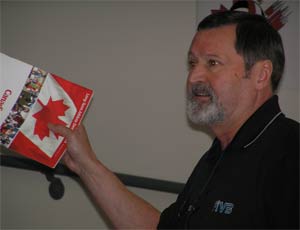
It’s interesting that the majority of these people have never heard of Istvan Balyi, the world’s foremost expert on long-term athletic development.

This guy really knows his stuff!

Nor are they familiar with the sensitive periods of specific athletic qualities during a young athlete’s development process.

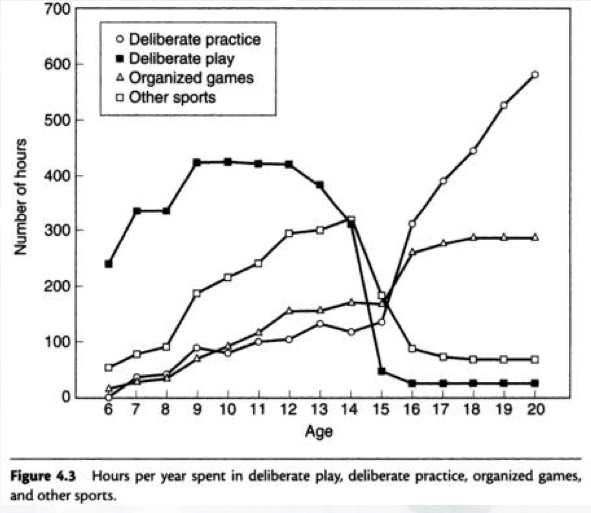
Nor are they aware that research has shown that the world’s best hockey players spend the overwhelming majority of their time during their developmental years playing for fun and playing other sports. Note that deliberate practice (what we think of as normal practice) and organized games don’t take over these players’ sport time until ~15 years old!

Taken from: Soberlak, P. & Cote, J. (2003) The Developmental Activities of Elite Ice Hockey Players. Journal of Applied Sport Psychology, 15 (1), pages 41 – 49.

I realize that the general tone of this post could be interpreted as blaming parents (and youth coaches for that matter). This is not my intention. In fact, hockey parents and youth coaches are truly heroic in the amount of time and energy they put into helping the kids. I don’t think any sport requires as much of a total commitment as ice hockey (team costs, equipment costs, travel time and costs, etc.). Youth hockey wouldn’t exist without their collective consistent efforts. Instead, the intention of this discussion is one of awareness. Parents are the largest advocates for the development of their kids, but are viewed as one of the larger barriers to positive change.

Ultimately, I think that player development decisions need to be placed back in the hands of the TRUE experts in long-term athletic development (and related fields), and that youth parents and coaches just need to be a little more patient with younger kids. It doesn’t matter if a kid isn’t a superstar at age 10! We shouldn’t be dividing kids by ability at this age anyway. At the mite and squirt levels, kids should have pucks on their sticks for the majority of the time they’re on the ice and should almost never stop moving. It should look like chaos, and it should be fun! By backing off the “rushed development” idea a bit, we can allow kids to develop a true love for the sport, which will be what fuels them to want to put in the time and energy to achieve excellence later in the development process.

I say all that to say this: It will be of great benefit to the hockey community to learn more about USA Hockey’s American Development Model-their intentions, their age-specific recommendations, and their plan of implementation. In a future post, I’ll identify some of the more “big picture” messages that accompany their ADM, but in the meantime you can refer to here for more information: ADM Kids

If your initial reaction to anything you read from their site is dismissive or generally disagreeable, please ask yourself these two questions:

  1. Do you believe that knowledge has the power to change opinion?
  2. Do you believe that you possess greater knowledge than the collective group of people that have collaborated in developing the model?

To your success,

Kevin Neeld

Please enter your first name and email below to sign up for my FREE Athletic Development and Hockey Training Newsletter!

A couple weekends ago, I had an opportunity to attend a weekend symposium for USA Hockey’s American Development Model (ADM). The symposium was a 4-day invite only event that focused on this year’s implementation of the USA Hockey’s ADM at the 8U level, but subsequent levels (10U and 12U) were also discussed. The speakers were a healthy mix of USA Hockey ADM representatives, athletic development experts from other sports, hockey development experts from other countries, and cognitive development experts with an athletic population background. In other words, there wasn’t an aspect of long-term player development left untouched, which made it a truly eye-opening experience. This was especially true considering that I was the only one in attendance whose primary responsibilities were off-ice training in nature. Everyone else coached (which I miss) or was responsible for running an entire youth program/league.

I left the weekend with a ton of notes, an energized enthusiasm to improve the programs we write for our players (especially the younger ones, as this was the focus of the weekend), a deep appreciation for the research that went into revamping USA Hockey’s ADM, and also a sense of discouragement in anticipation of the obstacles they’re going to face in implementing it. In my opinion, USA Hockey has created the BEST long-term athlete development model in any sport in our country. It should be widely adopted, and quickly, but I suspect that they’ll meet a lot of resistance in implementing their message, especially as they approach older age groups and more “elite” organizations. I’ll talk a little more about the nature of this resistance in a future post, but for now I want to point out some of the problems (or less than ideal occurrences) with our current youth player development model.

Problem 1: Excessive Focus on Winning
As a disclaimer, I want to point out that I love winning, and hate losing. This isn’t a new habit; I’ve always been this way. As young as a peewee, losses stuck with me for weeks and really fueled my practice/training efforts. I will never suggest that winning is unimportant, only that it’s overemphasized too early in the development process. This is, in part, because adults (coaches and parents) place a personal high value on winning and lose sight over what the kids are really involved in the sport for. Bob Bigelow, who went from a clumsy high school basketball player to a 1st round NBA draft pick (13th overall), cited research from Vern Seefeldt inquiring as to why kids play sports. Responses below:

  • #1 reason kids play sports is to have fun
  • #2 reason kids play sports is to get better
  • #3 is exercise
  • #4 make friends
  • In 5-12 year olds, winning was ranked #12 (last)
  • In high school athletes, winning was ranked #8!

Take Home-Youth players want to PLAY, get better, be active, and have fun with their friends. Winning is important to them (as it is to coaches), but NOT at the expense of any of the above. This speaks to the importance of making roster sizes smaller at younger levels (e.g. 12U) to allow more practice and game activity and equal ice time distribution for ALL players, regardless of ability level, at these same ages. The focus at these ages should be on DEVELOPMENT, not winning. This will be a recurring theme throughout this post.

Problem 2: The Illusion of Elite Youth Players
This might be the topic that inspires the most hate-mail for me. The trend in recent years is to push for early specialization. This may be the result of rare successes like Tiger Woods, who focused on a single sport their whole life and grew to be a world-leader. If this is the case, the movement ironically ignores the HUNDREDS OF THOUSANDS of players in every sport that drop out because of burnout or nagging overuse injuries (or injuries masked as traumatic, that really have fatigue accumulation roots). Early talent identification is a necessary byproduct of early specialization. After all, there’s no sense in specializing in a sport if you’re not good at it. You’ll never win that way!

Bob Bigelow said something, only half jokingly, that really resonated with me. To paraphrase, he said something along the lines of, “every 6th grader in the country stinks, some are just worse.” He’s right, but it’s a hard concept to understand. When you see one player that is clearly a step ahead of the others, the instinctual reaction is to believe that player is “better” than the others.


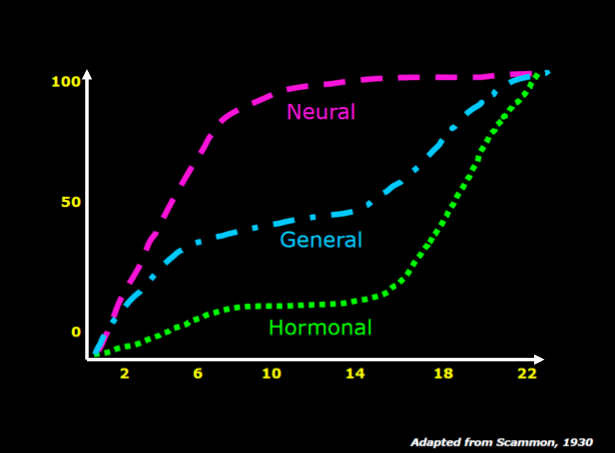
If you look at the graph above, you’ll note that there are different developmental curves for neural, general, and hormonal growth. Unfortunately absent from this graph are markers of variability. I think we can all agree that kids develop at different rates. This is very apparent from a physical standpoint, especially from around the 12-16 age range, as you’ll see some players that look like little kids and others that look like adults. Less apparent, is that there is an EQUALLY divergent range of development rates from a neural standpoint. The players that appear more elite may have developed more proficient movement patterns sooner than there “less elite” counterparts. This has NO prediction of how the two players will compare when they’re both fully developed. However, the trend is to identify the more skilled player at younger ages, and place them on “elite” teams. Again, there is no such thing as an elite 12-year old, but that is ultimately how we identify kids at young ages. The ones we describe as elite have simply developed in one or more systems (e.g. neural proficiency and/or physical stature) sooner than the others that we now place in “less elite” teams/leagues.

I anticipate that at least one person reading this is thinking that they’ve seen kids that were stars at young ages and that were also stars when they were older. This could be an example of a “win” for early identification. Let’s assume that this person has also NEVER seen a young star that grew up to be a mediocre player as an adult, which is a stretch. The reality is that there are a TON of kids that are identified as talented (or big) at young ages that succeed at older ages; the question is why? Think about what happens in these elite youth organizations. They get better coaches, more ice time, and play with other more rapidly developed players (which helps stimulate creativity through observational learning). This provides exponentially more opportunities to develop.  In other words, our early identification “wins” can be categorized as a self-fulfilling prophecy. We take an early developer and give them better resources to develop over the long-term. If we held off on these segregations for a few more years, you’d be surprised at how many that would be overlooked in the current system would rise to the top. Unfortunately many of these kids are either lost in a poor development model or are discouraged from early failures and end up going a different route athletically (e.g. playing baseball, soccer, lacrosse, etc.).

Concrete evidence in support of this idea can be found in the “relative age effect”. Darryl Nelson, who also spoke at the ADM symposium, wrote a great article on this for Hockey Strength and Conditioning a while back. Below is an excerpt from Darryl’s article:

Some research by Adonna and Yates has looked at birth months of all Canadian players that have been in the NHL. There have been 883 players in the NHL born in January and February, 691 born in June and July, and 660 born in November and December. They have also found that birth rates in Canada are at the lowest in January and February and higher in the summer months. Therefore, January and February have the lowest birth rates and still produce the highest number of players. It seems that relative age effect is very prominent even at the highest levels of ice hockey.

The general idea is that players born earlier in the year are relatively older than players born later in the year. Therefore, they develop faster, appear to be better, and are put into an “elite” hockey track at young ages. The relative age effect either highlights a glaring flaw in our development process, or indicates that couples genetically primed for producing NHL stars tend to copulate more in the Spring than any other season.

Problem 3: An Inappropriate Contentedness with Current National Progress
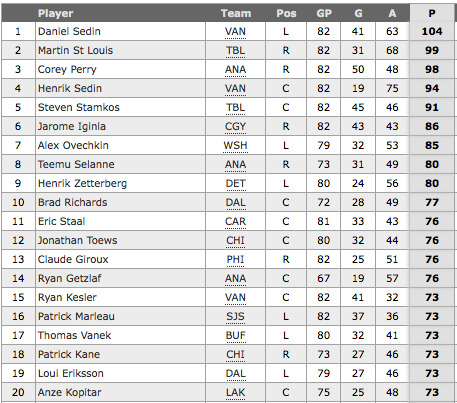
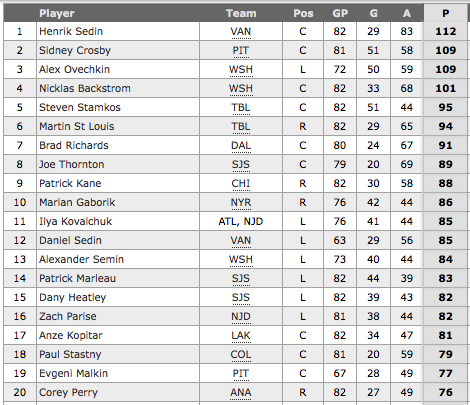
Two years ago, Sidney Crosby scored a game winning goal to help Canada win the gold medal over the U.S. in the 2010 Winter Olympics. The Olympics provide a somewhat crude display of which country is best in sport. This result would imply that Canada is still on top, and that the U.S. is not far behind. An unspoken implication of this result is that the development models of these countries are superior and should be mimicked by others. Take a second to look at the two tables below of the Top 20 NHL scoring leaders for the last two seasons.

2010-2011 NHL Scoring Leaders

2009-2010 NHL Scoring Leaders

Breakdown by country:

2010-2011:

  1. Canada (10)
  2. Sweden (4)
  3. U.S. (2)
  4. Russia (1)
  5. Finland (1)
  6. Austria (1)
  7. Slovenia (1)

2009-2010:

  1. Canada (9)
  2. Russia (4)
  3. Sweden (3)
  4. U.S. (2)
  5. Austrian (1)
  6. Slovakia (1)

These tables paint a slightly different picture.  As you can see, Canada tops the charts and the U.S. is just able to edge out the hockey powerhouses of Austria and Slovenia! In reality, these figures only tell part of the story. From a development standpoint, the U.S. and Canada follow more similar models compared to European and Eastern countries. If we “cluster” the countries that way we get:

2010-2011:

  • North America (12)
  • Rest of the World (8)

2009-2010:

  • North America (11)
  • Rest of the World (9)

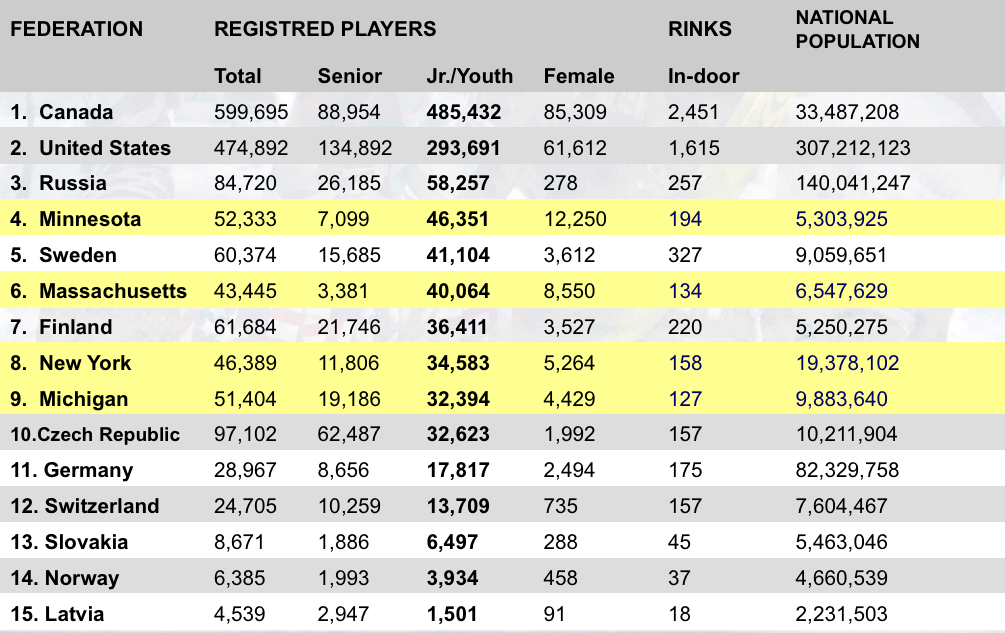
It’s interesting that the scoring leaders are more or less equally divided between North America and the rest of the world, especially in consideration of the raw number of players hailing from each country.

Hockey Playing Population by Country

This table is really telling. Look at the discrepancy between the number of registered players in Canada compared to the rest of the world. Do the same with the U.S. Viewed from strictly a population participation standpoint, Canada SHOULD win gold; the U.S. SHOULD win silver. Canada SHOULD have the most successful NHL players and the U.S. should be right behind them. In my opinion, these numbers really highlight the effectiveness of the development systems in other countries, especially Russia, Sweden, and Finland who are known for consistently producing some of the NHL’s most skilled players. I wonder how an All-Star team from the state of Minnesota would fair against Sweden? Would a Massachusetts team be competitive in a game against Finland? You can interpret this as you wish; to me, it made me question whether we’re doing a good job of developing players because of effective systems or because we have such a HUGE number of players in the game that it’d be difficult NOT to produce 20-30 extremely talented players.

On a smaller scale, we’re seeing a lot more kids from the Atlantic District move on to play Division I college hockey and some move on to play some level of pro. 15 years ago, this almost never happened. Now it seems almost normal. A couple weeks ago, I would have said that the hockey programs in this area have improved immensely and players coming out of the area and moving on to higher levels are evidence of that. While I think that is certainly a component of the success players from our area are seeing, I can’t help but look at the HUGE increase in popularity that the sport has enjoyed int his area over a similar time span. The number of ice surfaces and youth programs have roughly doubled, and as you’d expect, the number of kids participating has increased significantly too. Statistically, with the increased availability of hockey opportunities, you would expect to see more successful players, regardless of any improvement in the development systems.

If you take nothing else from this last discussion, understand that our hockey development systems have room for improvement. There’s no sense in saying whether we’re doing a “good” or “bad” job now; we can do better, and we should.

Take Home Message
The majority of the problems that youth hockey faces can be summarized by saying that we’re applying adult value systems to a youth sport. The current goal, spoken or otherwise, seems to be to have young players perform on the ice in ways similar to elite adults. This leads to things like an overemphasis on winning, early specialization, early talent identification, etc., and largely ignores the physical, mental, technical, and social development rates of young athletes. As a sport, and as a country, we can, should, and need to do a better job of self-examining our player development philosophies and systems. USA Hockey has done a lot of the leg work in providing a research- and experience-driven framework from which to start. It’s our job to adopt and adapt.

In a couple days, I’ll follow up with a post on the largest barriers the hockey community will face in attempting revamp their development systems. Until then!

To your success,

Kevin Neeld

Please enter your first name and email below to sign up for my FREE Athletic Development and Hockey Training Newsletter!
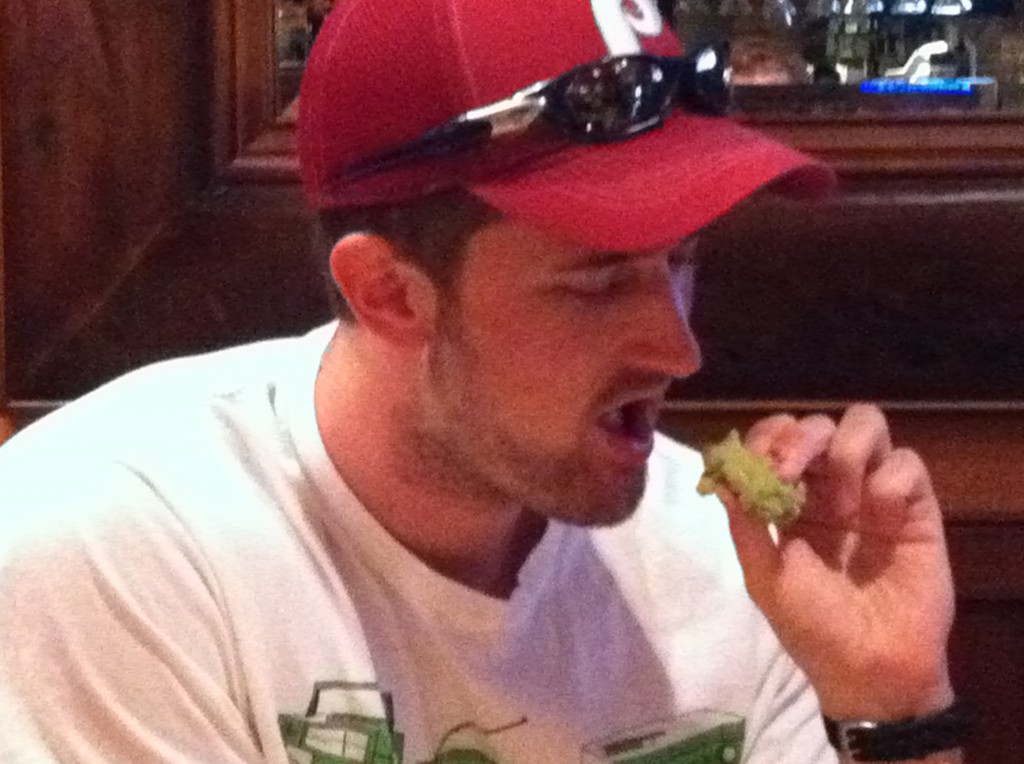
I hope you had a great weekend. This was the first weekend in a month that I’ve been home so it was nice to spend some time with Emily and relax a bit. On Saturday, Emily and I “doubled” with David Lasnier and his ladyfriend at Raw, my favorite sushi place in Philadelphia. Because of the company, David refrained from rolling all of the wasabi into one big clump and eating it whole.

I just assume this is common behavior in Canada

Last weekend I had an opportunity to attend an invite-only symposium on USA Hockey’s American Development Model. They did a great job bringing in speakers from different sports, countries, and disciplines, and I couldn’t say enough good things about the direction USA Hockey is going in general. In a few upcoming posts, I’ll explain more about the state of youth hockey, what USA Hockey is hoping to do, and what you can do to help. In the meantime, it’s been a while since I’ve done a “random thoughts” post and there are a lot of little things I want to share with you.

  1. I get questions about supplements ALL the time, usually from kids that eat like crap and have been “educated” (I use that term VERY loosely) by fellow high school students. Supplements can be very beneficial, but as an athletic society, we need to do a better job of educating our youth on the performance enhancing benefits of proper eating. I think kids view supplements as the key to performance enhancement, and eating a quality diet just as a means of improving general health, which they have no utility for as they’ve never suffered any consequences of impaired health (these things come much later in life). Often times, the best strategies for building muscle, facilitating recovery, and ensuring adequate energy to train and perform at a high intensity are found in pretty basic eating and hydration strategies that don’t require supplements.
  2. If you’re a high school player, it’s safe to say that EVERYTHING you’ve been told from your buddies about supplements is wrong.
  3. Speaking of misinformation, I’m amazed at the amount of garbage that is perpetrated as “goalie-specific training” for hockey goalies. Luckily, Maria Mountain has really stepped up as a CREDIBLE expert in this area and has done an outstanding job of providing goalies with training advice that will actually make them better. If you’re a goalie and haven’t heard of Maria, you’re spending more time pulling pucks out of your net than you should be. Check out her site here: Hockey Training Pro
  4. Citrulline Malate may be the most effective supplement you’ve never heard of. Dr. Mike Roussell first brought this to my attention at a seminar over the Summer and it’s definitely worth looking into. He recently wrote a great review of it on Joel Jamieson’s site here: Citrulline Malate – Your Key to Winning In the Last Round?
  5. Dave Ritter and Anne Davis, two presenters at USA Hockey’s ADM Symposium from the US Tennis Association recommended two NY Times articles that I had an opportunity to read through last week. They were just long enough to test my attention span, but I’m glad I worked my way through to the end. Both question current trends/thoughts in our country in the areas of athletic development and success. Check them out here: What if the Secret to Success is Failure?, How to Grow a Super-Athlete
  6. I’m always on the prowl for new resources. Recently I’ve found myself looking to these 4 guys more and more for new information or a different look at program design/implementation: Joel Jamieson’s 8 Weeks Out, Cal Dietz’s XL Athlete, Jim Snider’s Neuro Explosion, and Kyle Bangen’s Bangen Athletic Development
  7. Have you ever watched a mite or squirt hockey practice and noticed that the coach seems to be yelling more than teaching? Those kids should be having fun the ENTIRE time they’re on the ice. Similarly, the COACH should be having fun the entire time. If you don’t like kids, don’t coach them!
  8. With the popularity Facebook has enjoyed, it seems like every industry is trying to develop their own social media site. I can’t tell you how many requests I’ve received to join DIFFERENT business referral sites! Do we really need a social media site for people to say, “I think you should go train with Kevin at Endeavor”? Inevitably, the industry will overgrow before dying back down to a few reasonable, valuable resources. A local group has started a sports-driven site called UR Sports Page that I think may survive the process. Great idea to provide an exclusive site just for athletes.
  9. Core training continues to be a hot topic in athletic development and fitness crowds alike. Naturally, this means that a lot of people will fall victim (e.g. waste their time and money) to unscrupulous marketers making amazing claims about the crap they peddle. It’s great to see that Mike Robertson has spent the time and energy to put together a quality core training resource. If you haven’t been following Mike’s work over the last week, check out these posts: Should You Crunch?, Should You Crunch? Part 2, My Core Training Story. I know he has some other great posts planned for this week too. Click any of the links above to head over to his site now, read through the content and sign up for his webinar “Complete Core Training”. It’s free!

That’s a wrap for today. Check back in a couple days for a few interesting insights into the chicken and egg cycle with postural adaptations and goalie-specific performance.

To your success,

Kevin Neeld

Please enter your first name and email below to sign up for my FREE Athletic Development and Hockey Training Newsletter!
After a great weekend in Pittsburgh at USA Hockey’s ADM Symposium (and one of Tangradi’s pre-season games) and a busy Summer of travel in general, I’m finally back and getting resettled in Philadelphia.

Despite the popularity of these posts, I don’t write a lot about how specific off-ice training methods transfer to specific on-ice skills. My fear is that players will say “I need a quicker first step” and only do a few thing that I recommend for speed training, or in this case, “I need a harder slap shot” and only do the exercises in this article. The truth is that ALL players should be following a comprehensive training program and using single goals as a means of designing your plan will inevitably create imbalances and ultimately fail in helping you realize your true potential. I say that as a preface to this post with the hopes that you’ll understand that this the exercises referenced below were simply pulled from a more complete program to demonstrate how these components will help transfer to an on-ice ability.

Tips for Improving Slap Shot Power
Hockey players, especially young ones, frequently seek out ways to improve their shot power. In reality, shooting a harder slap shot often comes down to mastering the technical components (e.g. foot positioning, puck placement, stick contact point, hand position, hip drive, etc). That said, a lot of progress can be made by removing physical barriers and improving both general and movement-specific strength and power.

From a barrier standpoint, shooting requires a great deal of mobility through the hips and thoracic spine (upper back). Two great exercises to improve and maintain optimal mobility in these areas are:

The Lying Knee-to-Knee Mobilization
Purpose: Improve hip internal rotation range of motion

Side-Lying Diagonal Arm Arc
Purpose: Improve thoracic rotation range of motion


A player cannot realize their full power potential with significant mobility restrictions. Because we live in a more sedentary society than ever, the hips and thoracic spine are common points of restriction and can lead to a number of other problems in addition to diminished shot power. Once a player has full mobility through the hips and spine, the next step is to improve core strength. While mobility and stability can be developed somewhat simultaneously, it’s important to understand that proper reflexive stability depends on proper proprioception, which is driven by optimal range of motion. In other words, range of motion restrictions will impair the body’s ability to properly activate stabilization-oriented muscles. Stability work will help ensure that the power generated from the lower body is effectively transferred to the upper body and into the puck. One great exercise for this is:

½ Kneeling Belly Press
Purpose: Improve rotational core strength


There are dozens of other exercises that serve this purpose well, but this is a good one to start with. The final stage in developing a harder shot is to improve rotational power. Power expression can range from high load, low velocity to low load, high velocity. Because a puck weighs a mere 6 oz., there will be a better transfer of power improvements if exercises on the low load, high velocity end of the continuum are selected. Medicine ball exercises serve this purpose perfectly.

One basic rotational power exercise is:

Front Standing Med Ball Scoop
Purpose: Develop rotational power, emphasizing weight transfer, hip rotation, and upper body follow through.

(well-groomed playoff beard optional)

A more dynamic variation of this quality:

Side Standing Med Ball Shotput with Rapid Step Behind
Purpose: Develop rotational power in a more dynamic environment. This more closely mimics the changing foot positions where power will need to be generated on the ice (think of adjusting feet to take a one timer).


While these are a few specific exercises that will help improve rotational power, a more general approach to strength training will also have a positive impact. The great thing about a quality hockey training program is that the same tactics used to develop a harder slap shot will also improve maximum and transitional skating speed, the ability to give and withstand hits, general conditioning, and injury resistance. In general, I think the hockey hockey world is due for a paradigm shift away from a direct skill-transfer driven training approach to off-ice development and toward a more complete athletic development system.

To your success,

Kevin Neeld

Please enter your first name and email below to sign up for my FREE Athletic Development and Hockey Training Newsletter!
Use CODE: "Neeld15" to save 15%