
A couple weekends ago, I had an opportunity to attend a weekend symposium for USA Hockey’s American Development Model (ADM). The symposium was a 4-day invite only event that focused on this year’s implementation of the USA Hockey’s ADM at the 8U level, but subsequent levels (10U and 12U) were also discussed. The speakers were a healthy mix of USA Hockey ADM representatives, athletic development experts from other sports, hockey development experts from other countries, and cognitive development experts with an athletic population background. In other words, there wasn’t an aspect of long-term player development left untouched, which made it a truly eye-opening experience. This was especially true considering that I was the only one in attendance whose primary responsibilities were off-ice training in nature. Everyone else coached (which I miss) or was responsible for running an entire youth program/league.

I left the weekend with a ton of notes, an energized enthusiasm to improve the programs we write for our players (especially the younger ones, as this was the focus of the weekend), a deep appreciation for the research that went into revamping USA Hockey’s ADM, and also a sense of discouragement in anticipation of the obstacles they’re going to face in implementing it. In my opinion, USA Hockey has created the BEST long-term athlete development model in any sport in our country. It should be widely adopted, and quickly, but I suspect that they’ll meet a lot of resistance in implementing their message, especially as they approach older age groups and more “elite” organizations. I’ll talk a little more about the nature of this resistance in a future post, but for now I want to point out some of the problems (or less than ideal occurrences) with our current youth player development model.
Problem 1: Excessive Focus on Winning
As a disclaimer, I want to point out that I love winning, and hate losing. This isn’t a new habit; I’ve always been this way. As young as a peewee, losses stuck with me for weeks and really fueled my practice/training efforts. I will never suggest that winning is unimportant, only that it’s overemphasized too early in the development process. This is, in part, because adults (coaches and parents) place a personal high value on winning and lose sight over what the kids are really involved in the sport for. Bob Bigelow, who went from a clumsy high school basketball player to a 1st round NBA draft pick (13th overall), cited research from Vern Seefeldt inquiring as to why kids play sports. Responses below:
- #1 reason kids play sports is to have fun
- #2 reason kids play sports is to get better
- #3 is exercise
- #4 make friends
- In 5-12 year olds, winning was ranked #12 (last)
- In high school athletes, winning was ranked #8!
Take Home-Youth players want to PLAY, get better, be active, and have fun with their friends. Winning is important to them (as it is to coaches), but NOT at the expense of any of the above. This speaks to the importance of making roster sizes smaller at younger levels (e.g. 12U) to allow more practice and game activity and equal ice time distribution for ALL players, regardless of ability level, at these same ages. The focus at these ages should be on DEVELOPMENT, not winning. This will be a recurring theme throughout this post.
Problem 2: The Illusion of Elite Youth Players
This might be the topic that inspires the most hate-mail for me. The trend in recent years is to push for early specialization. This may be the result of rare successes like Tiger Woods, who focused on a single sport their whole life and grew to be a world-leader. If this is the case, the movement ironically ignores the HUNDREDS OF THOUSANDS of players in every sport that drop out because of burnout or nagging overuse injuries (or injuries masked as traumatic, that really have fatigue accumulation roots). Early talent identification is a necessary byproduct of early specialization. After all, there’s no sense in specializing in a sport if you’re not good at it. You’ll never win that way!
Bob Bigelow said something, only half jokingly, that really resonated with me. To paraphrase, he said something along the lines of, “every 6th grader in the country stinks, some are just worse.” He’s right, but it’s a hard concept to understand. When you see one player that is clearly a step ahead of the others, the instinctual reaction is to believe that player is “better” than the others.
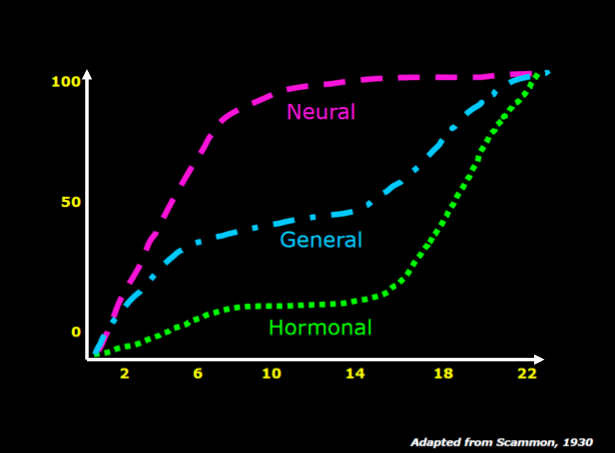
If you look at the graph above, you’ll note that there are different developmental curves for neural, general, and hormonal growth. Unfortunately absent from this graph are markers of variability. I think we can all agree that kids develop at different rates. This is very apparent from a physical standpoint, especially from around the 12-16 age range, as you’ll see some players that look like little kids and others that look like adults. Less apparent, is that there is an EQUALLY divergent range of development rates from a neural standpoint. The players that appear more elite may have developed more proficient movement patterns sooner than there “less elite” counterparts. This has NO prediction of how the two players will compare when they’re both fully developed. However, the trend is to identify the more skilled player at younger ages, and place them on “elite” teams. Again, there is no such thing as an elite 12-year old, but that is ultimately how we identify kids at young ages. The ones we describe as elite have simply developed in one or more systems (e.g. neural proficiency and/or physical stature) sooner than the others that we now place in “less elite” teams/leagues.
I anticipate that at least one person reading this is thinking that they’ve seen kids that were stars at young ages and that were also stars when they were older. This could be an example of a “win” for early identification. Let’s assume that this person has also NEVER seen a young star that grew up to be a mediocre player as an adult, which is a stretch. The reality is that there are a TON of kids that are identified as talented (or big) at young ages that succeed at older ages; the question is why? Think about what happens in these elite youth organizations. They get better coaches, more ice time, and play with other more rapidly developed players (which helps stimulate creativity through observational learning). This provides exponentially more opportunities to develop. In other words, our early identification “wins” can be categorized as a self-fulfilling prophecy. We take an early developer and give them better resources to develop over the long-term. If we held off on these segregations for a few more years, you’d be surprised at how many that would be overlooked in the current system would rise to the top. Unfortunately many of these kids are either lost in a poor development model or are discouraged from early failures and end up going a different route athletically (e.g. playing baseball, soccer, lacrosse, etc.).
Concrete evidence in support of this idea can be found in the “relative age effect”. Darryl Nelson, who also spoke at the ADM symposium, wrote a great article on this for Hockey Strength and Conditioning a while back. Below is an excerpt from Darryl’s article:
Some research by Adonna and Yates has looked at birth months of all Canadian players that have been in the NHL. There have been 883 players in the NHL born in January and February, 691 born in June and July, and 660 born in November and December. They have also found that birth rates in Canada are at the lowest in January and February and higher in the summer months. Therefore, January and February have the lowest birth rates and still produce the highest number of players. It seems that relative age effect is very prominent even at the highest levels of ice hockey.
The general idea is that players born earlier in the year are relatively older than players born later in the year. Therefore, they develop faster, appear to be better, and are put into an “elite” hockey track at young ages. The relative age effect either highlights a glaring flaw in our development process, or indicates that couples genetically primed for producing NHL stars tend to copulate more in the Spring than any other season.
Problem 3: An Inappropriate Contentedness with Current National Progress
Two years ago, Sidney Crosby scored a game winning goal to help Canada win the gold medal over the U.S. in the 2010 Winter Olympics. The Olympics provide a somewhat crude display of which country is best in sport. This result would imply that Canada is still on top, and that the U.S. is not far behind. An unspoken implication of this result is that the development models of these countries are superior and should be mimicked by others. Take a second to look at the two tables below of the Top 20 NHL scoring leaders for the last two seasons.
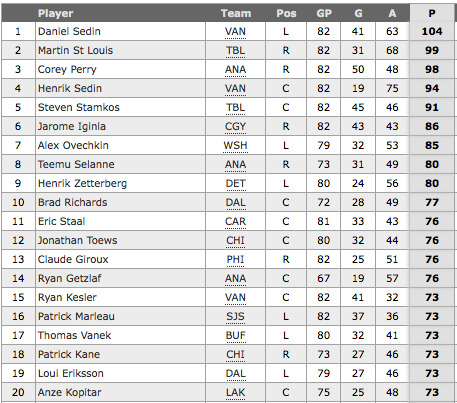
2010-2011 NHL Scoring Leaders

2009-2010 NHL Scoring Leaders
Breakdown by country:
2010-2011:
- Canada (10)
- Sweden (4)
- U.S. (2)
- Russia (1)
- Finland (1)
- Austria (1)
- Slovenia (1)
2009-2010:
- Canada (9)
- Russia (4)
- Sweden (3)
- U.S. (2)
- Austrian (1)
- Slovakia (1)
These tables paint a slightly different picture. As you can see, Canada tops the charts and the U.S. is just able to edge out the hockey powerhouses of Austria and Slovenia! In reality, these figures only tell part of the story. From a development standpoint, the U.S. and Canada follow more similar models compared to European and Eastern countries. If we “cluster” the countries that way we get:
2010-2011:
- North America (12)
- Rest of the World (8)
2009-2010:
- North America (11)
- Rest of the World (9)
It’s interesting that the scoring leaders are more or less equally divided between North America and the rest of the world, especially in consideration of the raw number of players hailing from each country.
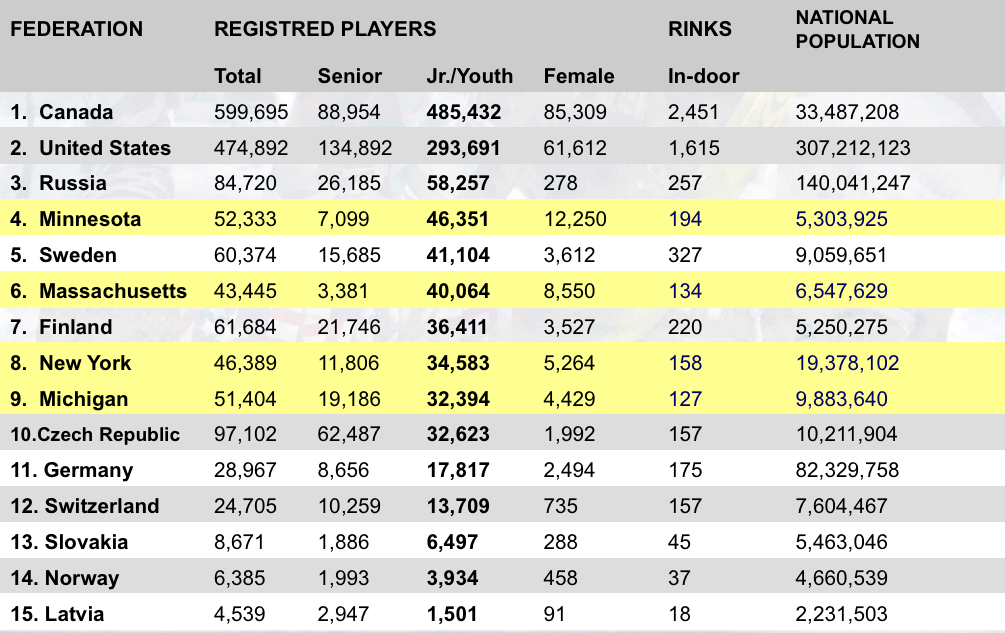
Hockey Playing Population by Country
This table is really telling. Look at the discrepancy between the number of registered players in Canada compared to the rest of the world. Do the same with the U.S. Viewed from strictly a population participation standpoint, Canada SHOULD win gold; the U.S. SHOULD win silver. Canada SHOULD have the most successful NHL players and the U.S. should be right behind them. In my opinion, these numbers really highlight the effectiveness of the development systems in other countries, especially Russia, Sweden, and Finland who are known for consistently producing some of the NHL’s most skilled players. I wonder how an All-Star team from the state of Minnesota would fair against Sweden? Would a Massachusetts team be competitive in a game against Finland? You can interpret this as you wish; to me, it made me question whether we’re doing a good job of developing players because of effective systems or because we have such a HUGE number of players in the game that it’d be difficult NOT to produce 20-30 extremely talented players.
On a smaller scale, we’re seeing a lot more kids from the Atlantic District move on to play Division I college hockey and some move on to play some level of pro. 15 years ago, this almost never happened. Now it seems almost normal. A couple weeks ago, I would have said that the hockey programs in this area have improved immensely and players coming out of the area and moving on to higher levels are evidence of that. While I think that is certainly a component of the success players from our area are seeing, I can’t help but look at the HUGE increase in popularity that the sport has enjoyed int his area over a similar time span. The number of ice surfaces and youth programs have roughly doubled, and as you’d expect, the number of kids participating has increased significantly too. Statistically, with the increased availability of hockey opportunities, you would expect to see more successful players, regardless of any improvement in the development systems.
If you take nothing else from this last discussion, understand that our hockey development systems have room for improvement. There’s no sense in saying whether we’re doing a “good” or “bad” job now; we can do better, and we should.
Take Home Message
The majority of the problems that youth hockey faces can be summarized by saying that we’re applying adult value systems to a youth sport. The current goal, spoken or otherwise, seems to be to have young players perform on the ice in ways similar to elite adults. This leads to things like an overemphasis on winning, early specialization, early talent identification, etc., and largely ignores the physical, mental, technical, and social development rates of young athletes. As a sport, and as a country, we can, should, and need to do a better job of self-examining our player development philosophies and systems. USA Hockey has done a lot of the leg work in providing a research- and experience-driven framework from which to start. It’s our job to adopt and adapt.
In a couple days, I’ll follow up with a post on the largest barriers the hockey community will face in attempting revamp their development systems. Until then!
To your success,
Kevin Neeld
Please enter your first name and email below to sign up for my FREE Athletic Development and Hockey Training Newsletter!
post comments
Together We Rise: A Campaign for Everyone