The stretch reflex of the quadriceps is typically utilized from a low position in skating.
 
This is the first of two examples of simple modifications to commonly performed jumping exercises to emphasize the stretch reflex and power output from these “skating-specific” positions.
 
Squat Jump w/ Quick Dip

The athlete starts around skating depth, quickly dips, and then jumps as high as they can. The goal is to maximize transition speed and jump height.
 
Typically performed for 3-4 sets of 5 reps.

To your success,

Kevin Neeld
SpeedTrainingforHockey.com
HockeyTransformation.com
OptimizingAdaptation.com

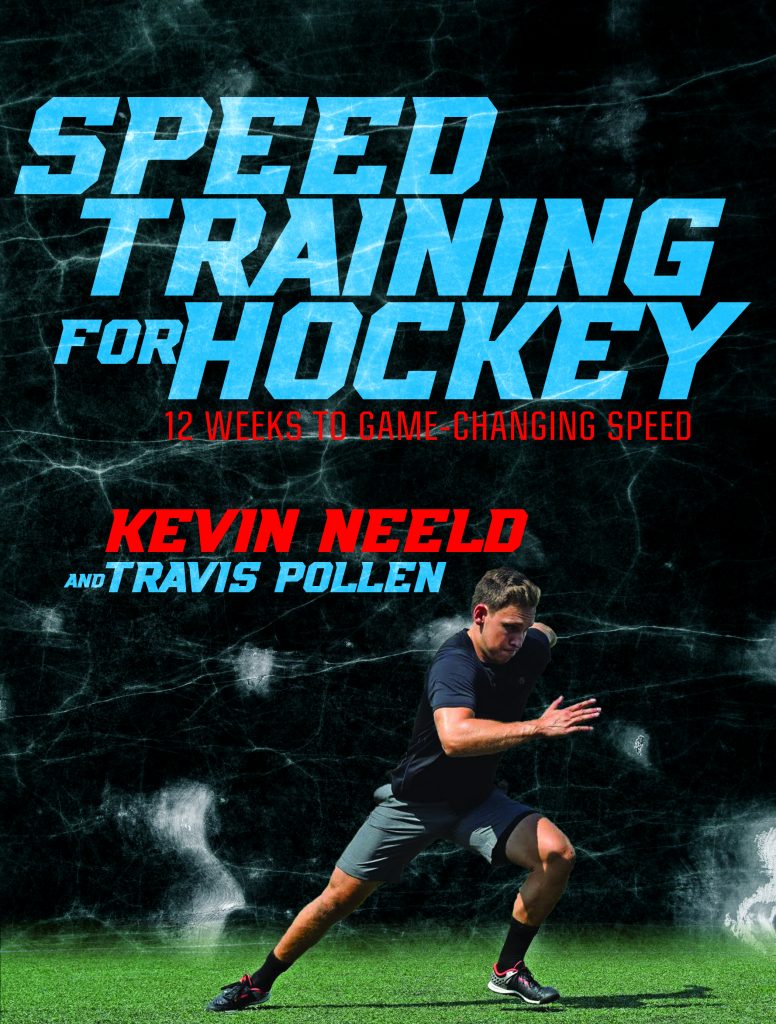
P.S. If you’re interested in improving your speed on the ice, check out my book Speed Training for Hockey.

Enter your first name and email below to sign up for my FREE Sports Performance and Hockey Training Newsletter!

While the previous two videos (see: Integrated Core Training for Dynamic Stability and Core Training Variations for Dynamic Stability) help reinforce elements of low-position control important for skating, the Single Leg Stance Med Ball Figure 8 is more of a traditional balance exercise.

The goal is to stay tall and centered over the foot.
 
When someone is performing this exercise, there are several things I’m looking for:

  • Foot stability: Do they maintain 3 points of contact with the heel, ball of the foot and 5th metatarsal (base of the pinky toe)? Some movement is expected, but the foot shouldn’t collapse inward or roll so far to the outside that the big toe peels off.
  • Hip positioning: As the ball moves, does the pelvis rotate, sway excessively side to side (this can also drive the foot to roll in or out), or dump forward?
  • Core control: Does the rib cage stay stacked above the pelvis? Most typical deviation from this position is to allow the pelvis to tip forward and rib cage to flare up, which is a sign of an posterior (low back) stabilization strategy, but some will also excessively crunch/brace which will cause them to “lose height”.
  • Head/Neck position: Does the head stay stacked above the rib cage and pelvis or does it drift forward?

Positioning and control in all of these areas are inter-related, (e.g. a foot collapsing inward can drive a hip tilt and loss of rib/pelvis stacking), so it’s important to observe up and down the chain. 

As with the other variations, this can be progressed by adding range of motion to the “8”, adding speed, or adding load. In certain cases, I’ve also progressed athletes to doing this with their eyes closed, to remove the visual contribution to balance. 

Give this a shot, and post any questions/comments below!

To your success,

Kevin Neeld
SpeedTrainingforHockey.com
HockeyTransformation.com
OptimizingAdaptation.com

Enter your first name and email below to sign up for my FREE Sports Performance and Hockey Training Newsletter!
Following up on a previous post, over the next few days, I’ll share other core variations we use to reinforce stability across a variety of different positions.

The video below is of a Split Squat Med Ball Figure 8.

As with the last video, the goal is to maintain depth and a forward lean/shin angle, and to control the momentum of the ball to maintain the pelvis/torso within the base of support.
 
The “Figure 8” (really an “infinity” symbol) pattern adds a diagonal component, in comparison to the “tight rotation” variation that is straight side to side.
 
This serves as an end-stage progression from dynamic cable chop and lift patterns.
 
With longer durations, a key point of emphasis is on “breathing through the brace.”
 
Give this a shot, and post any questions/comments below!

To your success,

Kevin Neeld
SpeedTrainingforHockey.com
HockeyTransformation.com
OptimizingAdaptation.com

Enter your first name and email below to sign up for my FREE Sports Performance and Hockey Training Newsletter!
I hope this finds you well, and that you’re as excited as I am for the start of the hockey season.

Over the last few years, balancing my work responsibilities with family time and wrapping up my PhD has not left a lot of extra time for writing.

When I started this site back in 2008, my main goal was simply to share information that could benefit athletes and coaches looking for an edge, and pass along things I was learning to my colleagues in strength and conditioning.

One of the many things I’ve learned over the last 13 years is that the writing process really helps me to clarify my thinking, particularly as I work to integrate new information into an evolving training system.

I’ve missed this over the last few years, and while I still don’t have the time to write long articles, I’ve recently started to share quick posts and videos on my instagram account (@KevinNeeld), which I’ll also post here.

As always, feel free to re-share anything that you think will benefit your friends, teammates, colleagues, etc, and please post any questions comments you have.

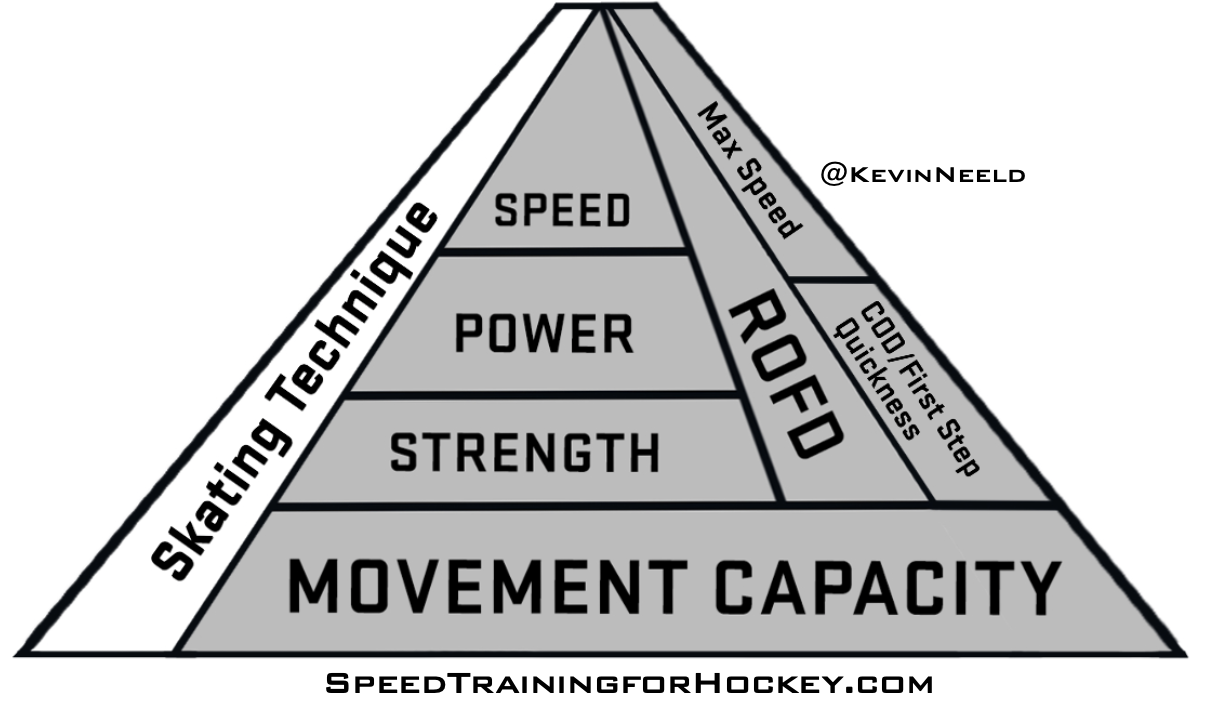
Hockey Speed Training Pyramid

In ideal circumstances, the training process should follow this process:

  1. Identify a goal
  2. Diagnose limiting factor(s)
  3. Design and implement a training intervention
  4. Re-assess

We often hear that different things work for different people.

There are many reasons why this is true, one being that most athletes are not exposed to Step 2.

There is no goal-driven diagnostic process to identify specific areas that are most likely to help the athlete achieve the desired outcome.

This picture is a general overview of my model of speed development for ice hockey players, taken from a presentation I gave recently for the Strength and Conditioning Association of Professional Hockey (SCAPH).

The key takeaway here is that athletes, particularly those with several years of training experience, shouldn’t identify a goal and start applying exercises without first diving into which areas of the pyramid are most limiting to their success.

To your success,

Kevin Neeld
SpeedTrainingforHockey.com
HockeyTransformation.com
OptimizingAdaptation.com

P.S. If you’re interested in learning more, check out my new book Speed Training for Hockey.

Enter your first name and email below to sign up for my FREE Sports Performance and Hockey Training Newsletter!
Hip pain is exceedingly common in hockey players.

Due to the repetitive nature of the skating motion, every player – even the “healthy” ones – flirts with some sort of overuse or under-recovery of their hip musculature over the course of a season.

Click here to read: How To Train Around Hip Pain for Hockey

Travis Pollen and I recently wrote an article for Dean Somerset’s site that discusses:

  • Several of the most common contributors to hip pain
  • How unique hip structure changes will influence your movement
  • A simple screen to assess your hip range of motion in a pattern relevant to skating and off-ice training
  • Specific exercises to maximize training progress while minimizing the risk of exacerbating hip pain

Click here to read: How To Train Around Hip Pain for Hockey

As a friendly reminder, our new book Speed Training for Hockey is available at a 39% discount until this Sunday (5/26) at midnight EST. If you’re interested in learning the most effective speed training methods for hockey players and getting access to age-specific off-season training programs, this is a perfect resource for you.

Grab your copy here: Speed Training for Hockey

To your success,

Kevin Neeld
HockeyTransformation.com
OptimizingMovement.com
UltimateHockeyTraining.com

Enter your first name and email below to sign up for my FREE Athletic Development and Hockey Training Newsletter!

Use CODE: "Neeld15" to save 15%