A few great additions to the site this week:

Anaheim Ducks Strength and Conditioning Coach Sean Skahan wrote an article called Reap the Benefits of Proper Stretching. If you’ve stayed current with the scientific research behind stretching, you know that it’s been a controversial topic for the last decade or so. As with any debate, there are people on both extremes. Some say you must stretch; others say it’s a complete waste of time (this comes as a surprise to most people in the hockey world). Much of the discrepancy lies in what people are thinking of when they hear “stretching” and when various stretching strategies are used. Sean does a great job of describing different kinds of stretching and if/when they’re appropriate to use.

Check it out >> Reap the Benefits of Proper Stretching

Darryl Nelson, the Strength and Conditioning Coach for the U.S. National Team Development Program, posted an off-season hockey training program. With the off-season rapidly approaching for most youth programs, I thought this was a timely addition. As I’ve mentioned in the past, there is a ton of value to be gained from seeing how other coaches design programs. In most cases, it’s not appropriate to take the program and use it “as is”, but you can pull ideas about exercise selection, order, and pairing, and other program design strategies from seeing how successful experienced coaches design theirs.

Hockey Training Program Here >> Off-Season Strength Training Program

My friend Maria Mountain has been a welcomed member to the Hockey Strength and Conditioning community. This week she posted an article entitled Top 5 Take Homes from my Weekend with Dr. Stuart McGill that I think anyone working with hockey players should take a few minutes to read. In the article, Maria describes several big-picture messages she gathered from Stuart McGill, one of the world’s leading researchers on low back injuries. As these are injuries that effect an overwhelming majority of both the hockey and general populations, it’s imperative that we do everything we can do understand how to avoid them. Maria’s article will get you started on that path.

Check it out >> Top 5 Take Homes from my Weekend with Dr. Stuart McGill

If you aren’t a member, go check out what you’ve been missing by clicking the link below. If you are a member, go check out all the content I mentioned above and hop on the forums to comment on the threads!

Click Here for the best in Hockey Strength and Conditioning

To your continued success,

Kevin Neeld

P.S. Remember, it’s only $1 to try HockeyStrengthandConditioning.com for the first week. You will never find more hockey training content anywhere for $1, and it’s only getting better. I’ll throw in a bonus offer-Register for $1 so you can check out all the content, and I’ll buy you a coffee (or protein shake?) the next time I see you. Can’t beat that!

Please enter your first name and email below to sign up for my FREE Athletic Development and Hockey Training Newsletter!

Happy Groundhog Day! Hopefully Bill Murray won’t see his shadow so we stop getting dumped on with all this snow!

For whatever reason, my ’99 Saturn is pretty good in the snow. Although, if you looked at it, you’d probably be wondering what is holding it all together. Last week on my drive back home from Endeavor, I stopped on the side of the road to help out a van that had swung off the road into a ditch. As I approached, I saw that there were two guys trying to push it up the small bank as another hit the gas. I hopped in behind the van on the left side to help push. About 4 seconds later, the van hit an icy patch, slid a few inches to the right, and I got blasted in the face with mud from the back tire. The next 15 minutes was filled with more of the same, but eventually we were able to push it out. The moral of the story is twofold

  1. If you see someone stuck on the side of the road, do what you can to help. Not everyone is okay on their own and most people don’t want to shell out the hundreds of dollars to be pulled a few feet by a tow truck.
  2. When abiding by “1”, opt to push in the middle…it’s much cleaner.

Over the last couple weeks I’ve been told on multiple occasions that I look like “that guy from Modern Family.”

What?! I’m not a red-head. I’m not gay! (Not that theres anything wrong with that)

The concept of the show highlights, as the title alludes to, the structure of the modern family in America. Having heard this comparison for the 3rd time in a few weeks and having just re-listened to Alwyn Cosgrove and Mike Boyle’s State of the Industry got me thinking about the structure of the “modern strength coach.”

In the development of a strength and conditioning professional, the commonly assumed path seems to be:

  1. Get a degree
  2. Get a certification
  3. Get a job

This was probably a great route when the profession first came to fruition, but now that’s only a piece of the puzzle. Because the field is so young, information is changing constantly. As a result, there are few (if any) academic programs that provide an adequate educational background, as a lot of the information in textbooks is overly narrow-focused or outdated. Similarly, I don’t think there’s a great single certification out there. While the CSCS is still the gold standard for people involved in training athletes (hopefully this is changing), I know quite a few CSCS certified people that I wouldn’t let train my dog.

This isn’t to say that an academic background and certification aren’t part of the equation, only that they are limited in their ability to continually prepare an individual for the requirements of this profession. In other words, these things are just the first step in a never-ending journey of continuous education. A “modern strength coach” needs to be well-versed in recognizing proper movement and movement impairments. They need to be able to quickly teach and cue exercise technique, using varying language to most effectively convey this information to specific individuals. They need to have sufficient knowledge and professionalism to communicate with sports medicine professionals of other specialties, including manual therapy, physical therapy, and orthopedics. Similarly, they need to build a referral network of these professionals to best serve their clients. They need to know how to motivate their clients, when to be a coach, and when to be a friend, and how to build a success-oriented atmosphere.

StrengthCoach.com: Go here to stand on the shoulders of giants!

All of this stems from a foundational in-depth understanding of functional anatomy, the neuromuscular system, andΒ  biomechanics, coupled with a sound comprehension of strength and conditioning methodology and programming, and finally, with countless hours of experience. This is certainly no easy task, which is why the drop-out rate in our profession is so high. So how do you stay on top of everything to keep up with modern changes? I think Mike Boyle said it best in his “State of the Industry” talk:

“Watch, read, and attend.”

This means watch as many DVDs as you can, read as many books as you can, and attend as many seminars as you can. I’d also add in to observe as many other professionals as possible, seek out and learn from great mentors, and surround yourself with as many like-minded people as possible.

I’ve been fortunate to learn from some of the best. I’m permanently indebted to Mike Boyle (who has been training athletes for longer than I’ve been alive) and Eric Cressey for all the guidance they’ve provided me over the last few years, and am incredibly thankful to have other mentors like Chris Boyko, Brijesh Patel, Sean Skahan, Mike Potenza, and most recently Charlie Weingroff to help guide me along the way. Nothing I’ve done in the past or plan to do in the future would be possible without those guys. The collective wisdom of this group is astronomical.

One slice a day keeps the ego away

Regardless of what you do, it’s likely you’ll have more people telling you why you can’t or shouldn’t than telling you why you can or should. Surrounding yourself with like-minded people is key for your development, and for your sanity. Doing things on your own is tough. When I first started at Endeavor, the rest of the training staff was pretty much gutted, leaving me on my own. As I’ve slowly rebuilt a staff I can trust, I continue to get the same feedback from them, that they love being here because everyone is so passionate about the field. In truth, I’m lucky to have them around. Being surrounded by passionate people helps keep you motivated; it also broadens the range of information you’re exposed to as everyone has different backgrounds and seeks out different information.

I’ve learned a lot in my first few years in the field, but more than anything I’ve learned that I’ll never stop learning; that’s what makes this so much fun. Mike Boyle once said “I’m not young enough to know everything.” I think there’s a profound wisdom in those words.

The modern strength coach, amongst other things, is ever growing.

To your success,

Kevin Neeld

Please enter your first name and email below to sign up for my FREE Athletic Development and Hockey Training Newsletter!

As I promised last week, we’ve gotten the new “youth hockey training program” addition of Hockey Strength and Conditioning underway by adding a team dynamic warm-up that players can use before every practice, off-ice training session, and game. Each exercise specifies the exact distance or repetitions to use and has a video. I thought adding a dynamic warm-up was the best place to start as this is something that EVERY player and team can implement immediately.

With warm-ups, consistency is key. The more players can internalize the process, the more it becomes part of their regular routine. This provides them an opportunity to go through something that is physically beneficial before games, but also allows them a time to mentally prepare for the game. Routines are great in this regard.

Get the warm-up here >> Team Dynamic Warm-Up

San Jose Sharks Strength and Conditioning Coach Mike Potenza added an interesting piece on post-game conditioning options. There is some room for debate regarding to what degree players should be conditioning in-season. This really depends on the player’s situation-number of ice slots per week, tempo of practices, playing time in games, and at the youth level-whether they’re playing other sports or not. Naturally, total stress to the body needs to be accounted for. The advantage of using a post-game conditioning strategy is that the team is already together and in “performance mode.” By clumping activity together during one time period of the day, you can maximize the recovery time throughout the rest of the day (at least, as much is possible in the professional setting). The thing I like about Potenza’s article is that he breaks down the conditioning protocols based upon the number of minutes his players play in a game. In this way, the conditioning is specific to the needs of the player and not just a one size fits all approach.

Check it out here >> Post-Game Conditioning

Lastly, my article “Dissecting the 1-Leg Squat” went up this week. The article outlines why I’ve completely abandoned the “pistol” variation of 1-leg squatting, how we lead up to 1-leg squats, and how we progress them. In my opinion, this version of the 1-leg squat is easier to perform, maintains a more optimal alignment of the involved segments and is easier to progress. The article spawned a forum rant about whether the traditional “thigh parallel” identifier of full squat depth is what we should be using.

Get the article here >> Dissecting the 1-Leg Squat

If you aren’t a member, go check out what you’ve been missing by clicking the link below. If you are a member, go check out all the content I mentioned above and hop on the forums to comment on the threads!

Click Here for the best in Hockey Strength and Conditioning

To your continued success,

Kevin Neeld

P.S. Remember, it’s only $1 to try HockeyStrengthandConditioning.com for the first week. You will never find more hockey training content anywhere for $1, and it’s only getting better.

Please enter your first name and email below to sign up for my FREE Athletic Development and Hockey Training Newsletter!

With the increased attention paid to “soft-tissue work” and “myofascial release” techniques, I think it’s important that everyone understands the basics that provide the underlying foundation for why these methods are effective and necessary.

I went into this at a very superficial level here: Foam Rolling Science Made Simple but I want to dive a bit more into the, well, slightly less superficial science behind it.

In laymens terms, these techniques are used to release or remove restrictions from the muscle. Most people are familiar with the feeling of having a “knot” in a muscle; that understanding will do for now.

Restrictions can be broadly categorized as adhesion or trigger point based. Wikipedia provides an easy-to-understand definitions:

Adhesions are fibrous bands that form between tissues and organs, often as a result of injury during surgery. They may be thought of as internal scar tissue.

In contrast:

Trigger points are hyperirritable spots in skeletal muscle that are associated with palpable nodules in taut muscle fibers.
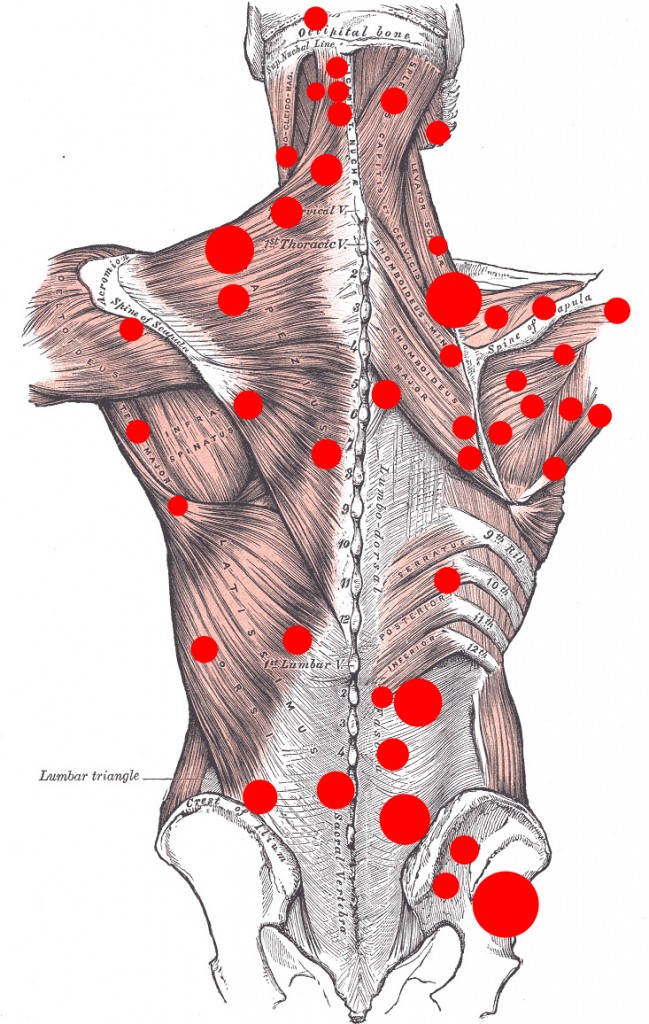
A display of potential trigger point areas

My understanding is that adhesions are more the result of damage (contact, improper muscle under-/over- use, injury, surgery, etc.), and that trigger points are more neurally mediated (excessive or inappropriate neural input to a localized area). In both cases, an adhesion or trigger point will pull on or otherwise affect surrounding areas in the presence of movement. This is ONE of the driving factors behind the idea that symptomatic areas aren’t always the cause of the problem.

Years ago, Michael Boyle provided a great illustration of this at a seminar one year where he put a band around someones neck and lightly pulled. “Where do you feel the pain?” “On the side of my neck.” General wisdom would say to ice, massage, and stretch the area. In reality, these methods may bring temporary relief, but as long as there’s a rope around your neck, it’s going to hurt. You could save yourself the ice, massage and stretching by just removing the rope (in this example).

For something a little less abstract, let’s consider that the glutes and/or TFL can become restricted and increase the tension on the IT Band.
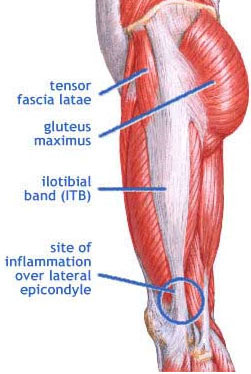
This scenario, which is pretty common in athletes from various sports, can lead to a host of painful symptoms including lateral knee pain (one of the locations of this potential pain is pictured above). Some manual therapy work to the TFL and glutes will release the tension and therefore return the athlete to a pain-free condition.

In many cases, adhesions and trigger points, which can be thought of as “soft-tissue restrictions” present because of positions we hold our bodies in for prolonged periods of time. For that reason, many people will have restrictions and common areas (e.g. hip flexors, pec major and minor, lats, cervical extensors, etc.). Because of the diagonal and rotational nature of the skating stride and the lateral nature of crossover patterns, hockey players tend to have pretty predictable restrictions in the hip rotators and the adductors.
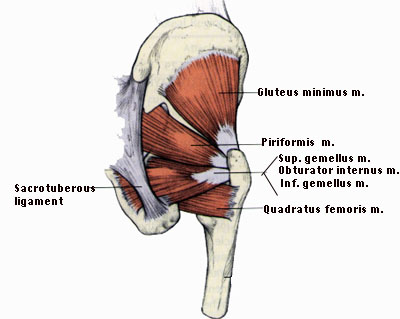
Digging a lacrosse ball into these muscles will make most players yelp
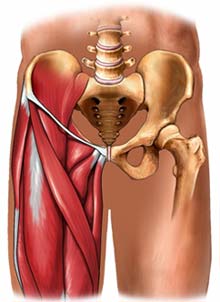
The high, inner area can become especially problematic for hockey players

Both of these pictures are especially illustrative of how adhesions between any two structures or triggers points in any one structure could affect surrounding areas, as optimal movement is dependent upon proper extensibility of and gliding upon these individual and collective muscles. By the time hockey players are in high school, the muscles around their hips’ are completely gunked up. This will impede blood flow, lead to abnormal firing patterns, and generally increase the amount of resting tension put on surrounding structures. In other words, the associated changes aren’t just mechanical, they’re also circulatory and neural. Maybe more importantly, addressing these restrictions will make the athlete FEEL better.

With a basic understanding of what the restrictions are and the effect they can have on the body, the question becomes how to get rid of them. Adhesions tend to break up in response to localized pressure driven along the direction of the adhesion.Β  Trigger points, on the other hand, tend to respond better to sustained pressure in one location. Using foam rollers, medicine balls, lacrosse balls and other implements to perform self-myofascial release work (to address these restrictions) is a great way to minimize the risk of these turning into more substantial problems. With that said, these methods aren’t nearly as specific or effective as getting worked on by an experienced manual therapist.

Check out the video below of Cole Hamels talking about his experience working with my friend Dr. Michael Tancredi:


Cole Hamels Explains Benefits Dr. Tancredi Chiropractic Care from Harry Scheid on Vimeo.

The thing I like the most about this video is that it’s straight from the athlete’s mouth, meaning it’s not overly scientific. If players started getting regular work done from an Active Release practitioner or a great massage therapist like my friend Craig Bohn at Hockessin Athletic Club, I think a lot of the chronic groin and hip flexor strains and sports hernias that we’re seeing through the high school, college, and pro levels would start to disappear. I know our athletes have had tremendous success in warding off these injuries (and returning from soft-tissue injuries sooner) as a result of getting regular soft-tissue work done.

Whether you perform self-myofascial release work or go see an experience manual therapist is secondary in importance to not neglecting soft-tissue quality altogether. Because it can be difficult to enforce this stuff on a team-wide basis in most youth programs, it’s up to parents to go buy a foam roller or look up a manual therapist for their son/daughter. It’s well worth the investment; your kids will thank you later!

To your success,

Kevin Neeld

Please enter your first name and email below to sign up for my FREE Athletic Development and Hockey Training Newsletter!



Use CODE: "Neeld15" to save 15%