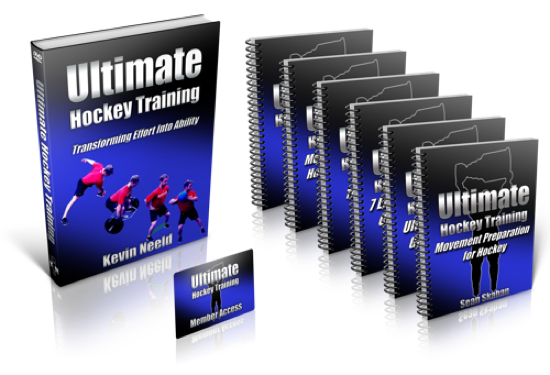
It’s finally here. I won’t drag this out with a long-winded introduction. Ultimate Hockey Training is now LIVE!

Click here to watch the final video and grab your copy today! >> Ultimate Hockey Training

In the last week I’ve released two videos on Transitional Speed Training for Hockey and Hockey Conditioning. In these, I’ve exposed many of the myths of hockey-specific training for speed and conditioning, and outlined a couple HIGHLY effective training techniques that are guaranteed to help you improve your game on the ice. Today, the third and final segment is available. This final video identifies all of the ESSENTIAL components of a comprehensive hockey training program. In this video, you’ll discover:

  1. How training certain qualities can lead to significant improvements in seemingly unrelated qualities (strength training improves conditioning?)
  2. 12 must-have components of a COMPREHENSIVE hockey training program
  3. The TRUE goal of off-ice training
  4. 6 variables that need to be manipulated throughout the year to optimize training progress
  5. The ULTIMATE resource to help add years and cheers to your career!

Click here to watch >> Ultimate Hockey Training

Ultimate Hockey Training also comes with 7 outstanding bonuses from some of the top minds in hockey training and sports performance and is available for an EXTREMELY (dare I say, excessively) reasonable investment. Click the link below and pick up your copy today!

Click here >> Ultimate Hockey Training

To your success,

Kevin Neeld

P.S. If you haven’t already, you will be asked to register with your name and email to access the video. This is necessary ONLY to let you know about the other videos in this series and when my book is officially released (you’ll be glad you found out first!); you won’t be contacted for any other reason; nor will you receive duplicate copies of my newsletter. And as always, you’re free to unsubscribe at anytime!

Please enter your first name and email below to sign up for my FREE Athletic Development and Hockey Training Newsletter!

I’m excited about this week. Last week all the youth teams I train killed it. They worked hard, they moved well, they listened, and they helped each other. I couldn’t ask for anything more. It creates a positive atmosphere, for them and for me, and ultimately creates an environment that culminates success. Watching players develop, both as individuals and as a team, is what makes me jump out of bed every morning. The start of the new week also means that we’re only days away from the release of my new book Ultimate Hockey Training!

Last week I released a free hockey training video outlining my transitional speed training system for hockey players. The video went through:

  1. Common problems in current hockey speed training
  2. 3 types of hockey speed and off-ice training strategies for each
  3. Why “agility” training will NOT make you a faster skater
  4. How speed training fits into a comprehensive off-ice training program
  5. How to alter your speed training depending on the time of year

I got a lot of great feedback about the video from a wide range of people-hockey players, coaches, trainers, etc. Today, I’m releasing another video on the component of hockey training that I get the 2nd most questions about: conditioning. Like speed training, conditioning is an essential part of off-ice hockey development, but is often performed in a way that doesn’t produce on-ice gains. There is always a transfer process from off-ice training to on-ice performance, but the goal is to provide the most appropriate stimulus off the ice to facilitate the most pronounced on-ice gains. Unfortunately, many off-ice conditioning practices can actually impair development more than promote it.

Click here to watch the video >> Hockey Conditioning

In this video on hockey conditioning, you’ll discover:

  1. 5 most important considerations for off-ice hockey conditioning
  2. 3 primary mechanisms that fatigue can limit your performance
  3. The most overlooked component of hockey conditioning
  4. A 3-stage progression for quickly improving this incredibly important quality!

Check out the link below to access the video. And please continue to spread the word about the videos by forwarding this link to your friends or posting a link on Facebook and Twitter. I appreciate the help and feedback!

Click here to watch the video >> Hockey Conditioning

To your success,

Kevin Neeld

P.S. If you haven’t already, you will be asked to register with your name and email to access the video. This is necessary ONLY to let you know about the two other videos in this series and when my book is officially released (you’ll be glad you found out first!); you won’t be contacted for any other reason; nor will you receive duplicate copies of my newsletter. And as always, you’re free to unsubscribe at anytime!

Please enter your first name and email below to sign up for my FREE Athletic Development and Hockey Training Newsletter!

I posted this yesterday, but wanted to put it up again in case you missed it. The feedback I’ve gotten on this hockey speed training video has been fantastic. Click the link below and check it out for yourself!

Click here to watch now >> Speed Training for Hockey

From yesterday…

And today, it begins.

Almost a year ago exactly, I started writing what I intended to be the most comprehensive hockey training resource ever created. I wasn’t interested in developing just another basic off-season program or a theoretical manual on hockey physiology. I wanted to put my entire system on paper: age-specific hockey development recommendations, components of a comprehensive program, year-round programming recommendations, linear and parallel exercise progressions and regressions, and more. It took a long time. I edited, rewrote, edited, re-edited, rewrote, and edited again until everything was just right. And when all the dust finally settled, I can say that I’m more proud of this book, Ultimate Hockey Training, than I am of anything else I’ve ever created, and I can’t wait to share it with you.

A preview of things to come…

Next week I will be officially releasing Ultimate Hockey Training to the public. To start getting you excited, I recorded three videos on various components of hockey training. The first covers a topic that I receive more questions on than any other: Speed Training.

Click here to watch now >> Speed Training for Hockey

In the video, you’ll discover:

  1. Common problems in current hockey speed training
  2. 3 types of hockey speed and off-ice training strategies for each
  3. Why “agility” training will NOT make you a faster skater
  4. How speed training fits into a comprehensive off-ice training program
  5. How to alter your speed training depending on the time of year

Click the link below to check out the video now!

Click here to watch now >> Speed Training for Hockey

Videos like this take a ton of time and energy to record. All I ask in return is that you help spread the word about the information. After you watch the video, please forward this link along to every hockey players, parent, coach, trainer, and strength coach that you think will benefit from the information! You can email it out, post it on Facebook, tweet it, or all of the above. Whatever you prefer! Thanks in advance, and enjoy the video!

To your success,

Kevin Neeld

P.S. As a fair warning, you will be asked to register with your name and email to access the video. This is necessary ONLY to let you know about the two other videos in this series and when my book is officially released (you’ll be glad you found out first!); you won’t be contacted for any other reason; nor will you receive duplicate copies of my newsletter. And as always, you’re free to unsubscribe at anytime!

Please enter your first name and email below to sign up for my FREE Athletic Development and Hockey Training Newsletter!

And today, it begins.

Almost a year ago exactly, I started writing what I intended to be the most comprehensive hockey training resource ever created. I wasn’t interested in developing just another basic off-season program or a theoretical manual on hockey physiology. I wanted to put my entire system on paper: age-specific hockey development recommendations, components of a comprehensive program, year-round programming recommendations, linear and parallel exercise progressions and regressions, and more. It took a long time. I edited, rewrote, edited, re-edited, rewrote, and edited again until everything was just right. And when all the dust finally settled, I can say that I’m more proud of this book, Ultimate Hockey Training, than I am of anything else I’ve ever created, and I can’t wait to share it with you.

A preview of things to come…

Next week I will be officially releasing Ultimate Hockey Training to the public. To start getting you excited, I recorded three videos on various components of hockey training. The first covers a topic that I receive more questions on than any other: Speed Training.

Click here to watch now >> Speed Training for Hockey

In the video, you’ll discover:

  1. Common problems in current hockey speed training
  2. 3 types of hockey speed and off-ice training strategies for each
  3. Why “agility” training will NOT make you a faster skater
  4. How speed training fits into a comprehensive off-ice training program
  5. How to alter your speed training depending on the time of year

Click the link below to check out the video now!

Click here to watch now >> Speed Training for Hockey

Videos like this take a ton of time and energy to record. All I ask in return is that you help spread the word about the information. After you watch the video, please forward this link along to every hockey players, parent, coach, trainer, and strength coach that you think will benefit from the information! You can email it out, post it on Facebook, tweet it, or all of the above. Whatever you prefer! Thanks in advance, and enjoy the video!

To your success,

Kevin Neeld

P.S. As a fair warning, you will be asked to register with your name and email to access the video. This is necessary ONLY to let you know about the two other videos in this series and when my book is officially released (you’ll be glad you found out first!); you won’t be contacted for any other reason; nor will you receive duplicate copies of my newsletter. And as always, you’re free to unsubscribe at anytime!

Please enter your first name and email below to sign up for my FREE Athletic Development and Hockey Training Newsletter!

Last week I posted two discussions on the status of youth hockey development that pointed out some commonly held misconceptions, areas that need revamping (or at least have room for improvement) and some of the barriers that the hockey community will face in pursuing a more effective model. If you missed those posts, I highly encourage you to go back and read them before continuing on here today. Check out the links below:

Hockey Development Post 1 –>> The State of Youth Hockey

Hockey Development Post 2 –>> Hockey Development Resistance

Those discussions were primarily inspired by my experiences in learning more about USA Hockey’s American Development Model. If you haven’t yet, I recommend heading over to their site and reading more about it: ADM Kids

Somewhat to my surprise (I thought I’d get more hate mail), both posts were really well received and a few people responded with great comments. One in particular had to do with the apparent discrepancy between the recommendation that youth players participate in multiple sports and activities in order to achieve elite level status later down the road, and the idea that players need to spend a substantial amount of time developing their sport-specific skills in order to perfect their abilities. This latter idea is referred to as the 10,000 hour rule, as some research has shown that it generally takes about 10 years and 10,000 hours of purposeful practice for an individual in ANY field to achieve expert mastery.

It’s easy to interpret the 10,000 hour rule as meaning that hockey players should focus ALL of their athletic time on the game of hockey to accumulate as many “practice hours” as possible at younger ages. Unfortunately, this idea is often misunderstood because “practice” is never adequately defined, and the idea of progressions and age-/developmental stage specificity is often lost. Briefly, I think it’s important to note that taking a young kid and submerging them into a single activity with the intention of making them one of the world’s elite has TREMENDOUSLY negative physical and psychological consequences. For our purposes today, however, I want to focus on what constitutes practice within the 10,000 hour rule paradigm.

In order to understand what counts as practice, we need to have an understanding of what drives performance. At a minimum, it’s important to understand that there are physical and psychological components. The lists below are slight expansions on these ideas.

Physical Components of Performance

  1. Technical Skill
  2. Athletic Ability
  3. Durability

Psychological Components of Performance

  1. Hockey Sense
  2. Mental Preparation
  3. Grit

Again, these lists are far from exhaustive, but are meant to start directing your thoughts as to lesser recognized components of performance and therefore of lesser recognized necessities of practice. So for a young hockey player looking to accumulate as much practice time as possible, what should they do?

10,000 Hours of Hockey Practice

  1. Structured hockey practice
  2. Unstructured hockey (pick-up)
  3. Watching game film of personal performances
  4. Watching practices, games, and/or film of players at the next level up
  5. Playing other sports
  6. Off-ice training

This is a pretty short list, but can be branched out to a wide variety of activities. Structured practice will help players develop technical skills, hockey sense and, at the appropriate age, their tactical awareness. It’s important to recognize that having 100 hours of practice won’t lead to 100 hours of benefit if the players spend the majority of their time standing in lines or staring at the ceiling while the coach draws on the whiteboard. This is one of the strongest points of USA Hockey’s recommendations for players at younger levels and one of the primary benefits of unstructured play-the kids actually get to touch a puck and move around on the ice! Unstructured play will also help develop technical skills and hockey sense, but increases the emphasis on fun (this doesn’t mean not COMPETING, it just means that the competition is for pride instead of the mixed emotions of pride, not letting your coach down, and not getting “Vince Lombardied” by your parents on the ride home from the rink), and ultimately fuels a kid’s passion for the game. Watching game film and next-level hockey will help players develop hockey sense, tactical skills, and components of technical abilities secondary to visualization. In other words, hockey players can improve their performance simply by analytically WATCHING players at the level above theirs.

Playing other sports and off-ice training serve some common and quite supplementary purposes. First, playing other sports exposes kids to different coaching methods, different social groups, different physical stresses, and emphasizes different athletic components. This helps develop highly coachable athletes with lots of friends, that are further from injury threshold and have more advanced athletic capacity. Simply, there is NO wrong here. To provide an athletic ability example (because that’s all the crazy parents and coaches will care about), playing baseball is “hockey-specific training” at younger ages. It teaches rotational power, hand-eye coordination, first step quickness, rapid reaction, and athletic body positions, all things that transfer. Similar arguments could be made for the benefits of soccer, lacrosse, basketball, football, and tennis for hockey. These other sports also provide more opportunities for young athletes to experience success, which is a primary driver in confidence. Also, simply because the “hockey player” is NOT playing hockey, they are maintaining a safe distance from their injury threshold due to overuse/under recovery (e.g. my stress overflow “theory”). Playing competitive hockey year-round is making old men out of young players; the insane number of players we see with chronic hip flexor and adductor (groin) injuries is evidence of a flawed development system. These nagging injuries become career limiting/ending for some, and experience/potential fulfillment limiting in everyone. Referring back to the lists above, it COMPROMISES durability.

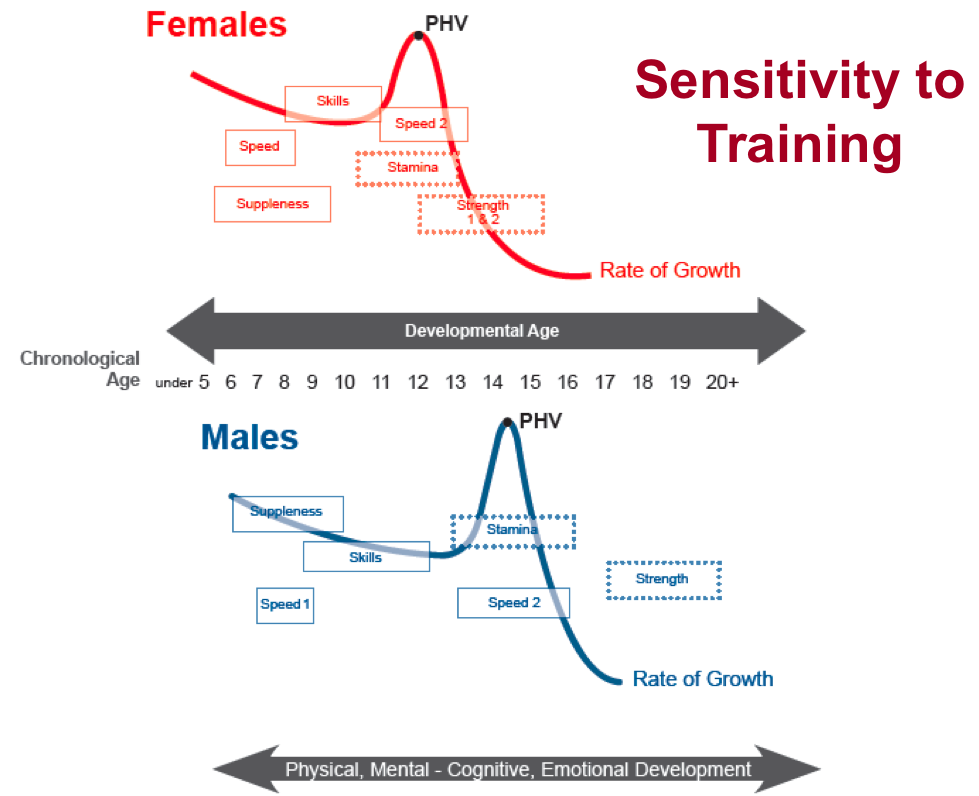
Regarding off-ice training, even BASIC off-ice activities like skipping, hopping, holding single-leg stance, etc. will help improve coordination, rythmicity, balance, and other motor qualities that will positively influence hockey. The nature of the off-ice training should develop in accordance with the physical quality sensitive periods.
Take Home Message
The 10,000 hour rule holds merit in long-term hockey development. If the goal is to achieve elite level status, it’s going to take time and hard work. Throughout this process, it’s important to broaden our horizons on what is considered practice and not ignore age-specific recommendations. 1,000 hours of practice for a 10-year old should NOT look like 1,000 hours of practice for a 20-year old. Seeking to build advanced hockey-specific skill sets on a narrow foundation of proper movement is a recipe for disaster. They call it long-term player development for a reason. Follow age-appropriate recommendations and be patient; excellence is inevitable.

To your success,

Kevin Neeld

P.S. I have a really special announcement later this week so make sure you check back!

P.S.2. If you think other players, parents, coaches, friends, family members, or co-workers would benefit from this information, please pass it along!

Please enter your first name and email below to sign up for my FREE Athletic Development and Hockey Training Newsletter!

Use CODE: "Neeld15" to save 15%