
A couple days ago, I outlined a terrific review article on what factors limit repeat sprint performance. If you missed it, you can check it out here: Hockey Conditioning: Understanding Fatigue. Repeat sprint performance, as the authors of that review defined, includes repeated maximum intensity efforts of <10s with <60s rest in between. Most people reading this are probably familiar with the idea that most of you reading this are familiar with the fact that an average hockey shift will fluctuate between ~30-75s depending on the position and level. What many people overlook, however, is that these shifts don’t involve 100% efforts the entire time the player is on the ice. Even the average excessively hyper 11-year-old hopped up on the donut holes and Monster their parents bought them as a pre-game meal couldn’t go 60s at this intensity.

If your son looks like this, he probably doesn’t need another energy drink.

There are inherent physiological mechanisms that will begin to limit performance if a certain intensity is maintained for prolonged periods of time (e.g. 10+ seconds). Elite level hockey players are very efficient at managing their fatigue during a shift. They intersperse periods of all-out efforts with periods of gliding, lighter skating, and repositioning, and when this isn’t possible, they keep their shift short to minimize the accumulated fatigue. Most don’t know they do this; it feels natural to them. For our purposes, the most important thing to recognize here is that a 45s shift is comprised of several significantly shorter high intensity efforts separated by periods of lower intensity efforts and/or stoppages. For this reason, understanding the mechanisms underlying performance decrements in repeat sprint ability is essential, as this is EXACTLY the quality hockey players want to train to ensure that they’re as fast at the start of the game as they were at the beginning.

Today, I want to explore the companion research review article from Bishop et al., 2011, titled “Repeated-Sprint Ability – Part II: Recommendations for Training”.  Before we get into it, I think it’s important to point out that recommendations on how to improve ANY physical quality always need to be kept in perspective. There are psychological, physiological, and training “age” considerations, but even within any combination of those cohorts, there are always appropriate times in the hockey calendar and obligatory progressions leading up to any given training practice; this is especially true of conditioning. My hope is that you won’t simply read “this is the best way to improve repeat sprint ability” and just use the recommendations from this article repeatedly year-round. This will invariably lead to decrements in OTHER physical qualities, which will negatively effect on-ice performance. Everything in training needs to be kept in context.

Training Recommendations to Improve Repeat Sprint Ability (RSA)
The authors kicked off the article by pointing out that having a “good” RSA is more about having a high average sprint speed, than just a low drop-off. In the case of the latter, a marathon runner would have a relatively low drop-off, but their starting speed wouldn’t be very fast, and therefore not adequate within the context of hockey speed. This, again, simply illustrates the trade-off between maximum speed and maximum endurance. Below is a list of take-home points from the article that help explain which types of training will help improve RSA. If you haven’t already, please read this article (Hockey Conditioning: Understanding Fatigue) before continuing on with the list below, as these points may not make sense without understanding how they affect one or more of the RSA fatigue mechanisms!

  1. A high-intensity interval training protocol of 6-12 x 2 mins of work at 100% VO2Max, followed by 1 minute of rest can significantly improve PCr (phosphocreatine) resynthesis/replenishment during the first 60s of recovery following a high-intensity effort. This is especially pertinent in light of the fact that NO changes in the rate of PCr resynthesis have been found following an interval training protocol of 8 x 30s of work at 130% VO2Max followed by 90s of rest, a protocol of 15 x 6s of all-out sprinting followed by 60s of light jogging, or a protocol of 4-7 all out 30s efforts followed by 3-4 minutes of rest. The authors pointed out that some of these results may be explained by the fact that other studies used a 3-minute post-exercise PCr check-in point, which may miss the initial changes in a more rapid resysnthesis. That said, the finding of improved PCr resynthesis in the first 60s following the above protocol is an interesting finding.
  2. Changes in enzymes that affect anaerobic glycolysis (such as phosphofructokinase and phosphorylase) are greater following a training protocol that involves repeated 30s sprints compared to one that involves repeated 6s sprints or continuous training.
  3. Changes in glycolytic enzymes are also greater following high-intensity intervals that are followed by long rest intervals (10-15 minutes) compared to shorter rest intervals (3-4 minutes), probably as a result of higher peak blood and muscle lactate levels with the longer recovery. Taken together, these results suggest the most optimal way to develop anaerobic performance is to train using 20-30s all-out intervals with ~10-minute rest intervals.
  4. There is not a linear relationship between VO2Max and various RSA fatigue measures, indicating that the goal should be to train for an “optimal” VO2Max, not necessarily a “maximal” V02Max.
  5. Interval training at approximately 100% VO2Max leads to larger increases in VO2Max than continuous training matched for total work, but only if the continuous training is below ~60% VO2Max, otherwise the differences are negligible.
  6. Interval training has the added benefits of augmenting other desired adaptations, such as the rate of PCr resynthesis and muscle buffer capacity. The authors recommend performing high-intensity intervals at ~80-90% VO2Max with rest periods that are shorter (e.g. 1 minute) than the work periods (e.g. 2 minutes).
  7. A high-intensity interval training protocol of 6-10 x 2 minutes work at 120-140% of the lactate threshold followed by 1 minute of rest increases muscle buffer capacity, but 30 minutes of continuous training at 80-95% of the lactate threshold does not.
  8. Excessive accumulation of H+ during training may actually have a detrimental effect on adaptations to the pH regulatory systems within the muscle. This could result from interval training at intensities >100% VO2Max.
  9. Taken together, these results imply that the best way to improve muscle buffer capacity is to train using high-intensity intervals at ~80-90% VO2Max with rest periods that are shorter than the work periods (e.g. 2 minutes on, 1 minute off) to ensure that the working muscles are being trained in a moderately lower pH environment.
  10. High-intensity interval training leads to better improvements in muscle buffer capacity and Na+/K+ pump isoform content compared to repeated-sprint training, which has shorter sprint durations at higher intensities with longer rest periods.
  11. However, repeated-sprint training leads to better improvements in best sprint time and mean sprint time compared with interval-based training.
  12. Interestingly, although not overwhelming, 10-weeks of training 2x/week using small area soccer games (2-4  reps of 2.5-4 minute games) lead to a ~4% improvement in best and mean sprint times during an RSA test, which was the same as an interval training protocol of 12-24 x 15s of work at 105-115% VO2Max followed by 15s of rest.
  13. A resistance training protocol involving 2-5 sets of 10-15 maximal repetitions lead to comparable increases in mean work performed during a RSA test (~12%), compared to a high-intensity interval training program (~13%), and a sprint training program (~12%). Resistance training also lead to a ~8-9% increase in first-sprint performance, and ~20% improvement in the sprint decrement score.
  14. Greater improvements in RSA have been founding using resistance training protocols that involve 20s of rest between sets, compared to 80s of rest, despite less improvements in maximum strength (20 vs 46%), probably due to the increases in metabolic byproduct accumulation with the shorter rest periods.

Take Home Points
As I mentioned in the intro, it’s always important to understand exactly what physical quality you’re seeking to improve with your training, and to put that within context of the whole training program. The evidence above suggests that one of the better ways to improve RSA is through training with a protocol of 6-10 x 2 minutes of work at ~80-100% VO2Max followed by 1 minute of rest, and with resistance training exercises using relatively high reps and short rest intervals. These things lead to improvements in the rate PCr resynthesis, glycolytic enzymes, muscle buffer capacity, and V02Max, all of which should benefit RSA performance.

While hockey is a very lactate-driven sport, I think there is much to be gained from maximizing the alactic and aerobic systems to minimize the lactic load associated with any given shift. Because the anaerobic-lactic system is associated with significant decrements in performance and longer recovery times, utilizing the “surrounding systems” in the anaerobic-alactic and aerobic systems to the greatest extent possible will likely allow the player to maintain a high level of performance for a longer period of time. This will not only translate into finishing a period strong, it will also translate into finishing a game and even a series of games strong. With this in mind, the improvements in PCr resynthesis (which can be considered a “fuel” for the anaerobic-alactic system) and VO2Max (which is a decent marker of aerobic capacity) are especially appealing.

Ultimately, it’s elite-level conditioning that allows players to exhibit their elite level skill, consistently.

To your success,

Kevin Neeld

P.S. Don’t forget to check out Ultimate Hockey Training, which covers year-round hockey conditioning principles in detail and provides a ton of implementable training progressions!

Reference:
Bishop, D., Girard, O., & Mendez-Villaneuva, A. (2011). Repeated-Sprint Ability – Part 2: Recommendations for Training. Sports Medicine, 41(9), 741-756.

Please enter your first name and email below to sign up for my FREE Athletic Development and Hockey Training Newsletter!
At the end of last week, I did an interview on various hockey training and player development topics with my friend Brian St. Pierre. In the interview, we covered:

  1. My background and how I got involved with training hockey players
  2. Why hockey players are the best athletes to train
  3. Common issues I see in youth and adult hockey players
  4. The integration between performance enhancement and injury prevention
  5. Why youth hockey coaches in the US need to start paying attention to the evidence around us of a failed long-term development system and start taking notes on USA Hockey’s new ADM
  6. What most people don’t know about the Soviet’s “hockey schools”
  7. How I assess a new hockey player
  8. The most common hip limitation I see in all hockey players and how it affects their stride
  9. Why Ultimate Hockey Nutrition is the single best nutrition resource for hockey players ever created

As you can tell, we went through a lot in this interview. Take a few minutes to read through it and if you have any questions, post them below!

Read the interview here >> Ultimate Hockey Training – The Interview

To your success,

Kevin Neeld

Please enter your first name and email below to sign up for my FREE Athletic Development and Hockey Training Newsletter!
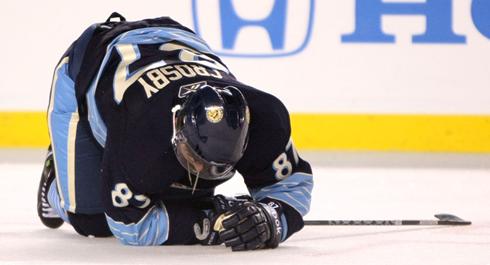
Concussions have been a hot topic over the last two years in the NHL. Not in small part to Sidney Crosby’s concussion, more attention is now being paid awareness, prevention, and more conservative return-to-play guidelines.

Long-term concussion symptoms are becoming a more prevalent problem

Concussions are far from a simple injury. It’s the underlying complexities in injury mechanism AND predisposition that makes concussions so hard to treat. As I’ve mentioned in the past (see Sidney Crosby’s Concussion), a large component of preventing things from getting worse than they need to is following a complete return-to-play sequence. Given the alarming statistic that 92% of repeat-concussions occur within 10-days of the original incident, it would seem logical that a bare minimum precaution should be to keep players out for 2 weeks following ANY concussion suspicion. I can see the hesitation in adopting this practice as a norm, but the reality is that the amount of development and exposure that can occur within this time frame is negligible, especially when put in the light of the potential short- and long-term consequences of suffering a repeat head injury.

As my friend Maria Mountain recently wrote (see A Rant about Concussions in Hockey), it’s bizarre that the phrase “concussion-like symptoms” seems to frequent hockey media channels now. This is a suspicious description given both the diverse nature of concussion symptoms (which can range from those comparable to tension headaches to those resembling vertigo), and the lack of clarity in diagnosis in general. How does someone suffering concussion-like symptoms differ from someone with a concussion? Is concussion-like symptoms simply being used as an umbrella diagnosis to put a name on something not medically understood? If concussion-like symptoms are being used as a diagnosis for those exhibiting symptoms that don’t present with observable brain trauma and/or have relatively normal ImPACT scores, then it’s important to look at some of the underlying mechanisms that dispose athletes to these symptoms.  There are certainly a lot of questions that remain to be answered regarding concussions, but with the increased attention being paid to the associated consequences of impact and adaptations to the brain itself, I thought it would be beneficial to discuss some of the lesser known underlying causes of “concussion-like symptoms” that may be related to or exacerbated by impact, but aren’t necessarily a brain injury.

Mechanisms of Concussion-Like Symptoms
Below are three mechanisms that can cause concussion-like symptoms, that are not associated with a brain injury:

  1. Poor Visual Tracking
  2. Sub-occipital nerve impingement
  3. Altered sensory input secondary to a loss of neutrality

Poor Visual Tracking
I was first introduced to this idea by Dr. Josh Bloom at Pete Friesen’s Physio-Fitness Summit a couple years ago. Dr. Bloom pointed out that in players with ongoing symptoms, or those that do not seem to be making progress, it is often the case that they have an eye that is not tracking properly. In a sort of ocular constraint-induced movement therapy, the employed strategy involved covering the properly functioning eye and training the eye that did not track optimally. He noted that in some cases, symptoms resolved almost immediately (within a single session) and had no recurrence. Whether ever player has this experience or not, it’s certainly worth looking into. The idea that a player may have ongoing symptoms that they think are related to a concussion may cause inappropriate limitations in their training and practice and a delayed return to play.

Sub-Occipital Nerve Impingement
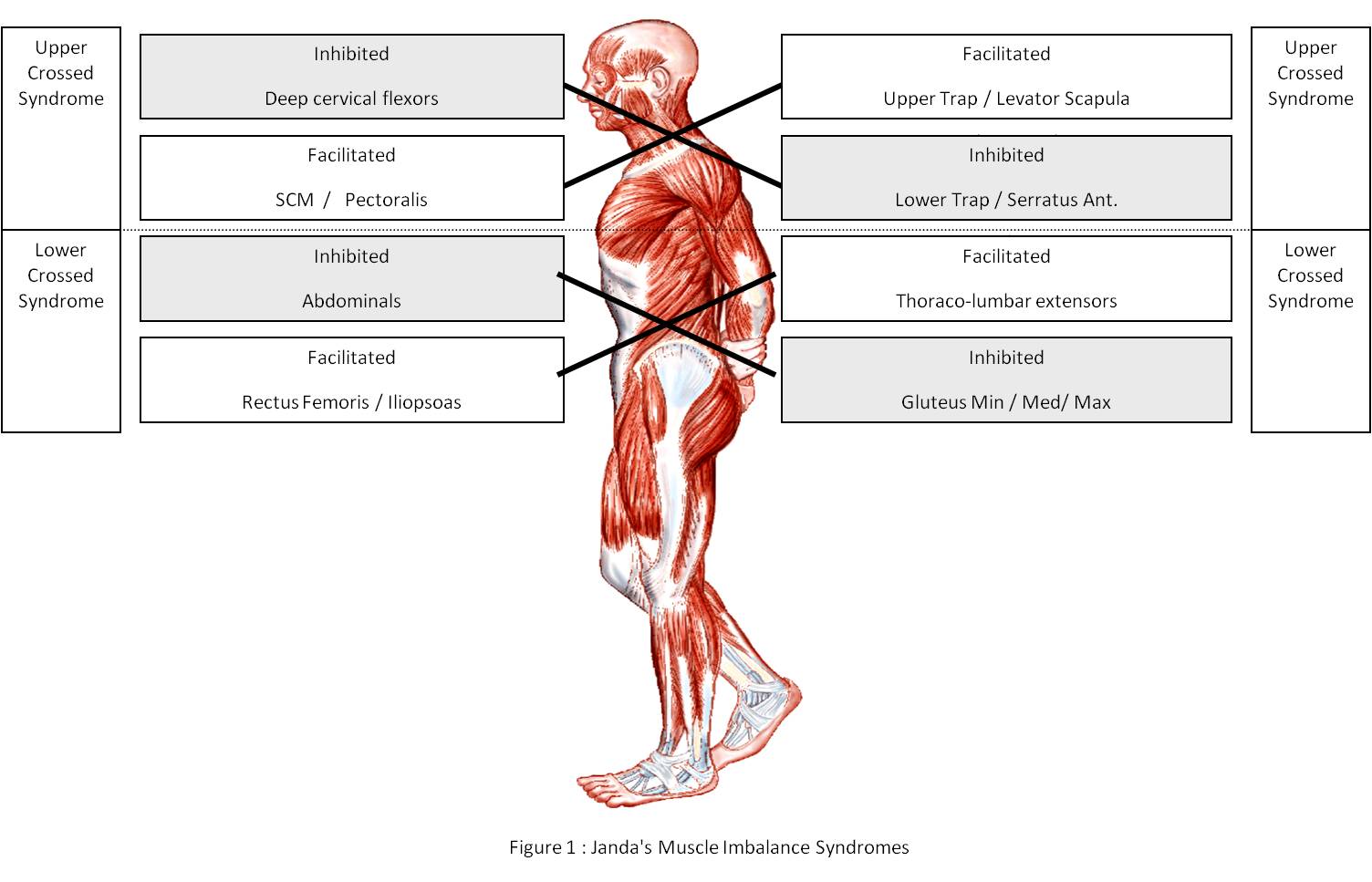
Over the Summer, my friend Ned Lenny (physical therapist based in Cherry Hill, NJ if you’re local) and I were talking about postural adaptations that we see in both the hockey and general populations, and about how the hockey adaptations were typically in-line with a more extreme version of what we saw in the general population. In other words, the postural changes we see in most people that result from sitting too much and moving too little are significantly worse in hockey players. In general, these adaptations can be described by Janda’s upper and lower crossed syndromes.

Most relevant to the concussion discussion, the adaptation that most directly influences these symptoms is a forward head posture, or more directly, a posterior rotation of the occiput on the atlas.

Ned pointed out that hockey players spend a substantial amount of time sitting on the bench, in cars/buses/airplanes, playing video games at home, and after many practices and games, they hop on a stationary bike. Going for a post-skating bike ride isn’t inherently harmful; in fact there is some value in restoring a more optimal autonomic nervous system balance. The kicker is that players hop on the bike and immediately look for the TV, which is usually posted above their heads somewhere, forcing them to rotate their head further back. Living in this position of posterior cranial rotation predisposes them to suffering symptoms related to impingement of the local nerves when forced further into posterior rotation, which can result from contact of varying severity. This might be why you see some players with prolonged symptoms after taking what looked like a relatively innocent hit.

The key to minimizing this predisposition is to improve the player’s posture and awareness of cervical position. We spent a lot of time last off-season emphasizing a “packed neck” position with all our hockey players at Endeavor and continue to emphasize this position now with our in-season groups. In reality, this isn’t an injury prevention strategy as much as it’s just the right way to train, but it can feel a bit unnatural for players at first.

Chicks dig guys with a good neck pack

Altered Sensory Input Secondary to a Loss of Neutrality
This is a very complex way of saying that humans are inherently asymmetrical and have tendencies to drift toward predictable positions of non-neutrality. This concept stems from my ongoing apprenticeship of the Postural Restoration Institute information, and has profound implications for athletes and non-athletes alike. Over the last week at Endeavor, I’ve assessed a dozen people that all had NO adduction on their left side, but had full adduction on their right side. For hockey players, this pattern will compromise their stability and skating power, and it’s likely that a player will feel more comfortable crossing over one way (usually to the right) than the other. Failing to address this pattern can lead to a number of compensations of varying severity. Luckily, neutrality can be restored pretty easily using a number of specific breathing techniques.

Importantly, these human tendencies aren’t limited to the hips, but affect everything from the position of the foot to the position of the temporal bones. Specific to the cranial region, it’s worth noting that the common adaptations in the spine lead to a non-neutral head orientation. Because the body naturally seeks a position where the eyes are horizontal, there are compensations that occur through the spine, bones of the head, and the ocular system, all of which will alter the related sensory input, and can lead to feelings of dizziness or general feelings of spatial instability. I realize this is an abstract concept, but it’s not one to be overlooked. At PRI’s Advanced Integration course a couple weeks back, Ron Hruska discussed what he referred to as “ocular scoliosis” and noted that restoring neutrality can actually change a person’s eye prescription. The eyes are among the body’s most powerful sensory organs. Restoring a more neutral position can lead changes in sensory “symptoms” stemming from multiple sources.

Take Home
The major take home from this discussion is that it’s possible to have symptoms resulting from contact that resemble those of a concussion that have an underlying cause not related to brain impact. Because all of the above mechanisms have relatively quick fixes, they’re certainly worth exploring if you have ongoing symptoms AND should be attended to regularly in the interest of minimizing concussion risk in the first place. With the medical team that Sidney Crosby has put together, you would hope that these, and all other underlying factors, are also being addressed.

That’s a wrap for today. Pass this along to other players, parents, and coaches, or anyone else you think may benefit from learning more about concussion prevention!

To your success,

Kevin Neeld

Please enter your first name and email below to sign up for my FREE Athletic Development and Hockey Training Newsletter!
Back on track with another update on what’s been going on in the world of hockey strength and conditioning. Since my last update, I’ve added 6 articles to my site. If you missed them, you can check them out at the links below:

  1. Hockey’s Original Recovery Drink
  2. Hip Stabilization Exercises
  3. Current Ice Hockey Research
  4. An Updated Look at Femoral Acetabular Impingement (FAI)
  5. The Most Valuable Lesson I’ve Ever Learned
  6. Energy Systems Training for Hockey

There have also been a lot of great content additions to HockeyStrengthandConditioning.com over the last few weeks. Check out what you’ve been missing!

Hockey Training Articles

  1. Off-Ice Skating Strength Exercises from Mike Potenza
  2. Rotary Power Demands for Hockey Players from Anthony Donskov
  3. My Favorite Set and Repetition Schemes from Darryl Nelson

Hockey Training Programs

  1. 2011 Off-Season Phase 3 Strength Training from Sean Skahan
  2. Christmas Break Training from Darryl Nelson
  3. Clarkson In-Season Phases from Jaime Rodriguez

Training Videos

  1. Skater Crossover Step Lunge from Mike Potenza
  2. Athlete with Bilateral CAM Impingement from me

As you can see, we’ve had a diverse mix of quality content over the last few weeks. Potenza’s videos demonstrate “hockey-specific” exercises that are valuable options for youth programs looking to improve body awareness and skating technique OFF the ice and without equipment. I’m glad Darryl added their holiday break program, as I think it’s timely AND illustrates that the development process is ongoing! This isn’t the time for me to get on my soap box, but we’ve all seen players that work their ass off in the off-season and then pack it in and don’t train at all during the year. In this case, most holiday breaks verge on a month, which is long enough to have a substantial detraining effect if not handled correctly. Darryl’s program also demonstrates the need to make things simple for players when they’re out training on their own, a lesson that also applies to coaches working with an unfavorable coach-to-athlete ratio.

If you haven’t seen the video I posted of the athlete I’ve been working with that has bilateral CAM impingement, I suggest you take the time to do so. Recognizing that EVERY athlete will have a varying degree of hip mobility that is 100% structural and will never be improved through stretching, soft-tissue work, or joint mobilizations, will help prevent a lot of unnecessary damage resulting from trying to force athletes through these ranges of motion. As a profession, we need to appreciate that everyone is built differently, and movement standards need to be adjusted accordingly.

It’s always good to have contributions from guys like Jaime Rodriguez, who recently took over as the Head Strength and Conditioning Coach at Clarkson University (he’ll be getting a few Endeavor players over the next couple of years), and Anthony Donskov, who runs a private facility out in Columbus, OH. These are both guys that I look to for new information and better coaching techniques.

Lastly, check out these threads on the forum:

  1. Youth Hockey Practice Times
  2. Boogaard Article
  3. Nike Vapor Strobes
  4. Grit
  5. Set and Rep Schemes

That’s a wrap for today. As always, if you aren’t a member yet, I encourage you to try out Hockey Strength and Conditioning for a week. It’ll only cost $1, and if it’s not the best buck you’ve ever spent, I’ll personally refund you! Plus, getting a glimpse of Potenza’s mustache in the Skater Crossover Step Lunge video is MORE than worth the price of admission!

To your success,

Kevin Neeld

Please enter your first name and email below to sign up for my FREE Athletic Development and Hockey Training Newsletter!

I mentioned yesterday that I’ve spent a substantial amount of time reading through research pertaining to energy system development, GPS tracking, and heart rate variability. In reality, these topics are more interrelated than separate, as they all pertain to what energy systems athletes are relying on, and how much recovery time may be warranted following any give stress load (or work bout).

As you likely know, I’ve been a huge supporter of interval training for hockey players. In general, mantras such as “train fast to be fast” are applicable to hockey. This message is especially important for the players that ONLY condition by going on long jogs or bike rides. However, I think what might get lost in the “pro interval training” message is the need to use this strategy to train different energy systems, or phrased another way, different fuel replenishment systems. In other words, not EVERY interval of EVERY training session is going to be 20-30s of all out effort. Some will be shorter; some will be longer; some will be all out; some will be lower intensity. The desire to over simplify often leads us astray.

Over the last week I’ve been going back through a few hockey training and periodization resources that I haven’t read in several years. It’s interesting to re-read these things. Naturally, as one’s knowledge evolves, so to will their interpretation of any information.

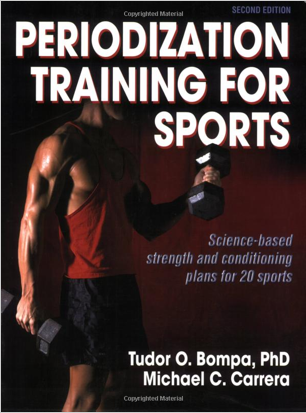
Relevant to energy systems training for hockey, it’s important to recognize that, although hockey is a highly interval-based sport, the contributions of the aerobic system are still quite significant. In fact, in “Periodization Training for Sports” by Tudor Bompa and Michael Carrera, they point out that:

“Acceleration and quick changes of direction are important elements of ice hockey. Training should focus on refining skills and developing power and aerobic and anaerobic endurance.”

They also estimate that energy supply for hockey performance is:

  1. 10% Alactic
  2. 40% Lactic
  3. 50% Aerobic

Periodization Training for Sports

And, as I’ll mention shortly, while I think it’s important to recognize how the game has evolved over the last decade, I still think this information holds a lot of merit. The “aerobic base” that is often cited in periodization literature doesn’t mean that hockey players need to train like marathon runners, but building a strong aerobic system STRATEGICALLY during portions of the early off-season will improve the player’s ability to recover quickly from high intensity bouts AND improve their overall stress capacity.

In order to truly understand the energy contributions of the game, it’s helpful to have an illustration of the intensity and duration dynamics of a typical period and a typical game. One study (from Green et al., 1976) provides information on shift durations and distances covered during a college hockey game and differences in these measures between positions. They found:

  1. Total playing time averaged ~24.5 minutes
  2. ~5,553 meters were covered in the span of the game
  3. An average shift consisted of 39.7 seconds of uninterrupted playing, followed by 27.1 seconds of stoppage, repeated 2.3 times.
  4. Across the three periods, playing time (+17.4%), playing time per shift (+18.7%), playing time between stoppages (+13.3%), and the time taken to resume play after a stoppage (+22.0%) all increased.
  5. The average velocity remained constant over the first two periods and then dropped 5.2% in the 3rd period
  6. The average heart rate was found to be 87-92% of the max value achieved during a VO2 test
  7. Compared to forwards defensemen had more shifts (+26.1%), shorter recovery periods (-37.1%), and played longer (+21.2%).
  8. However, the average defensemen shift was shorter (-7.4%), had less continuous playing time (-10.1%), and took longer to resume play following a stoppage (+12.9%) compared to forwards.
  9. Lastly, on average, defensemens’ heart rates were 10-15 beats/min lower than forwards
  10. Interestingly, the authors also noted that blood lactate increased 457.1% after the first period, but gradually declined over the next two periods!
  11. Goalies showed relatively insignificant changes in blood lactate

Given that this research is now 35 years old, the results should be interpreted with a degree of caution and awareness of the changes in today’s game. That said, research like this is incredibly valuable in understanding the true demands placed on players throughout practices and games. Information in distance traveled and time at specific velocities can be achieved in outdoor sports using GPS systems. Unfortunately, GPS systems aren’t of much use to ice hockey, and other indoor sport. Although, a company called Catapult Sports is pioneering the integration of indoor monitoring systems, and will likely lead the way in providing a technology that governs the future of load and sport-related stress management in hockey. This information is doubly valuable with the addition of monitoring heart rate variability, as this provides information on both the training load AND the individual’s physiological response. If you’re not familiar with heart rate variability, I highly recommend you read David Lasnier’s post Managing Fatigue and Recovery and Joel Jamieson’s free report The End of Group Training.

Joel referenced an interesting study in his energy systems presentation that I had an opportunity to read on my flight back from Lincoln regarding how energy system contribution changes with repeat high intensity interval performance, which I’ll discuss more about next week. The big take home from this discussion is that ALL energy systems contribute to hockey performance and all need to be trained. The balance, progression and periodization of each system is where the magic lies.

To your success,

Kevin Neeld

P.S. Don’t forget, less than 48 hours left to take advantage of the $1 trial and $100 discount on what I consider the best fitness business product out there! Click here for more information: Fitness Business Blueprint!

Please enter your first name and email below to sign up for my FREE Athletic Development and Hockey Training Newsletter!
Use CODE: "Neeld15" to save 15%