I hope you had a great week. This has been a really exciting week for me personally. If you follow me on Twitter and/or read this site regularly, you may have noticed that I frequently allude to the fact that there is a lot more to the concussion story than is being recognized. At the beginning of last week, I got the idea of putting together a presentation on the topic, which I had an opportunity to record a few days back. Other than my garbage mic making me sound like a pre-pubescent boy, it came out pretty well. Look for that early next week.

Yesterday I got an email from an old teammate of mine saying he was flipping through a Men’s Fitness while waiting for a haircut and saw a hockey training piece that I wrote. I didn’t even know it was printed! Pick up a copy of the April issue of Men’s Health (see pg 104).
Finally, early in the week I was asked to contribute to a chapter in the new Men’s Health Book of Abs. I’m sincerely humbled to have an opportunity to work on this project and am really looking forward to seeing the finished product. I’ll keep you in the loop as it nears completion.

Just as a final reminder, today is the LAST DAY to test run the Elite Training Mentorship for $1. As I’ve said over the last couple of weeks, to have an opportunity to learn from Eric Cressey, Mike Robertson, BJ Gaddour, and Dave Schmitz for a buck is a no-brainer. Eric and Mike are two guys I’ve regularly looked to for great training information over the last 5 years. I still bounce ideas off Eric on a regular basis. I’m really happy these guys are doing this. Any way their information can reach more people is a positive in my book. Check out this link for more information: Elite Training Mentorship

On to this week’s hockey training updates…

If you haven’t already, check out these posts from the last two weeks:

  1. Athletic Development Things You Should Read
  2. Elite Training Mentorship
  3. Metabolic Training (Free Video!)
  4. Dissecting Muscle Function: Force Production
  5. Dissecting Muscle Function: Influence

We’ve been busy at Hockey Strength and Conditioning over the last two weeks.

To kick things off, I added our final youth program of the year. The focus of this program changes somewhat drastically toward more mobility and regeneration work in the interest of recovery. The goal is to taper and generally unload the body so that the kids can hit the playoffs full steam ahead. Now is not the time to push off the ice; it’s more a time to showcase the hard work the players have been putting in over the season.

Get the program here >> 2-Day In-Season Training Program: Phase 5

Darryl Nelson added a video of what I would classify as a low load high velocity power exercise. These types of exercises have a lot of carryover to different components of hockey, but I generally frame it within the context of shooting. High speed hip rotation and core transfer are two keys to shooting power.

Watch the video here >> Medicine Ball Baseball Pitcher

Anthony Donskov wrote a terrific piece on the state of youth hockey. This is a message that I don’t think can be shouted too frequently. Things are NOT okay in youth sports, and youth hockey has been one of the front-runners in leading the craziness. I’m proud of USA Hockey for stepping up and taking serious action to help right the ship with their new ADM model. Ultimately, though, it’s up to us-coaches, parents, educators, etc. to adopt what they’ve put forth. Anthony’s article is filled with a lot of simple facts about the odds of a youth player reaching the pro ranks, and has guidelines for 60-minute practice that maximize development and fun. This is a MUST READ!

Read the article here >> Adult Values + Child Activities = Burnout

Mike Potenza added a video with two interesting exercises. Both strike me as great ways to train and/or test (or “audit”) multi-segmental stability. I’m looking forward to playing around with these over the next couple weeks and potentially mixing them in to future programs.

Watch the video here >> Leaning Tower

Sean Skahan wrapped things up with an All-Star Break Program. This is a great program for those in youth hockey to look at, not to simply steal it and use it as is, but because the program is built around body weight exercises. The only pieces of equipment this player had was a foam roller and stability ball. In all of the years I’ve worked training youth teams, I’ve only had any appreciable equipment for this past season. It’s important that these players to learn how to move properly and to get a training effect, both of which can be accomplished with relatively basic body weight exercises if they’re programmed and coached well. Sean’s program is a good template for that.

Get the program here >> All-Star Break Program

Don’t forget to log-in and check out the forum as well. Check out these discussions:

  1. Flexibility Help
  2. Post Game Snack Variety
  3. NHL Concussions
  4. United States Anti-Doping Agency
  5. Hockey Skill Warm-Up Drills
  6. Planning and Periodization for Playoffs

That’s a wrap for today. As always, if you aren’t a member yet, I encourage you to try out Hockey Strength and Conditioning for a week. It’ll only cost $1, and if it’s not the best buck you’ve ever spent, I’ll personally refund you!
To your success,

Kevin Neeld

P.S. I have lots of great stuff coming your way next week, so make sure you check back. In the mean time, test drive the Elite Training Mentorship and let me know what you think!

Please enter your first name and email below to sign up for my FREE Athletic Development and Hockey Training Newsletter!
In Part 1 of this “Dissecting Muscle Function” series, I outlined many of the characteristics of muscle that dictates its function. While this was far from a comprehensive look on muscle function, it does illustrate a few of the major concepts that dictate how we produce force, and how these components can be manipulated to improve performance. If you missed it, check it out here: Dissecting Muscle Function: Force Production

In Part 2, I want to demonstrate the vast influence that muscle can have on surrounding structures. Many of these concepts can be described within the paradigm of regional interdependence, which I touched on in a recent post.

Origins and Insertions vs. Attachments
When I first learned about muscle anatomy, it was very simple. Each muscle originated on one bone, inserted on another, and when movement was warranted, the origin stayed fix while the muscle moved the insertion. I’ve come to appreciate that this is a GROSSLY over-simplified view of functional anatomy. In reality, muscles don’t have “origins and insertions” as much as “attachments”. This distinction is important, as it implies that either end of the muscle segment is prone to stability or mobility. Certainly specific joints lend themselves more toward a specific end of that continuum, but there are countless examples of “origins” moving while “insertions” stay still, and excessive motion at joints thought to be stable is a common cause of injury. As a simple example, consider that the biceps bring the forearm to the shoulder in a typical curling movement, but bring the shoulder to the forearms in a chin-up movement. This is the same muscle and same movement (elbow flexion), but with a different point of stability in each exercise.

Functional Anatomy
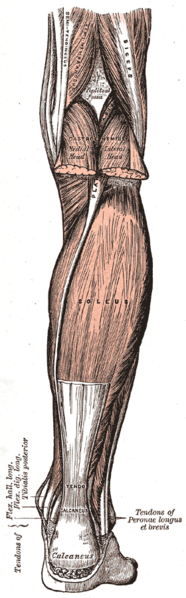
Even in adopting a new appreciation for the appropriateness of using attachments in place of origins and insertions, there is still much more complexity to the muscular system’s influence on movement than is taught in traditional anatomy classes. Muscles almost always have influence in multiple planes, and express different movements depending on whether the movement is open- or closed-chain. For example, most people are familiar with the fact that the soleus, one of the calves, serves a primary role in plantar flexion (pushing up onto your toes). However, when the feet are fixed on the floor, as in a squatting/deadlifting pattern, the calcaneus is relatively fixed, and therefore the soleus will function to pull the tibia posteriorly. Although this is technically plantarflexion, this directly translates into knee extension, and in the presence of a stationary pelvis, hip extension. In this way, the soleus is a knee extensor in closed chain movement, and also influences the hip.

Soleus: Plantarflexor, knee extensor, hip extensor?

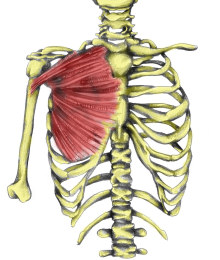
Similarly, muscles play a significant role in joint orientation. While this is somewhat implied by the understanding that muscles move bones, the totality of this relationship is frequently overlooked. For example, fibers of the pectoralis major extend from the sternum, horizontally across the ribs, and insert into the intertubercular groove of the humerus. When describing the function of the pec major, it’s role in glenohumeral flexion, horizontal adduction, and internal rotation is often emphasized. However, the force transmitted to the humerus to produce these motions is dually transmitted to the sternum. The pec major is a major influencer of sternal position (no pun intended), and therefore of the positioning of the opposing pec major. In this way, muscles can influence the positioning and consequent function of bones and muscles.

Note the strong connections of the pec major to the sternum

Interestingly, it is often (but not always) the muscle that is eccentrically loaded that people subjectively feel as tight. In the above example, this would mean that the short or excessively stiff pec major that biases the sternum in one direction may feel relatively normal, whereas the opposite pec major that is under increased tension because of the sternal orientation may feel tight. Stretching, in this case, is not desirable and could even be harmful, as the muscle is already in a lengthened state, and pushing through this could result in compensatory movement of other segments and/or lead to laxity of surrounding tissue.

Postural Restoration Institute
Fortunately, many of these orientations are fairly predictable via the Postural Restoration Institute methodology, which seeks to drive the body toward a more neutral orientation as a means of restoring reciprocal motion between the left and right halves and therefore of improving performance and decreasing injury risk.

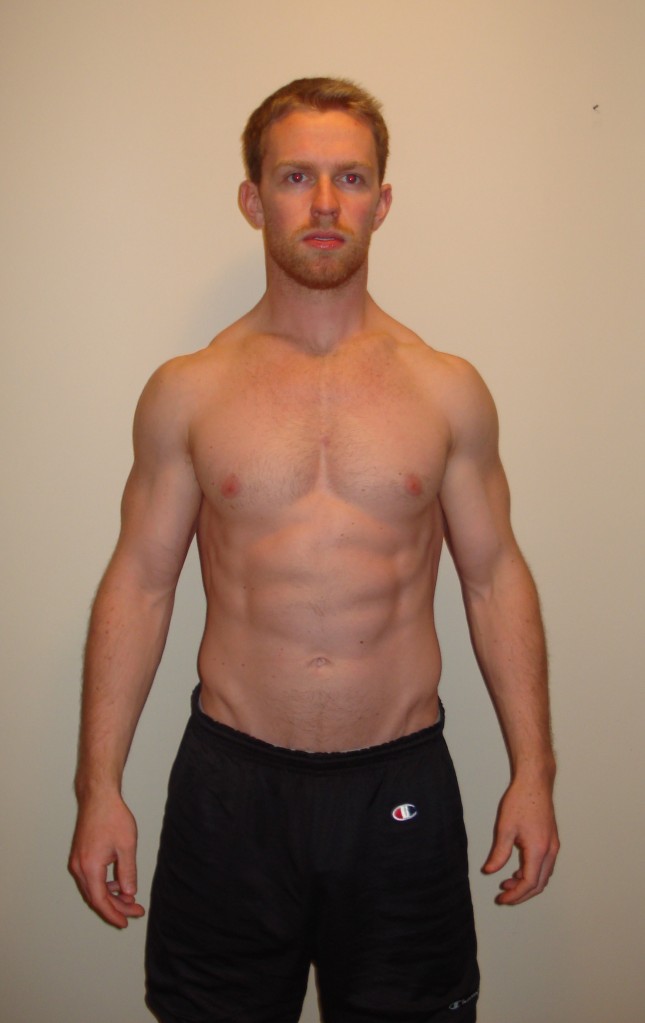
I was able to dig up a picture from a couple years ago that I took as part of a new diet experiment. Check out the picture below and note any side-to-side differences. What do you see?

While some of these things can be difficult to pick up at first if you don’t have a well-trained eye, the fact that my skin is pale to the point of borderline translucency should help. You may notice that my hips are rotated to my right (note the difference in the position and prominence of my obliques), my upper torso is rotated back to the left (note how my right hand is positioned in front of my left hand, and how the left pec major appears to be rotated back and more stretched out), and I’m slightly side-bent to the right (note how my right hand is about an inch lower than my left). You can see that these asymmetries extend up to the orientation of my head (see how much more apparent my right ear is?).

This is a textbook illustration of what PRI would describe as a Left AIC, Right BC position, and, assuming no ligamentous laxity, I would expect to see a decrease in left hip adduction and extension, right glenohumeral internal rotation, and left glenohumeral flexion and horizontal abduction secondary to poor positioning. In other words, it’s not necessarily that short/stiff muscles are limiting the range of motion, it’s simply the position of the underlying skeleton that is positioning the muscles poorly to perform their role. This is evidenced by the fact that in most cases almost complete symmetry can be restored in less than a minute with any number of relatively simple exercises that use active muscle contraction and breathing to re-orient specific bones into a more neutral position. Simply, in one minute, almost full range of motion can be restored. Do you think a baseball pitcher could benefit from 15-20 more degrees of internal rotation on his throwing arm? Can you appreciate how a hockey players stride and crossover ability will be affected by improved hip extension and adduction on the left side?

Wrapping Up
Hopefully you see the importance of understanding the integrated nature of our musculoskeletal/connective tissue and neural systems, and the power in a system that addresses these systems collectively. Relating back to the introductory topic, a muscle’s function is largely dictated by its position, which can be heavily influenced by the role other muscles play in driving and responding to skeletal positioning. The ability to view the body as an integrated system is invaluable, and a failure to do so can have frustrating and even tragic consequences.

To your success,

Kevin Neeld

P.S. Don’t forget, you have only have a few days left to get access to a TON of information to help make you stronger, faster, and get you in drastically better shape for only $1! Click here now >>  Elite Training Mentorship

Please enter your first name and email below to sign up for my FREE Athletic Development and Hockey Training Newsletter!
I hope you had a great weekend. Emily and I kept pretty busy. We hosted a game night for a few of her friends Saturday night; I discovered that I’m not very good at Pictionary. Oddly, the group wasn’t very receptive when I proposed a redemption challenge of a deadlift contest.

I thought we’d mix things up a bit to start the week off and I’d direct you to a few articles I think you’ll really enjoy.

Good Read # 1: 2012 Resolutions: A Healthier Plan Creates a Healthier Golfer

About a year ago I started doing some writing for the Golf Association of Philadelphia. In this article, they asked me for some tips on how to avoid the pitfalls of traditional new year’s resolutions. While this was written for a golf audience, almost everything in the article is applicable to anyone reading this. Give it a read and let me know what you think by posting your comments below!

Good Read # 2: What’s Wrong With Keeping Your Chest Up?

David Lasnier wrote this post earlier in the year and I thought it was really well-written. David outlines why a common coaching cue needs to be put into perspective, and highlights the effect that extension at the thoraco-lumbar junction has on the ribs anteriorly. There are a number of powerful performance implications from the message David provides in this article; a definite must-read for anyone in the performance training field.

Good Read # 3: 24 Habits of 24-Hour Athletes

This is a simple, to the point article from my friend Kyle Bangen. Kyle is the Head Strength and Conditioning Coach at Michigan Tech. I’ve had the pleasure of going to a few seminars with him, which affords some time to talk shop and pick his brain. In this article, he emphasizes that athletes can’t just be committed during their 2-hour practice or training time if they want to be successful; it has to be a lifestyle. I recommend retyping his 24 habits, printing them, and posting the list somewhere where you’ll see it frequently.

Good Read # 4: Core Values

This is another article from Kyle Bangen on the core values of his program at Michigan Tech. Along the same concept as the previous post, Kyle uses core values to describe his philosophy and expectations, both for himself and for his athletes. #9 is the key to success in hockey, as in life.

Bonus Read: Good Fitness Reads for the Week

Every week, Ben Bruno puts together an EXHAUSTIVE list of fitness articles, videos, and interviews that he enjoyed the previous week. I’ve been fortunate to be included in many of these; that may have even been how you first came across my site! If you’re looking to kill a few minutes…hours…or days, check out Ben’s list and click through some of the articles that pique your interest.

To your success,

Kevin Neeld

Please enter your first name and email below to sign up for my FREE Athletic Development and Hockey Training Newsletter!

I hope you had a great week. We’ve had a good week at Endeavor. We’re wrapping up our in-season training for the youth program we work with. They’ve done a great job this year. One of our ’96s just committed to Penn State, and one of our U-18s has offers on the table from Yale and Princeton (not bad schools to choose from). I’m really proud of how hard these players (and their teammates) have worked this year and am happy to see that I’m not the only one noticing! I’m looking forward to watching some of the older teams compete in the playoffs over the next few weeks.

It’s been two weeks since my last hockey strength and conditioning update. In that time, I’ve added a ton of hockey training content that you’ll want to check out. Last week, I posted three videos on speed training for hockey, hockey conditioning, and designing comprehensive off-ice training programs. You can check those out here:

  1. Ultimate Hockey Training: Transitional Speed Training
  2. Ultimate Hockey Training: Hockey Conditioning
  3. Ultimate Hockey Training: Comprehensive Off-Ice Training

This week, I added two new articles, one on an incredibly important concept related to human (and therefore hockey) performance that is often only glossed over, if mentioned at all, in academic programs. I also added an article dissecting the “nature vs nurture” debate of athletic excellence. Check them out at the links below:

  1. Understanding Regional Interdependence
  2. Athletic Excellence: Nature vs Nurture

We’ve also added some great stuff at HockeyStrengthandConditioning.com over the last two weeks.

Darryl Nelson added a new youth hockey training program geared toward improving conditioning or what others may refer to as “work capacity”. These youth training features are meant to provide those in the trenches training youth hockey programs without much equipment some new ideas on things they can implement. Darryl’s players are holding light weight plates, but if you don’t have access to weights you can really use anything (water jug, puck bag, etc.). This circuit looks pretty brutal!

Watch the video here >> Metabolic Circuit #2

Mike Potenza added a pre-camp off-season work capacity program, which is similar on concept to what Darryl posted in his video. Mike’s program is really insightful because it shows how he structures the training week (not every day is a grind), and he provides some extra examples of work capacity circuits that players can use. Because Mike’s players, in general, have a relatively strong training background, he’s built quite a bit of diversity/variety into these circuits, attacking the same physical quality(or qualities) through different means.

Get the program here >> Off-Season Pre-Camp Work Capacity Circuits

Eric Renaghan, who I had the pleasure of meeting when I was out in San Jose last Fall, is Mike Potenza’s assistant with the Sharks this year. Eric is a really bright guy that has a unique combination of insight stemming from his experience as an elite soccer player, strength and conditioning coach, and manual therapist. He put together an interesting article on breaking the cycle of repeat groin strains. His thoughts are very much in-line with what I’ve been preaching for the last few years. An adductor (or “groin”) strain is a SYMPTOM of a larger problem. Avoiding these injuries certainly requires some soft-tissue work to the adductors themselves, but the most causative factors likely lie elsewhere, which is what Eric discusses in this article.

Read the article here >> Help…I’ve strained my groin, again

We also added a new “poll” feature. Log in to the site today to weigh in on what you think needs to be addressed most regarding the current concussion epidemic! This is a very controversial topic, so we’d love to have your opinion. This should spark some great conversations on the forum.

That’s a wrap for today. As always, if you aren’t a member yet, I encourage you to try out Hockey Strength and Conditioning for a week. It’ll only cost $1, and if it’s not the best buck you’ve ever spent, I’ll personally refund you!

To your success,

Kevin Neeld

Please enter your first name and email below to sign up for my FREE Athletic Development and Hockey Training Newsletter!
Although I tend to wear several hats, from an athletic development standpoint, my job essentially boils down to two primary responsibilities:

  1. Make sure athletes don’t get hurt
  2. Improve their performance

Foundational to both of these goals is an understanding of regional interdependence. Regional interdependence  can be crudely defined as a phenomenon whereby one segment or system of the body influences another, sometimes remote, segment or system. The manners through which these interactions take place can be incredibly complex, but for our purposes, a more general view of these interactions can be relatively easily described.

Before we get to that, it’s worth pointing out that understanding this concept is incredibly important both in recognizing how seemingly unrelated areas can be the cause of (or at least very much related to) injury or inefficiencies in other areas. In other words, it helps explain how we function, and understanding function is requisite to maximizing it.

Although I used slightly differently terminology, this idea of regional interdependence was one of the first topics I covered in my book Ultimate Hockey Training.

Traditionally regional interdependence is thought of from a mechanical standpoint from both a local and global perspective, but there are also what I think of as more “functional” applications of the concept. To be clear, there is no isolation or segregation between mechanical and functional concepts so please don’t be misled by the terminology. I tend to think of regional interdependence within these 5 paradigms, some or all of which may be familiar to you already.

  1. Tensegrity
  2. Synergistic Dominance
  3. Anatomy Trains
  4. Joint by Joint Approach
  5. Functional Outcome Prioritization

Tensegrity
Tensegrity is the concept that mechanical stresses placed on or across any given structure can be transmitted to adjacent structures, with an intensity that diminishes as the distance from the original stress increases. For example, if a hockey player takes a puck to the anterior thigh, that stress spreads through the skin, underlying muscle, deeper muscle, and adjacent muscles and soft tissue structures much like water ripples when a rock is thrown in it. Stress to an area is co-absorbed by surrounding tissues. The same is true when a muscle contracts; some of the stress of that contraction spreads to surrounding tissues. In this way, the stress response and force outputs in any given movement are dependent upon the capacity and integrity not just of  the “target” tissue, but also of those surrounding it. This is regional dependence through mechanical load sharing.

Synergistic Dominance
This is a concept Dr. Shirley Sahrmann identifies in her book “Diagnosis and Treatment of Movement Impairment Syndromes” which explains why sometimes the muscle that is doing everything right is the one that gets injured. As an example relevant to hockey players, if a certain degree of hip flexion force is needed and one or more of the hip flexors is weak, than one or more of the remaining hip flexors will need to pick up the slack. Over a single repetition (one stride recovery), this may not be injurious. But over time with thousands and thousands of repetitions (not uncommon for a single week of practice), the hip flexors that are picking up the slack can become overworked and break down. This is regional dependence through synergistic movement production.

Anatomy Trains
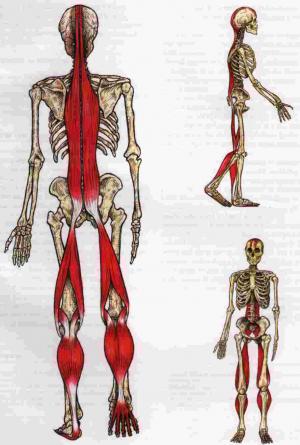
Anatomy trains is a term that was coined by Thomas Myers to describe the the myofascial (or connective tissue) connections within the body. As one example, Myers describes the “Superficial Back Line” as originating on the plantar surface of the foot, traveling around the achilles tendon and gastrocnemius, up through the hamstrings, connecting to the pelvis via the sacrotuberous ligament, continuing up the erector spinae and up around the back of the head to the brow of the forehead via the galea aponeuroses and scalp fascia. In other words, there is a continuous structural link from the bottom of the foot to the forehead.

Superficial Back Line

This helps explain why someone that has trouble touching their toes can make significant progress in this range of motion by simply rolling their plantar fascia with a tennis ball. Even more abstract, this explains one mechanism why someone with restrictions through their calves may have neck pain. This is just one illustration of an anatomical network; these exist everywhere throughout our body and provide direct anatomical links for why restrictions in one area can have a significant impact on seemingly remote areas. This is regional interdependence through anatomical connection via connective tissue, which is also naturally affected by tensegrity.

Joint by Joint Approach
The “Joint by Joint Approach” was a phrase coined by Mike Boyle and Gray cook to describe a system of alternating joint function as you progress from foot to head. In reality, every joint needs a specific balance of mobility and stability based on its structure, but the JBJA system helps us understand the mechanism underlying a lot of common injuries. To be overly simplistic, if a joint in the mobility column has sub-optimal mobility (or range of motion), an adjacent joint will need to “fill in the gap” by providing the additional range of motion. Usually this “compensatory movement” occurs at the next joint up. Following this idea, you can refer to the table and see that mobility restrictions in the left column lead to compensatory movements (and consequent injuries) to the joints in the right column.

Much like the “Anatomy Trains” concept, this has tensegrity implications for load sharing as well, but adds to the regional interdependence idea by illustrating how deficiencies in joint range of motion (mobility) and/or control of that range of motion (stability) can affect neighboring joints.

If you’re interested, I wrote more about this concept here: Mobility-Stability Continuum

Functional Outcome Prioritization
Finally, segments with NO (or at least minimal) direct anatomical or biomechanical influence on each other can still have profound impacts on one another via this idea of functional outcome prioritization. Simply, this refers to the almost infinite degrees of freedom your body has in creating a movement that leads to a desired outcome. For example, if you need to raise your arm overhead to open a cabinet, you have options of reaching as high as you can with a relatively neutral trunk and lower body, you can side bend your trunk to get your arm higher, you can stand on your toes to get your arm higher, etc. It doesn’t matter, so long as your hand reaches the handle. THAT is the functional outcome.

More relevant to hockey players, in opening up to receive a pass and take a shot from the point, you will need to follow through with your stick directed toward the goal. If you’re positioned in the middle of the ice by the blue line, this is roughly a 180 degree rotation from a full wind-up to a full follow through. In achieving this, you can divide that rotation up amongst the joints in the body so that your feet rotate on the ice, your hips rotate, and your upper spine rotates. If rotation range of motion is lacking in any of these segments, it will need to be made up for somewhere else. Locally, this could mean that a lack of hip rotation causes excessive lumbar rotation (Joint by Joint Approach), but it could also mean that your shoulder blades and shoulders need to rotate and translate more than would otherwise be desirable. Similarly, a certain degree of rotation is required to position the skate at a 45 degree angle during a forward skating stride. A lack of hip rotation could cause compensatory rotation at the other hip, knee, or ankle, and/or changes through the lumbar spine. In this way, the body can choose a strategy to achieve a specific functional outcome, which may or may not be the optimal strategy based on sound biomechanics. This is regional interdependence through functional outcome prioritization.

Taken together, these illustrations of regional interdependence underline the importance of assessing and training the whole body, even when a more local goal is desired (e.g. ACL tear rehabilitation and/or increase in upper body strength). To maximize function, balance in range of motion, stiffness, strength, and control must be achieved throughout the body, within, across, between, and among joints.

To your success,

Kevin Neeld

P.S. If you want a comprehensive step-by-step hockey training system based on these principles, check out my new book Ultimate Hockey Training

Please enter your first name and email below to sign up for my FREE Athletic Development and Hockey Training Newsletter!
Use CODE: "Neeld15" to save 15%