I haven’t spent as much time reading others’ websites as I typically do over the last 6 months as I’ve been chin-deep in massage school, a few good books, and working on a couple projects for Endeavor. That said, I’ve come across several awesome articles that I wanted to share with you that cover a range of topics from hockey training to parenting to manual therapy to soccer preparation (these articles have direct applications to hockey players too!). Most of these won’t take very long to read, so don’t be overwhelmed by the number of articles here. Lots of good stuff so grab a seat somewhere comfortable and dig in!
Please enter your first name and email below to sign up for my FREE Athletic Development and Hockey Training Newsletter!
What Muscles Do You Use to Shoot?
Last week I received a question from a reader that I’ve gotten a few times in the past and thought I’d address here. If you have specific questions you’d like me to address in a future post, please post them in the comments section below!
Question:If you could please tell me what muscles are used in taking the slap shot. What muscles are being used eccentrically, concentrically as well as isometrically. I would greatly appreciate it. Thanks Chris
I’ve written about exercises to improve shooting power quite a bit in the past, as I know that’s a question a lot of players have. Whenever I get these questions, my first thought is “why do you want to know?” I suspect that the line of thought here goes something like:
I (or my son/daughter/member of my team) does not have a very hard shot (by someone’s standard)
I need to learn what muscles are used in shooting
I need to strengthen these muscles to improve my shot power
In response to this thought process, I could dissect all the muscles involved with various shot patterns, how their roles change depending upon body position, and explain their actions. That said, I think in this situation I might be providing the right answer to the wrong question. In my opinion, a better, more direction question would be:
“How can I improve my shot?”
Improving a shot in hockey comes down to a few simple concepts:
Technique
Accuracy
Release
Power
In almost every case, all of these things feed each other. If someone isn’t strong enough, they may not be able to shoot with the ideal technique (especially true at the youth levels). A slow release can make a hard shot seem slow, since the goalie/opponents have an opportunity to adjust their positioning to the expected shot before it gets off.
Check out the video below of my buddy Johnny Gaudreau. He’s not going to win any hardest shot contests, but he sure finds the back of the net!
Quick release and accuracy may be more important than shot power for some players
Many coaches like defensemen with a big shot from the point. This certainly isn’t a bad thing, and in many cases is desirable. That said, Mark Recchi played the point for years on the power play and almost exclusively took snap shots. As mentioned above, sometimes placement is more important than power.
I’ve also heard stories of some of the world’s top scorers admitting that they didn’t “aim” as much as just try to get the shot off as quickly and as hard as possible. The point of this discussion is to recognize that many players have found success using different strategies, most of which gravitate toward their talent predispositions. If you’re the parent or coach of an undersized player, they will absolutely benefit from some strength training, but they may never have the hardest shot on their team. That’s okay; they can find success with other strategies!
With all that said, let’s dig into the heart of this question: What muscles are used in shooting and how do we train off the ice to improve shooting power?
Do muscles matter?
There are in excess of 600 muscles in the body, most of which are active in some capacity during a max effort shooting pattern. Some will be used to “load”, some will be used to accelerate through the shooting pattern, and some will be used to decelerate the movement. While it might be possible to dissect the role of every muscle in every shooting situation, I think the training application of this information would get pretty muddy very quickly. For example, for a right-handed shot to open up and take a big slap shot would involve an eccentric loading of the back-side (right) external oblique during the loading phase, an isometric action during the transition from the wind-up to lowering the stick, and a concentric action as the player accelerates the stick down. This is just one example of one muscle in one shot from one position. To use information like this to design specific exercises to address each component would be overly laborious and incredibly inefficient. Not to mention, muscle action is position- and velocity-specific, so simply doing a bunch of Russian twists to train the obliques would leave A LOT to be desired (not to mention this is a garbage exercise anyway).
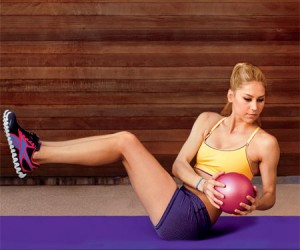
Scrap these in favor of plank rotations and belly press variations
In contrast, I’d urge you to temporarily let go of thinking of the involved muscles and start thinking more in terms of movement patterns. When you view sports in this frame, you’re able to train multiple muscles in their sport-specific roles simultaneously. This concept, however, has been bastardized by the “hockey-specific” folks that started loading up hockey sticks with resistance tubing and having players go through shooting motions in this manner. A few things to consider:
Shooting patterns, like all truly sport-specific movements, are position and velocity dependent and involve a very specific motor program within the nervous system. Creating an excessive overload during sport-specific patterns can NEGATIVELY affect the motor program, ultimately leading to a sloppier pattern. This is especially true with movements where accuracy is a primary objective.
Relevant to the above, tubing progressively increases resistance as it gets stretched, so the resistance is maximized as the players stick reaches the “follow through” phase of the shot. This is the exact opposite of shooting on the ice, where maximum resistance is reached either during the transition from wind-up to shooting phases, or during contact with the puck. A much more effective way of utilizing this concept would be to use pucks that are MODERATELY heavier (e.g. ~ 1 oz for bantams and midgets, and up to ~2oz heavier for juniors, college, etc.; peewees and below shouldn’t use heavier pucks!)
Off-ice training can have a HUGE impact on sport-specific qualities by breaking down the movements into more fundamental patterns that don’t directly mimic those used on the ice, but still have some similarities. For example, shooting is a low load, high velocity rotational power movement. These can be trained off the ice using med ball throw variations from different positions, that will help mimic the rotational loading and force generation through the hips, transfer of this power through the core, and follow-through through the upper body. In this way, the pattern is similar enough that it can transfer to on-ice improvements, but not so similar that it will interfere with the accuracy/precision of the movement on the ice.
Tube-resisted shooting: The key to developing inaccurate shots and sports hernias
Our med ball work can generally be broken down into these variations:
Shotput or scoop
Front standing or side standing
Static or dynamic start
In this way, we’re able to address a wide variety of shooting environments that players face on the ice. We generally progress to lighter loads throughout the off-season to help shift toward higher velocity movements. I’ve posted a ton of these videos in the past, so if you’re interested in seeing these exercises in motion, check out the posts below!
I hope this clears up any confusion regarding the most appropriate off-ice training strategies to improve on-ice shooting power. Please post any questions you may have below!
To your success,
Kevin Neeld
Please enter your first name and email below to sign up for my FREE Athletic Development and Hockey Training Newsletter!
Off-Ice Hockey Conditioning Programs
As a follow-up to my previous post on creating off-season (or lock-out friendly) programs that coordinate on- and off-ice demands, today’s post presents the mobility circuit and conditioning programs referenced in the training schedule from that last post. The mobility circuit serves to help improve multi-planar hip mobility and thoracic mobility, two areas that are commonly restricted in hockey players, while also getting some blood flowing which will help facilitate recovery. After completing the circuit (twice), the player should feel loose and energized, but not fatigued at all. Circuits like these are a great way to get some low level aerobic work in without fatiguing the system. I also included an abbreviated mobility circuit with just the stationary mobility work, as I think these are important to mix in frequently throughout the week, and, frankly, I don’t think most players will do the entire circuit 6+ times per week in addition to their pre-existing dynamic warm-ups.
Hockey requires extremes of hip range of motion. Achieving and preserving optimal multi-planar hip mobility is an important off-ice training objective, year-round.
The conditioning programs are presented with three options so the player can still get the work in even without access to any given piece of equipment or space (e.g. field or ice), and to give the player some ownership over the program. They’re listed in order of preference, meaning in an ideal world the player would perform the 1st option, followed by the 2nd if the 1st isn’t an option, and finally, the 3rd. Each day is designed to be in accordance with the targeted energy system for that day’s lifting and on-ice work. Within Conditioning 2, I started to incorporate some work that somewhat diverges from the rest of the work for that day to prepare the player for an upcoming on-ice skating test.
Check everything out below, and please post any questions you have! In a future post I’ll put up a video with all the exercises in the mobility circuit for your reference. This can also be used as a substitute dynamic warm-up for players that need a change of pace. Enjoy.
Mobility Circuit
Wall Ankle Mobilization: 3x(5x2s)/side
Back Knee Elevated Quad Mobilization: 10x2s/side
Back Knee Elevated Lateral Kneeling Adductor Mobilization: 10x2s/side
Supported Hip Airplane: 10x1s/side
Quadruped Cat/Camel: 10x1s
Quadruped Thoracic Rotation: 10x1s/side
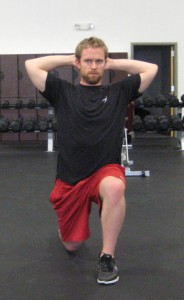
Reverse Lunge w/ Hands Behind Head: 10/side
Modified Yoga Push-Up: 10
Lateral Lunge w/ Hands Behind Head: 10/side
Scap Wall Slide: 10
Inverted Reach: 10/side
Modified Mobility Circuit
Wall Ankle Mobilization: 3x(5x2s)/side
Back Knee Elevated Quad Mobilization: 10x2s/side
Back Knee Elevated Lateral Kneeling Adductor Mobilization: 10x2s/side
Supported Hip Airplane: 10x1s/side
Quadruped Cat/Camel: 10x1s
Quadruped Thoracic Rotation: 10x1s/side
Conditioning 1
50-Yard Shuttle Run (Lines at 0&25) on 60s (Run the shuttle as fast as possible and rest the remaining time until the next minute):
Week 1: 10x
Week 2: 11x
Week 3: 12x
Treadmill: 10s/50s (Put the treadmill at a low incline (2-4°) and put the speed at something you can barely maintain with good running mechanics for the full 10s. Straddle or put the speed to 3mph during the rest)
Week 1: 10x
Week 2: 11x
Week 3: 12x
Elliptical: 10s/50s (Pick a resistance that is hard, but that you can still move fairly quickly for the work intervals; push it all the way down for the rest):
Week 1: 10x
Week 2: 11x
Week 3: 12x
Conditioning 2
On-Ice Shuttle Skate (Goal and Blue) Work ~16s w/ 44s rest
Week 1: 3 x (3×2 Laps on 60s) w/ 2 mins between reps
Week 2: 2 x (4×2 Laps on 60s) w/ 2 mins between reps; 1 x 7 Laps
Week 3: 1 x (6×2 Laps on 60s); 2 x 5 Laps w/ 5 mins between reps
Off-Ice Shuttle Run (Lines at 0&25)
Week 1: 3 x (3×100 yards on 60s) w/ 2 mins between reps
Week 2: 2 x (4×100 yards on 60s) w/ 2 mins between reps; 1 x 300 yards
Week 3: 1 x (6×100 yards on 60s); 2 x 250 yards w/ 5 mins between reps
Airdyne
Week 1: 3 x (3x20s/40s) w/ 2 mins between reps
Week 2: 2 x (4x20s/40s) w/ 2 mins between reps; 1 x 60s
Week 3: 1 x (6x20s/40s); 2 x 50s w/ 5 mins between reps
To your success,
Kevin Neeld
Please enter your first name and email below to sign up for my FREE Athletic Development and Hockey Training Newsletter!
Matching On- and Off-Ice Demands
A while back I wrote a post outlining the physical qualities that can be trained at the same time without creating too large of a conflicting stimulus to the body. As I’ve mentioned in the past, attempting to train conflicting qualities at the same time (think powerlifting and marathon training) will result in the training efforts interfering with the adaptation of the other, and ultimately a blunted response to both. There are a myriad of ways to design programs to minimize this interference and progress to peak for a certain quality or group of qualities (e.g. progress from hypertrophy -> strength -> power -> speed).
You can’t be both
While no periodization model (read: planning) is perfect, I think when an individual has a relatively advanced training age (e.g. 5+ years of structured strength and conditioning ), the more targeted a given training phase will need to be to continue to make progress. In other words, it’ll be that much more important that phases are designed using almost entirely complimentary qualities (as outlined here: A New Perspective on Program Design), using a minimum volume of conflicting qualities to help maintain previously built levels.
During the off-season, it’s ideal to frame on-ice work within the same targets as the off-ice work. In other words, if you’re focusing off-ice efforts on developing maximum speed or power, which primarily rely upon alactic energy systems, and then you bag yourself on the ice with a lot of lactic work, the on-ice work will actually impair your off-ice efforts. This certainly isn’t to say that you’d gain some on-ice benefits from skating and handling a puck, only that there is a more targeted/optimal approach to take.
Recently I’ve had an opportunity to consult with some high level players about this very topic. Below is an example of the plan I put together for one, based on a preexisting skating schedule.
Monday: Upper Body/Skill Work
Off-Ice: Upper Body Lift 1
Conditioning: Mobility Circuit (2x through)
On-Ice: Low IntensitySkill Work
Skating Technique Work
Goal to Goal: Slow forward skating focusing on optimal body position, stride angle and extension. Progress in speed to ultimately ramp up to full speed by far blue.
50% x 2-3
75% x 2-3
100% x 2 (ramping up to 100%)
Faceoff Circle: Crossover skating focusing on driving under with the cross-under leg. Progress to faster strides around the circle.
2-3 x ~20s/side
Last Rep should ramp up to full speed for ~8-10s
Goal to Goal: Inside and outside edge holds, forward and backward. Progress to tighter turns.
2x/edge/direction (2 on inside and outside edge each, forward and backward; 8 trips total)
Puck Work
Puck handling on all sides of the body (front, back, left, right). Ramp up speed, weight shifts, width of puck handling, and transition between positions.
Stationary shots from different areas of the ice
Quick movements into shots (< ~3 strides before shooting; should only take 2-3 seconds and shouldn’t be overly taxing)
Tuesday: Lower Body/Intense Practice
Off-Ice: Lower Body Lift 1
Conditioning 1 (Pick 1; Listed in order of preference)
On-Ice: Practice
Focus on short, high-intensity drills if possible.
Hopefully this gives you an idea of how on- and off-ice work can be designed in a complimentary fashion to maximize development and avoid (to the extent possible) sending conflicting signals to the body, ultimately allowing for a deeper, more significant adaptation.
In a future post, I’ll post the “Mobility/Recovery Circuit” and Conditioning recommendations alluded to above so you can see how they line-up with the on-ice work. Stay tuned and, as always, please post your questions below!
To your success,
Kevin Neeld
Please enter your first name and email below to sign up for my FREE Athletic Development and Hockey Training Newsletter!
Hockey Training Tip: Single-Leg Stability
Hockey Training Tip: When a player doesn’t have good single-leg stability, it is common to see his/her knee collapse in while in single-leg stance. This is important because when the knee collapses in, the players foot rolls in and puts more force on the inside edge of the skate blade. These players tend to ride their inside edge on their glide leg, and therefore “brake” against the propulsive force produced by their stride leg. This isn’t only inefficient, it also puts the player at an increased risk of injury.
In addressing this issue, it’s important to recognize that knee position is largely influenced by hip control. While the foot can also influence knee position (those with “flat” or overpronated feet also tend to have an inward collapse of the knee), training the muscles of the lateral hip and grooving a quality single-leg pattern seems to be the most appropriate strategy to help improve this movement impairment.
Bad knee position due to poor hip control
Better knee position with better hip activation
Poor alignment
Corrected
One of the exercises we use the most frequently to help correct this is a simple Lateral MiniBand Walk. The band acts to pull the knees in toward each other, which helps active the muscles on the outside of the hip to prevent this from happening.
Lateral MiniBand Walk
*If you don’t have them already, you can pick up a few MiniBands here: MiniBands
Naturally, this is just one step in improving this pattern. It’s important to reinforce proper alignment during all movements/exercises, especially those that involve single-leg stance.
To your success,
Kevin Neeld
P.S. Check out Ultimate Hockey Training for more hockey training strategies to improve single-leg strength and skating speed!
P.S.2. When you sign up for my newsletter (below) you’ll automatically receive a FREE copy of my hockey speed training manual “Breakaway Hockey Speed”.
Please enter your first name and email below to sign up for my FREE Athletic Development and Hockey Training Newsletter!


 Use CODE: "Neeld15" to save 15%