
With hockey seasons at all levels ramping up, I’ve been getting a lot of questions about in-season training. When putting together a program at any time of year, there are a lot of things to consider. Today’s post will dive into the primary considerations when designing an in-season hockey training program.

1) Age of the athlete/Stage of Athletic Development
This is a topic I’ve talked a lot about in the past so I’ll just touch on it briefly now. Youth players at different stages of development (largely based on age brackets associated with changes in growth rates) experience windows of time where they’re better able to develop certain athletic qualities. In a comprehensive model, this would influence both on- and off-ice recommendations. This is where USA Hockey’s ADM really excels and provides an outstanding roadmap for on- and off-ice professionals alike to plan their season based on the best long-term interest of the players. The image below is taken from the material and provides a visual illustration of the general ages at which certain athletic qualities are sensitive to accelerated development.
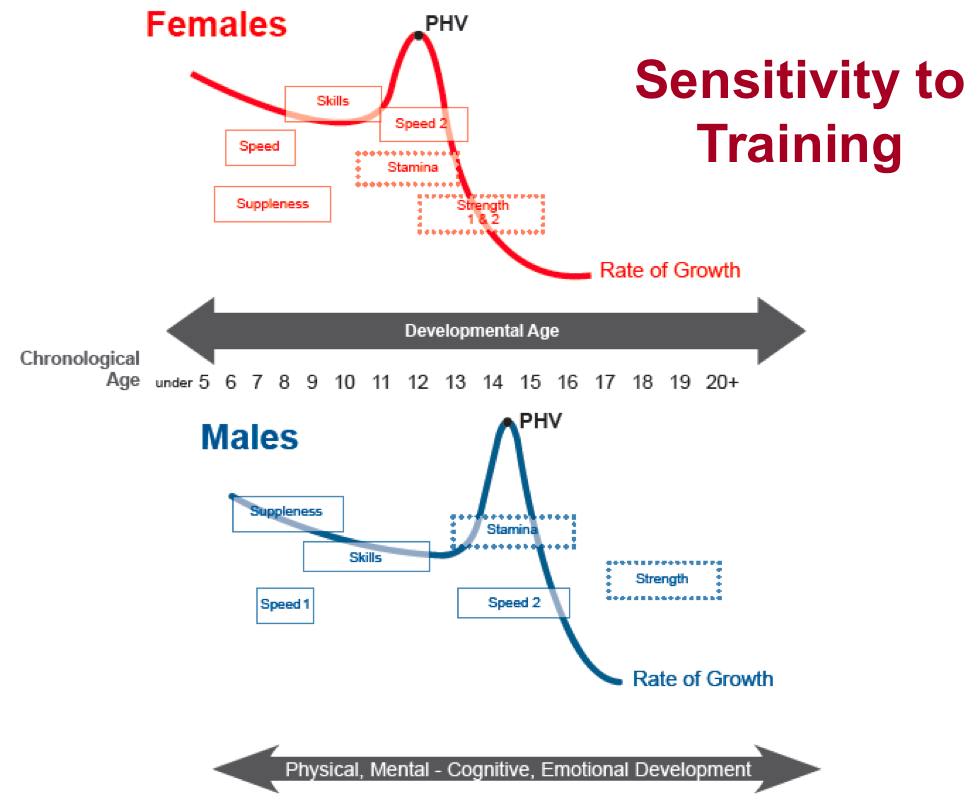
Long-Term Athletic Development-Sensitivity to Training
I found out last week that I was quoted in the most recent issue of USA Hockey Magazine for my support of their ADM. I thought that was pretty cool because I can remember reading the magazine when I was a squirt! That said, I think it’s important to point out that I first came across the ADM material while studying long-term athletic development material, largely from professionals in other countries, and was intrigued by how comprehensive and well-thought out the ADM was, and even specific to hockey! I had no affiliation to USA Hockey at the time, but thought then (and still think now) that it’s the best, most comprehensive sport-specific long-term athletic development plan I’ve come across. Naturally, it being a “long-term plan” means that it’s going to be met with some resistance from those eager for immediate gratification. I always come back to the idea of identifying where you want your finish line to be. The ADM is an outstanding model for creating truly elite players; it may not be the best way to create the world’s best peewee.

From an off-ice training perspective, I don’t think it’s necessary to ONLY train whatever the quality is that coincides with a given age group. I do, however, think it’s important to keep that quality(ies) in mind while designing the program and  consider how the program you’re using is either training that specific quality or supporting qualities. For example, during the “Speed 2” window, it’s not necessary to ONLY do sprints. The reality is that speed can be limited by a number of factors and including things like joint mobility work (despite not being in the “suppleness” or flexibility phase), basic strength work (despite not being in the “strength” phase), and lower body power work will all positively influence the player’s ability to develop speed at that age.

In this context, certain exercises aren’t always what they appear. A kid lifting weights may be “speed training” because it’s teaching him/her to better recruit the muscle mass they do have, even if they haven’t hit puberty and don’t have a hormonal system conducive to putting on muscle mass. I touched more on this topic here: Youth Hockey Training: The Truth About Resistance Training

2) On-Ice Demands
This is a simple concept, but one that I think a lot of programs overlook, at least at the youth levels. Off-season and in-season training programs should be COMPLETELY different in terms of training frequency, total training volume, and training focus/goal because the on-ice demands on the players are completely different (or at least it should be). If we take a step back from being “hockey coaches” or “strength coaches” and just look at all on- and off-ice work in light of the type of stress is places on the body, it’s fairly evident that players at all positions perform dozens of repetitions of short-duration high intensity movements (e.g. speed training) during every practice, and they also experience a multitude of heart rate responses to elicit alactic and lactic conditioning responses. All of these “training” stresses occur during several practices and many also occur during games over the weekend. While different teams across different ages have different practice/game schedules, the bottom line is that there are certain stresses or athletic qualities that are being trained ON the ice that do not need to be further trained OFF the ice. In many ways, hockey-specific in-season training should be anti-hockey-specific.

This is where I think understanding the idea of training complimentary qualities becomes incredibly valuable. How do you improve a player’s speed without doing speed training? How do you improve a player’s ability to perform explosive movements repeatedly with minimal drop-off without doing high intensity interval training? This is where the magic is.

3) Practice Plan/Game Schedule/Travel Demands
To piggyback on the last point, having an understanding of the coach’s practice plan can go a long way in helping ensure the off-ice work is appropriate. Broadly, if a coach intends to bury the players on the ice, it’s probably best to back off from an off-ice training perspective, keeping the volume of the training low and putting a greater emphasis on recovery than on attempting to drive any significant adaptation in speed, power, strength, conditioning, etc. Similarly, if a team just finished a weekend with 3-6 games (especially if they had to travel, which is another stress to the body), and they come in to train the next day (e.g. Monday after a tournament/showcase weekend), the focus of the off-ice training should be in-line with the aforementioned recovery emphasis. If we can agree that a primary goal of training is to reduce injury risk, having an understanding of the total stress load to the athlete is obviously an important piece of the puzzle.

4) Soft-Tissue/Muscle Stresses
This is simply another way of looking at the last two points and comes back to the idea of in-season training being anti-hockey-specific. Hockey players at all levels (incredibly) experience pain/injury to hip flexors and adductors (e.g. the “groin”). These muscle groups have significant on-ice workloads, and even though they’re important for hockey, the time to strengthen/prepare these areas for on-ice work is the off-season. Too much work to these areas in-season is likely to increase injury risk.

I got a question on Twitter last week about when it’s most appropriate to start doing hip mobility work. The reality is that range of motion is much more easily lost than gained, and we (as a society…and DEFINITELY as a sport) spend a significant amount of time “training” our bodies to lose hip mobility by sitting for prolonged periods of time (school, cars, couches, locker room, bench, etc.) and from practicing/playing. A little bit of mobility work on a daily (or near daily) basis is much more effective than a lot every once in a while. Similarly, because we never “shut off” the stimulus to lose hip mobility, there’s never really an appropriate time to stop being proactive to maintain or improve the hip mobility we have.

One of my favorite soft-tissue techniques for the adductors

A mobility/recovery circuit with a lot of quality exercises that can be used in a training program

5) Logistical Considerations
All of the above should contribute to a basic understanding of the goal of an off-ice program for players at different ages and how to make adjustments based on the game schedule. The actual design of a training program will depend on a number of logistical issues, including:

  1. Space/Equipment
  2. Coach:Athlete Ratio
  3. Athlete Training Age
  4. Athlete Social Maturity
  5. Coaching Experience

In general, less space, less equipment, more athletes per coach, younger athlete training ages, less social maturity and less coaching experience will all lead to a more basic training program. This doesn’t necessarily mean less effective, just more basic. To dig a little deeper, the foundation of any quality program should be built on optimal exercise technique. If a program requires too much exercise variety (based on the coach:athlete ratio or athlete training age) or exercises that the coach doesn’t feel comfortable teaching, it undermines this principle. The effectiveness of any exercise, in terms of performance benefits or injury risk reduction, is dependent upon the athletes ability to perform it correctly, which is largely dependent on the coach’s ability to teach it. Olympic lifts are great, but if a coach doesn’t have experience teaching them, they probably shouldn’t be in the program. I think all of this is intuitive for strength and conditioning coaches working in a team setting, but it’s easy for a youth hockey coach or parent taking on the added responsibility of off-ice training to read something on the internet (e.g. “the best exercise for speed development”) and come in the next week with exercises they don’t have much experience with.

That’s a wrap for today. If you have any specific questions, feel free to post them in the comments section below! If you want more information on hockey training programs, check out Ultimate Hockey Training!

To your success,

Kevin Neeld
OptimizingMovement.com
UltimateHockeyTraining.com

Please enter your first name and email below to sign up for my FREE Athletic Development and Hockey Training Newsletter!


A couple days ago I outlined the entire testing process we went through recently with the Philadelphia Flyers Junior Team. This included everything from test selection through implementation, and how we coordinated everything to ensure we got the most valid information, without overlooking the main intent of the camp: to prepare the players for the season. If you missed that post, you can check it out here: Off-Ice Testing

Flyers Logo

Today I want to follow up on that post by sharing how I convey this information to the players. One of the great things about this level is that it’s a developmental league. While there is no doubt there is an expectation (and a desire) to win, ultimately the goal is to develop the players to be successful at the next level. This is important because it means the kids are hungry for information that will help them become better players, which feeds into both why we tested the things we did, and how we’re going to use that information.

I’ve been collecting information on our off-season hockey group for years. The majority of the time, the information was purely mobility based and was used to drive our corrective exercise and technique modifications throughout the Summer. I think two big mistakes I made in the past was that I didn’t fully explain to players why this information mattered (e.g. how it would affect their performance or durability), and I didn’t show them how they improved following any of the work they did. Despite most players trusting me, there’s something about seeing the off-ice testing data that is very powerful. For that reason, I have developed “Player Cards” to convey testing data to all of our players. These player cards take two forms:

  1. Single-test presentation
  2. Multiple-test presentation

Single-Test Presentation
This is only something I’ve used with this junior team and not with our off-season kids, as a lot of what I include in this sheet isn’t relevant for a diverse group that will leave to go play on different teams and at different levels. On this sheet, all of the individual’s testing information is presented in an organized, fairly simple manner. Players are also presented with the top performance and how their test ranked, both in terms of their position and for the team as a whole.

If you’ve been reading this site for a while, you likely know that I don’t think comparing players based solely on testing data is very efficacious. The best players aren’t always the most remarkable off the ice (especially at this age), and the true ranking of players should be done ON the ice. That said, I think there is value in using a ranking system as a means of communicating areas of improvement to players. If a player is dead last in their average shuttle time and has the team’s worst body fat percentage, that could open the door to a conversation on how improving his nutrition could improve his conditioning. Similarly, if a player has the teams lowest (or near lowest) vertical jump, and the coach tells me the biggest factor holding the player back is his speed/explosiveness on the ice, this allows me to communicate to the player how these things could be related and will help with getting the player to buy-in to the program. A testing score, in isolation, really doesn’t mean a whole lot in most cases. By putting things in context of the rest of the group, it provides a “this is where you are relative to other players at your level” that is easy for players to understand, and in many cases very motivational.

You can check out a sample of this sheet here: Sample Player Testing Sheet

You’ll see that I also include a notes section at the bottom. I use this section to convey the top “red flags” or areas to work one that I pick up from the testing sheet. Given the amount of information on these sheets, it’s easy for a player to become overwhelmed or misinterpret some information. For example, if one of our mobility assessments is identified as being “Limited”, that isn’t necessarily a bad thing, depending on the results of the other tests and on the player. Jotting down a few notes at the bottom streamlines the player’s attention to what he should be focusing his efforts on in the immediate future.

Multiple-Test Presentation
As I mentioned before, players want to know they’re making progress. In addition to some periodic monitoring throughout the Summer, we retested everything we did at the beginning of the Summer with all of our players. This information is set-up into a basic excel spreadsheet with all the body comp and mobility information from each testing period (pre- and post-Summer) pooled on one sheet, and all the performance testing pooled on another. As a group, this allows me to sit down and sift through all the numbers to make sure that the group as a whole is moving in the right direction, which can influence future programming considerations. I then take all of this information and divide it up into individual spreadsheets so I can just add future testing sessions as a new row each testing bout.

This allows me to easily track progress for a player and adjust future programs when necessary. It also allows me to put an individual’s testing results within context. For example, we had a player on the junior team whose vertical jump test was toward the bottom of the team. Naturally, it would be easy for the player to look at that information and become discouraged. However, this player put on 10 lbs of lean mass and added 4″ to his vertical in the 3 months he trained with us this off-season. Even though he’s toward the bottom end of the team, he’s made remarkable progress since he started.

This Summer, I emailed all of these sheets out to players and highlighted a few things that they should be proud of, and a few things that they should continue to focus on during the year. With this, players are able to see their progress as well as have an indication of where to focus their efforts moving forward.

In the next post, I’ll discuss how I present the testing information to the coaching staff and how I use this information to drive programming decisions. Check back tomorrow and please post your comments below!

To your success,

Kevin Neeld
OptimizingMovement.com
UltimateHockeyTraining.com

Please enter your first name and email below to sign up for my FREE Athletic Development and Hockey Training Newsletter!
Over the Summer I had an opportunity to train a junior player for the NHL combine. While I recognize that combine prep can be big business, I’ve steered clear of doing stuff like this in the past because I think training to prepare specifically for a testing battery can often be conflicting with training to prepare for the season. In this case, the player was one that was friends with many of the kids we trained already and had a very narrow window between finishing his junior program and attending the NHL Combine, after which he reported immediately to college to train for the remainder of the off-season. I wish I had the player for the full Summer, but it was fun preparing him for the combine before he left for college.

As with all of our athletes, we started this player off with an assessment and an overall “needs analysis”. We used our mobility screening to implement an individualized corrective program (as I discuss in detail in Optimizing Movement). From a performance standpoint, there were a few things to consider.  The combine is an opportunity for programs to get an understanding of your physiological makeup, as well as your psychological makeup. To address the latter point, it was important for the player to recognize that part of what coaches are looking for is how you respond when things start to suck. There are a few tests in the combine (notably the VO2Max test and the Wingate) that aren’t very pleasant to go through; it’s important for players to dig deep and grind through these tests to leave a positive impression regarding their work ethic and resolve. We talked about this quite a bit, while he was training with us.

In terms of physiological profiles, what is viewed as advantageous (or disadvantageous) may depend a bit on the position of the player. In this case, the player was a goalie, so explosive power is an extremely important quality. I don’t always think it’s appropriate to judge players based on off-ice tests, but if I see a goalie with less than ~24″ vertical jump, I think they’re under powered and they better be EXCEPTIONAL in terms of their positioning and anticipation if they want to compete at higher levels. There are certainly some goalies that fit this criteria, but I’d much rather have an overpowered goalie than an underpowered one. Bottom line is the position requires a significant amount of explosive movement, and it’s important that goalies possess this quality.

In this case, the player came in and jumped 25.5″ with a counter movement, a number that isn’t remarkable in a positive or negative way. Being that the goal of him training with us was to help him stand out in this process in relevant areas, one of our major short-term targets was to improve this number as much as possible. Another major goal was to improve the athlete’s familiarity with the tests. This comes back to the idea I alluded to earlier, that test preparation and season preparation aren’t always the same thing. With our time frame, the more the athlete practiced the tests, the better prepared he’d be for combine.

Another major consideration when designing any training program is how much time the player has to train. In this case, we only had 3 weeks. This is extremely important, because it drives what can be emphasized with a realistic expectation of adaptation. If a player doesn’t possess a lot of strength, and you only have three weeks to make a difference, training methods involving higher rep sets with short rest periods designed to increase muscular size are unlikely to create a significant adaptation within that time window. In contrast, low rep, high intensity sets will have a much more profound influence given that the adaptations are primarily neural. In other words, from a speed/power/strength perspective, the training process in this time frame is much more about maximizing the individual’s current capacity than it is about creating a larger foundation from which to develop higher peak levels of these qualities.

In the end, the program consisted of:

  1. Individualized corrective work
  2. Contrast training to improve maximum strength and maximum power
  3. Integrating each physical test into the program on a weekly basis (sometimes more)
  4. High intensity work at a low volume to minimize fatigue accumulation and keep the quality and frequency of training high.
  5. So-called “assistance work” to help keep the program balanced

The player trained 5 days per week for 3 weeks. The day of the combine, I got a text message that he tied for the combine lead in vertical jump at 28.5″, 3″ up from where we initially tested him 3 weeks prior. We actually tested him at 29.5″ at our facility the last day before he left (a discrepancy that could be explained by a number of factors, including a different warm-up process, nerves, etc.). All of his other numbers improved similarly, and in the end the player was rewarded for all of his hard work with a 3rd round selection (I was told this was ~2 rounds earlier than hew as projected).

Aside from being really proud of the work he put in, and happy that it paid off for him, I think this process helps shed light on the program design process in general. Every training program should be designed in consideration to the answers of these questions:

  1. What is the athlete preparing for?
  2. Who is the athlete (what is their training background and injury history, how do they move and what limits more optimal movement, and what are their current strengths and weaknesses)?
  3. How much time do they have to train, both in terms of the total duration of their program, and how much time they can dedicate each week, day, etc.?

For Ultimate Hockey Training Insiders, I added the NHL Combine Prep program last week so you can see exactly what we did. If you’re not currently an Insider and are interested in joining, check out this link for more information: Ultimate Hockey Training

Ultimate Hockey Training-Membership Card Insider Small
To your success,

Kevin Neeld
OptimizingMovement.com
UltimateHockeyTraining.com

Please enter your first name and email below to sign up for my FREE Athletic Development and Hockey Training Newsletter!

Emily and I just got back from an awesome road trip out west, where we spent Canada Day in Vancouver, drove down to Seattle, out to Cannon Beach, and then over to Portland. I left my laptop charger at home, which was a blessing in disguise! It was great to get away for 8 days and recharge a bit.

Right before we left, I wrote a post digging into the “Bilateral Deficit” idea a bit, and explaining some of the discrepancies we see between unilateral and bilateral lifts and how they may or may not be explained through a neural lens. This has a lot of application into how we design programs on a daily basis, so if you missed it be sure to check it out here: Understanding the Bilateral Deficit

One of the training goals a lot of players have for their off-season training is to improve their explosive power and speed. I hear words like “quicker first step” a lot. As I’ve mentioned in the past, there is A LOT of considerations in how to improve an on-ice ability such as acceleration, speed, or shooting power. From an off-ice perspective, understanding the underlying energy systems and physical qualities (e.g. strength, mobility, stability, etc.) that enable a player to develop or express a certain skill is important. We’re at a point in our off-season programs where many players have completed a couple of phases of strength work and are transitioning more into power training at various points on the high load/low velocity (think heavy hang cleans) to low load/high velocity spectrum (think med ball throws).

One method that can be effective in maintaining or continuing to improve maximum strength while also developing power is known as “contrast” training, where a heavy strength exercise is paired with a movement-specific power exercise. There are several examples of this, including:

  1. Squat -> Vertical Jump
  2. Deadlift -> Broad Jump
  3. Bench Press -> Explosive Push-Up or Med Ball Chest Pass
  4. Chin-Up -> Overhead Med Ball Slam

I talked about this concept in more detail in a previous post: Post-Activation Potentiation

Another application of this concept is known as “French Contrast Training”, which is a method I first learned about from University of Minnesota Strength & Conditioning Coach Cal Dietz. With this method, you pair 4 exercises, all performed continuously, followed by a 3-5 minute break. The exercises should be performed in this order:

  1. Compound Exercise: 1-3 reps at 80-90% load
  2. Plyometric: 3-5 reps
  3. Weighted Explosive Exercise: 3-5 reps
  4. Accelerated/Unloaded Plyometric: 4-6 reps

We’re currently using a few variations of this method in some of our players’ programs:

Lower Body French Contrast Circuit

  1. DB Reverse Lunge (Day 1), DB RFE Split Squat (Day 2): 2-3/side
  2. Lateral Bound (Continuous): 3/side
  3. Vertimax Jump (Continuous): 5x
  4. Unloaded Squat Jump: 5x

A video from a couple Summers ago of hometown hero Johnny Gaudreau doing Unloaded Squat Jumps

Apparently this exercise also gives you silky mitts!


And just for the USA Hockey fans out there…

Upper Body French Contrast Circuit

  1. Bench Press: 2-3
  2. Explosive Push-Up: 5x
  3. DB Push Press: 5x
  4. Unloaded Explosive Push-Up: 5x

Unloaded Explosive Push-Ups being demonstrated by future Maine Black Bear Andrew Tegeler

This is only one piece of the power development puzzle, but the players that have started this type of training have enjoyed the focus on being explosive and the variety in exercise selection. While I would never recommend doing something stupid in the interest of appeasing your clientele, finding effective exercises/methods that the athletes also enjoy is ideal. In this case, the unloaded exercises are a blast for the players, and they also help improve power and contraction velocity, all good stuff if the goal is to improve quickness, speed, shooting power, etc.

In a couple days, I’m going to post a video of one of my new favorite integrative core exercises, so be sure to check back soon!

To your success,

Kevin Neeld
UltimateHockeyTraining.com

P.S. The Ultimate Hockey Training Database will be updated soon with even MORE videos. If you’re interested in getting access to over 800+ videos of hockey training exercises, check out Ultimate Hockey Training for more information on becoming an Insider.

Please enter your first name and email below to sign up for my FREE Athletic Development and Hockey Training Newsletter!

A couple weeks ago I wrote a random thoughts post on topics ranging from youth hockey performance to heart rate variability to hip impingement. If you missed it, you can check it out here: Hockey Training Random Thoughts

Today’s post follows up on that with some discussion on the disconnect between exercise selection and adaptation, nutrition, supplementation, and the importance of context. Enjoy!

  1. There seems to be a general misconception that certain exercises necessarily deliver certain adaptations without a respect for how the exercise is loaded and performed. For example, we use kettlebell swings often as a power exercise. However, if the swings are performed like they are in most bootcamp settings (more like a squat into front raise), and not with a rapid eccentric loading and quick transition, the power benefit of the exercise is lost. Likewise, a squat loaded at 50% 1-RM for 3 sets of 8 may be used as a recovery or teaching tool, 50% with a rapid concentric or “up phase” could be used for power development, loaded at 75% may be used for hypertrophy, and loaded at 80-90% for 8 sets of 3 could be used for strength development.  Simply naming an exercise doesn’t always dictate the adaptation.
  2. I think people make the assumption that all food choices with the names “smoothie” or “salad” are healthy. The reality is that most smoothies that you can purchase at a restaurant or stand are complete garbage. Most smoothies are pre-made mixes or use a fruit juice base, which is almost always loaded with sugar and/or high fructose corn syrup. The “real fruit” component of smoothies means they put 2-3 frozen strawberries in the mix and may add half a frozen banana. Likewise, most salads leave a lot to be desired. Cesar salads are the worst offenders. Romaine lettuce has a nutrition value slightly above that of crunchy water, croutons offer no worthwhile nutrition value, and all your left with after that is some grated cheese and dressing (which COULD offer some valuable fats if made well). The grilled chicken that often tags along is the only thing that offers some actual nutrition. Nutrition isn’t that complicated, but the efforts to mask unhealthy food as healthy steers a lot of people wrong. If you’re at a loss for what to eat while staying within the boundaries of “healthy”, I strongly encourage you to check out Ultimate Hockey Nutrition, which provides lists of best, good, and bad food choices, smoothie recipes, grocery lists, sample snack ideas, preparation tips, and more!
  3. It seems like omega-3s and vitamin D have received a lot of attention from the nutrition community and even the popular media. More people are aware of the health benefits of monitoring and (when appropriate…which is almost always for most people) supplementing these two supplements. I think magnesium is the next big supplement to gain traction and reach the masses. Magnesium serves a lot of functions in the body, but in general it has a calming effect on the nervous system, which is one reason why it’s found in a lot of sleep supplements. Given the high and prolonged levels of stress that today’s students, athletes, professionals are under, magnesium deficiencies are probable and supplementation will likely have an immediately positive impact. This post dives into some of the science behind magnesium’s role in the body and the differences between the various forms: Gnolls.com Opens the Door to Obesity Fight
  4. In a perfect world, people should get certain health/nutrient measures monitored and then adjust lifestyle/nutrition/supplementation accordingly, a topic I covered here: Recovery Week: Monitoring Nutrient and Hormone Status. The problem with doing this within the general medical system is that there is a notable difference between “normal” and “optimal”. I’m not involved enough in the medical world to know this for sure, but I’ve read that the “norms” are determined by calculating averages of relatively large sample sizes of the population. On the surface, this appears to be a valid approach, but is undermined by the fact that widespread insufficiencies are likely to bring “norms” down far below optimal levels. With the “population average” approach, obesity in the US would be considered “normal”, and wouldn’t raise a red flag in the medical system. Naturally, this is not the case because the norms in this regard were established using prior to the obesity climb, and with some different outcomes as supporting markers.
  5. Every piece of exercise advice needs to be understood within the context from which the person is recommending it. I’m a huge believer in heart rate variability monitoring (as I discussed here: Hockey Training Random Thoughts), but I think it holds a lot more power in situations where athletes are in-season, or training 4+ days per week. Not that the information is ever worthless, but if you only have an opportunity to influence an individual’s training habits one day per week, the total stress your program will add/alleviate in an hour per week is a fairly small drop in the bucket. You could still use HRV information to make lifestyle recommendations, but the direct effect on the day’s training will be less, in my opinion. Likewise, most of the best coaches I’ve had an opportunity to learn from agree on more than they disagree on, and most of the differences in program design stem less from a philosophical difference than strictly operating under different circumstances: space, equipment, supervisors, coach:athlete ratio, athlete level/training background, etc. If you’re in the training industry, understand who you’re taking advice from before you take it.

That’s a wrap for today. I have a couple posts coming in the next week on the bilateral deficit and groundbreaking research on hip injuries, so be sure to check back!

To your success,

Kevin Neeld
UltimateHockeyTraining.com

Please enter your first name and email below to sign up for my FREE Athletic Development and Hockey Training Newsletter!

Use CODE: "Neeld15" to save 15%