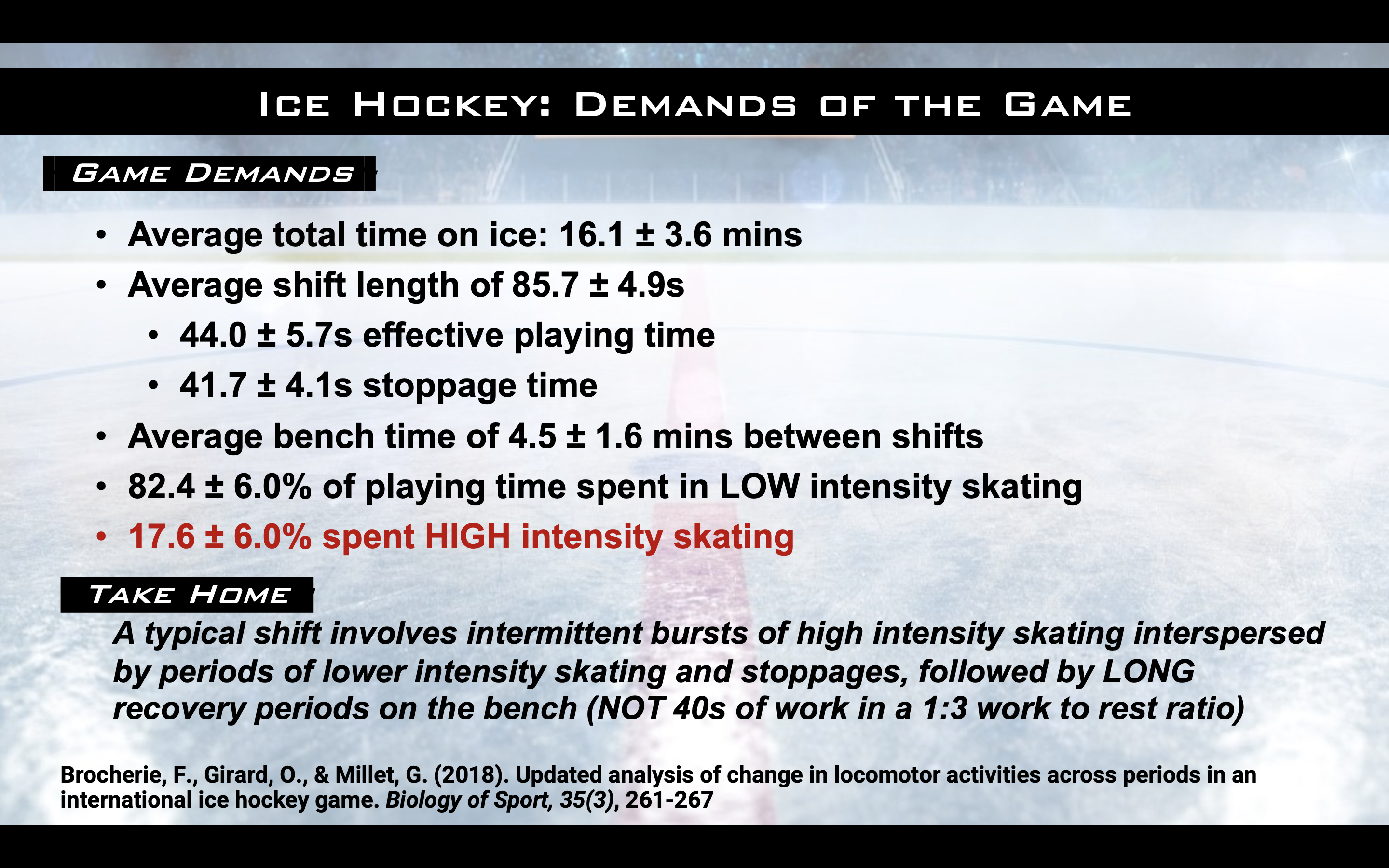
In an international hockey game, the average shift length was ~86s, which was split in half between playing and stoppage time. Players spent ~18% of their playing time in high intensity skating.

The big take home here is that the ice hockey requires bursts of high intensity skating interspersed by periods of lower intensity skating and stoppages.

Shifts are followed by LONG recovery periods on the bench.

This is significantly different from the 40s of work, 1:3 work to rest ratio commonly used to describe game demands.

The longer you go, the slower you go.

So recognizing that the game is comprised of peaks and valleys in movement speed/intensity (higher highs and lower lows), opposed to 40s of continuous work, should have a significant impact on how players condition.

To your success,

Kevin Neeld
SpeedTrainingforHockey.com
HockeyTransformation.com
OptimizingAdaptation.com

P.S. For in-season and off-season hockey conditioning programs, click here >> Ultimate Hockey Transformation

Enter your first name and email below to sign up for my FREE Sports Performance and Hockey Training Newsletter!

There are many ways to break down the demands of the game to gain insight into how to best prepare. In ice hockey, it’s common to look at shift length and work-to-rest ratios as an indicator of game demands.

At most levels of hockey, a typical shift is 40-60s and teams carry 3-4 forward lines and 3 d-pairs. Following this thinking, “hockey-specific” conditioning would involve work bouts of 40-60s with a 1:3 work-to-rest ratio.

While seemingly logical, this is one of the biggest mistakes in hockey conditioning.

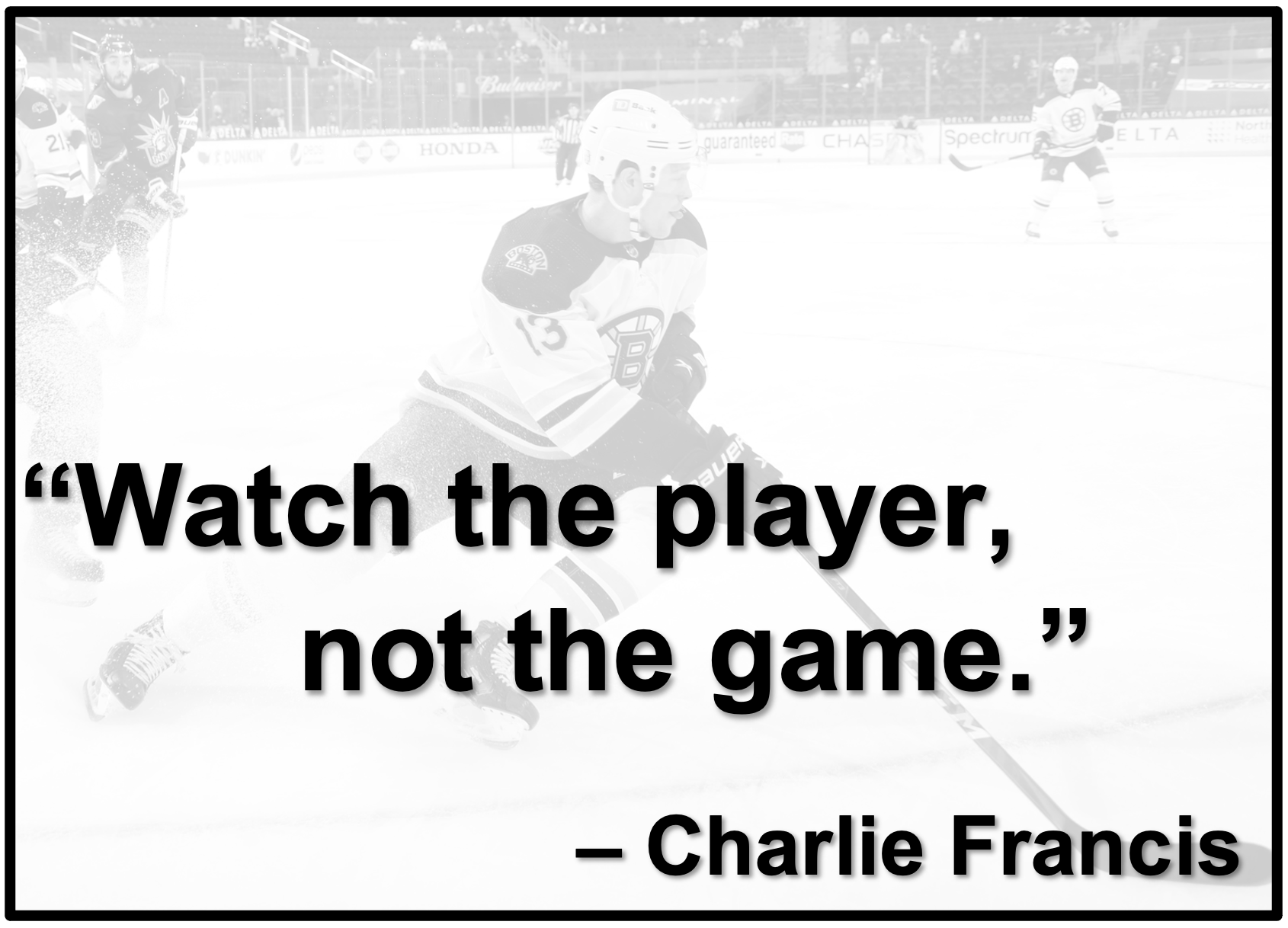
Legendary track coach Charlie Francis is often referenced as saying “Watch the player, not the game.”.

When you do this in hockey, a very different pattern emerges. For the individual player, a typical shift consists of intermittent maximum effort bouts interspersed with brief periods of rest.

Over-emphasizing 40-60 second work bouts, particularly on the ice, will compromise speed in 3 key areas: 1) speed of skating, 2) speed of skill execution, and 3) speed of decision making.

Over the next few weeks, I’ll share some of the available research highlighting the demands of the game, limiting factors to hockey conditioning, and specific training strategies.

If you have any specific questions or comments, post them below and I’ll address them throughout this series.

To your success,

Kevin Neeld
SpeedTrainingforHockey.com
HockeyTransformation.com
OptimizingAdaptation.com

P.S. For in-season and off-season hockey conditioning programs, click here >> Ultimate Hockey Transformation

Enter your first name and email below to sign up for my FREE Sports Performance and Hockey Training Newsletter!

Conditioning for hockey is arguably one of the most misunderstood elements of preparing for the sport. If done well, conditioning can help support speed development and repeating high-speed efforts over the course of a game and throughout the season. If done poorly, conditioning can interfere with speed development, and compromise the consistency of a player’s energy. 

Traditionally, many players just “played themselves into shape” over the course of the first few weeks of the season. Conditioning was more of an afterthought, not a structured, specifically sequenced training plan.

Our beliefs about hockey conditioning have come a long way in recent years. Thanks to technology like heart rate monitoring, video tracking, and accelerometry, sports scientists now have a much better understanding of the unique demands of the sport.

Unfortunately, this understanding has been slow to trickle down to the masses, and even slower to make meaningful change in how most players prepare for the season.

Below are four hockey conditioning myths that will interfere with optimal speed development.

1. A typical shift is 40-60s, so players should condition using intervals of this length to make shifts feel easier on game day

If you’re only looking at a stopwatch, intervals in the 45-60s range seem like the most specific way to prepare for hockey.

However, as world-renowned sprint coach Charlie Francis once said, “watch the player, not the game.” The reality is that, while the shift may last 45s, most players perform 2-5 high intensity skating and/or battling efforts lasting ~3-7s for a total work output of 15-25s per shift.

Of course, taking this information to mean that players should just perform intervals 20s in length would be almost as misguided as the rationale for going 45s.

The most effective use of this information lies in understanding the layers of what contributes to maximal performance in this environment. More specifically, the abilities to:

  • maximize acceleration/speed
  • produce high work outputs for durations less than ~8s
  • repeat several maximal work outputs of short duration with incomplete rest
  • effectively manage acidic environments and shuttle lactate to be used as a fuel by other muscles

These qualities all have specific training strategies, and working in the ~20-60s range really only addresses the last ability.

2. High-intensity interval training (HIIT) alone is sufficient for hockey conditioning

This is really related to the first point, but different in that high-intensity interval training is a phrase that has been driven largely by the fitness industry, whereas the 45-60s idea came from the hockey world.

It is common to see off-season training programs that prescribe high-intensity intervals (e.g. 8-10 rounds of 30 seconds on, 60 seconds off) using shuttle runs, slideboards, bikes, circuit training, etc.

While the inclusion of HIIT is a positive trend, it has come at the expense of other important conditioning strategies.

As mentioned above, these types of intervals are fueled heavily by glycolytic and aerobic energy systems, and repeat performance in these activities is heavily dependent upon pH management (the ability to buffer the acidic environment), the efficacy of the aerobic system of both providing energy and shuttling lactate to be used as a fuel by other muscles.

In contrast, shorter intervals with relatively longer rest periods (i.e. longer rest as a percentage of the work duration) emphasize higher movement speeds (neural and mechanical outputs), while also training the body to increase the rate of fuel delivery/processing.

Simply, this type of training helps players produce higher work rates during their high-intensity efforts each shift.

Exclusively using longer intervals misses an opportunity to train qualities essential to on-ice speed. To be clear, longer intervals definitely have a place in the off-season programs of most players, but only for a phase or two. And these phases should be placed at specific points within an off-season program to maximize on-ice transfer and minimize any interference with speed development.

3. Short rest between sprints is still speed training

This is one of the most common practical mistakes I’ve seen in a lot of youth hockey programs over the years. Coaches want to do “speed work” so they line the kids up, have them do sprints, walk back, and then go again.

On the surface, this seems like it’s abiding by the rules I laid out above (i.e. not just using longer duration intervals for conditioning). However, it’s important to really understand the GOAL of the training. Let me provide a few quick examples:

  • 25-Yard Sprint (60-90s rest): Conservatively, this sprint would take less than ~5s (depending on the age of the player), so resting for 60s is a 1:12 work to rest ratio. While elite sprinters require longer rest intervals, performing sprints in this manner in small clusters (e.g. 2-3 sprints then resting longer before performing another cluster) is effective at improving speed in hockey players.
  • 50-Yard Shuttle (75-90s rest): Slightly lengthening the work (~8-10s) while maintaining the same rest period will shift the emphasis toward extending high work outputs for prolonged periods of time. The rest period will not allow the player to recover fully, but will allow the player to perform ~6-8 sprints without a significant drop-off in time.
  • 50-Yard Shuttle (30s rest): Shortening the rest will lead to a significant drop-off in speed/time across repeated sprints. This decrease in speed is the result of an inability of the body’s fast energy delivery systems to recover from the previous efforts. In short, as speed decreases, more of the energy is supplied by the aerobic system. This isn’t inherently bad (as we’ll see shortly), but it’s clearly not speed training.

These are just a few simple examples to demonstrate the effect that the work and rest durations can have on the outcome of the training.

If the goal of sprinting is to improve speed, a good rule of thumb is to wait until the players are no longer breathing heavy – and then wait another 15-30s – before beginning the next sprint.

4. Aerobic training is unnecessary (and boring)

With such an emphasis on maintaining high speed outputs throughout training, you may be thinking that aerobic training is obsolete.

Here’s the thing – having a well-developed aerobic system will help players recover faster from high intensity efforts (e.g. recover faster from a sprint), recover better between games, and generally adapt to training better.

These are all obviously desirable benefits. There are two important things to consider when integrating aerobic training into off-season hockey training programs – the method, and the timing.

Aerobic training gets a bad reputation in part because when most people hear aerobic training they think of long, slow continuous running or biking. While these are certainly methods that can serve a purpose, there are several others less monotonous ways to develop the aerobic system.

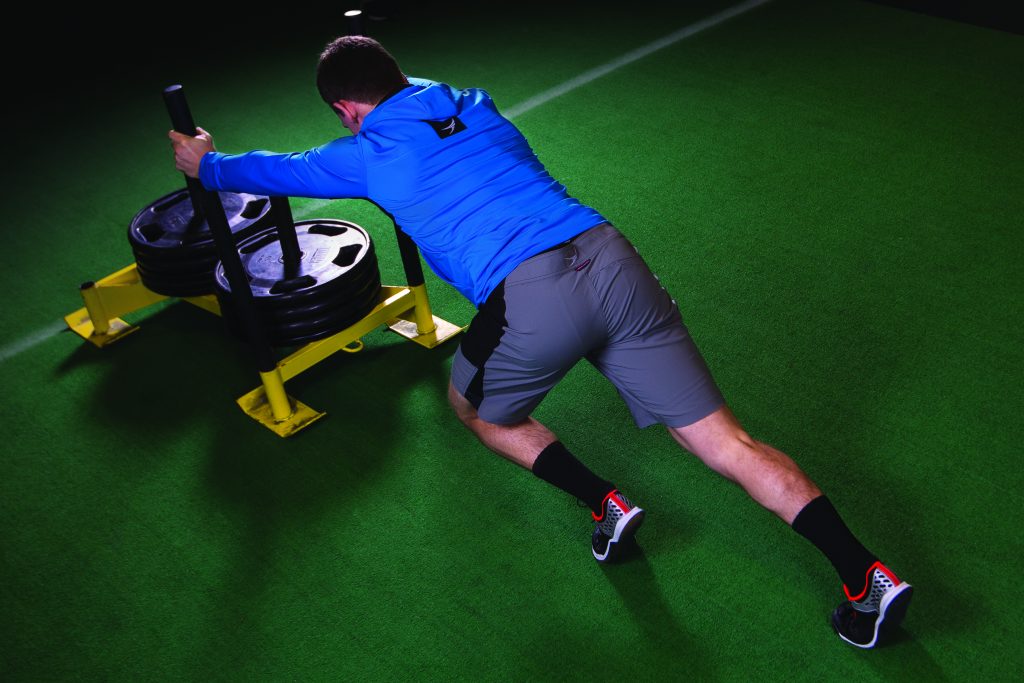
For example, repeating intervals of a 10s heavy sled push with 60s of rest with heart rate below the anaerobic threshold can be a way to improve the oxidative abilities of fast twitch muscle fibers.

As another example, running clusters of 30s of work with 30s of rest at a speed around a mile run pace allows players to accumulate a significant amount of work above VO2 Max, which is a strong stimulus for improving aerobic power.

Neither of these methods resemble traditional aerobic training, but the training targets are aerobic in nature.

The second major consideration is the timing. There is more flexibility to adjust timing as training frequency increases, but in general – it’s best to avoid high volume aerobic work on the same day as high speed/power/force work.

Because the body adapts to high loads on the nervous and muscular systems differently than it does to aerobic training, attempting to improve both in the same day leads to conflicting messages about how the body should adapt.

Ultimately, this compromises improvements in both areas. This is particularly true with athletes that have been training for more than a couple years.

Including aerobic work on the days between “lifting days” can be a great method to help players improve their aerobic abilities, recover from the previous day, and accumulate more training volume. In this way, the player can enjoy the benefits of aerobic training without sending conflicting messages to the body about how to adapt.

When more optimal methods are chosen and programmed at the right time, aerobic training can be an effective means of improving a hockey player’s ability to consistently perform high speed efforts, shift after shift, game after game, season after season.

Wrap Up

These four hockey conditioning “myths” are all well-intentioned and seemingly logical. Understanding why and when to program specific strategies can make a huge difference in whether the strategies are effective at supporting consistent high-speed performance, or whether the conditioning interferes with a player’s speed training efforts. 

Tomorrow morning I’m going to send a special announcement exclusively for newsletter subscribers. If you haven’t already, get on the list by entering your name and email in the form below!

To your success,

Kevin Neeld
HockeyTransformation.com
OptimizingMovement.com
UltimateHockeyTraining.com

Enter your first name and email below to sign up for my FREE Athletic Development and Hockey Training Newsletter!

A couple days ago, I mentioned that we’re hosting Joel Jamieson’s new Certified Conditioning Coach course at our facility on April 2nd and 3rd. In response to that post I received a bunch of notes from people either expressing an interest in taking the course, or telling me how great it was when they took it previously.

If you’re interested in taking the course, register ASAP. We’re limiting the course to ~40 attendees and have already sold over half the seats. You can get more information and register at the link below.

Certified Conditioning Coach

Reserve your seat here >> Certified Conditioning Coach

Given the interest in energy system development my last post sparked, I thought it would be an opportune time to repost a video I’ve shown a few times of a presentation Joel gave on the topic. This is a GREAT presentation, and one of the best free resources available. Check it out below!

A few years ago when I first came across this presentation from Joel Jamieson, it caused me to rethink a lot of what I thought I knew about “conditioning”. Since that time, I’ve read (and re-read) his two books, seen him speak a few times, and even spoke alongside him when the two of us did a one day seminar (where Optimizing Movement was filmed).

Joel Jamieson-Ultimate MMA Conditioning

Ultimate MMA Conditioning is a must-read for anyone that trains athletes in any sport

Needless to say, I think this information is incredibly valuable; it’s had a profound impact on the way that I write my programs.

Even in rereading my comments about the video below, I know that my perspective on energy systems work has changed considerably over the last 4 years, especially as it pertains to redeveloping aerobic qualities in hockey players (and all athletes in general) in the early off-season. We’re using methods now that I would have never thought to use in 2011, and the foundation for a lot of that change was built on this video.

Enjoy! And if you want to share any of the conditioning methods you’re using or have any questions, please post them in the comments section below.

A New Perspective on Energy Systems

I hope you’re all enjoying your day off (if you got one). Endeavor Sports Performance typically shuts down for Memorial Day, but Matt, David, and I are leaving Thursday night to head up to Boston for the Hockey Symposium, so we have to open up today to make sure all of our athletes can get their sessions in before we go. Just another day in the office! (I’m pretending that today isn’t the first day that it hasn’t precipitated since last November).

Rather than spending the day outside enjoying the sun and BBQing, I thought you’d be more interested in watching a great presentation on energy systems development from Joel Jamieson, who’s a really bright guy. Joel primarily trains MMA fighters out of his facility in Seattle, WA, but he also has experience with football and soccer players. More importantly, and you’ll get this quickly from watching his presentation, his training philosophy is science-based. While I don’t think that every line on a training program needs to have a citation next to it, I think using quality research as a backing for your training philosophies ensures that you understand the underlying principles of athletic development, which can be effectively applied to any sport (in a sport- and athlete-relevant manner).

This video is from a presentation Joel gave at the Central Virginia Sports Performance Seminar at the University of Richmond in Virginia, and he includes a download link for the power point slides so you can follow along. Click the link below and watch the video now (it’s completely free and doesn’t require registering for anything):

Click Here to Watch >> A New Perspective on Energy Systems

I finished watching the video late last week and left with a few good research resources to look into and an augmented understanding of energy metabolism and physiology. I can’t help but feel that some of his words will be grossly misinterpreted though.

One thing that stood out to me as extremely hockey conditioning relevant is the large degree to which the aerobic system contributes to repeat sprint performance with incomplete recovery. Using running as a model, Joel presented that the energy delivery for 200m (~22s) and 400m(~49s) sprints were 29% and 43% aerobic, respectively. In other words, in the time equivalent of an average hockey shift, roughly 1/3-1/2 of the energy provided is aerobic, and this is likely to increase with incomplete recovery between bouts (e.g. as shifts progress within a period).

In my opinion, Joel’s presentation offers more accurate explanatory power than it does a drastic change in the way we condition for hockey. The major take home message is that you need to understand the demands of the sport and prepare accordingly. I think people see something like “50% of energy is from anaerobic sources and 50% is from aerobic sources” and think “50% of my training should be sprint repeats and 50% should be continuous aerobic work.” In reality, all this is saying is that the sprint repeats will eventually be developing aerobic systems in addition to the know anaerobic benefits.

Primarily Aerobic? Anaerobic? Does it matter?

This is one of the reasons why I think it’s more important to have an in-depth understanding of the work:rest ratios and overall work intensities of the game than it is to understand the underlying physiological mechanisms driving them. As an overly simplified example, if hockey includes, on average, about a 40s shift of which about 20s is spent at all out intensities every 3 minutes, and we use some similar work intervals and work to rest ratios to create a slight overload on the involved metabolic systems, does us realizing that more of the on-ice energy AND off-ice training energy is coming from aerobic metabolism than we previously thought change the way we train? I’m not sure it does. I’m certainly not implying that I disagree with anything Joel said in his presentation, and I agree that certain athletes will need a greater emphasis on certain qualities based on their athletic profiles, but I think some people over-emphasize the physiological explanations and under-emphasize the much more obvious and intuitive game demands. What do you think? Check out the video and post your comments below!

To your success,

Kevin Neeld
HockeyTransformation.com
OptimizingMovement.com
UltimateHockeyTraining.com

Please enter your first name and email below to sign up for my FREE Athletic Development and Hockey Training Newsletter!
Get Optimizing Movement Now!

“…one of the best DVDs I’ve ever watched”
“A must for anyone interested in coaching and performance!”

Optimizing Movement DVD Package

Click here for more information >> Optimizing Movement

Today’s Thursday Throwback is an appropriate follow-up to last week’s post on the relationship between flexibility and muscle injury risk. If you missed that, you can check it out here: Does Flexibility INCREASE your risk of injury?

This is another short, but important read, as it touches on an idea that I think every youth athlete I’ve ever worked with has been taught incorrectly. Enjoy the post, and please pass it along to any friends or family you think would benefit from reading it!

Should You Stretch After You Pull A Muscle?

Think about the times in your life that you’ve “tweaked” a muscle or slightly strained/pulled it.

What was the FIRST thing you did on your own or were told to do?

If you’re like most people, you immediately stretched the muscle.

straight-leg-adductor-stretch-bilateral

This isn’t always the answer

The very first thing I tell my athletes if they tweak a muscle is NOT to stretch it!

A muscle strain can range from a slight over-stretch to a complete tear. Assuming the muscle isn’t COMPLETELY torn, it’s likely that there is some micro-damage to the muscle and that the muscle feels tight because it’s guarding against further injury.

This means that most people are attempting to stretch an over-stretched muscle AGAINST the muscles’ contraction.

Not only is this not an effective way to speed up your healing, but it’s probably making your injury worse!

Think about your muscle as a rubber band. Now imagine cutting a small slit in the rubber band with a razorblade.

If you stretch that rubber band now, what’s going to happen?

The small slit is going to expand, getting longer and wider.

Does making a slight tear in your muscle longer and wider seem like a smart recovery strategy?

If you tweak a muscle, DO NOT stretch it. You can ice it if you want (although I’m not convinced that ice does anything either). If you’re going to stretch anything, stretch the muscles that OPPOSE the injured muscle.

Many muscles are overworked or strained because of a relative stiffness imbalance with their antagonists, so stretching the opposing muscle can help bring you back into balance.

To your success,

Kevin Neeld
OptimizingMovement.com
UltimateHockeyTraining.com

Please enter your first name and email below to sign up for my FREE Performance Training Newsletter!

Get Optimizing Movement Now!

“…one of the best DVDs I’ve ever watched”
“A must for anyone interested in coaching and performance!”

Optimizing Movement DVD Package

Click here for more information >> Optimizing Movement

Use CODE: "Neeld15" to save 15%