
Over the last couple of weeks, I’ve shared some research underlying why I believe hockey should be viewed as a “repeat sprint” sport.

One thing I didn’t mention…repeat sprint ability should be built on a foundation of low position endurance.

Maintaining low positions provides an opportunity for players to develop maximal power through each stride, along with a number of other benefits in terms of angling, puck protection, and leverage to give and absorb contact.

It’s also simple to assess and train.
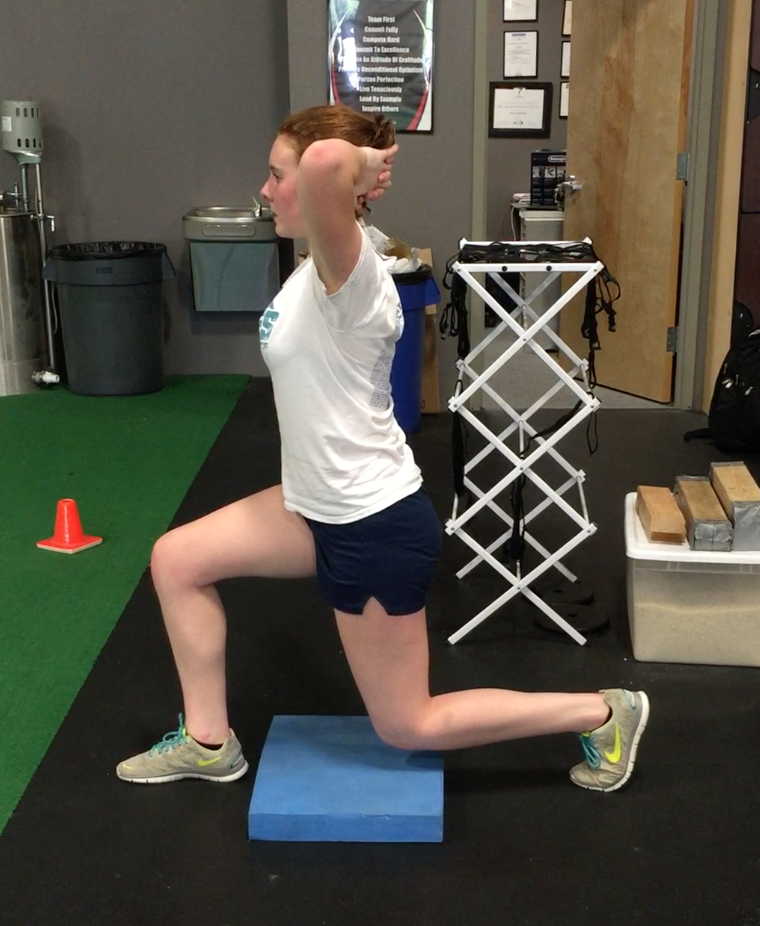
In my book Speed Training for Hockey, I outlined the below age-based standards for a Split Squat IsoHold:

  • U-14: 60 seconds
  • U-18: 60-90 seconds
  • 18+: 90-120 seconds

Give this a shot and see how you do. If you can’t meet these times, building in holds 2-3 times per week is a great place to start.

Feel free to post any other comments/questions you have below. If you found this helpful, please share/re-post it so others can benefit.

To your success,

Kevin Neeld
SpeedTrainingforHockey.com
HockeyTransformation.com
OptimizingAdaptation.com

P.S. For comprehensive programs to improve your speed AND repeat sprint ability, check out: Speed Training for Hockey
Enter your first name and email below to sign up for my FREE Sports Performance and Hockey Training Newsletter!
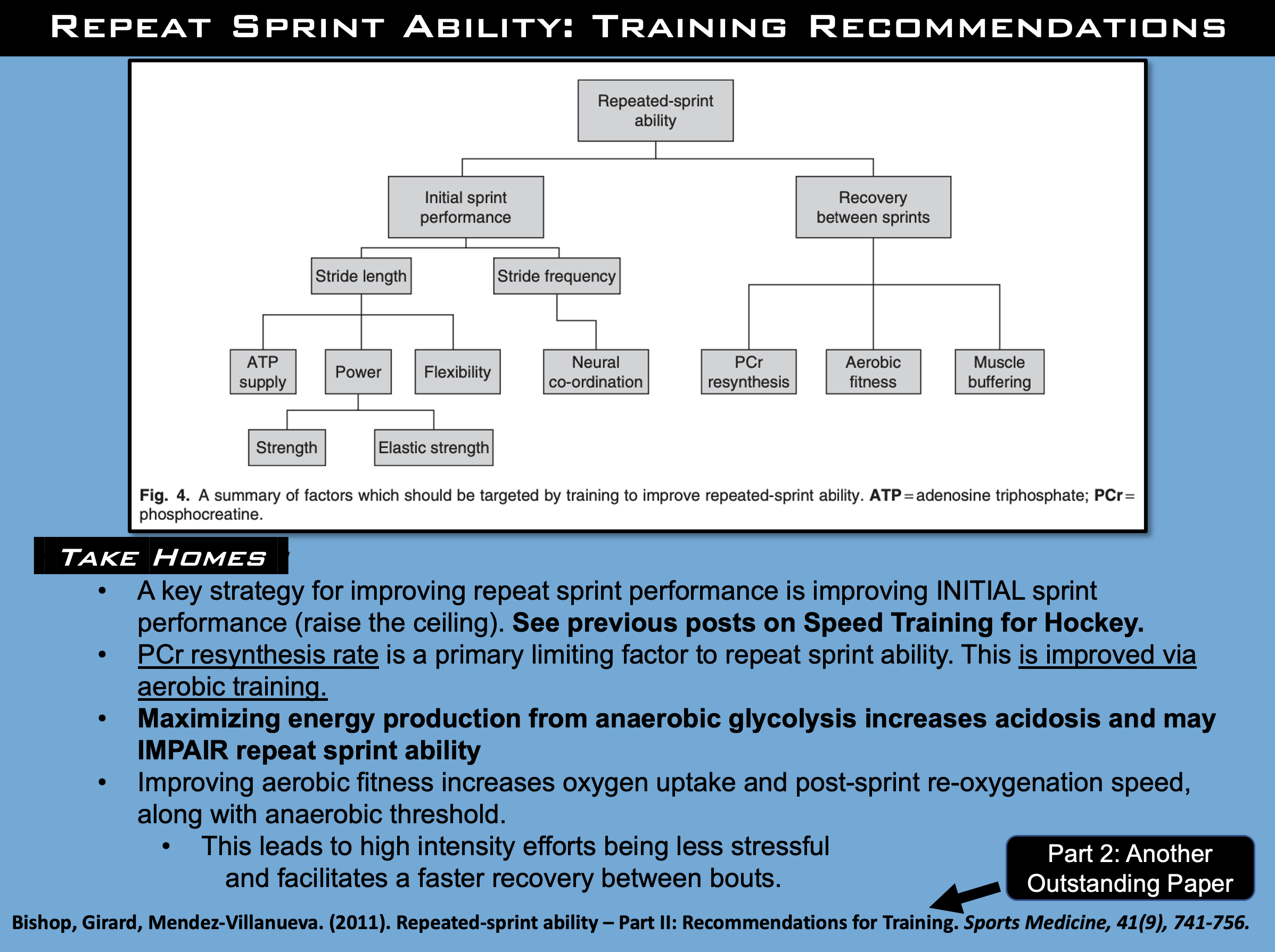

There are two main strategies for improving repeat sprint ability:

  1. Improve initial sprint performance
  2. Improve recovery between sprints

If you’re interested in training strategies to improve speed, check out the previous series I did on Speed Training for Hockey (also available at my instagram account: @KevinNeeld)

Clearly, training to improve speed requires maximum effort, high-intensity work bouts. What may be less obvious is that the most effective strategies for training a player to SUSTAIN these high-intensity efforts lean heavily on aerobic training.

Train high to improve speed.

Train low to improve recovery.

High. Low.

A key message here is to MINIMIZE work at moderate intensities.

I’ll share some specific examples in future posts, but feel free to post any other comments/questions you have below. If you found this helpful, please share/re-post it so others can benefit.

To your success,

Kevin Neeld
SpeedTrainingforHockey.com
HockeyTransformation.com
OptimizingAdaptation.com

P.S. Get your off-ice training programs here >> Hockey Conditioning Programs

Enter your first name and email below to sign up for my FREE Sports Performance and Hockey Training Newsletter!
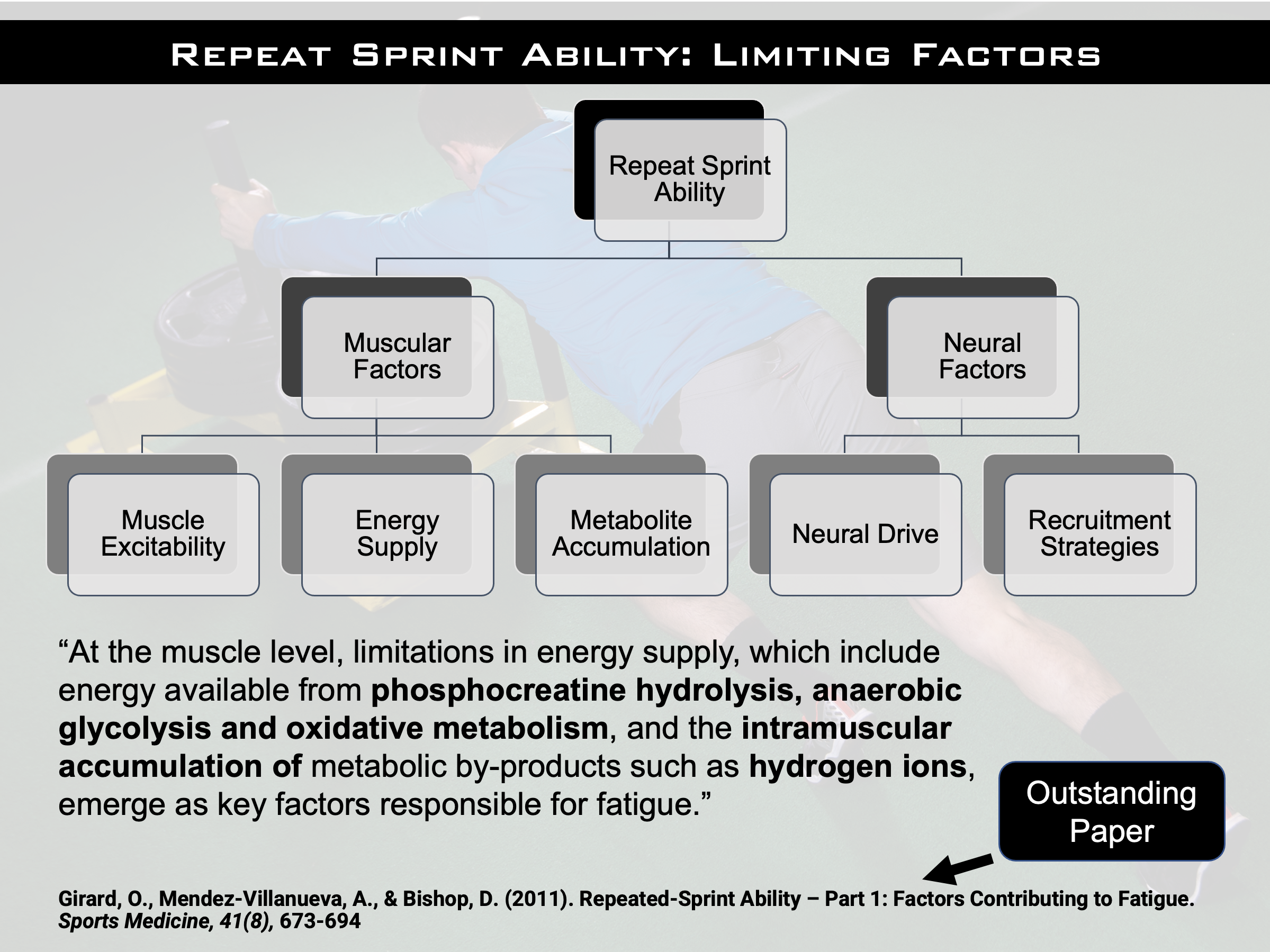
One of the most common questions I get is “what’s the best way to condition for hockey?” Often times, people are looking for one prescription (e.g. “Do 12 sets of 15s of work with 45s of rest”).
 
This review paper from Girard et al. (2010) details the factors that contribute to fatigue in repeat sprint efforts (must read for anyone working in strength and conditioning or sports science roles).

In order to have repeat sprint ability, you need to first have sprint ability. Training to improve maximal output and rate of energy production will positively impact single effort bursts.

In order to sustain output, training maximum effort, longer duration efforts (e.g. 20-60s) will help improve buffering.

Lastly, sustained outputs AND recovery from maximal effort bursts, including replenishing depleted energy stores, are reliant on the aerobic system, so aerobic training can have a profound effect on within-shift, within-gam, and within-season sustainability.

The key take home here is that conditioning for hockey, like most team sports, is going to require developing all of the energy systems.

Feel free to post any comments/questions below. If you found this helpful, please share/re-post it so others can benefit.

To your success,

Kevin Neeld
SpeedTrainingforHockey.com
HockeyTransformation.com
OptimizingAdaptation.com

P.S. Get your off-ice training programs here >> Hockey Conditioning Programs

Enter your first name and email below to sign up for my FREE Sports Performance and Hockey Training Newsletter!
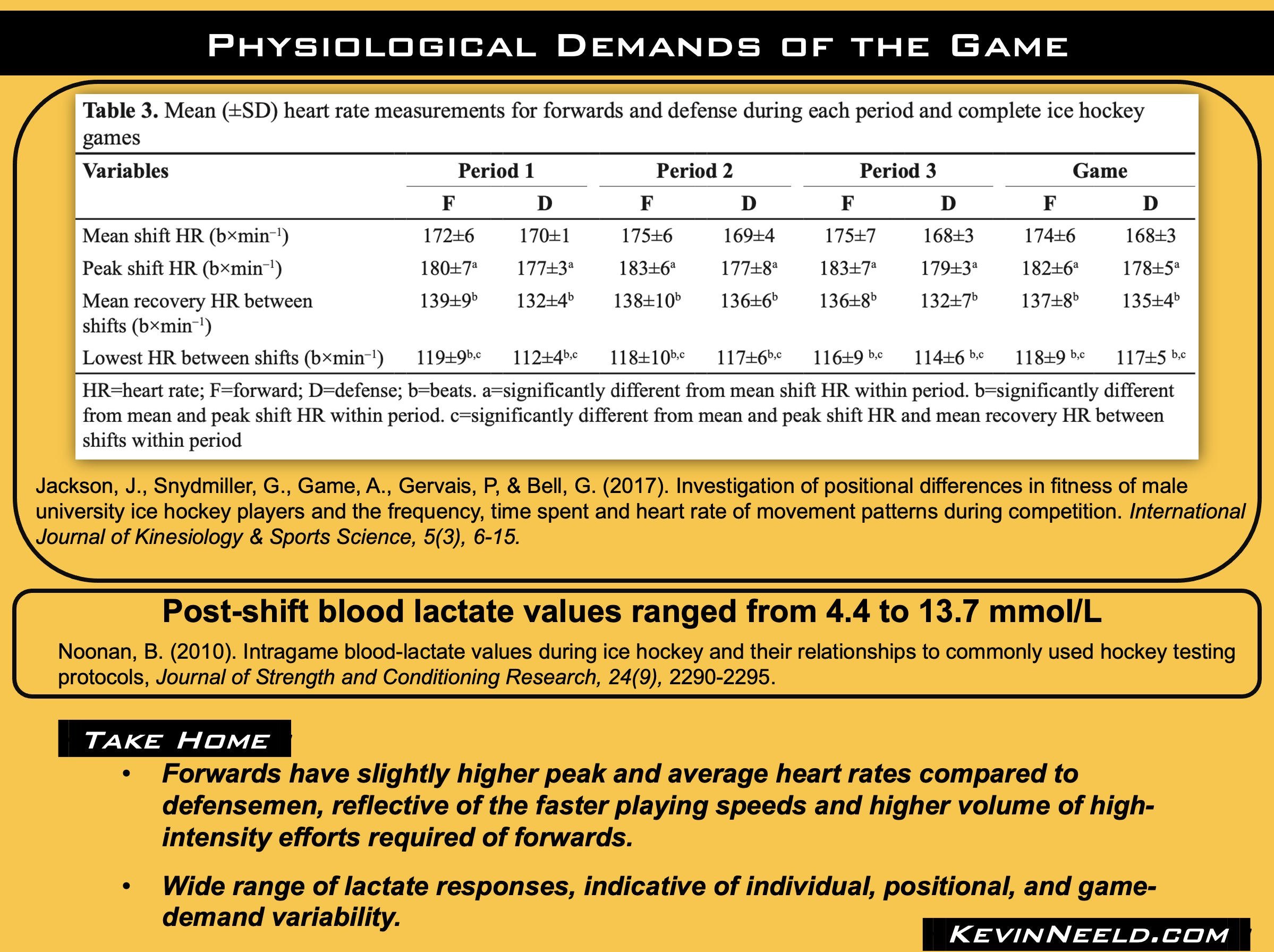
There are many ways to analyze the physiological demands of a sport, but tracking heart rate (HR) is the most commonly used.

When looking at the HR response during shifts of male Canadian university players, forwards had higher peak and average HRs compared to defensemen. This is consistent with my experience, and speaks to the faster playing speeds and greater number of high intensity efforts forwards accumulate during a typical shift (mentioned in previous posts).

Hockey is often described as a “lactic” sport. When analyzing post-shift levels, Noonan (2010) found that players’ blood lactate ranged from 4.4-13.7 mmol/L. 4 mmol/L is traditionally referenced as the “lactate threshold”, which means thinking of hockey as a lactic sport isn’t wrong, but the wide range of values highlights the individual, positional, and game-demand variability.

Further, it raises questions about whether we should be training players to more heavily rely on lactic metabolism or maximize aerobic power to minimize the amount of work that crosses that threshold.

Feel free to post any comments/questions below. If you found this helpful, please share/re-post it so others can benefit.

To your success,

Kevin Neeld
SpeedTrainingforHockey.com
HockeyTransformation.com
OptimizingAdaptation.com

P.S. Get your off-ice training programs here >> Hockey Conditioning Programs

Enter your first name and email below to sign up for my FREE Sports Performance and Hockey Training Newsletter!
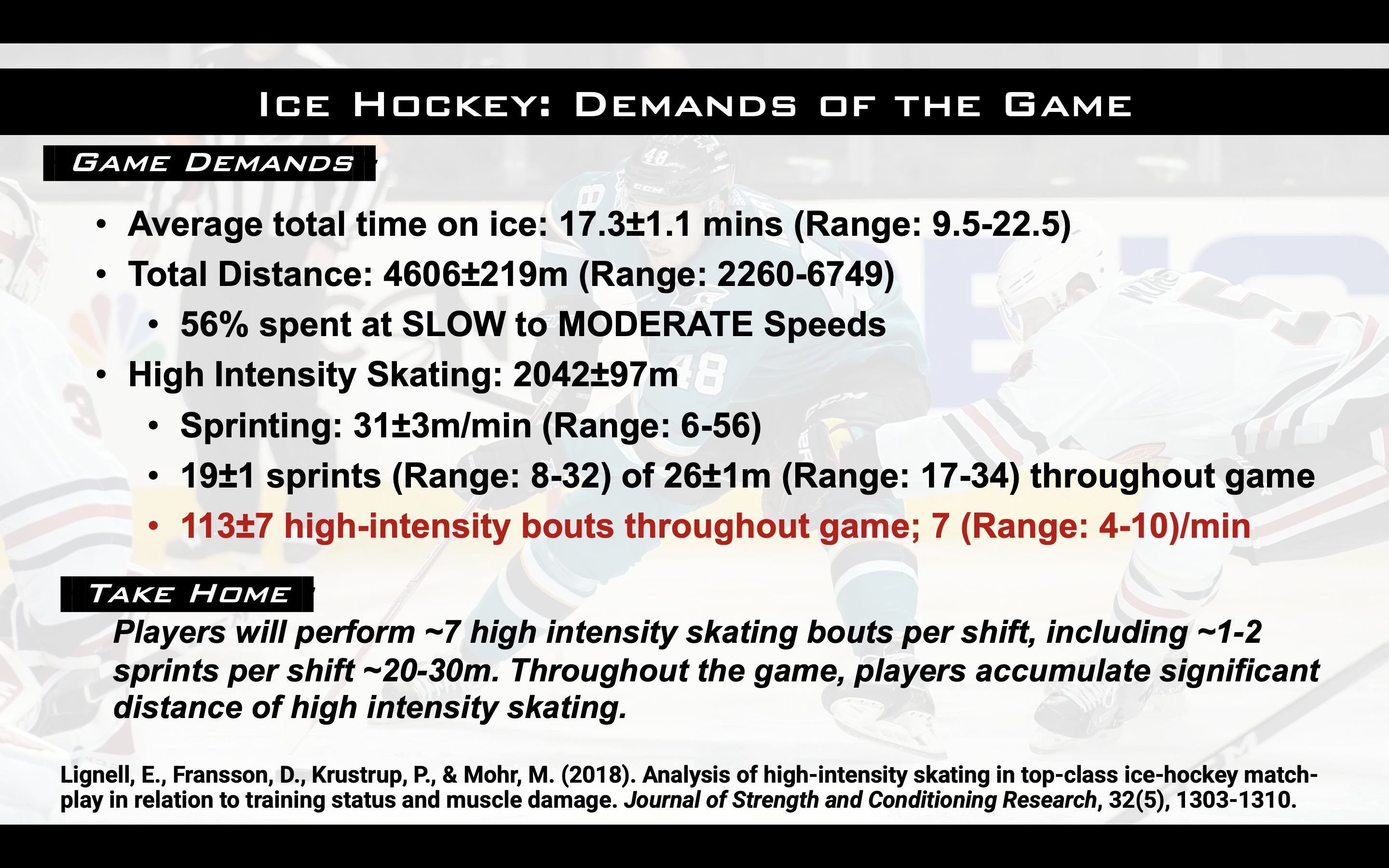
In a professional hockey game, players perform around 7 high intensity skating efforts per shift, including 1-2 sprints around 20-30m, accumulating over 2000m in high intensity skating throughout a game.
 
These sprinting efforts often have an impact on possession, scoring opportunities, and ultimately the outcome of the game.
 
Ice hockey is a repeat sprint sport, and as a result, hockey conditioning programs should be built around an understanding of the limiting factors to repeat sprint ability.
 
There are two other important considerations:

  1. Positional differences
  2. The impact of body position and contact during “slow to moderate speed” skating

More on these to come…

To your success,

Kevin Neeld
SpeedTrainingforHockey.com
HockeyTransformation.com
OptimizingAdaptation.com

P.S. For in-season and off-season hockey conditioning programs, click here >> Ultimate Hockey Transformation

Enter your first name and email below to sign up for my FREE Sports Performance and Hockey Training Newsletter!

Use CODE: "Neeld15" to save 15%