On Monday, I recounted a few of the highlights of 2011. If you missed it, you can check it out here: 2011 in Review
As I mentioned in that post, KevinNeeld.com has grown significantly over the last year, all in thanks to your help in spreading the word. After reviewing the popularity of all posts over the last year, I’ve compiled a list of the top 10 Athletic Development & Training Posts of 2011. Check them out at the links below!
These were all well-received posts related to general athletic development and strength and conditioning. I’ll wrap up the week in a couple days with the top hockey training and nutrition posts of 2011. Stay tuned for that and please pass this along to everyone!
To your success,
Kevin Neeld
Please enter your first name and email below to sign up for my FREE Athletic Development and Hockey Training Newsletter!
2012 Sports Rehab to Sports Performance Teleseminar
Every year, my friend Joe Heiler from SportsRehabExpert.com interviews some of the world’s top professionals in rehabilitation and performance training and makes them available to you for FREE! This year’s line-up looks to be better than ever. Check out who’s speaking:
Shirley Sahrmann PT – Movement Impairment Syndromes of the Cervical/Thoracic Spines and Extremities.
Calvin Dietz – U. Minnesota – Triphasic Undulating Training Model, Submax.High Velocity Training, the Role of the CNS in Strength and Conditioning
Charlie Weingroff PT/Bill Hartman PT – Dynamic Neuromuscular Stabilization and Postural Restoration Institute
Pavel Tsatsouline RKC – Kettlebell Training for Performance, Injury Prevention, and Rehab
Patrick Ward- LMT, CSCS– Comparing the Soft Tissue Systems, the Fascial System and Load Transfer, STM for Recovery
Kyle Kiesel PT – Motor Control Research and Applications to Rehab/Training, Diagnostic Ultrasound and Low Back Pain
Greg Rose DC – 4×4 Matrix, Asymmetry and Motor Control Dysfunction
Mike Reinold PT – RTC repair, Patellofemoral Rehab, Functional Stability Training
Craig Liebenson DC – Functional Evaluation and Treatment
Eric Cressey CSCS – Impingement and Instability, Power Training, Functional Stability Training
The lecture series will kick off on Tuesday January 17th at 8pm, with a new interview posted every Tuesday evening through March 21st. Each interview will be available for the entire week on a free page on my site so you can catch them when you’ve got the time.
I look forward to this every year. I still regularly listen to several of the interviews from last year’s teleseminar. Head over to this link and sign-up now: The Sports Rehab to Sports Performance Teleseminar
It’s completely free, so you’ve got nothing to lose!
To your success,
Kevin Neeld
Please enter your first name and email below to sign up for my FREE Athletic Development and Hockey Training Newsletter!
2011 in Review
With 2012 officially upon us, it’s a great time to reflect on the past year, which was the busiest year of my life.
I knew 2011 was going to be an interesting year based on how it started. On New Year’s Eve last year, Emily and I went out with a group of our friends to a bar/restaurant in Center City Philadelphia to celebrate the occasion. At the end of the night, Emily wasn’t feeling too hot so we left early to grab a cab home. Unfortunately, and very uncharacteristically, there wasn’t a cab in sight. Apparently the other ~100,000 people in the city that night also decided they didn’t want to walk home in the sub-freezing weather. After 5 minutes of futile searching, we decided to huff it ~1 mile through the city to our apartment. About 23 feet into that journey, Emily was shaking because she was so cold. Dresses don’t make great windbreakers. At a loss for resources, I offered for her to wear my khakis to help warm her up, which she graciously accepted. 2011 kicked off with a freezing, pant-less saunter through the city! About a quarter of the way home, a clever gentleman yelled, “I guess we know who wears the pants in that relationship!”
All partial nudity aside, 2011 has been an exciting year for me. In addition to being swelteringly hot, the Summer was extremely busy.
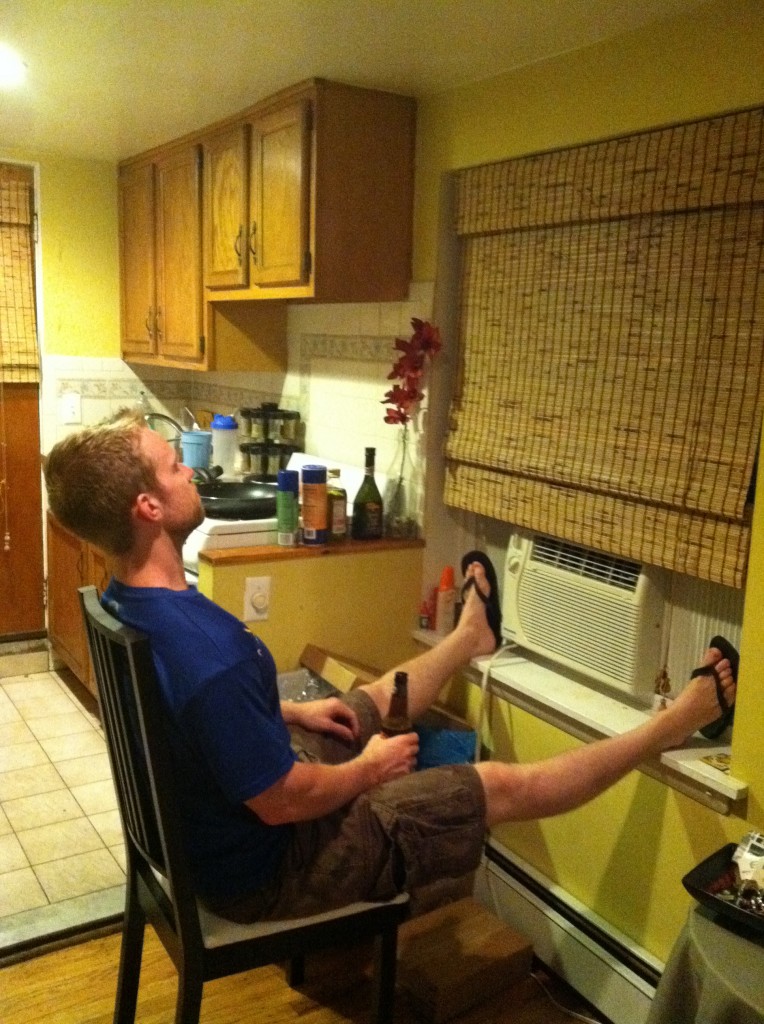
Keeping cool in our 3rd floor Philadelphia apartment
Our off-season hockey group at Endeavor included 41 elite players from the Tier I youth level through those competing for NHL jobs, the majority of which were Junior A and NCAA players. This is in addition to the dozens of youth players we had. Naturally, with all of the assessments, individualized corrective work, and ongoing program management, our off-season hockey group kept me pretty busy over the Summer! I’m very proud of the work these guys put in over the Summer, and to see the growth in players competing at elite levels from the Mid-Atlantic area since I was a player. I always joke with people that I run a hockey-specific training facility in the hockey hot-bed of South Jersey. The Mid-Atlantic still isn’t Minnesota or Quebec, but the sport has grown tremendously over the last 15 years and as more players gain recognition from the area, it will continue to do so.
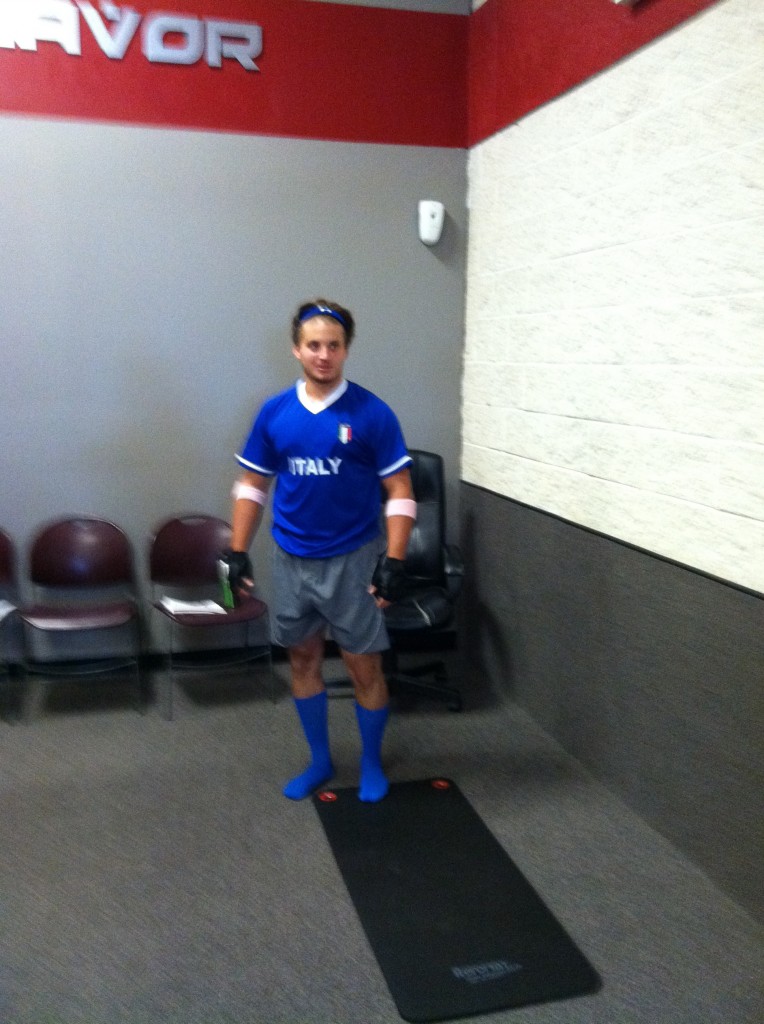
The kids took their liberties when I lifted all dress code policies for the last day of the off-season
Superimposed on this off-season group was my most concentrated continuing education efforts to date. From June 3rd through December 1st, I completed one home study course, attended 6 seminars, and 3 certification programs. These included trips to Boston, Chicago, New York City, Pittsburgh, Phoenix, and Lincoln, Nebraska. This was on top of the two trips I made to Blaine, MN and one trip to Quinnipiac University to help with the U.S. Women’s National Hockey Team camp testing and strength and conditioning, a trip to San Jose to help with the Sharks’ Training Camp, and a trip to San Diego with Emily to relax for a few days. Needless to say, I’ve gotten to know the Philadelphia airport!
Me and Coach Boyle at the Perform Better Summit in Chicago
In the midst of the busiest year of my life, the release of my new book Ultimate Hockey Training stands out as the highlight of the year. Ultimate Hockey Training, which is only a few months old at this point, has sold extremely well and has received outstanding feedback from parents, coaches, and sports medicine professionals from all over the world. I appreciate all of your feedback and help in spreading the word. In 2012, I’m going to make a bigger push to improve the book’s exposure in hockey pro shops, super stores, and magazines. If you’re interested in selling it at your location and/or have any other ideas on how to make more people aware of it, I’d love to hear from you! Just shoot me an email and we can work through the details.
The Ultimate Hockey Training Package
This has been a groundbreaking year for KevinNeeld.com as well. Over the last year, the site has received 188,535 page views, a ~99% increase from the previous year. Much of this growth can be attributed to you, as it’s through you forwarding the posts you like via email, Facebook and Twitter that most people come across my site in the first place. Throughout the rest of the week, I’ll be recounting the top hockey training and athletic development posts of 2011. Stay tuned! And thank you again for your continued support. I couldn’t do it without you.
To your success,
Kevin Neeld
Please enter your first name and email below to sign up for my FREE Athletic Development and Hockey Training Newsletter!
Hockey Conditioning: Combating Fatigue
A couple days ago, I outlined a terrific review article on what factors limit repeat sprint performance. If you missed it, you can check it out here: Hockey Conditioning: Understanding Fatigue. Repeat sprint performance, as the authors of that review defined, includes repeated maximum intensity efforts of <10s with <60s rest in between. Most people reading this are probably familiar with the idea that most of you reading this are familiar with the fact that an average hockey shift will fluctuate between ~30-75s depending on the position and level. What many people overlook, however, is that these shifts don’t involve 100% efforts the entire time the player is on the ice. Even the average excessively hyper 11-year-old hopped up on the donut holes and Monster their parents bought them as a pre-game meal couldn’t go 60s at this intensity.
If your son looks like this, he probably doesn’t need another energy drink.
There are inherent physiological mechanisms that will begin to limit performance if a certain intensity is maintained for prolonged periods of time (e.g. 10+ seconds). Elite level hockey players are very efficient at managing their fatigue during a shift. They intersperse periods of all-out efforts with periods of gliding, lighter skating, and repositioning, and when this isn’t possible, they keep their shift short to minimize the accumulated fatigue. Most don’t know they do this; it feels natural to them. For our purposes, the most important thing to recognize here is that a 45s shift is comprised of several significantly shorter high intensity efforts separated by periods of lower intensity efforts and/or stoppages. For this reason, understanding the mechanisms underlying performance decrements in repeat sprint ability is essential, as this is EXACTLY the quality hockey players want to train to ensure that they’re as fast at the start of the game as they were at the beginning.
Today, I want to explore the companion research review article from Bishop et al., 2011, titled “Repeated-Sprint Ability – Part II: Recommendations for Training”. Before we get into it, I think it’s important to point out that recommendations on how to improve ANY physical quality always need to be kept in perspective. There are psychological, physiological, and training “age” considerations, but even within any combination of those cohorts, there are always appropriate times in the hockey calendar and obligatory progressions leading up to any given training practice; this is especially true of conditioning. My hope is that you won’t simply read “this is the best way to improve repeat sprint ability” and just use the recommendations from this article repeatedly year-round. This will invariably lead to decrements in OTHER physical qualities, which will negatively effect on-ice performance. Everything in training needs to be kept in context.
Training Recommendations to Improve Repeat Sprint Ability (RSA) The authors kicked off the article by pointing out that having a “good” RSA is more about having a high average sprint speed, than just a low drop-off. In the case of the latter, a marathon runner would have a relatively low drop-off, but their starting speed wouldn’t be very fast, and therefore not adequate within the context of hockey speed. This, again, simply illustrates the trade-off between maximum speed and maximum endurance. Below is a list of take-home points from the article that help explain which types of training will help improve RSA. If you haven’t already, please read this article (Hockey Conditioning: Understanding Fatigue) before continuing on with the list below, as these points may not make sense without understanding how they affect one or more of the RSA fatigue mechanisms!
A high-intensity interval training protocol of 6-12 x 2 mins of work at 100% VO2Max, followed by 1 minute of rest can significantly improve PCr (phosphocreatine) resynthesis/replenishment during the first 60s of recovery following a high-intensity effort. This is especially pertinent in light of the fact that NO changes in the rate of PCr resynthesis have been found following an interval training protocol of 8 x 30s of work at 130% VO2Max followed by 90s of rest, a protocol of 15 x 6s of all-out sprinting followed by 60s of light jogging, or a protocol of 4-7 all out 30s efforts followed by 3-4 minutes of rest. The authors pointed out that some of these results may be explained by the fact that other studies used a 3-minute post-exercise PCr check-in point, which may miss the initial changes in a more rapid resysnthesis. That said, the finding of improved PCr resynthesis in the first 60s following the above protocol is an interesting finding.
Changes in enzymes that affect anaerobic glycolysis (such as phosphofructokinase and phosphorylase) are greater following a training protocol that involves repeated 30s sprints compared to one that involves repeated 6s sprints or continuous training.
Changes in glycolytic enzymes are also greater following high-intensity intervals that are followed by long rest intervals (10-15 minutes) compared to shorter rest intervals (3-4 minutes), probably as a result of higher peak blood and muscle lactate levels with the longer recovery. Taken together, these results suggest the most optimal way to develop anaerobic performance is to train using 20-30s all-out intervals with ~10-minute rest intervals.
There is not a linear relationship between VO2Max and various RSA fatigue measures, indicating that the goal should be to train for an “optimal” VO2Max, not necessarily a “maximal” V02Max.
Interval training at approximately 100% VO2Max leads to larger increases in VO2Max than continuous training matched for total work, but only if the continuous training is below ~60% VO2Max, otherwise the differences are negligible.
Interval training has the added benefits of augmenting other desired adaptations, such as the rate of PCr resynthesis and muscle buffer capacity. The authors recommend performing high-intensity intervals at ~80-90% VO2Max with rest periods that are shorter (e.g. 1 minute) than the work periods (e.g. 2 minutes).
A high-intensity interval training protocol of 6-10 x 2 minutes work at 120-140% of the lactate threshold followed by 1 minute of rest increases muscle buffer capacity, but 30 minutes of continuous training at 80-95% of the lactate threshold does not.
Excessive accumulation of H+ during training may actually have a detrimental effect on adaptations to the pH regulatory systems within the muscle. This could result from interval training at intensities >100% VO2Max.
Taken together, these results imply that the best way to improve muscle buffer capacity is to train using high-intensity intervals at ~80-90% VO2Max with rest periods that are shorter than the work periods (e.g. 2 minutes on, 1 minute off) to ensure that the working muscles are being trained in a moderately lower pH environment.
High-intensity interval training leads to better improvements in muscle buffer capacity and Na+/K+ pump isoform content compared to repeated-sprint training, which has shorter sprint durations at higher intensities with longer rest periods.
However, repeated-sprint training leads to better improvements in best sprint time and mean sprint time compared with interval-based training.
Interestingly, although not overwhelming, 10-weeks of training 2x/week using small area soccer games (2-4 reps of 2.5-4 minute games) lead to a ~4% improvement in best and mean sprint times during an RSA test, which was the same as an interval training protocol of 12-24 x 15s of work at 105-115% VO2Max followed by 15s of rest.
A resistance training protocol involving 2-5 sets of 10-15 maximal repetitions lead to comparable increases in mean work performed during a RSA test (~12%), compared to a high-intensity interval training program (~13%), and a sprint training program (~12%). Resistance training also lead to a ~8-9% increase in first-sprint performance, and ~20% improvement in the sprint decrement score.
Greater improvements in RSA have been founding using resistance training protocols that involve 20s of rest between sets, compared to 80s of rest, despite less improvements in maximum strength (20 vs 46%), probably due to the increases in metabolic byproduct accumulation with the shorter rest periods.
Take Home Points As I mentioned in the intro, it’s always important to understand exactly what physical quality you’re seeking to improve with your training, and to put that within context of the whole training program. The evidence above suggests that one of the better ways to improve RSA is through training with a protocol of 6-10 x 2 minutes of work at ~80-100% VO2Max followed by 1 minute of rest, and with resistance training exercises using relatively high reps and short rest intervals. These things lead to improvements in the rate PCr resynthesis, glycolytic enzymes, muscle buffer capacity, and V02Max, all of which should benefit RSA performance.
While hockey is a very lactate-driven sport, I think there is much to be gained from maximizing the alactic and aerobic systems to minimize the lactic load associated with any given shift. Because the anaerobic-lactic system is associated with significant decrements in performance and longer recovery times, utilizing the “surrounding systems” in the anaerobic-alactic and aerobic systems to the greatest extent possible will likely allow the player to maintain a high level of performance for a longer period of time. This will not only translate into finishing a period strong, it will also translate into finishing a game and even a series of games strong. With this in mind, the improvements in PCr resynthesis (which can be considered a “fuel” for the anaerobic-alactic system) and VO2Max (which is a decent marker of aerobic capacity) are especially appealing.
Ultimately, it’s elite-level conditioning that allows players to exhibit their elite level skill, consistently.
To your success,
Kevin Neeld
P.S. Don’t forget to check out Ultimate Hockey Training, which covers year-round hockey conditioning principles in detail and provides a ton of implementable training progressions!
Reference: Bishop, D., Girard, O., & Mendez-Villaneuva, A. (2011). Repeated-Sprint Ability – Part 2: Recommendations for Training. Sports Medicine, 41(9), 741-756.
Please enter your first name and email below to sign up for my FREE Athletic Development and Hockey Training Newsletter!
Hockey Conditioning: Understanding Fatigue
I hope you had a great holiday weekend with your families (even if you don’t celebrate the holiday!). Today is the day after Christmas, which means most of the people I know will be sleeping until around noon, then waking up and going shopping. I, on the other hand, was up at 5:30am to catch a plane to Minneapolis, MN. Several weeks ago, Reagan Carey, who is the Director of USA Hockey Women’s Ice Hockey Program, asked if I wanted to come serve on the Strength and Conditioning Staff for the US Women’s National Team winter camp, which I graciously accepted. I’ve helped out at two of these camps earlier in the year and the staff, both in terms of hockey and off-ice training, is outstanding. Great group of people with a ton of experience. There’s a lot to be learned when you spend a week surrounded by people like that! I fly back 12/31, right in time to take Emily out for dinner for New Year’s.
Hockey Conditioning Hockey conditioning has come a long way in the last couple of decades. The norm has evolved from “play yourself into shape” to “endurance training on a bike” to “interval training using a combination of slideboards, shuttle runs, bike rides, and exercise circuits.” This is certainly a huge step in the right direction, but as with almost all things, the best practice typically involves a balance of several methodologies. Regarding conditioning, those that go high intensity intervals year-round are likely missing out on the powerful effects of aerobic training for hockey players. On the other hand, those that go steady-state aerobic training year-round are likely missing out on the powerful effects of a more strategic aerobic training progression AND the benefits of interval-based training. Progression and periodization are absolutely necessary for optimal results, especially as the athlete’s training age increases. In other words, the longer the athlete has trained, and the broader his/her base, the more focused his/her training needs to become to continue making progress.
In developing a hockey conditioning program, it’s important to understand what contributes to fatigue in the first place. This was a topic I covered in great detail in my book Ultimate Hockey Training.
The factors leading to performance decrements in a marathon-type event are different from those in repeat sprint performance events (as in most team sports), and as a result, training to improve performance (or minimize fatigue) must be specific to the mechanisms of fatigue. Last week, I read an excellent research review on this very topic from Girard et all., 2011.
The review identified the various mechanisms of fatigue that limit performance in “repeated sprint performance” (RSE), which they defined as short-duration sprints (<10s) interspersed with brief recovery periods (<60s). Below is a list of take-home points from the review that apply directly to conditioning for hockey:
Fatigue develops immediately, following even a single sprint
Performance on the initial sprint is directly related to the decrement in performance over subsequent sprints.
In comparing performance decrements across five 6s cycling sprints repeated every 30s, those with low aerobic training fatigued more than those with moderate aerobic training.
Previous fatiguing RSE, followed by a period of rest, accelerates the rate of fatigue during subsequent RSE.
In monitoring field hockey players across three games within four days, the frequency of repeated sprints decreased across the three games.
RSE results in an impairment of the Na+/K+ (sodium/potassium) pump, such that K+ ions accumulate outside of the cell, which impairs cell membrane excitability and force development. This will also cause a decrease in action potential amplitude and impulse conduction.
M-waves (artificial muscle contractions secondary to an electrical stimulation of a motor nerve) experience a decrease in amplitude, but not duration following an RSE protocol (12 x 40m with 30s of recovery), which may indicate a decrease in action potential transmission across the synapse.
Phosphocreatine (PCr) stores are reduced to 35-55% of resting levels following a single maximal 6 second sprint, and a full recovery can take more than 5 minutes. PCr loss is also greater in fast twitch fibers compared to slow twitch.
Resynthesis of PCr is directly related to the recovery of power output int he first 10s of a 30s sprint
Glycolysis contributions to ATP production decrease 8x from the first to last sprint in a 10 x 6s sprint protocol with 30s recovery periods.
Oxidative phosphorylation contributes a mere 10% of the energy for a single short-duration sprint, but up to 40% as RSE protocols progress.
Decreases in sprint performance are associated with decreases in blood pH (more acidic).
Increased inorganic phosphate levels decreases calcium release from the sarcoplasmic reticulum and/or myofibrillar calcium sensitivity, which decreases cross-bridge formation and subsequent force production.
97% of the variance in total work performed during 10 cycle sprints with 30s of rest was explained by changes in quadriceps EMG, providing evidence of a decreased neural drive to the working muscle.
The central nervous system (CNS) receives feedback from muscle spindles, Golgi tendon organs, free endings of group III and IV nerves, all of which are integrated into determining the level of descending neural drive to the working muscle. Reductions in central drive may serve to avoid peripheral fatigue beyond some threshold level.
Progressive arterial O2 desaturation (less oxygen in the blood) is highly correlated to reductions in mechanical work, and O2 availability is also related to motor cortex excitability and neuromuscular activity in general.
The relaxation rate of muscles decreases with fatigue, and so does the muscle firing rate to maintain an optimal tetanus in a changing metabolic environment.
Fatigue results in an earlier activation of antagonistic muscles.
Increases in core temperature beyond some threshold level results in decreased RSE performance, probably as a result of alterations in CNS function.
Take Home Points I realize this can get a bit wordy. To be honest, I skipped over a lot of the really neat neuroscience stuff because it can get more confusing than we need for our purposes. The major take homes I want to leave with you are:
Fatigue is multi-dimensional, incorporating neural, muscular, and metabolic relationships.
Initial sprint performance is related to decreases in subsequent sprint performance, meaning the faster the first sprint, the greater the drop-off. This is likely the result of the athlete relying on more anaerobic systems during this first sprint, which results in a greater accumulation of metabolic “waste” and consequent more pronounced decrease in performance. From a more global perspective, this highlights the trade-off between max speed and max endurance and highlights the importance of finding the balance that is most appropriate for your position, within your sport, at your level (or the level you aspire to play at).
With repeat sprint performance, there is an increase in aerobic contributions to energy. This highlights the importance of having a well-developed aerobic system, even for seemingly purely anaerobic sports.
Aerobic training isn’t all bad!
Check back in a couple days to find out how to use all this information to effectively train for improved repeat sprint performance!
To your success,
Kevin Neeld
P.S. Don’t forget to check out Ultimate Hockey Training, which covers year-round hockey conditioning principles in detail and provides a ton of implementable training progressions!
Reference: Girard, O., Mendez-Villanueva, A., & Bishop, D. (2011). Repeated-Sprint Ability – Part 1: Factors Contributing to Fatigue. Sports Medicine, 41(8), 673-694.
Please enter your first name and email below to sign up for my FREE Athletic Development and Hockey Training Newsletter!







 Use CODE: "Neeld15" to save 15%