

Although I tend to wear several hats, from an athletic development standpoint, my job essentially boils down to two primary responsibilities:
- Make sure athletes don’t get hurt
- Improve their performance
Foundational to both of these goals is an understanding of regional interdependence. Regional interdependence can be crudely defined as a phenomenon whereby one segment or system of the body influences another, sometimes remote, segment or system. The manners through which these interactions take place can be incredibly complex, but for our purposes, a more general view of these interactions can be relatively easily described.
Before we get to that, it’s worth pointing out that understanding this concept is incredibly important both in recognizing how seemingly unrelated areas can be the cause of (or at least very much related to) injury or inefficiencies in other areas. In other words, it helps explain how we function, and understanding function is requisite to maximizing it.
Although I used slightly differently terminology, this idea of regional interdependence was one of the first topics I covered in my book Ultimate Hockey Training.
- Tensegrity
- Synergistic Dominance
- Anatomy Trains
- Joint by Joint Approach
- Functional Outcome Prioritization
Tensegrity
Tensegrity is the concept that mechanical stresses placed on or across any given structure can be transmitted to adjacent structures, with an intensity that diminishes as the distance from the original stress increases. For example, if a hockey player takes a puck to the anterior thigh, that stress spreads through the skin, underlying muscle, deeper muscle, and adjacent muscles and soft tissue structures much like water ripples when a rock is thrown in it. Stress to an area is co-absorbed by surrounding tissues. The same is true when a muscle contracts; some of the stress of that contraction spreads to surrounding tissues. In this way, the stress response and force outputs in any given movement are dependent upon the capacity and integrity not just of the “target” tissue, but also of those surrounding it. This is regional dependence through mechanical load sharing.
Synergistic Dominance
This is a concept Dr. Shirley Sahrmann identifies in her book “Diagnosis and Treatment of Movement Impairment Syndromes” which explains why sometimes the muscle that is doing everything right is the one that gets injured. As an example relevant to hockey players, if a certain degree of hip flexion force is needed and one or more of the hip flexors is weak, than one or more of the remaining hip flexors will need to pick up the slack. Over a single repetition (one stride recovery), this may not be injurious. But over time with thousands and thousands of repetitions (not uncommon for a single week of practice), the hip flexors that are picking up the slack can become overworked and break down. This is regional dependence through synergistic movement production.
Anatomy Trains
Anatomy trains is a term that was coined by Thomas Myers to describe the the myofascial (or connective tissue) connections within the body. As one example, Myers describes the “Superficial Back Line” as originating on the plantar surface of the foot, traveling around the achilles tendon and gastrocnemius, up through the hamstrings, connecting to the pelvis via the sacrotuberous ligament, continuing up the erector spinae and up around the back of the head to the brow of the forehead via the galea aponeuroses and scalp fascia. In other words, there is a continuous structural link from the bottom of the foot to the forehead.
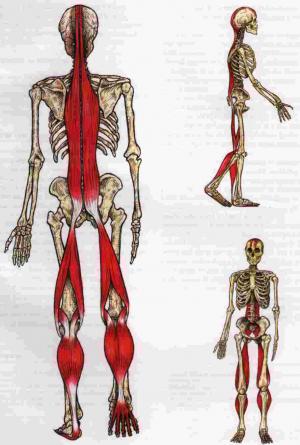
Superficial Back Line
This helps explain why someone that has trouble touching their toes can make significant progress in this range of motion by simply rolling their plantar fascia with a tennis ball. Even more abstract, this explains one mechanism why someone with restrictions through their calves may have neck pain. This is just one illustration of an anatomical network; these exist everywhere throughout our body and provide direct anatomical links for why restrictions in one area can have a significant impact on seemingly remote areas. This is regional interdependence through anatomical connection via connective tissue, which is also naturally affected by tensegrity.
Joint by Joint Approach
The “Joint by Joint Approach” was a phrase coined by Mike Boyle and Gray cook to describe a system of alternating joint function as you progress from foot to head. In reality, every joint needs a specific balance of mobility and stability based on its structure, but the JBJA system helps us understand the mechanism underlying a lot of common injuries. To be overly simplistic, if a joint in the mobility column has sub-optimal mobility (or range of motion), an adjacent joint will need to “fill in the gap” by providing the additional range of motion. Usually this “compensatory movement” occurs at the next joint up. Following this idea, you can refer to the table and see that mobility restrictions in the left column lead to compensatory movements (and consequent injuries) to the joints in the right column.

Much like the “Anatomy Trains” concept, this has tensegrity implications for load sharing as well, but adds to the regional interdependence idea by illustrating how deficiencies in joint range of motion (mobility) and/or control of that range of motion (stability) can affect neighboring joints.
If you’re interested, I wrote more about this concept here: Mobility-Stability Continuum
Functional Outcome Prioritization
Finally, segments with NO (or at least minimal) direct anatomical or biomechanical influence on each other can still have profound impacts on one another via this idea of functional outcome prioritization. Simply, this refers to the almost infinite degrees of freedom your body has in creating a movement that leads to a desired outcome. For example, if you need to raise your arm overhead to open a cabinet, you have options of reaching as high as you can with a relatively neutral trunk and lower body, you can side bend your trunk to get your arm higher, you can stand on your toes to get your arm higher, etc. It doesn’t matter, so long as your hand reaches the handle. THAT is the functional outcome.
More relevant to hockey players, in opening up to receive a pass and take a shot from the point, you will need to follow through with your stick directed toward the goal. If you’re positioned in the middle of the ice by the blue line, this is roughly a 180 degree rotation from a full wind-up to a full follow through. In achieving this, you can divide that rotation up amongst the joints in the body so that your feet rotate on the ice, your hips rotate, and your upper spine rotates. If rotation range of motion is lacking in any of these segments, it will need to be made up for somewhere else. Locally, this could mean that a lack of hip rotation causes excessive lumbar rotation (Joint by Joint Approach), but it could also mean that your shoulder blades and shoulders need to rotate and translate more than would otherwise be desirable. Similarly, a certain degree of rotation is required to position the skate at a 45 degree angle during a forward skating stride. A lack of hip rotation could cause compensatory rotation at the other hip, knee, or ankle, and/or changes through the lumbar spine. In this way, the body can choose a strategy to achieve a specific functional outcome, which may or may not be the optimal strategy based on sound biomechanics. This is regional interdependence through functional outcome prioritization.
Taken together, these illustrations of regional interdependence underline the importance of assessing and training the whole body, even when a more local goal is desired (e.g. ACL tear rehabilitation and/or increase in upper body strength). To maximize function, balance in range of motion, stiffness, strength, and control must be achieved throughout the body, within, across, between, and among joints.
To your success,
Kevin Neeld
P.S. If you want a comprehensive step-by-step hockey training system based on these principles, check out my new book Ultimate Hockey Training
Please enter your first name and email below to sign up for my FREE Athletic Development and Hockey Training Newsletter!
 Use CODE: "Neeld15" to save 15%