I hope you had a great weekend. I had a busy few days as I spent Friday and Saturday with the US Women’s Olympic Team, then headed a little north to watch UMass Lowell’s home opener with my friend Devan McConnell. As always, it was great to work with all the girls and the coaching, medical and support staff with the US Team. Such a great group of people. It was also nice to finally get to watch some hockey!

As you may know, I spend the better part of my non-coaching time attending courses or reading research/books on a variety of topics within the fields of sports training, manual therapy, and physical therapy. The underlying scientific explanations and interactions are of particular interest to me, because these create the foundation for the way the body adapts to everything we throw at it, from a therapy or training standpoint. In the realm of recovery, there is A LOT to consider. With the advances in technology and the efforts of private companies to simplify taking your health into your own hands, it’s now easier than ever to measure things like heart rate variability, nutrient status, food sensitivities, and hormone levels, all of which can have a profound impact on an athlete’s ability to adapt to further training stresses, and therefore are worth monitoring. A couple weeks ago, I finished reading Biochemical Monitoring of Sport Training by Atko Viru and Mehis Viru that dives into these topics in further detail. It’s a little outdated at this point, but still has a lot of interesting information.
Biochemical Monitoring of Sport Training

That said, the reality is that only a small portion of the athletic population are even aware of these factors, let alone the importance of monitoring them. Those that get this far still may not know HOW to monitor these things and/or be able to afford the available options. Furthermore, it seems silly to track a lot of these things when most athletes have sporadic sleep patterns and horrific diets. As is often the case, recovery efforts, and therefore maximizing your ability to adapt, starts with mastering the basics.

This was a main part of the 2-hour talk I gave to the Flyers Junior Team at the beginning of the season. The goal is to simplify powerful strategies that you almost always have control over, so that you can be CONSISTENT in adhering to these basic concepts. Below are 3 powerful strategies to maximize recovery.

1) Stay Hydrated
Even mild dehydration can significantly impair physical and mental performance. This is one of those things that everyone knows, but few athletes are diligent about adhering to. Keep a water bottle with you sip water throughout the day. There are lots of water recommendations, but the easiest way to assess how you’re doing here is by checking your urine color. Clear, consistently, is the goal. Naturally, the more active you are and the more you sweat, the more fluid you’ll need to replenish. If you’re a heavy sweater and/or prone to cramping, it may be worth looking into picking up some Gatorlytes, which are just packets of electrolytes to give you a little extra sodium, chloride, potassium, calcium, and magnesium. When you sweat, you lose water AND electrolytes. Your body likes to keep a specific concentration of electrolytes based on the amount of circulating fluid to optimize a number of processes (like muscle contraction). If you only replace the water, you’re missing a big piece. A lot of people do fine with this simply from eating food or from taking a quality sports drink like Biosteel or Generation UCAN, but some athletes benefit from getting in a little extra. Gatorlytes are easy to transport and take in a hurry, so there a good option. You can get them at a lot of places, but I tend to buy a lot of my supplements from a site called Vitacost.com because you can get quality brands at discounted prices.
Glass of Water

The most powerful supplement there is…

Anecdotally, I can tell you that a lot of times when players come to be complaining about early fatigue in practices or games, and a variety of other symptoms like not being able to concentrate or getting headaches, poor hydration is an underlying factor.

2) Get Quality Sleep
When it comes to minimizing the damage of accumulated stress (e.g. that from training, practices, school/work, relationships, nutrition excesses or insufficiencies, and the environment), nothing is more powerful than quality sleep. Simply, it’s time for your body to rest, repair, and regenerate. We are very poor “resters” in our country. From a practice and training standpoint, there is often an overemphasis on “doing” and an underemphasis on “adapting”, which takes a more holistic look at the stimulus-recovery relationship. That said, even those that try to sleep long enough may not be getting quality sleep. Here are a few tips to help get you started on the right path:

-Track the number of hours you sleep every night. The goal is to be above 8 every week. Factor in that it probably takes 30 minutes for you to fall asleep, meaning you’ll need to set aside closer to 9 hours to get 8 of sleep each night.
-Go to bed and wake up within an hour of the same times every night THAT YOU CAN. In short, get off of Twitter and Facebook  and stop texting in bed. -Remember the phrase “An hour before midnight is worth two after”
-Keep the room COLD, DARK, and QUIET! Use blinds to block outside lights, turn alarm clocks away from you, place cell phones face down (so you can’t see the light), and turn off your ring or vibration. It can wait until the morning.

All of these things can go a long way toward improving your sleep quality. If you have trouble falling asleep, I’d look into picking up an Earthing Sheet (Read more about this here: Recovery Week: Earthing Products) and/or a magnesium supplement like Poliquin’s Uber Mag Px or TopicalMag, both of which are great at quickly quieting your mind and helping you transition into a deep sleep.

Poliquin's TopicalMag

Rub a few squirts of this on your feet for the best sleep ever…

3) Eat REAL Food, Almost Always
Simply, real food can be hunted or grown. The overwhelming majority of the kids I talk to eat very little, if any, real food throughout the day. Most eat something along the lines of cereal, sandwich with chips, and whatever my parents cook me (typically pasta or chicken…and pasta). Everyone can do better. The overwhelming majority of food that enters your body should be meats, eggs, vegetables, fruits, nuts, seeds, and various oils (e.g. Extra Virgin Olive Oil). The food you eat literally provides the building blocks for every structure within your body. If you build your body with garbage, you will feel and perform like garbage. This may express itself in different forms. Some people get fat, some are moody, some have frequent gastrointestinal distress (cramping, bloating, farting, etc.), some have poor energy or attention spans, some have a difficult time putting on muscle mass, and some are more injury prone (among others). NO ONE is unaffected. Think about the meals you have over the last week and how many of them have been comprised of real food. Start by changing breakfast and move on from there. There are TONS of quality meal ideas in Ultimate Hockey Nutrition so check that out if you’re not sure where to start.

I tell our players that there are times when you don’t have control (or you have less control) over what foods you can eat (e.g. on the road), so it’s important to eat as well as you possibly can during the times when you DO have control (e.g. during the week and during weekends with home games). The goal is to spend as much time eating “right” as possible, so maximizing controllable opportunities is a big piece of the puzzle.

As you can see, there is nothing overwhelmingly advanced about any of these strategies. Every athlete has almost complete control of these at all times. Although none of these are very “sexy”, they are extremely powerful. In a couple days, I’ll be back with a few more recovery considerations, but until then, stick to the above and start gaining some momentum toward optimal health, recovery, and performance.

To your success,

Kevin Neeld
OptimizingMovement.com
UltimateHockeyTraining.com

Please enter your first name and email below to sign up for my FREE Athletic Development and Hockey Training Newsletter!

A few days back, I posted an article discussing several things that need to be considered when designing an in-season hockey training program. While this was really framed within the context of hockey, the reality is that these same principles are relevant for every sport, and for every time of year. If you missed that post, I’d encourage you to check it out here: 5 In-Season Hockey Training Considerations

Today I wanted to follow up on the topic of in-season hockey training by sharing the intro phase we’re using for our youth midget-aged players. This is just one of several programs posted to the Ultimate Hockey Training Insider’s Section each month, which along with the 800+ video database, is a great resource for those of you looking for a little more structure to your programs and some new exercise ideas.

Ultimate Hockey Training-Membership Card Insider Small
The goal of sharing this program isn’t necessarily to give you something to print and use, but to help refer back to some of the topics covered in the previous article and provide some real life examples of how we’re implementing those concepts in our setting.

Phase 1: Day 1

A1) Hang Clean Technique: 3×5
A2) Glute Bridge: 3x(3x10s)
B1) Front Squat: (2-0-2 Tempo): 3×6
B2) 1-Arm DB Row: (2-0-2 Tempo): 3×6/side
C1) Slideboard Hamstring Curl: 3×8
C2) DB Chest Press: 3×8
D1) Split Squat IsoHold: 3x30s/side
D2) Front Plank: 3x25s
D3) Side Plank: 3x20s/side

Phase 1: Day 2

A1) Hang Clean Technique: 3×5
A2) MiniBand Knees Out: 3x(6x5s)
B1) Stiff-Legged Deadlift (2-0-2 Tempo): 3×6
B2) Loaded Push-Up (2-0-2 Tempo): 3×6
C1) DB Reverse Lunge: 3×8/side
C2) Chin-Up: 3×6
D1) 2-Way Skater: 3×12/side
D2) Front Plank: 3x25s
D3) Side Plank: 3x20s

This is “Week 2” of this program. Week 1 started out with one less set for the B-D blocks and a little less time for the planks and IsoHold. Every training session is preceded by foam rolling and a dynamic warm-up. Being an “Intro” phase, the primary goals of this program are to:

  1. Familiarize every player with the PROCESS of proper training. Simply, I want players to internalize the daily process of foam rolling, warming up, training under a structured program with a coach, and then stretching.
  2. Have all of the player learn how to perform all of the primary exercises properly. Many will be familiar with some of these movements already. Some will pick up the new ones quickly; others will not. Exercise technique, like any skill, requires practice. My philosophy is that hockey players (and athletes…and everyone else) need to learn to move well before they move faster, under load, or more often. As a result, Phase 1 puts a primary emphasis on motor learning, which helps create a foundation of quality movement and exercise proficiency that we can build on in the future.
  3. Allow players to acclimate to practicing 2-3 days per week, playing 2-4 games on the weekends and training 2 days per week on top of it. With the increased on-ice load that comes from the start of the season, it’s important to remember that we can’t just keep adding more and more training stress to the athletes and expect them to recover. This drastic increase in on-ice work also comes with increased travel demands, and coincides with starting school, which means extremely long days (up at 6am, home from practice at 10pm, off of Twitter by 12, up at 6 again). In-season training in general, but especially the first phase, should be kept fairly low volume to account for this and ensure that the training isn’t pushing them past the threshold of stress they’re able to recover from.

Returning back to the previous article, we can break down this program in light of the 5 recommendations I made.

1) Age of the Player/Stage of Development
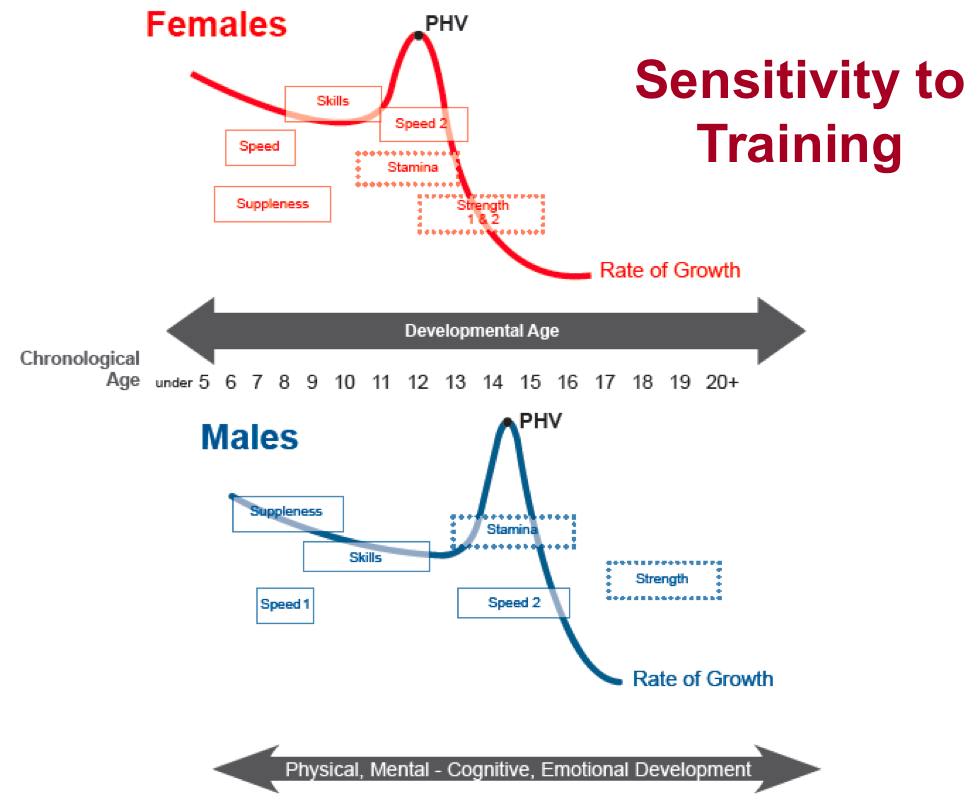
Midget-aged players are in the tail end of the “Speed 2” and “Stamina” window and entering the “Strength” window. This first phase, as mentioned above, is more motor learning (one of the goals of the 2-0-2 tempo is to slow the motion down and allow the players to feel their way through the full range) than strength oriented, but this phase is laying the foundation for the strength work to come. The next phase uses an almost identical exercise list, but the loads, sets, reps, and tempos are altered in a way that still emphasizes the motor learning component, but puts a greater emphasis on strength. There is a clear component of local muscular endurance (one form of stamina) for the lower body/hip musculature with split squat isohold and high-rep 2-way skater exercises, but because both of them are fairly isometric in nature, they won’t result in a lot of soreness. Improved focus on strength in the future will support the speed work that players are getting on the ice.

2) On-Ice Demands
Players at this age group train at our facility 3-4 days per week in the off-season (U-16s tend to be 3, U-18s are 4). Training sessions tend to be 75-90 minutes. When the season starts, the kids are only training 2 days per week for 60 minutes, with about 15-20 of those minutes spent on low stress things like foam rolling, warming up, stretching, etc. In short, the training volume is drastically reduced. Also, you’ll note that sprints, plyometrics, slideboarding, shuttle runs, etc. are all missing from this program. While I think there is a place for some of this work in in-season programs, in general players at this age group are getting the majority of their speed, power, and interval-based conditioning work on the ice. We return to some of these qualities in one form or another in future phases, but definitely not the first one.

3) Practice Plan/Game Schedule/Travel Demands
This part can get a little trickier depending on how much the hockey coach communicates with our coaches. We aren’t always aware of the on-ice practice plan, which isn’t ideal, but is understandable at this level. That said, we almost always know when teams have a big weekend (important games and/or 3-4 games), and can adjust the program accordingly. There are lots of different strategies to alter training stresses before or after a big game, but some of the ones we use most frequently are:

  1. Doing one less set of all the exercises
  2. Cutting loads down so all sets are completed easily, putting an emphasis on perfect form and moving through the lift quickly to create more of an aerobic effect
  3. Only performing the explosive movement and core work (the A and D blocks above, but without isoholds or 2-way skaters)
  4. Bailing on the lift altogether and simply spend extra time rolling, warming up, and stretching

Periodically, the coach will just cancel off-ice, which isn’t always a bad thing. For example, we had one team play 10 games in the last two weekends and cancel a few off-ice training sessions during that stretch. While I don’t necessarily think anyone (especially not players at this age) should play 1/4 of a college hockey season in two weekends, I do think given the ridiculous fatigue accumulated in ONE weekend like this, let alone two, makes canceling training the right call.

4) Soft-Tissue/Muscle Stresses
All of the players foam roll, warm up, and stretch every day they’re with us. The stretching puts a very lopsided emphasis on stretching the glutes/posterior hip region, which I’ve found to be an effective strategy in helping players recover from and minimize risk for groin and hip flexor strains. We also steer clear of any focused work from a training standpoint for these areas during the first phase because of the on-ice load put on these muscle groups.

5) Logistical Considerations
Over the last year, we were able to acquire a larger space at the rink to train the youth players that play there, and we also moved more equipment over so space and equipment constraints aren’t as bad as they used to be. It’s certainly come a long way from doing all body weight work in the winter in the parking lot or rink lobby! I remember teaching 20 U-16 players with minimal lifting experience how to hang clean in an old party room that could be more than 700 sq ft. While far from ideal, I believe strongly that those situations are where you can really learn how to coach, and the kids learn to stay focused because there simply isn’t enough space to screw around. All of that said, part of the simplicity of these programs is to account for the ~16-20:1 Athlete:Coach ratio we’re working with. Again, a program is only as effective as the athletes’ ability to perform it correctly. As a result, there shouldn’t be anything in the program that we don’t feel comfortable coaching. In the past, we used more “Tri-Sets” (e.g. A1, A2, A3, B1, B2, B3, etc.), but have backed away from that this year in an effort to keep things simpler and a little more organized from a traffic flow standpoint.

Hopefully that gives you an idea of the rationale for how I’ve designed our in-season programs and provides a few real life examples of how to implement the information mentioned here: 5 In-Season Hockey Training Considerations

If you want access to more training programs and the largest hockey training exercise database out there, be sure to check out the Ultimate Hockey Training Insider’s Section! As always, if you have any questions, please post them below!

To your success,

Kevin Neeld
OptimizingMovement.com
UltimateHockeyTraining.com

Please enter your first name and email below to sign up for my FREE Athletic Development and Hockey Training Newsletter!

With hockey seasons at all levels ramping up, I’ve been getting a lot of questions about in-season training. When putting together a program at any time of year, there are a lot of things to consider. Today’s post will dive into the primary considerations when designing an in-season hockey training program.

1) Age of the athlete/Stage of Athletic Development
This is a topic I’ve talked a lot about in the past so I’ll just touch on it briefly now. Youth players at different stages of development (largely based on age brackets associated with changes in growth rates) experience windows of time where they’re better able to develop certain athletic qualities. In a comprehensive model, this would influence both on- and off-ice recommendations. This is where USA Hockey’s ADM really excels and provides an outstanding roadmap for on- and off-ice professionals alike to plan their season based on the best long-term interest of the players. The image below is taken from the material and provides a visual illustration of the general ages at which certain athletic qualities are sensitive to accelerated development.

Long-Term Athletic Development-Sensitivity to Training
I found out last week that I was quoted in the most recent issue of USA Hockey Magazine for my support of their ADM. I thought that was pretty cool because I can remember reading the magazine when I was a squirt! That said, I think it’s important to point out that I first came across the ADM material while studying long-term athletic development material, largely from professionals in other countries, and was intrigued by how comprehensive and well-thought out the ADM was, and even specific to hockey! I had no affiliation to USA Hockey at the time, but thought then (and still think now) that it’s the best, most comprehensive sport-specific long-term athletic development plan I’ve come across. Naturally, it being a “long-term plan” means that it’s going to be met with some resistance from those eager for immediate gratification. I always come back to the idea of identifying where you want your finish line to be. The ADM is an outstanding model for creating truly elite players; it may not be the best way to create the world’s best peewee.

From an off-ice training perspective, I don’t think it’s necessary to ONLY train whatever the quality is that coincides with a given age group. I do, however, think it’s important to keep that quality(ies) in mind while designing the program and  consider how the program you’re using is either training that specific quality or supporting qualities. For example, during the “Speed 2” window, it’s not necessary to ONLY do sprints. The reality is that speed can be limited by a number of factors and including things like joint mobility work (despite not being in the “suppleness” or flexibility phase), basic strength work (despite not being in the “strength” phase), and lower body power work will all positively influence the player’s ability to develop speed at that age.

In this context, certain exercises aren’t always what they appear. A kid lifting weights may be “speed training” because it’s teaching him/her to better recruit the muscle mass they do have, even if they haven’t hit puberty and don’t have a hormonal system conducive to putting on muscle mass. I touched more on this topic here: Youth Hockey Training: The Truth About Resistance Training

2) On-Ice Demands
This is a simple concept, but one that I think a lot of programs overlook, at least at the youth levels. Off-season and in-season training programs should be COMPLETELY different in terms of training frequency, total training volume, and training focus/goal because the on-ice demands on the players are completely different (or at least it should be). If we take a step back from being “hockey coaches” or “strength coaches” and just look at all on- and off-ice work in light of the type of stress is places on the body, it’s fairly evident that players at all positions perform dozens of repetitions of short-duration high intensity movements (e.g. speed training) during every practice, and they also experience a multitude of heart rate responses to elicit alactic and lactic conditioning responses. All of these “training” stresses occur during several practices and many also occur during games over the weekend. While different teams across different ages have different practice/game schedules, the bottom line is that there are certain stresses or athletic qualities that are being trained ON the ice that do not need to be further trained OFF the ice. In many ways, hockey-specific in-season training should be anti-hockey-specific.

This is where I think understanding the idea of training complimentary qualities becomes incredibly valuable. How do you improve a player’s speed without doing speed training? How do you improve a player’s ability to perform explosive movements repeatedly with minimal drop-off without doing high intensity interval training? This is where the magic is.

3) Practice Plan/Game Schedule/Travel Demands
To piggyback on the last point, having an understanding of the coach’s practice plan can go a long way in helping ensure the off-ice work is appropriate. Broadly, if a coach intends to bury the players on the ice, it’s probably best to back off from an off-ice training perspective, keeping the volume of the training low and putting a greater emphasis on recovery than on attempting to drive any significant adaptation in speed, power, strength, conditioning, etc. Similarly, if a team just finished a weekend with 3-6 games (especially if they had to travel, which is another stress to the body), and they come in to train the next day (e.g. Monday after a tournament/showcase weekend), the focus of the off-ice training should be in-line with the aforementioned recovery emphasis. If we can agree that a primary goal of training is to reduce injury risk, having an understanding of the total stress load to the athlete is obviously an important piece of the puzzle.

4) Soft-Tissue/Muscle Stresses
This is simply another way of looking at the last two points and comes back to the idea of in-season training being anti-hockey-specific. Hockey players at all levels (incredibly) experience pain/injury to hip flexors and adductors (e.g. the “groin”). These muscle groups have significant on-ice workloads, and even though they’re important for hockey, the time to strengthen/prepare these areas for on-ice work is the off-season. Too much work to these areas in-season is likely to increase injury risk.

I got a question on Twitter last week about when it’s most appropriate to start doing hip mobility work. The reality is that range of motion is much more easily lost than gained, and we (as a society…and DEFINITELY as a sport) spend a significant amount of time “training” our bodies to lose hip mobility by sitting for prolonged periods of time (school, cars, couches, locker room, bench, etc.) and from practicing/playing. A little bit of mobility work on a daily (or near daily) basis is much more effective than a lot every once in a while. Similarly, because we never “shut off” the stimulus to lose hip mobility, there’s never really an appropriate time to stop being proactive to maintain or improve the hip mobility we have.

One of my favorite soft-tissue techniques for the adductors

A mobility/recovery circuit with a lot of quality exercises that can be used in a training program

5) Logistical Considerations
All of the above should contribute to a basic understanding of the goal of an off-ice program for players at different ages and how to make adjustments based on the game schedule. The actual design of a training program will depend on a number of logistical issues, including:

  1. Space/Equipment
  2. Coach:Athlete Ratio
  3. Athlete Training Age
  4. Athlete Social Maturity
  5. Coaching Experience

In general, less space, less equipment, more athletes per coach, younger athlete training ages, less social maturity and less coaching experience will all lead to a more basic training program. This doesn’t necessarily mean less effective, just more basic. To dig a little deeper, the foundation of any quality program should be built on optimal exercise technique. If a program requires too much exercise variety (based on the coach:athlete ratio or athlete training age) or exercises that the coach doesn’t feel comfortable teaching, it undermines this principle. The effectiveness of any exercise, in terms of performance benefits or injury risk reduction, is dependent upon the athletes ability to perform it correctly, which is largely dependent on the coach’s ability to teach it. Olympic lifts are great, but if a coach doesn’t have experience teaching them, they probably shouldn’t be in the program. I think all of this is intuitive for strength and conditioning coaches working in a team setting, but it’s easy for a youth hockey coach or parent taking on the added responsibility of off-ice training to read something on the internet (e.g. “the best exercise for speed development”) and come in the next week with exercises they don’t have much experience with.

That’s a wrap for today. If you have any specific questions, feel free to post them in the comments section below! If you want more information on hockey training programs, check out Ultimate Hockey Training!

To your success,

Kevin Neeld
OptimizingMovement.com
UltimateHockeyTraining.com

Please enter your first name and email below to sign up for my FREE Athletic Development and Hockey Training Newsletter!
A couple days ago, I posted an article comparing a few lower body power tests, and how they may or may not be “hockey specific”. If you missed that article, you can check it out here: A Hockey-Specific Power Test

A comment that I’ve gotten a few times, and something I had considered myself while interpreting the data, was simply that the lateral bound test would be confounded (or at least influenced) by the height of the individual. In other words, because it involves jumping off of one leg and landing on the other, having longer legs and therefore a larger lateral excursion would lead to increased jumping distances. I think it would be hard to argue that leg length doesn’t in some way influence a test like this, but it’s important to remember, as I noted in the previous post, that the ability for longer legs to equate to larger lateral excursions depends on a number of factors, notably pelvis structure and positioning, femoral head architecture and positioning, and length of the adductor complex on both sides. Bottom line is that when sifting through the data, many of the top achievers were among the smaller kids on the team and many of the bottom achievers were among the taller kids on the team. In short, there’s a lot more to the story than just how tall someone is!

Last Friday I had an opportunity to sit down over a cup of coffee and catch up with Joe Heiler from Sports Rehab Expert. I’ve known Joe for over 4 years now and I was fortunate to have a chance to contribute some articles to his site early in its evolution. Now, SportsRehabExpert.com is over 4 years old and has really grown into an incredible resource.

Sports Rehab Expert

With the recent release of my Optimizing Movement DVDs, Joe wanted to talk about some of the topics discussed in my presentations, including:

  1. An overview of the presentation: Who it’s for, what’s covered, and what people can expect from it
  2. The 4-step process to establish Optimal Movement in athletes and non-athletes alike
  3. Why the appearance of full mobility could actually be a bad thing
  4. The assessment process we use with our athletes and clients, and what I would use in a time crunch
  5. Some of my more “surprising” assessment findings
  6. The 4 “Pervasive Movement Considerations” that influence the correct performance of almost every exercise
  7. How we’ve used kinesiotaping techniques to restore mobility and reduce asymmetries
  8. How all of this integrates into our training system

Joe was kind enough to let me repost the interview here so you can listen to it for free. You can download it at the link below:

Click here to listen >> SportsRehabExpert.com Interview on Optimizing Movement

Optimizing Movement DVD Package

Optimizing Movement continues to get great reviews from those at both ends of the rehabilitation to elite performance continuum. This is what Penn State University Hockey Strength and Conditioning Coach Rob McLean had to say:

“In Optimizing Movement Kevin does an amazing job of laying out many of the dominant philosophies that are influencing our industry, and discusses how they influence his approach to training.  Much of the FMS, SFMA and PRI information is very complicated and yet Kevin presents them with a simplicity that allows you to grasp the concepts quickly and recognize how important it is to look for movement dysfunction. He then discusses how he evaluates his athletes and uses that information to direct his movement-based approach to create a training program that deals specifically with the athletes’ limitations. Lastly Kevin reveals overwhelming evidence to show that most athletes walking through our doors already are dealing with sub-threshold injuries that must be managed or else we, as strength coaches, will only make them worse and never achieve the best result possible for our athletes.

I try to review all the great information that is available every year from Cressey, Robertson, Reinold, Weingroff, Ward, Jamieson and many others. For me, Kevin’s Optimizing Movement was definitely the best DVD I’ve seen this year and I would consider it one of the best DVDs I’ve ever watched. This is the DVD that brought everything together for me and allowed me to implement my knowledge and define my core beliefs. I strongly recommend it to strength coaches or athletes who are looking for direction in applying these philosophies to create athletes that are more durable and move better.”

Rob McLean, Head Strength and Conditioning Coach, Penn State University Hockey

Check out OptimizingMovement.com for more information!

Next week I’ll be posting a couple articles discussing early in-season training programs for hockey players, so be sure to check back. In the meantime, enjoy the interview and don’t forget to stop by SportsRehabExpert.com to check out all of the articles, videos, interviews, and forum discussions!

To your success,

Kevin Neeld
OptimizingMovement.com
UltimateHockeyTraining.com

Please enter your first name and email below to sign up for my FREE Athletic Development and Hockey Training Newsletter!
Last week, I posted three articles that gave a fairly detailed look inside the recent testing process we went through with the Philadelphia Flyers Junior A team, how we reported this information back to the players and coaches, and how it immediately influenced our programs. If you missed those three posts, you can check them out here:

  1. Off-Ice Testing
  2. Hockey Team Testing: Player Reporting
  3. Hockey Team Testing: Coach Reporting and Programming

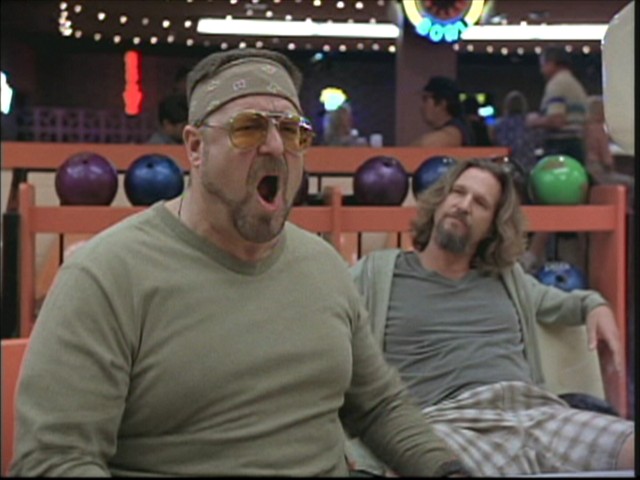
Today I wanted to expand on part of the testing process we did to assess our players’ lower body power. It’s generally accepted that power is an important quality to improve in hockey players. In fact, every Summer I hear players (or parents/coaches) reference needing to improve their “first few steps” or “explosiveness” more times than Walter references his experience in Vietnam.

The Big Lebowski

Over the line!”

While I don’t think anyone would argue the importance of power in hockey, the topic of how to assess/measure it is interesting. The vertical jump is the most widely used assessment of lower body power and one that is used at all levels in all sports. The vertical jump, however, has been critiqued as being a vertical pattern, which is less specific to the overwhelming majority of team sports that involve primarily horizontal vectors (the goal is to move forward, not upward). Within this context, it would seem that a broad jump may be more “sports-specific”. That said, and likely as you would expect, in athletes that are familiar with both patterns, there’s a pretty strong correlation between performance in the vertical jump and that in the broad jump. In other words, they’re likely assessing the same thing (or close enough to the same thing), so picking the one that makes the most sense in your situation depending upon logistics and what comparisons you want to make with the data (more widely available norms for vertical jump) is reasonable.

Enter the lateral bound as a lower body power assessment, which could be considered the most hockey-specific power assessment. The lateral bound is a single-leg, lateral, horizontal movement pattern, which is notably more skating specific than either a broad or vertical jump. It also gives the option of comparing side to side imbalances, which could result from a number of factors ranging from true power discrepancies to hip abduction limitations on the landing leg. Nonetheless, a significant difference between sides would at least highlight the athlete as one that may require a little extra attention.

As you may have read last week, with the Flyers junior team we tested vertical jump and lateral bound. The birds eye view of the thought process here is that a lot of teams test vertical jump so having that information on the players allows us, on a team and individual basis, to look at college and pro programs and see where our players stack up. The lateral bound, as I just mentioned, is a more hockey-specific pattern, and gives us the ability to look at side to side differences. In all honesty, I fully expected the ranking order between the two tests to be almost identical. After all, some of the kids are going to be more explosive than others, based on a number of factors, and this should show up in both tests.

And then I looked at the testing results…

There is certainly a degree of similarity in some cases, but if I take the rank from the vertical jump test and rerank based on the average lateral bound between legs, this is what shakes out:

  1. 1st Lateral Bound: 1st VJ
  2. 2nd LB: 15th VJ
  3. 3rd LB: 5th VJ
  4. 4th LB: 4th, 7th, and 10th VJ tied
  5. 7th LB: 22nd VJ
  6. 8th LB: T-2nd VJ
  7. 9th LB: 13th VJ
  8. 10th LB: 15th VJ
  9. 11th LB: 19th VJ
  10. 12th LB: 9th VJ
  11. 13th LB: 7th VJ
  12. 14th LB: 4th VJ
  13. 15th LB: 19th VJ
  14. 16th LB: 10th & 23rd VJ tied
  15. 18th LB: 5th, 18th, & 19th VJ tied
  16. 21st LB: 10th and 15th VJ tied
  17. 23rd LB: 13th VJ

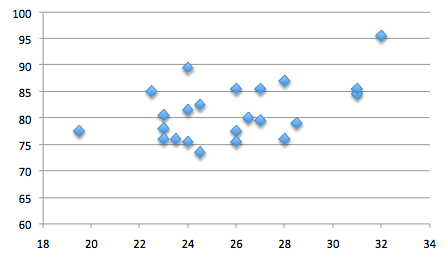
Plotting lateral bound distance versus vertical jump height looks like:

Hockey Power Test Comparison

Clearly, if you remove the one “best of both worlds” and the one “needs improvement in both worlds” (for the sake of defending his honor, this player spent the last 6 weeks of the Summer recovering from a concussion and not training), what’s left is a non-linear cloud of jumbled testing results. This is evident if you sift through the data in the list above and note all of the high achievers in one power test that weren’t so consistent on the other.

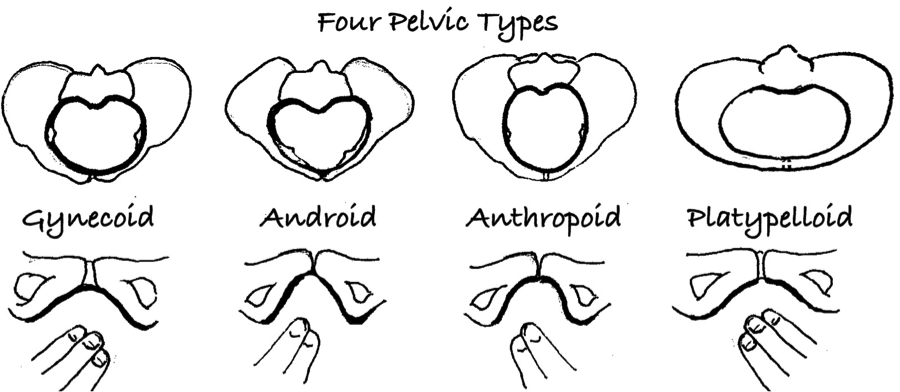
As you may suspect, there is a degree of familiarity that will influence these tests. Players that have used these movements in their programs (e.g. practiced them) more will perform closer to their true potential than those with a less refined pattern. Having seen all of these tests, however, I don’t think this is the main confounding issue here. A few months ago Dean Somerset wrote a great article on Eric Cressey’s site (see: Pelvic Arch Design and Load Carrying Capacity), that explained how certain people have different hip structures that make lateral movement more difficult, and how these structures may influence performance in different exercises.

4 Pelvis Types

The wider arches may be more conducive for lateral movements.

Interestingly, but not necessarily surprisingly, this seems to be the primary factor in explaining some of the discrepancies we saw between vertical and lateral power. Those with structures not conducive to large lateral movement/excursions have an opportunity to demonstrate their lower body power more effectively in a vertical or broad jump movement than a lateral bound. Ultimately, the goal is always to improve their on-ice speed and testing results are always better suited for tracking progress than comparing individuals, but this seems to provide evidence that including multiple tests will help ensure you’re capturing all of the information you need to profile a player’s strengths and weaknesses. In this case, if we would have only looked at the most “hockey-specific” test, it would have been easy to conclude that some of the players were under-powered, when the reality is that they just have a different hip structure than some of the other guys. Once again, this highlights the importance of appreciating the individual variations players have in their hip structures and the impact this can have on their performance. If you don’t currently have a good assessment process or feel comfortable recognizing if a limitation is structural or functional, check out Optimizing Movement, which details the approach I’ve used for the last several years with our athletes.

To your success,

Kevin Neeld
OptimizingMovement.com
UltimateHockeyTraining.com

Please enter your first name and email below to sign up for my FREE Athletic Development and Hockey Training Newsletter!
Use CODE: "Neeld15" to save 15%