Emily and I leave for Italy on Wednesday for 10 days, but before we leave I wanted to let you know that Joe Heiler recently released the interview we did as part of his 2016 Sports Rehab to Sports Performance Teleseminar.
In the interview, we discussed a lot about the evolution of my training philosophy and preventing hip injuries, including:
How I first got interested in addressing movement quality in our training programs
How to balance movement capacity training with “performance” training
Why Tabata’s are stupid (or at least a misnomer)
Keys to building (physically and psychologically) resilient athletes
Common hip injuries and what we’re doing to prevent them
A case study of a NCAA D1 college player that cancelled his hip surgery
This is just a snapshot. Joe also posted an article I wrote on developing explosive power for hockey. All of this is available for FREE right now. I’m genuinely not sure when he’ll pull this down, so check out the link below to get access today.
“Kevin Neeld is one of the top 5-6 strength and conditioning coaches in the ice hockey world.” – Mike Boyle, Head S&C Coach, US Women’s Olympic Team
“…if you want to be the best, Kevin is the one you have to train with” – Brijesh Patel, Head S&C Coach, Quinnipiac University
Hockey-Specific Speed and Power Training
Last week, I hopped on the phone with Joe Heiler to do an interview for the 2016 Sports Rehab to Sports Performance Teleseminar. If you haven’t signed up for the series, go do that now. It’s completely FREE, and every year the speakers deliver great content.
As is almost always the case in these types of interviews, Joe sent over a list of topics for us to dig through…and as is ALWAYS the case…I got hopped up on coffee and ended up going on a long-winded rant about hockey hip injuries, what imaging does and does not tell you, how I approach the screening and program design process, and the outcome of another case study of a kid limping into our facility convinced he needed surgery immediately.
That is to say, we didn’t get an opportunity to talk about speed and power training, topics I’m equally passionate about. With that in mind, I thought I’d take the opportunity to share a few important considerations for hockey-specific speed and power training.
Hockey-Specific Speed and Power Training
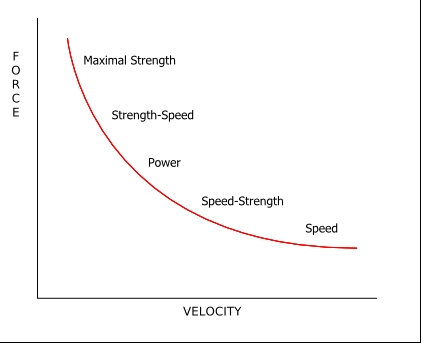
Hockey is really an interesting sport because it lives across the entire strength-speed to speed-strength, or what I refer to as the high-load low-velocity to low-load high-velocity continuum.
Skating in open ice and shooting are two examples of where training the middle to higher velocity ends of that continuum are really beneficial, but when players are delivering or accepting contact or battling for pucks in corners, they really need the high load, low-velocity end as well.
From a training standpoint, we’ve always used sprints from a variety of starting positions, plyometrics, med ball throws and Olympic lift variations as part of our speed and power efforts. If you view these purely from a speed of movement standpoint, Olympic lift variations will fall closer to the strength-speed/power side of the curve, plyometrics will live in the power/speed-strength area, and med ball throws and sprint work will fall closer to the speed end of the continuum.
Obviously, the load you use for all of these exercises, but especially the Olympic lifts, can shift where you are on the curve. With the O-lifts, if you’re near your max load for any given lift and rep range, you’ll be closer to the strength-speed side of the curve.
Similarly, different starting positions can slightly shift the emphasis. For example, 1/2 kneeling starts require more force to get up and out of the start, and will therefore be slower than standing variations (2-point, side standing, etc.). This isn’t a bad thing, but if your training day is geared toward maximal velocity and 1/2 kneeling positions look slow, it may be worth shifting to a standing position.
Both of these variations have a place in off-season programs, but this version will lead to quicker initial accelerations. Video taken from Ultimate Hockey Transformation
Top End Speed Work isn’t Hockey-Specific
The nature of skating requires a few special considerations. It’s easy to see that hockey requires a lot of movement in the frontal and transverse planes, so training should reflect that.
It might not be quite as obvious, but the ground contact times are drastically longer (leading to a larger impulse – the cumulative amount of force produced over the duration of a stride) in skating compared to running.
I’ve talked a lot about why I don’t think the overwhelming majority of ladder drills should be considered speed training for anyone, but especially hockey players. Moving the feet really quickly without moving the body very far is not speed training.
But I also don’t think top end speed sprinting drills, which are characterized by more of a rapid sweeping motion, are even remotely specific to the long duration pushing motion of skating.
Appreciate both the cadence of Bolt’s strides as well as how long his foot is on the ground
Note how much longer Larkin’s skate is in contact with the ice compared to Bolt’s foot, and how much slower the cadence is.
Longer duration and max speed sprints carry a higher injury risk for almost every athlete, but hockey players are typically terrible runners, so the risk of something breaking is even higher.
Shorter duration acceleration drills are much more specific to the hockey stride and also carry a drastically reduced injury concern. I can count on exactly zero hands the number of quad and hip flexor strains I’ve seen in sprints under 20 yards.
Programming Considerations
One of the biggest changes we’ve made since I first started is we’ve moved to more a block periodization model from a more concurrent model a few years ago. This simply means that if we have a training phase or training day within a phase with the primary target of influencing speed-strength, the entire training day we’ll be designed around that quality, so we may use methods like contrast training and low load lifts performed for as many reps as possible within a set time frame.
We’ll also keep our conditioning consistent with the energy system focus of the day, so athletes may be running series of short sprints with long rest intervals, whereas in the past there wasn’t that level of continuity. In the past, players may have had a high dose of sprints or med ball throws in the beginning, then grinded through some heavy lifts, and then, depending on the time of the off-season, done more lactic-based conditioning.
The block periodization approach sends a clearer message to your body about how you want it to adapt and therefore will lead to larger increases in the target quality. This is especially important for athletes with a higher training age that are passed the “everything works” phase of their development.
Wrap Up
Hockey challenges an exceptionally broad range of athleticism. When developing speed and power, it’s important to consider the full spectrum of the force-velocity curve. Specific areas of the curve can be targeted using a block periodization approach, based on the specific needs of the individual. Off-ice speed training programs should be designed with a full understanding of the uniqueness of the skating stride and the specificity that will lead to the best on-ice transfer, as well as the methods that carry the lowest injury risk.
“Kevin Neeld is one of the top 5-6 strength and conditioning coaches in the ice hockey world.” – Mike Boyle, Head S&C Coach, US Women’s Olympic Team
“…if you want to be the best, Kevin is the one you have to train with” – Brijesh Patel, Head S&C Coach, Quinnipiac University
A New Perspective on Energy Systems
A couple days ago, I mentioned that we’re hosting Joel Jamieson’s new Certified Conditioning Coach course at our facility on April 2nd and 3rd. In response to that post I received a bunch of notes from people either expressing an interest in taking the course, or telling me how great it was when they took it previously.
If you’re interested in taking the course, register ASAP. We’re limiting the course to ~40 attendees and have already sold over half the seats. You can get more information and register at the link below.
Given the interest in energy system development my last post sparked, I thought it would be an opportune time to repost a video I’ve shown a few times of a presentation Joel gave on the topic. This is a GREAT presentation, and one of the best free resources available. Check it out below!
A few years ago when I first came across this presentation from Joel Jamieson, it caused me to rethink a lot of what I thought I knew about “conditioning”. Since that time, I’ve read (and re-read) his two books, seen him speak a few times, and even spoke alongside him when the two of us did a one day seminar (where Optimizing Movement was filmed).
Needless to say, I think this information is incredibly valuable; it’s had a profound impact on the way that I write my programs.
Even in rereading my comments about the video below, I know that my perspective on energy systems work has changed considerably over the last 4 years, especially as it pertains to redeveloping aerobic qualities in hockey players (and all athletes in general) in the early off-season. We’re using methods now that I would have never thought to use in 2011, and the foundation for a lot of that change was built on this video.
Enjoy! And if you want to share any of the conditioning methods you’re using or have any questions, please post them in the comments section below.
A New Perspective on Energy Systems
I hope you’re all enjoying your day off (if you got one). Endeavor Sports Performance typically shuts down for Memorial Day, but Matt, David, and I are leaving Thursday night to head up to Boston for the Hockey Symposium, so we have to open up today to make sure all of our athletes can get their sessions in before we go. Just another day in the office! (I’m pretending that today isn’t the first day that it hasn’t precipitated since last November).
Rather than spending the day outside enjoying the sun and BBQing, I thought you’d be more interested in watching a great presentation on energy systems development from Joel Jamieson, who’s a really bright guy. Joel primarily trains MMA fighters out of his facility in Seattle, WA, but he also has experience with football and soccer players. More importantly, and you’ll get this quickly from watching his presentation, his training philosophy is science-based. While I don’t think that every line on a training program needs to have a citation next to it, I think using quality research as a backing for your training philosophies ensures that you understand the underlying principles of athletic development, which can be effectively applied to any sport (in a sport- and athlete-relevant manner).
This video is from a presentation Joel gave at the Central Virginia Sports Performance Seminar at the University of Richmond in Virginia, and he includes a download link for the power point slides so you can follow along. Click the link below and watch the video now (it’s completely free and doesn’t require registering for anything):
I finished watching the video late last week and left with a few good research resources to look into and an augmented understanding of energy metabolism and physiology. I can’t help but feel that some of his words will be grossly misinterpreted though.
One thing that stood out to me as extremely hockey conditioning relevant is the large degree to which the aerobic system contributes to repeat sprint performance with incomplete recovery. Using running as a model, Joel presented that the energy delivery for 200m (~22s) and 400m(~49s) sprints were 29% and 43% aerobic, respectively. In other words, in the time equivalent of an average hockey shift, roughly 1/3-1/2 of the energy provided is aerobic, and this is likely to increase with incomplete recovery between bouts (e.g. as shifts progress within a period).
In my opinion, Joel’s presentation offers more accurate explanatory power than it does a drastic change in the way we condition for hockey. The major take home message is that you need to understand the demands of the sport and prepare accordingly. I think people see something like “50% of energy is from anaerobic sources and 50% is from aerobic sources” and think “50% of my training should be sprint repeats and 50% should be continuous aerobic work.” In reality, all this is saying is that the sprint repeats will eventually be developing aerobic systems in addition to the know anaerobic benefits.
Primarily Aerobic? Anaerobic? Does it matter?
This is one of the reasons why I think it’s more important to have an in-depth understanding of the work:rest ratios and overall work intensities of the game than it is to understand the underlying physiological mechanisms driving them. As an overly simplified example, if hockey includes, on average, about a 40s shift of which about 20s is spent at all out intensities every 3 minutes, and we use some similar work intervals and work to rest ratios to create a slight overload on the involved metabolic systems, does us realizing that more of the on-ice energy AND off-ice training energy is coming from aerobic metabolism than we previously thought change the way we train? I’m not sure it does. I’m certainly not implying that I disagree with anything Joel said in his presentation, and I agree that certain athletes will need a greater emphasis on certain qualities based on their athletic profiles, but I think some people over-emphasize the physiological explanations and under-emphasize the much more obvious and intuitive game demands. What do you think? Check out the video and post your comments below!
Common Hockey Training Mistakes & Hockey Training Podcast
Have you ever had one of those weeks where you feel like you’re just getting CRUSHED with work?
Last week I had to wrap up some work (basically “Finals”) for my Applied Sports Science and Technology & Informatics classes as part of my doctorate program, make some last minute preparations for our upcoming wedding in Costa Rica on December 5th (…can’t believe it’s less than 2 weeks away), and do some mid-season testing on our junior team.
It was in the middle of this that I learned all of the media files on all of my product sites were blocked, which is slightly worse than worst case scenario.
After a long weekend of work, I’m excited to say that all of the sites are up and running again and that the dust has settled a bit. To celebrate making it through the experience without doing anything brash, like deleting all of my websites out of frustration…or smashing my computer through the floor), and with Black Friday right around the corner, I’ve decided to offer my Ultimate Hockey Transformation “Olympic Package” at a substantial discount. This package features Ultimate Hockey Transformation, the accompanying nutrition manual (which I still consider the best hockey nutrition resource available today), and my book Ultimate Hockey Training.
If purchased separately, this package would cost $182.
Until Friday at midnight, you can get access to all of the material for only $67.
This is less than the price of any of the Ultimate Hockey Transformation packages alone, so even if you’ve already bought my book, this is a great deal.
If you’ve already invested in these products, feel free to pass this offer along to a friend that you think would benefit.
Common Hockey Training Mistakes & Hockey Training Radio Feature
A couple weeks ago, I wrote an article for our Endeavor Sports Performance website on 3 common hockey training mistakes and how to avoid them. The article sparked a lot of conversation (even some spirited debates) through social media, so I wanted to share it with you.
I was also recently a guest on Mike Robertson’s Physical Preparation Podcast. Mike is one of my most trusted resources in the field, and his podcast is arguably the best training podcast out there. Needless to say, I was humbled to be a guest on it. On the show, we discussed:
My background and how I got started in hockey.
What originally led me to the world of physical preparation.
My “Big Rocks” when it comes to athletic development.
The physical tools and traits I would bestow upon a perfect hockey player (if I could create one)!
Thoughts on anaerobic/glycolytic development for hockey players, and why this may NOT be the best way to train them.
How I deal with the short off-season in pro hockey, and attempt to balance true time off with getting back into shape.
My experience working with USA Hockey.
The BIG Question.
And of course a scintillating lightning round, where Mike asks me my favorite hockey team, my favorite non-hockey sport, and much more!
You can check out the article and the podcast at the links below:
“Kevin Neeld is one of the top 5-6 strength and conditioning coaches in the ice hockey world.” – Mike Boyle, Head S&C Coach, US Women’s Olympic Team
“…if you want to be the best, Kevin is the one you have to train with” – Brijesh Patel, Head S&C Coach, Quinnipiac University
Hockey Hip Injury Prevention Project
A while back I consulted with the Foundation for Goalie Research and Education on their Hockey Hip Injury Prevention Project.
FGRE is an organization that I was introduced to by Molly Schaus, long-time member of USA Hockey’s Women’s National Team. The goal for this particular project was to help create a simple, equipment-free warm-up that goalies could perform on a regular basis to help minimize their risk of future hip injury. While this is designed with the goalie in mind, these exercises would also benefit players at all positions.
Molly did a great job with this, so I wanted to share it with you. Please pass this along to other players and coaches, as these types of exercises can make a big impact on your long-term health and durability.







 Use CODE: "Neeld15" to save 15%