I’m very excited to announce my new hockey training membership site, HockeyTrainingExpert.com is officially LIVE!

I really think this site will change hockey training forever.

I’ve added everything that I think a hockey player, coach, or strength and conditioning coach would want to know:

– Dozens of hockey training programs for hockey players of all ages

– Over 230 hockey training exercise videos (and growing daily!)

– An open forum for all members of the ice hockey community to discusses current trends, ask questions, and brainstorm about what we can collectively do to improve the development of our players

Articles on everything from preventing common hockey injuries, to nutritional strategies to help you prepare for games

In the future I’m planning on adding on-ice demonstrations on how to improve skating technique, shooting technique and power, and puckhandling ability.

If you’re a hockey player, coach or strength coach, this is the site you’ve been waiting for!

If you aren’t a member of the ice hockey community, please forward this post to anyone you know that is.

Click here to sign up now!


If you have any questions about the site, please email me today. I’m excited for you to be a part of this incredible hockey community.

P.S. If you sign-up today, you’ll also get THREE incredible bonuses. I’m only offering these bonuses to the fast action takers; they won’t last long!

Bonus # 1: Breakaway Hockey Speed

Breakaway Hockey Speed

Discover the secrets to the number one question most players ask: How do I get faster? This 25-page manual from Hockey Training Expert founder Kevin Neeld outlines how to change your body position to maximize the power of your stride and reveals the truth about short choppy strides vs long powerful strides (this will surprise you!). Breakaway Hockey Speed includes 6 Linear Speed Drills, 15 Transitional Speed Drills, and the information you need to integrate a comprehensive speed training program into your current training program.  This manual is exactly what you need to become faster and more explosive on the ice!

Bonus # 2: Hockey Nutrition 101

Hockey Nutrition 101-2


Proper nutrition is the most commonly recognized, but least practiced aspect of high level athletic performance. Kim McCullough’s Hockey Nutrition 101 is an INCREDIBLE resource for hockey players and coaches. Kim brilliantly discusses how proper eating and hydration can have a huge impact on your performance, recovery, and overall development. Kim gives you all the tools you need to figure out what you should be eating/drinking, how to make simple changes in your current diet, and how to track your intake so you can monitor your new high-performance diet!

Bonus # 3: Mental Performance Package

Mental Performance Package-2

What percentage of your performance is mental? If you’re like most players, you’ll say anywhere from 50-90%. But how much of your training time is dedicated toward improving your mental performance? If you’re like most players, you’ll say anywhere from 0-0%. Kim McCullough’s Mental Performance Package gives you step-by-step instructions on how to develop the focus and confidence of a champion!

Click here to sign up now!

Please enter your first name and email below to sign up for my FREE Athletic Development and Hockey Training Newsletter!

Part 3 of the return to normal in-season hockey training following knee surgery…

If you missed the first two posts, check them out below:

Training Hockey Players with Knee Injuries

Hockey Training with a Knee Injury

Following the first 4 weeks of training (described in the previous two posts), the player visited Shattuck St. Mary’s so he missed a week of training. When he returned, he said he’d been doing loaded, full range of motion exercises on both legs at physical therapy. His brace had been removed and he was cleared to do normal full range of motion movements, just not jump or sprint work.

I was told he had two more weeks of physical therapy, then he’d probably need another month before he’s able to return to full speed running, cutting, jumping, and skating.

Phase 3 (Weeks 5-7): Upper Body/Non-Operative Leg (Heavy)/Operative Leg (Light)
Program Goals:

  • Improve upper body strength and power
  • Improve core strength and power
  • Improve strength/coordination of the non-operative leg/hip
  • Improve single-leg stability on operative knee while minimizing compression
  • Make him work hard so he still “feels” like an athlete
  • Use exercises that won’t piss off PT or surgeon

A sample training session would look like:

A1) 1-Leg Squat: 4 x 12/side
A2) DB Incline Chest Press: 3 x 8
A3) 4-Way Stability Ball Front Plank: 3 x (3×4)/side
A4) Scap Wall Slide: 3 x 8
B1) 1-Arm DB Row: 3 x 8/side
B2) Split Squat (Front foot on BOSU): 3 x 8/side
B3) Rice Digs: 3 x 60s
C) Lying Partner Multi-Planar Hamstring Stretch

The  major changes in this program were the addition of single-leg exercises (A1 and B2) performed on BOTH legs. He told me his balance was terrible since the injury, which is why I went with higher reps on the 1-leg squats and added the BOSU for the spit squats. He really struggled with these at first, but made a ton of progress from set to set.

Multi-planar hamstring stretch
Lastly, this player has great range of motion everywhere except in his hamstrings, so we added a long hamstring stretch emphasizing hip flexion in a neutral rotation position, in external rotation and abduction (leg going outside of hip), and in internal rotation and adduction (leg going toward opposite shoulder).

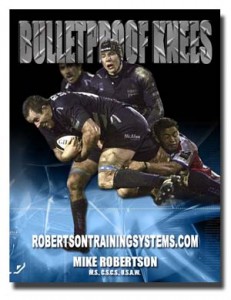
I’ve had success training hockey players with knee injuries, both in terms of improving their strength/performance and minimizing/preventing knee pain or further injury. A lot of what I know about preventing and training around knee injuries I learned from my colleague Mike Robertson. He put together an incredible resource, Bulletproof Knees, that I HIGHLY recommend to anyone with a history of knee pain/injury or currently dealing with knee pain. Bulletproof Knees details exactly how you can figure out what’s wrong with you (it may not be a knee problem causing your knee pain!) and gives you the exercises to fix it. Check it out below:

Bulletproof Knees

-Kevin Neeld

Please enter your first name and email below to sign up for my FREE Athletic Development and Hockey Training Newsletter!
A couple days ago I wrote about the training program I used for a hockey player that had recently undergone knee surgery. You can read that here: Training Hockey Players with Knee Injuries.

That post included a sample upper body training session that he used. After the first couple weeks, the general inflammation from the surgery was gone, and so was the pain and any hesitation about hurting his knee. Of course, the absence of pain doesn’t mean that his knee had completely healed, so it was important not to push his operative leg so far.

Phase 2 (Weeks 3-4): Upper Body/Non-operative Leg
Program Goals:

  • Improve upper body strength and power
  • Improve core strength and power
  • Improve strength/coordination of the non-operative leg/hip
  • Minimize compression on operative knee
  • Make him work hard so he still “feels” like an athlete
  • Use exercises that won’t piss off PT or surgeon

He again came in 2x/week for the next two weeks before taking a week break to visit Shattuck St. Mary’s Prep. One of his training sessions looked like this:

A1) Chin-Up: 5 x 6
A2) 1-Leg Stiff Legged Deadlift (non-operative leg only): 4 x 8
A3) Standing Belly Press Iso-Hold: 3 x 20s/side
B1) Weighted BOSU Push-Up: 3 x 10
B2) Standing Tight Rotations: 3 x 20s
B3) 1-Leg Squat (On box so operative leg can stay extended; non-operative leg only): 3 x 8
B4) Stability Ball Front Plank w/ Small Circles: 3 x 20s
B5) Rice Digs: 3 x 60s

The major difference between Phase 2 and Phase 1 is the addition of two lower body exercises (1-Leg Stiff-Legged Deadlift and 1-Leg Squat). Both of these exercises were performed only on the non-operative leg. As I’ve written in the past, strength improvements on one-leg are, at least in part, transferred to the other side. This is one of the brilliant adaptations of the nervous system.

I had him go slow on the way down in each of these exercises since more strength is transferred during contractions of longer “negative” or “eccentric” phases.

Stay tuned for Phase 3 of this progression, when we start to re-integrate our injured hockey player back to normal full-body training sessions.

-Kevin Neeld

P.S. I’m less than two weeks away from the official launch of my new hockey training membership site. You won’t want to miss the incredible bonuses that go to the action takers that sign up right away! Keep checking back for more information on the launch.

Please enter your first name and email below to sign up for my FREE Athletic Development and Hockey Training Newsletter!
A couple weeks ago, I mentioned that I was doing some work with a young hockey player that had recently undergone a meniscal repair surgery. You can read that article here: Doctors vs. Strength Coaches: A Difference in Perspective

After speaking with his surgeon and physical therapists, I put together a program for him.

Phase 1 (Weeks 1-2): Upper Body Only
Program Goals:

  • Improve upper body strength and power
  • Improve core strength and power
  • Minimize compression on operative knee
  • Make him work hard so he still “feels” like an athlete
  • Use exercises that won’t piss off PT or surgeon

He came in 2x/week for these weeks. With the above goals in mind, one of his training sessions may have looked like:

A1) DB Chest Press: 5 x 6
A2) Front Plank/Side Plank/Side Plank: 3 x 30s/each
A3) Scap Wall Slides: 3 x 10
B1) Chin-Up: 5 x 6
B2) Standing Tight Rotations: 3 x 20s
C1) DB Curls: 4 x 8
C2) DB Skull Crushers: 4 x 8

I realize how basic this program is, and that some of you may be surprised based on some of the things I’ve written about and programs I’ve posted in the past. The idea isn’t to overwhelm him with variation. The goal is to improve his upper body strength as much as possible without irritating his recently operated-on knee.

I steared clear of many of my favorite exercises (e.g. low pulley row, standing 1-arm db row, overhead mb floor slam…to name a few) to be extra cautious that he didn’t do ANYTHING that would bother his knee.

In the next couple days, I’ll write how we transitioned into “Phase 2” to get him working a little harder and strengthening his non-operative leg.

-Kevin Neeld

P.S. If you’re a hockey player or coach, check out my hockey training site for some great information on how to become a fast, strong, well-conditioned player.

Please enter your first name and email below to sign up for my FREE Athletic Development and Hockey Training Newsletter!
Most youth hockey programs get 1-2 hours a week for off-ice training.  In the last two articles I’ve gone over dynamic warm-ups and core training, the most important two forms of training that every hockey player should be doing.  Taken together, the warm-up and core training generally takes the first 15 minutes of each session.  That doesn’t leave much time for everything else.  This makes it that much more important that hockey players don’t waste their time with garbage training.

While speed, agility, and quickness training and conditioning are generally viewed as separate entities, they can be combined in the interest of saving time.  The key is to really understand the demands of hockey.  Speed is one of the most important skills of the game, but top speed is rarely reached and when it is, it’s almost never maintained for very long before a player will need to change direction.  As a result, the abilities to start explosively, stop quickly, and change direction rapidly are much more desirable than simply being fast in a straight line.  To be overly simplistic, hockey-specific speed is really just well-designed agility training.

When designing hockey-specific agility drills, you’ll want to:
1) Include what I refer to as proactive and reactive drills.  Proactive means that the path and direction changes are pre-determined.  The player must move through the drill as quickly as possible.  Reactive means the player’s movement is in response to some other stimulus, usually in the form of a partner (mirror drills) or coach (command drills).

2) Include movement changes specific to hockey.  Hockey players often have to transition between forward, backward, diagonal and lateral movements.  Agility drills should reflect these movement changes.  For instance, you could design a circuit of agility drills that involve a 5 yard back pedal to a 5 yard sprint in the diagonal forward direction (45° turn); then a 5 yard back pedal to a 5 yard sprint in a lateral direction (90° turn); then a 5 yard back pedal to a 5 yard sprint in the backward diagonal direction (135° turn); etc.  You could also mix in shuffling, crossover steps, and different starting positions (forward, backward, lateral, push-up position) to maximize the on-ice carryover.

3) Include speed changes specific to hockey.  While I made it a point to acknowledge that top speed isn’t maintained for long, it’s important to understand that many of the direction changes in hockey occur at near-top speeds.  Also, many max effort sprints don’t begin from a stationary position.  Your off-ice training should reflect this.  Include longer range accelerations (20-30 yards) with a quick deceleration and direction change (similar to a pattern a wide receiver may run).  Include agility circuits that start with a speed build-up.  This allows the athlete to practice accelerating from a moving position, which is usually the way it happens on the ice.

If you consider all of these things while designing your agility drills, you should be able to maximize the effectiveness of your speed, agility and quickness training while minimizing your training time.  Switching gears a bit, a lot of these same concepts can be applied to a hockey specific conditioning.  Again, analyze the demands of hockey.  Do hockey players skate at a low or medium intensity for several minutes at a time?  Not if they’re any good!  Most players and coaches recognize that the average shift is 30-60 seconds, followed by AT LEAST twice that much time of rest.  This means that hockey specific interval training would involve work to rest ratios of 1:2 at the low-end and 1:6 at the high end.  However, while a shift may last 60 seconds, shifts almost NEVER involve maximal effort skating throughout the entire duration.  Usually there’s a quick sprint, then a glide, then lighter skate to a new position, then another quick sprint, etc.  In other words, most shifts are characterized by multiple short, high-intensity sprints followed by brief resting periods.

To maximize the hockey specificity of your conditioning, high intensity multi-directional movements should be used.  As an example, I’ve used 10-yard repeat sprints from a push-up starting position as a conditioning exercise.  The athletes explode up from a push-up position, sprint 10 yards, then walk back and immediately repeat for 4-6 reps.  Then they take a few minute break before repeating the interval.  That’s just an example.  You could also use a partner mirror drill as a conditioning tool.  Have one player be a leader, another a follower.  The leader can move within a pre-determined area or along a pre-determined path and the follower must mirror the movements exactly.  Let them go for 15 seconds or so, rest 15 seconds, then switch roles for an interval, then rest for a couple minutes before repeating everything again.  Depending on the length of the work intervals, I generally keep conditioning down between 3-8 work intervals.  I may use 3 work intervals for something like a 300 yard shuttle run with cones at 0 and 25, and 8 intervals for something like 20s lateral mirror drills (4 repetitions as the leader and 4 as the follower).  Starting to get the picture?  The idea is to build a higher work capacity by maintaining a high workload, while still providing adequate rest to maintain a high intensity.  Usually conditioning should last about 10-15 minutes.

If you follow all the principles outlined in this article, you can effectively improve hockey-specific speed, agility, quickness, and conditioning in less than 30 minutes.  By incorporating a well-designed dynamic warm-up and core training program, you can drastically improve on-ice performance in less than two hours a week.  Now with all the tools, the only missing ingredient in the success formula is your unparalleled determination to outwork your opponent.  Keep working hard.  Your results will speak for themselves.

This article was originally published at ezinearticles.com

Kevin Neeld, BSc, MS, CSCS is the Director of Athletic Development at Endeavor Fitness in Sewell, NJ and the author of Hockey Training University’s “Off-Ice Performance Training Course,” a must-have resource for every hockey program.  Through the application of functional anatomy, biomechanics, and neural control, Kevin specializes in guiding hockey players to optimal health and performance. Kevin developed an incredible ice hockey training membership site packed full of training programs, exercise videos, and articles specific to hockey. For a FREE copy of “Strong Hockey Core Training”, one of the sessions from his course, go to his hockey training website.

Please enter your first name and email below to sign up for my FREE Athletic Development and Hockey Training Newsletter!
Use CODE: "Neeld15" to save 15%