P.S. For more information on in- and off-season program design, training and reconditioning for injured players, and integrating sports science into a comprehensive training process, check out Optimizing Adaptation & Performance
Enter your first name and email below to sign up for my FREE Sports Performance and Hockey Training Newsletter!
Hockey Conditioning: Where to start
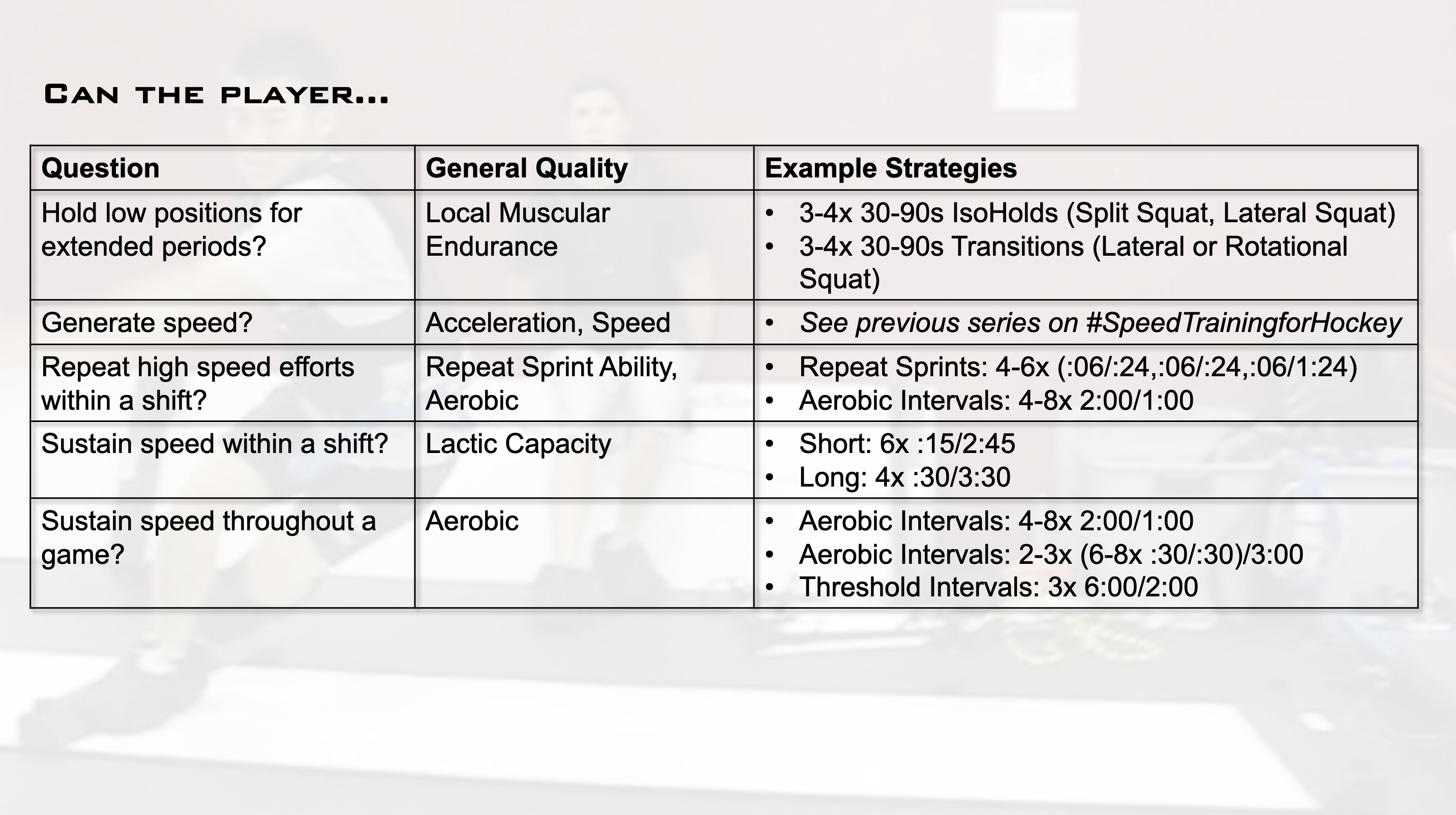
Different players will have different limiting factors to their conditioning. Answering these questions may help the player hone in on more specific strategies for their individual needs:
Can the player hold low positions for extended periods of time? (see previous post for target times)
Can the player generate speed? (see previous series for information on #SpeedTrainingforHockey)
Can the player repeat high speed efforts within a shift?
Can the player sustain speed within a shift?
Can the player sustain speed throughout a game?
While it’s possible to address each of these things at the same time, it’s more effective to pick a target and focus on that.
For example, lactic capacity work, which will help improve within-shift sustainability, will compromise gains in speed and power. As a result, it’s better to train these qualities on different days, and preferably in different phases.
In contrast, speed/power and repeat speed work can be trained on the same days, with aerobic work built into days between the higher intensity training sessions.
As a general rule, players will benefit from following this hierarchy: Low Position Endurance -> Speed -> Repeat Sprint/Aerobic -> Lactic Capacity
Feel free to post any other comments/questions you have below. If you found this helpful, please share/re-post it so others can benefit.
Enter your first name and email below to sign up for my FREE Sports Performance and Hockey Training Newsletter!
The Biggest Mistake in Hockey Conditioning
There are many ways to break down the demands of the game to gain insight into how to best prepare. In ice hockey, it’s common to look at shift length and work-to-rest ratios as an indicator of game demands.
At most levels of hockey, a typical shift is 40-60s and teams carry 3-4 forward lines and 3 d-pairs. Following this thinking, “hockey-specific” conditioning would involve work bouts of 40-60s with a 1:3 work-to-rest ratio.
While seemingly logical, this is one of the biggest mistakes in hockey conditioning.
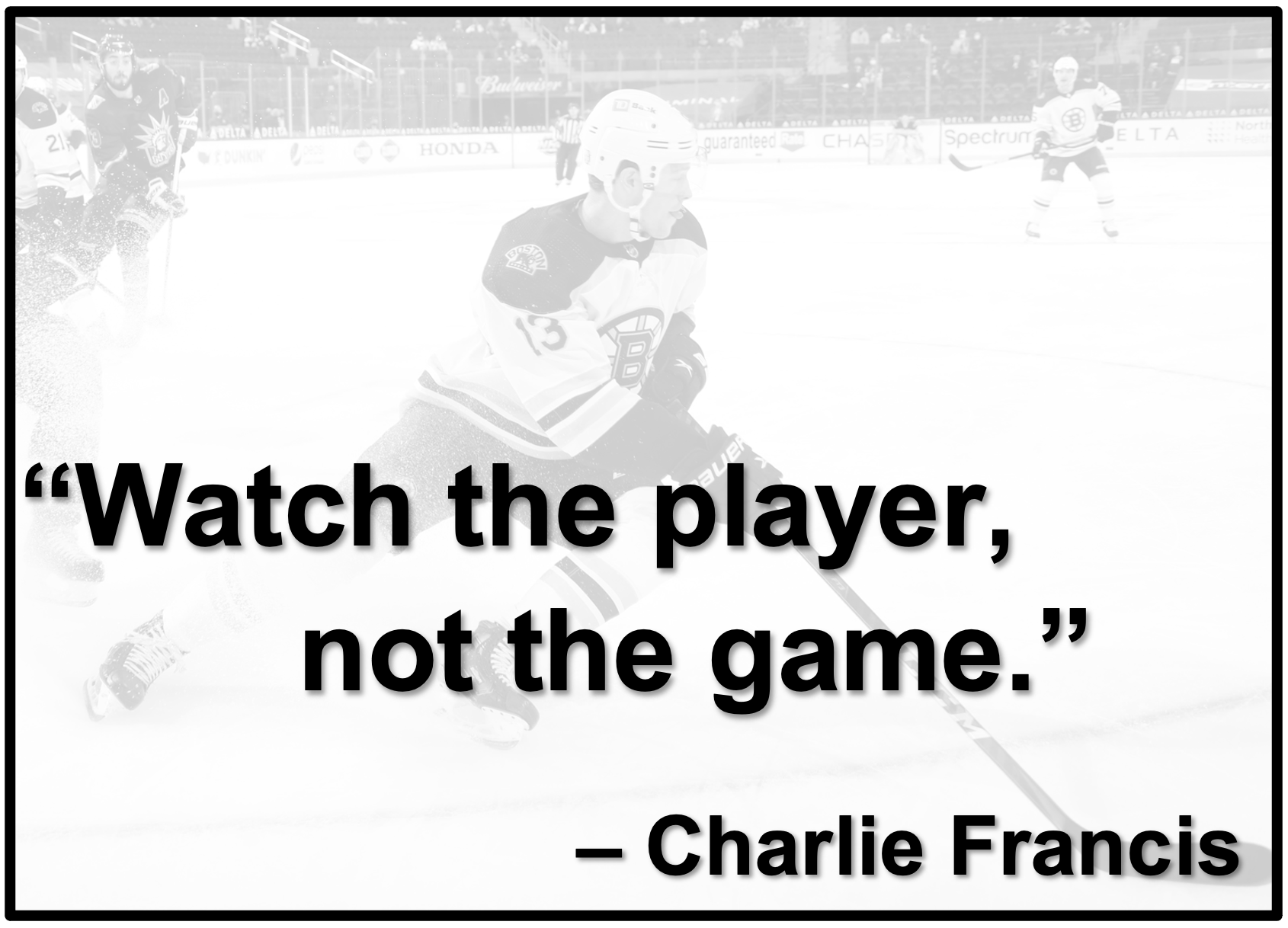
Legendary track coach Charlie Francis is often referenced as saying “Watch the player, not the game.”.
When you do this in hockey, a very different pattern emerges. For the individual player, a typical shift consists of intermittent maximum effort bouts interspersed with brief periods of rest.
Over-emphasizing 40-60 second work bouts, particularly on the ice, will compromise speed in 3 key areas: 1) speed of skating, 2) speed of skill execution, and 3) speed of decision making.
Over the next few weeks, I’ll share some of the available research highlighting the demands of the game, limiting factors to hockey conditioning, and specific training strategies.
If you have any specific questions or comments, post them below and I’ll address them throughout this series.
Enter your first name and email below to sign up for my FREE Sports Performance and Hockey Training Newsletter!
Improving Power from Low Positions Continued…
Lateral Bound from Pause w/ Drop Start
Similar goal as the Squat Jump w/ Quick Dip with maximizing transition speed except now the push is lateral, so the athlete should “push the turf away” to cover as much ground laterally as possible. The emphasis is on the push, NOT on reaching out with the lead leg.
Typically performed for 3-4 sets of 5 reps per side.




 Use CODE: "Neeld15" to save 15%