Hopefully you’ve enjoyed “Theory Week” here at KevinNeeld.com. In case you missed them, I put up two posts discussing a new way to view an athlete’s muscle fiber make-up (Neeld Muscle Fiber Continuum Theory) and long-term soft-tissue stress accumulation as it pertains to common injuries and performance limitations (Soft-Tissue Stress Overflow Theory).

It’s also been a busy week over at HockeyStrengthandConditioning.com.

Sean Skahan added Phase 1 of his ACL Rehab training program. I’ve been reading up on ACL research this week because Endeavor has partnered with a local youth Soccer organization. As you know, ACLs plague soccer players and are often career-limiting injuries. Anything we can do from a strength and conditioning standpoint to improve the athlete’s likelihood of competing at their pre-injury level after surgery is a life changing opportunity. Timely program from Sean.

Check it out here >> ACL Rehab Phase 1 from Sean Skahan

We also added a couple videos. Darryl Nelson added videos of two Olympic Lift variations that he uses with the NTDP. He also points out that the players in one of the videos are goalies…Yes…goalies need to lift too.

Watch them here >> Olympic Lifts from the Hang Position from Darryl Nelson

Mike Potenza added a few exercises to help restore function and balance across the hip joint. In my opinion, having multiple exercises in your “toolbox” that serve a similar function is a great way to add variation in your programs (at least in the athlete’s mind) without neglecting the necessary creation of stress to certain structures/patterns. Mike shows a couple exercises using a somewhat specialized piece of equipment, but these could also be done with a slideboard and some resistance bands.

Watch them here >> Abduction and Adduction Exercises from Mike Potenza

There are also some great forum discussions that you should check out. If you’re in charge of making equipment purchases for a training facility, you’ll want to read up on the thread that’s shedding some light on the differences between the Woodway Curve and Woodyway Force.

Jim Reeves has posted some enlightening comments in response to a question from a member asking what he should do for his players to stay in good shape for a tournament they have 3 or 4 weeks after the season ends. I face a pretty similar situation in that a lot of our athletes finish the season and immediately want to prepare for tryouts. It’s a difficult thing to balance actively reversing some of the negative adaptations of the season while also continuing to prepare them for a hockey-related assessment.

Lastly, Mike Potenza started a thread on an interesting assessment designed to assess neural fatigue in athletes. This piqued my interest because of my background in exercise neuroscience and because I had no idea such a concept existed. I’ll be interested to read more about this in the future and look into it for our guys here.

Enjoy your weekend!

Click Here for the best in Hockey Strength and Conditioning

To your continued success,

Kevin Neeld

P.S. Try HockeyStrengthandConditioning.com for 7 days for only $1! It’ll be the best dollar you’ve ever spent.

Please enter your first name and email below to sign up for my FREE Athletic Development and Hockey Training Newsletter!

When I was an undergrad at the University of Delaware, we, like most undergrads in exercise science or related fields, learned about different muscle fiber types. This is important information as different muscle fibers lend themselves to different tasks. As a very quick over-simplified example, some are more endurance-based and others are more strength- or power-based.

While some mild adaptations have been made to this model since I first learned it, in general muscle fibers are broken down into one of three categories: Type I Slow-Twitch (Oxidative), Type IIa Fast-Twitch (Oxidative), or Type IIb Fast-Twitch (Glyolytic). While there are multiple ways of classifying or characterizing muscle fiber types (contractile, enzymatic, structural, and metabolic characteristics), all of these things are inter-related and it would therefore be, for our purposes today, superfluous to go into extensive details on each.
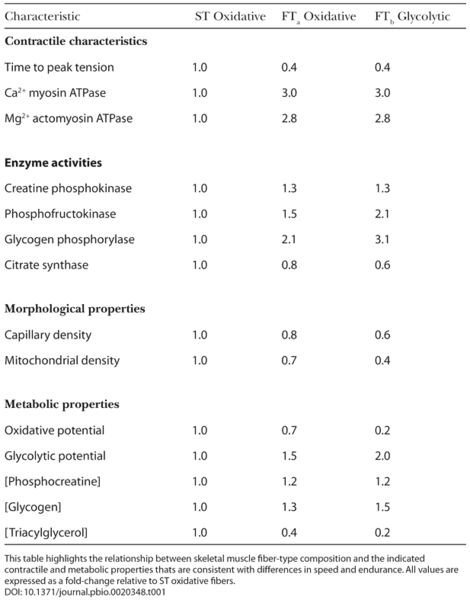

An example breakdown of muscle fiber characteristics

The general consensus is that, based largely on genetic make-up, each of us has a certain percentage of slow twitch, fast twitch, and transitional muscle fibers. The transitional fibers are “trainable”, meaning that they can adapt to the stresses we place across them to become more slow- or fast-twitch-like. Another inherent message in this system is that, no matter what you do, there are fibers whose characteristics cannot be changed.

As you may have guessed, I have some questions about this way of viewing muscle fibers.

First, no discussion on muscle fibers would be complete without mention of motor neurons. A motor neuron is what drives a muscle fiber to contract. In other words, muscle fibers are somewhat useless if they’re disconnected from a motor neuron (still can generate passive tension, but nothing active…at least until they’re re-innervated). There is also some evidence that it’s the motor neuron that determines the muscle fibers contractile characteristics. For instance, an old study on cats showed that when the experimenters took a fast twitch motor neuron and connected it to a slow twitch muscle fiber, and vice versa, the slow twitch muscle fiber started to behave with fast twitch characteristics, and the fast twitch muscle fiber behaved with slow twitch characteristics. Basically, fast and slow twitch muscle fibers switched behavior in response to having their neural inputs switched.

Moreover, it is well established that motor neurons are recruited in order from smallest to largest, which recruits muscle fibers from “least strong” to “most strong” (an oversimplification, but illustrative of the point). With these things in mind, I’m surprised that we’re still viewing muscle fibers in these “buckets” of EITHER Type Ia, Type IIa, or Type IIb. I’m aware that researchers are beginning to “discover” Type IIc and Type IIx fibers, but are we missing the big picture?

Opposed to describing set muscle fiber types, wouldn’t it be more accurate to describe muscle fibers as exhibiting characteristics along a continuum ranging from PURELY slow twitch/high endurance to fast twitch/low endurance? And if there are indeed muscle fibers that exhibit fast twitch AND high endurance characteristics, maybe the continuum’s shape will change from something linear to something more triangular?
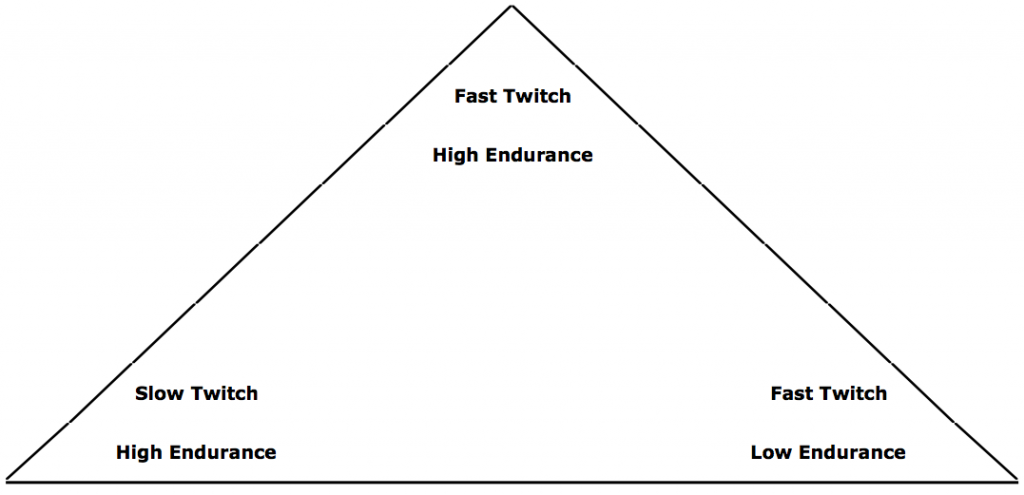
A new view on muscle fiber characterization

The neuromuscular system is HIGHLY plastic, meaning adaptable to training (and living) demands. The idea that we have muscle fibers that “cannot be transformed” ignores the fact that we would never want to have PURELY “Type I” or “Type IIa” fibers. Think of the implications of this. When we stand, there are dozens of muscles, including those of the circulatory and respiratory systems, that are tonically (read: constantly) active at low levels, sufficient to keep us breathing, oxygenated, and from falling. These muscles require at least some of their muscle fibers (and again-muscle fibers in this context is just another way of saying “motor unit” or the motor neuron and connected muscle fibers) to exhibit Type I characteristics. Death is the alternative. This means that, even for the sports/activities that are the MOST fast-twitch dominant (e.g. powerlifting, Olympic lifting, shotput, javelin, etc.), the athlete will need a combination of fast- and slow-twitch fibers to stay alive. It also means that, during everyday life, EVERY living human is creating a reinforcing stimulus for these Type I fibers. In other words, it’s not that they aren’t “trainable”; it’s that they’re constantly being fed a stimulus to remain exactly as they are.

The same can be said for endurance-based athletes. There are times when contractions necessitating higher force levels are advantageous for health and performance (e.g. quickly adapting to unpredictable ground changes or overall perturbations via stretch-reflex mechanisms), and every time the body needs to produce high amounts of force, it’s creating a stimulus to the body to maintain high force levels. Interestingly, during immobilization, where some of the tonic postural maintenance roles of the involved musculature is diminished, there is some evidence that muscles will lose some of their Type I characteristics (Hortobagyi et al., 2000).

I think we’ve both over-complicated and misrepresented the characteristics of the neuromuscular system.

A live webcam shot of David Lasnier reading this post…from his new computer

As I mentioned, the body is highly adaptable to the stimuli we present it. In this regard, it may not be that certain muscle fibers are “untrainable”, it may be that we need to expand our view on what we consider “training”. Training, realistically, is EVERYTHING we do, as every movement or lack thereof is creating some stimulus of adaptation (for better or worse) to our bodies. And because the stimuli we constantly provide inevitably varies with regards to the force and endurance characteristics, our neuromuscular system has created a CONTINUUM of motor neuron/muscle fiber characteristics to cater to our needs as humans and as athletes. Inevitably, these adaptations have occurred throughout the history of mankind via DNA alteration processes, and more acutely via inter-lifetime adaptations to imparted stimuli.

To your success,

Kevin Neeld

Reference:

Hortobagyi, T., Dempsey, L., Fraser, D., et al. (2000). Changes in muscle strength, muscle fibre size and myofibrillar gene expression after immobilization and retraining in humans. Journal of Physiology, 524, 293-304.

Please enter your first name and email below to sign up for my FREE Athletic Development and Hockey Training Newsletter!

This week at Hockey Strength and Conditioning was one of those “forum weeks”. Every now and then we intentionally slow down the amount of content we add in the form of articles, programs, videos, etc. so that our members have an opportunity to catch up on some of the stuff we’ve posted over the previous few weeks.

Last week we added Brian Burke’s presentation, which I think echos the hockey development sentiments of the HockeySC team, and (as you know) is one that I think everyone involved in hockey should take an hour to watch. On that note, I understand that some of the Maple Leafs fans out there are reluctant to listen because of a lack of satisfaction with the direction the organization has taken in recent years, but that is not the focus of his presentation-it’s on what changes need to occur in youth hockey to improve the development process. His words are equally applicable to current norms in both the U.S. and Canada!

YOU MUST WATCH THIS!! >> Youth Hockey Presentation

We added a 2 day/week in-season program that I’ve used with our players at Endeavor. In it, you’ll see a new sprint start technique we’ve been experimenting with recently and a new method of conditioning in-season (which we do our best to cycle through to avoid overworking any one pattern).

Check it out here >> In-Season Hockey Training Program

When you sign in, make sure you’re checking in on the forums. The discussions over the last week have been awesome, and Darryl Nelson posted a great video (in the thread “Psychology vs. Physiology) from Dr. Larry Lauer on building/restoring confidence in your team. It’s only five minutes, but there are some important messages in it.

Lastly, my dad emailed this video to me a couple weeks ago and I wanted to share it with you. It’s amazing what people can accomplish when we work together!

[windowsmedia] http://kevinneeld.com/videos/Stick-Figure-Punter.wmv [/windowsmedia]

If the video does not appear above, click this link to watch it >> Stick Figure Punter

I have some great stuff lined up for you for next week so make sure you check back in!

Click Here for the best in Hockey Strength and Conditioning

To your continued success,

Kevin Neeld

P.S. Try HockeyStrengthandConditioning.com for 7 days for only $1! It’ll be the best dollar you’ve ever spent.

Please enter your first name and email below to sign up for my FREE Athletic Development and Hockey Training Newsletter!

I’m breaking my usual Monday-Wednesday-Friday update routine because I wanted to let you know about something I’m really excited about. As you know, I’ve been a huge promoter of Body By Boyle Online since it was first launched several months ago.

Mike Boyle’s work has had a profound impact on my training philosophies and methodologies. I’ve been fortunate to have had the opportunity to read his books, watch his DVDs, attend his seminars, and visit his facilities at BU and MBSC. He’s also been an incredible mentor, always making himself available to me if I have questions about anything from sports hernia referrals to running a private training facility. Moreover, I’ve learned and continue to learn a lot from his disciples (Sean Skahan, Mike Potenza, Darryl Nelson, Devan McConnell, Kim McCullough, and Jaime Rodriguez…to name a few).

In short, Boyle has had a remarkable impact on the hockey training and development industry as well as strength and conditioning as a whole. This is, in large part, a result of his dedication to continuing education. In fact, if there’s one thing that he taught me that I had to highlight as THE most important thing, it’s that I should never stop learning. In this way, I’ll always stay on top of my game, be aware of new information, and put my athletes in the best environment to succeed.

It is for that reason that I place so much value in Body By Boyle Online and why I know you’ll benefit so much from it as well. That brings us to today’s exciting announcement.

A couple weeks ago, I got an email from Boyle and Kevin Larrabee about them relaunching their site in a way that makes the content more easily accessible and costs less. Instead of having me try to describe all the changes to you, I thought it would be easier if I had Kevin (the other Kevin) come on and do a quick interview about it.

Enter Kevin:

Me: First off, congratulations to you and the rest of the Michael Boyle Strength and Conditioning staff for being ranked the #1 Gym in America. That’s quite an honor! As you know, I’ve been a huge supporter of BodyByBoyleOnline since you guys first launched it. Looking through the programs provides invaluable insight into Coach Boyle’s underlying philosophies and methodologies, and the constant content updates are outstanding. In fact, we use many of the presentations as continuing education for our staff during our weekly meetings. Can you talk a bit about what changes you’re making to the subscription options with this “re-launch” and what lead you to make these changes?

KL: Thank Kevin! We are bringing everything that has helped make MBSC the #1 Gym in America to BodyByBoyle Online. With the relaunch we had two major goals. First off we wanted to make the content as easy to assess as possible. For us, that meant duplicating all of our content for a website, and in doing so offering multiple qualities of the videos for those with fast or slow connections.

Second, we wanted to created a second membership level for those that might not want to do online training and just want the rich educational content that we have put together. To be honest over half of our members simply come to watch the staff meeting videos as well as the exclusive seminars that we film. For example we just filmed the 2011 MBSC Winter Seminar that featured Dan John as well as Mike. We understand that many people want to go to more seminars, but the time and cost of travel is just too high. So for those people, we now offer a standard version of BodyByBoyle Online at a reduced rate of $39.97/month (for now). Of course all of our current members will also be given access to the website as part of their Platinum membership ($59.97/month).

Me: Although the site is “Body By Boyle”, he’s not the only content contributor to the site. Can you provide some insight into some of the other guests you have add content?

KL: I think that is what makes BodyByBoyle Online so great and a pleasure to produce. We have had speakers come in to the facility to do private seminars for our staff. In the last couple months we have had Sue Falsone form Athlete’s Performance present and do a hands on about the thoracic spine, Nick Tumminello came in to talk rotary training, Chris Frankel did a lecture and hands on about suspension training, and always have guests stopping by, especially when the Perform Better Circuit is coming through town. This just goes to show you how much Mike values continuing education and how important it is for you to be one of the best in this field.

Me: I think one of the things that causes people to hesitate sign up for sites/services with monthly memberships is a fear that the information will stagnate. Can you talk about what plans you guys have for the site in the future and what members have to look forward to?

KL: Trust me when I say you have an ongoing stream of new content. We film our staff meetings each week, our guest speakers, F.A.Q. with Mike where he goes in depth on subjects and answers questions from the members, and we are even dipping into the vault with some classic Boyle videos. All you need to do is take a look at Mike’s shorts to see the videos are 15 years old or so. But the best part, is that the videos from the past are even more relevant now than they were then. One of the VHSs that Mike has converted to digital video is his olympic lift video where he goes through the various lifts. Guess what, we still use the same coaching steps as he did back then.

We have also made digital versions of Mike’s current DVD offerings such as the three DVD set he just produced and released a few months ago.

Me: Thanks Kevin. I appreciate you taking the time to be with us today. I look forward to seeing the content additions over the upcoming months!

To your success,

Kevin Neeld

Please enter your first name and email below to sign up for my FREE Athletic Development and Hockey Training Newsletter!

Last week I mentioned that we added a “must-see” presentation from Toronto Maple Leafs President and GM Brian Burke to Hockey Strength and Conditioning. I’ve now watched, re-watched, and re-watched the presentation again. For those of you that know me pretty well, you know that I’m constantly attempting to fit 25 hour days into a 24 hour world. I’m incredibly defensive about my time and dislike wasting it on anything that lacks purpose. As a result, I RARELY re-read or re-watch resources unless I feel like it’s absolutely essential. In this case, it was.

Listen to him. Hockey’s future depends on it!


There is incredible insight to be drawn from this presentation for hockey coaches and players, but also for parents. We’re living in a time where hockey players are faster, stronger, and more skilled than ever before in history. This may give the false illusion that changes we’ve made to our development systems are for the better. Mike Boyle used to say that great athletes will, in some cases, succeed DESPITE their training, not because of it. I think the same thing can be said about hockey development today.

I whole-heartedly and enthusiastically commend USA Hockey for the changes they’re making to with the launch of the American Development Model. As Burke mentioned in his presentation, they’re long overdue, but it’s going to be an uphill battle. Burke mentioned that parents are absolutely integral to the whole thing-they need to pay for their kids to play, buy equipment, drive them to the rink, etc. However, they can also be the most formidable opponent to changes that are in the best interest of their kids. As he points out, it’s quite a paradox.

Hockey Development, The Right Way (Finally)

3 Things all Hockey Parents Should Know
1) You’re a parent or you’re a coach, but not both
One of the most continually dreaded moments in a young player’s career is getting into the car after a bad game to hear his dad (and sometimes mom) tell him about all the things he did wrong. Burke mentioned that his father had an outstanding rule when he was growing up: If he didn’t want to talk about the game, he didn’t have to. I wish EVERY parent would adopt this rule. If we’re being honest, most parents don’t have the technical and tactical background necessary to give their kid appropriate feedback on their performance. Even if they did, there is still a questions as to whether that would benefit them in the long run. Kids play hockey to have fun, not to hear about how bad their parents think they played. Not only does it take the enjoyment out of the game, but it also takes some of the familial love out of the household.

2) You’re a spectator, not an elevated referee
Burke pointed out that he was blown away that anyone would get into officiating anymore. I concur. Let’s face it-refs are human. They’re going to make good calls, but they’re also going to make mistakes. No one is infallible. In certain circumstances, bad calls may warrant a conversation between a coach and the ref. The fact that refs get openly screamed at by parents, EVEN AT MITE HOCKEY GAMES, strikes me as borderline comically insane. What kind of culture are we creating with this behavior? I can’t help but think of the Seinfeld episode where Jerry heckles a woman in her office in response to her heckling him at his performance.

I hope parents can see how obnoxious it would be if someone openly berated them for EVERY thing they did that any individual in a crowd of people disagreed with. Not that they were wrong, only that someone disagreed with their vantage point. Clap when your team scores or if they kill of a penalty. Otherwise, keep your mouth shut.

Burke made the a great analogy of parents starting to treat the ice rink like a school bus. When kids go to school, parents don’t get on the bus with them, sit next to them while they’re in class, and critique every mistakes they make. They put them on the bus, trust them in the hands of trained professionals, and leave them alone. Why not to the same with hockey? Or more relevantly, why does every parent feel they’re a fully trained hockey development expert?

“Pretend you’re on a school bus when you come to the rink. You can go up there and sit and watch, and cheer if you want, but shut up if it’s negative. And don’t come down and beat me afterward about who’s on the power play.” – Burke

3) STOP Playing Spring and Summer Hockey and START Training!
This is something that anyone in hockey development worth his/her salt already knows, but parents really struggle with. Burke mentioned that they filmed and analyzed a couple dozen of these games a while back and they found that in any 90 minute game, on average, the third line right winger had the puck on his stick for about 2s and didn’t complete a single pass. Obviously these statistics would be more telling if we had information about other lines, but even if the kid is an absolute super star, the point is still clear. The American Game-to-Practice ratio is COMPLETELY wrong, and Spring and Summer hockey are the worst culprits. This is the time where players should be taking time away from the rigors of competitive hockey and training to improve their athleticism. When they’re on the ice, it should be for non-competitive SKILL work only. How much will that right winger’s hands improve during that game? Probably none. How much will they improve with a 60-minute puck handling clinic? Probably substantially. This is so intuitive and obvious I’m shocked that it’s not already the norm. The Europeans and Russians are way ahead of us in this regard. Igor Larionov, an INCREDIBLY skilled player of Russian descent, played his FIRST organized hockey game at age 12. Before that it was all for fun and for skill development. Less games. More practice. Better players.

This is one more pass than you’re son or daughter will complete in a typical Spring or Summer League game!

“If you’re gearing your program to get kids to me, you’re sadly sadly mistaken. The odds of a player on any one team playing in the NHL are infinitesimal. If he’s good enough, he’ll find us, and we’ll find him.” – Burke

Addressing the Hockey Community

“You people are vital to the development of hockey players. You’re our sales staff. You have to go back and sell this to these parents that have a different vision of how hockey should be played because it’s all they know. They’re ignorant; it doesn’t mean they’re stupid. They’re uninformed; it doesn’t mean they can’t be changed. That’s your job. This is the way to go. And I can tell you confidently that this will be copied in lots of other countries in a hurry, because this is the best way to develop young players.” -Burke

The information on how to do things the right way is becoming available. It’s up to us to use it.

To your success,

Kevin Neeld

Please enter your first name and email below to sign up for my FREE Athletic Development and Hockey Training Newsletter!
Use CODE: "Neeld15" to save 15%