Most of our off-season hockey players wrapped up their training last week. Most youth programs are getting started with camps in the next couple weeks. At this time of year, I get a ton of questions from players and parents about what they can do in-season to help maintain or continue progressing their physical development.

For starters, I think it’s important to establish how crucial in-season training is. In-season training has certainly gained favor over the last decade or so, but there are still thought-leaders/organization heads with an old-school mentality that don’t emphasize it nearly enough. This, in part, might be explained by a lack of understanding of the goals of in-season training:

  1. Maintain physical qualities (continue to increase in lesser trained players)
  2. Reverse negative changes in soft-tissue length and quality
  3. Facilitate recovery

This stuff is VERY important in-season!

All of these goals are inter-related. When done right, in-season training will help players feel, perform, and recover faster. As an example, take a look at a few interesting statistics from my friend Stieg Theander’s work with the Phoenix Coyotes:

Man Games Lost to Injury

  • 1996: 450
  • 1997: 473
  • 1998: 250 (Stieg’s first year!)
  • 1999: 149
  • 2000: 142

The first year resulted in a ~45% reduction in man games lost to injury. After 3 years, that number decreased another 25%. That’s a 70% reduction in man games lost to injury in three years! It would be short-sighted to attribute all of this to in-season training, but it highlights the magnitude of change a quality training program can have on a team’s health. Think your team would do better with a 70% reduction in games lost to injury?

In-Season Training Composition
Some of the hesitancy with implementing in-season training programs boils down to not understanding how to design and implement the program. If a player take their off-season program and follows it through the year, they’ll be completely buried before Thanksgiving. The off-season is about developing capacity; the in-season is about doing the bare minimum to maintain capacity. These are much different goals and require drastically different approaches.

Three In-Season Program Changes
I’m in the process of developing the new in-season programs for the entire Team Comcast Tier I youth organization for this season, so I’ll probably post some of the programs to HockeySC.com over the next couple weeks. Until then, here are three in-season program changes to think about:

1) Speed and conditioning work is on the ice
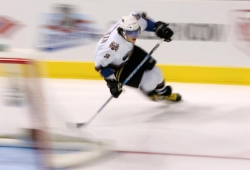
In the off-season, we sprint twice per week and condition between 2-3 times depending on the phase. In-season, the players’ speed and conditioning work should be done on the ice. If players perform drills at a high tempo, they’re getting the most hockey-specific form of speed training possible, and most practices are of sufficient tempo to prepare players to compete in a game (despite what physiologists may tell you). Hammering sprint and conditioning work off the ice will put excessive wear and tear across the muscles of the hips and lower body. In-season, sprint work should be limited to very low volume (e.g. 4-6 sprints of 10-15 yards), and be done sporadically. Conditioning should be low impact (e.g. on bikes or using circuits), and be used to compliment on-ice conditioning. Most youth players skating 4+ times per week will be fine in this department. Pro players that may not get much ice during games are a different story and will benefit from supplementary conditioning work.

2) Avoid rotation
This is anti-sport-specific training at it’s finest. Hockey players rotate several hundred times per week during practices and games to turn, give and accept passes and hits, shoot, and orient their eyes in a more optimal position to read the play. All of this is stress in a rotation pattern. Like speed work, rotation-based core work should be limited in volume and frequency.

During this time, however, it is extremely important to maintain rotation-pattern mobility. Amongst others, hips and thoracic spines tend to stiffen up as the season prolongs. Maintaining this mobility is a top priority and should be done on as close to a daily basis as possible. In our setting, we built our warm-up to encompass these qualities so we know they’re hitting them every time we see them, and encourage teams to do the same warm-up when they’re not under our supervision. We’ll also build some extra mobility work into the off-ice training sessions (lying knee to knee mobilizations, diagonal hip rocks, wide stance quadruped rock, seated thoracic rotations, diagonal arm arcs, etc.).

Lying Knee to Knee Stretch. This can also be done for reps with 2s holds, and with a sleeved shirt.

3) Strength and Power are Key
In general, the physical qualities stressed on the ice during the season are multi-directional speed, low load power, and work capacity/conditioning. To design a program that compliments on-ice work, it’s important to consider what qualities ARE NOT being stressed on the ice. Strength and high load power are visibly absent from the list above. ALL in-season work should be low volume, but there should be a greater proportion of the total training program allocated to these qualities than the others that receive more on-ice attention. To be overly simplistic, if all players did was follow this template:

A1) Olympic Lift
A2) Hip Mobility
B1) LB Push
B2) UB Pull
C1) LB Pull
C2) UB Push

they’d be much better off than what most players do.

Great display of power. Colby Cohen hang cleans 235 x 3

The key is to get a low volume of high intensity high quality reps in, and then call it a day. Don’t overdo it. 2-3 sets of 4-8 reps is all it takes for most in-season lifts. As a general rule, player’s shouldn’t be smoked at the end of an in-season training session; they should feel warmed up and energized. There is a time for tough sessions in the interest of team building or developing mental toughness, but this is the exception, not the rule.

Hopefully this provides a reasonable insight into the composition of an in-season training program. In a couple days, I’ll post some important information on how to alter the stimulus of a training program to minimize the risk of detraining throughout the year. Check back soon!

To your success,

Kevin Neeld
Please enter your first name and email below to sign up for my FREE Athletic Development and Hockey Training Newsletter!

In the past, I’ve proposed that speed (both on and off the ice) comes down to force application. In other words, the more force you put into the ice, the faster you skate. This understanding is important because it helps athletes (and parents and coaches) that are ONLY interested in speed understand the importance of strength training. Simply, using the transitive property of mathematics:

More Strength = More Force
More Force = More Speed
More Strength = More Speed

While there’s more to it than this, it really is THIS simple for many of the hockey players I work with. They’re simply not strong enough to skate faster than they are. They need to improve their capacity to develop speed before they can develop speed.

I recently came across a new study on sprinting performance that had some interesting results. Bret Contreras, who is about as well-read in strength and conditioning research as anyone I know, wrote a summary of the article here: Sprinting Performance is Not Solely About Force Put Into the Ground. Legendary ice hockey physiologist Jack Blatherwick wrote a more hockey-specific interpretation of the study here: Acceleration: It’s not just about strength; it’s about efficient application of strength .

You can read the abstract here: Technical Ability of Force Application as a Determinant Factor of Sprint Performance

Basically, the results of this study support the idea that the TOTAL amount of force put into the ground isn’t as important as the direction of the force. At first glance, this strikes me as one of those studies that people will misinterpret and inappropriately cite for years. “Force doesn’t matter!”. Force still matters. In fact, force is still the key; it just needs to be qualified.

In these studies, researchers can use force platforms to dissociate between force applied in vertical and horizontal orientations. Every ground-based athletic movement will involve both, but with certain movements it will be more desirable to shift a greater proportion of the force production in either a vertical or horizontal orientation. For example, a vertical jump would necessitate maximal vertical force production and minimal horizontal force production. Likewise, it is only logical that sprinting, an activity whose performance is quantified by the time it takes to cover a horizontal distance, would necessitate more force put forth in a horizontal direction than vertical.

Optimal acceleration positioning

As Blatherwick pointed out in his article, the primary finding of this study is one that track coaches (and the strength and conditioning coaches that put a premium on sprint technique) have known for years. Training to improve a player’s capacity to produce force (e.g. strength) is a necessary part of development. The important take home from this study is that movement quality cannot be overlooked, and in itself is a worthy training aim. Once QUALITY is established, then QUANTITY should be overlaid to improve capacity.

To your success,

Kevin Neeld

P.S. You can get a free copy of my hockey speed training manual “Breakaway Hockey Speed”. Just enter your name and email below!

Please enter your first name and email below to sign up for my FREE Athletic Development and Hockey Training Newsletter!

We’re in the final phase of our off-season hockey training program at Endeavor Sports Performance, which means a lot of our players are starting to trickle back to their teams. It also means we’re at the final stage of exercise progressions for physical qualities like power, speed, and conditioning. From a programming standpoint, this is the most fun phase to write. It’s also the most fun phase to coach. A lot of new exercises that encompass multiple training qualities. In today’s post, I want to show you a video of a dynamic rotational power exercise.

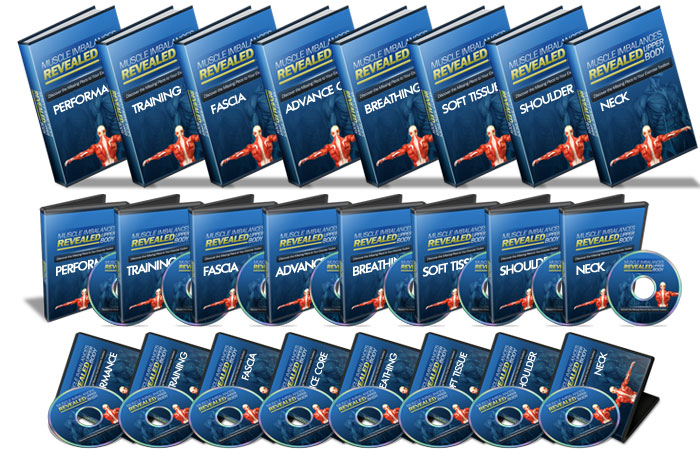
Before we get to that, I wanted to let you know that my friend Rick Kaselj is just releasing his new system: Muscle Imbalances Revealed: Upper Body. Rick’s lower body system was a huge hit, and this features a couple new presenters in Tony Gentilcore and Jeff Cubos. I’m about half way through reviewing it (might write a full review if I can find the time in the near future), and it’s an awesome resource. Tony’s presentations alone are worth the price of admission. I could sit down with a beer and watch these on repeat. It’s like listening to Larry David giving a highly educational and well-researched talk on upper body assessments and exercise programming. Jeff Cubos, Dean Somerset, and Rick cover a host of other important topics, including soft-tissue work, advanced core training, linking breathing to performance and rehab, and neck exercises. For those of you that train people for a living, the system comes with CEU’s too. If you’re interested, check out the link below for more information.

Click here >> Muscle Imbalances Revealed

Med Ball Shotput with Rapid Step Behind with Partner Pass
Our rotational power exercises progress in:

  • Symmetry (more sets in non-shooting direction in early off-season)
  • Volume (more sets toward end of off-season)
  • Load (heaviest load in 2nd off-season phase, then back off in 3rd phase to emphasize velocity)
  • Starting position (progress to dynamic movements toward end of off-season)

Within the 2nd and 3rd off-season phases, we’ll incorporate a partner pass. The video below is of a “Med Ball Shotput with Rapid Step Behind with Partner Pass”, an exercise our hockey players perform in the final two weeks of their last off-season program.

Great power and eye movement

Another med ball for the graveyard

I’m all for creativity, but I won’t include an exercise in our athlete’s programs unless it serves a specific purpose. In this case, we’ve added components to the exercise to integrate other important athletic qualities without sacrificing the core goal: rotational power. Adding a dynamic start teaches the athlete to generate maximal rotational power from a non-stationary position, which is traditionally how this quality is needed on the ice. Adding a partner pass teaches the athlete to make quick adjustments based on the accuracy of the pass to maintain power. We also cue our players to rapid turn their eyes to the wall, pick a spot on the wall, and throw the ball THROUGH that spot. Actually, we tell our players that’s what we’re looking for, and then we just say “eyes” as a reminder. We use the same cue during transitional sprint work: “eyes first”. We want to get our players into the habit of maximizing their occulomotor drivers, and, more simplistically, just looking where they’re going/shooting.

I’ve talked a lot about how the most sport-specific training can be anti-sport-specific training, and that you don’t want to revert back to the moronic chaos of exercises like band-resisted slap shots and things of that nature. In this case, I think the demands of this exercise are about as hockey-specific as it gets, at least without throwing in someone to play defense. Maybe the best terminology is to think of training qualities, but not skills. In this case, we’re incorporating qualities like visual adjustment and tracking, dynamic adjustment, and projectile accuracy without sacrificing the core goal of rotational power.

To your success,

Kevin Neeld

P.S. Don’t forget to check this out to see if it’s right for you! Muscle Imbalances Revealed

Please enter your first name and email below to sign up for my FREE Athletic Development and Hockey Training Newsletter!

Before I get into today’s article, I want to remind you that Alwyn Cosgrove is hosting a free seminar titled “The Death of Personal Training” on Monday. When it comes to the business aspect of fitness and running a training facility, Cosgrove is the man. If you haven’t already, go ahead and register for it here: The Death of Personal Training

It’s been a while since I’ve been able to write a Hockey Strength and Conditioning update. Last Wednesday I flew out to Blaine, Minnesota for a few days to help out with the training/testing of the U-18 and O-18 girls at the U.S. Women’s National Development Program camp. It was great spending a few days working alongside Coach Boyle, Anthony Donskov, Chris Pietrzak-Wegner, Dawn Strout, Cal Dietz and Jim Snider. Awesome group of coaches. I flew back Friday and spent the weekend catching up on everything. I’m actually flying up to Maine later today to go to a PRI course with Eric Cressey. Busy time of year!

Chris Pietrzak-Wegner wrote a great article on selecting a quality protein/energy bar. Chris pointed out a lot of the lesser known downfalls of these products and identified specific ingredients to look out for. He also identifies what things you should look for in a quality bar. I know a lot of players tend to lean on these as a post-practice/game meal resource because of how quick/convenient they are. If you fall into this category, I encourage you to read through this article. Parents and coaches need to continue making an educational push away from processed foods and to foods with more natural ingredients (and usually less total ingredients). The things Chris covers in this article can really be applied to all foods, not just protein bars. Check out the article at the link below.

Click here to read >> Choosing a Protein/Energy Bar Wisely from Chris Pietrzak-Wegner

Darryl Nelson added one of my favorite articles to date. If you don’t know this already, I STRONGLY believe that the idea of “natural ability” or “talent” is GROSSLY over-exaggerated. If you buy into the 10,000 hour rule, I think that, in general, we fail to fully recognize the less obvious factors or forms of practice that create natural ability. For example, the benefits of mental rehearsal are fairly well-established. In other words, visualizing yourself performing a certain skill or movement will result in improvements in that skill or movement. Mental practice is practice. It counts. I think some players are more proactive in this visualization process. On a related note, I think certain players watch hockey games analytically, and apply what they see into their mental rehearsal repertoire so they’re better prepared when they encounter similar situations in their own games. They react more instinctively. It’s practice and it’s highly beneficial, but it’s rarely taught or promoted.

Another less obvious factor contributing to a player’s development is known as the “Relative Age Effect”, which identifies how a player’s birthday may influence their ability to develop in our current system. This was the focus of Darryl’s article, and another thing that everyone from players to administrators in youth hockey should be aware of.

Click here to read >> Relative Age Effect from Darryl Nelson

Sean Skahan added the final phase (Phase 5) of his ACL Rehab/Reconditioning program. Now that he’s posted the last phase, I recommend going back through the site and finding all 5 phases, laying them out, and studying the progression. Individual programs hold limited value (not NO value, just limited), but progressions can give you a ton of insight into the rationale behind the reconditioning strategy. This understanding is what will ultimately give you the ability to apply a similar rationale in your own setting.

Click here for the program >> ACL Rehab/Reconditioning Phase 5 from Sean Skahan

There are some good discussions going on the forum too. My friend Cristi Landrigan asked a specific question about a very popular protein powder that her son was taking and Chris chimed in with some great alternative options. Potenza also started a thread on ways to load someone on the ice other than sleds. A few great ideas there too.

As always, if you aren’t a member yet, I encourage you to try out Hockey Strength and Conditioning for a week. It’ll only cost $1, and if it’s not the best buck you’ve ever spent, I’ll personally refund you!


To your continued success,

Kevin Neeld

Please enter your first name and email below to sign up for my FREE Athletic Development and Hockey Training Newsletter!

I was recently asked to do an interview with Kyle Coleman, a corporate chef based out of Phoenix, AZ. Kyle has taken on the noble task of asking experts in various sports/aspects of athletic development to weigh in on their thoughts on everything from nutrition to training to development programs in general. Kyle’s questions were great, so I wanted to share the interview with you. Check it out below:

1. Would you please give us some insight on what your position entails?

I’m the Director of Athletic Development at Endeavor Sports Performance, a private training facility for aspiring athletes competing from recreational youth to professional leagues. We work with athletes in every sport, but are best known for our ice hockey development programs.  On a day-to-day basis, my job involves writing training programs, coaching training sessions, supervising and scheduling our coaching staff, and providing content for our website and newsletters. On a grander scale, it’s my responsibility to stay current on new research and more effective training methods, implement any changes in assessment or program design structure, and help create the vision for the future of our company.

2. Which aspect of your position is the most gratifying?

I’m a coach first, everything else second. While I appreciate the program design aspect of things, coaching is really what gets me out of bed in the morning. Taking part in an athlete’s development is a special opportunity; one that I’m eternally grateful for.

3. What led you to becoming a Hockey Training Specialist, Athletic Development Coach?

The short story is that during my early youth years I was a skilled hockey player that was too fat or slow to compete at high levels. One solid off-season of training changed that for me, and I knew then (age 14) that I wanted to make a career out of helping other players do the same. Hockey has always been my passion, but working with athletes in other sports is equally gratifying and the fundamental principles that govern the design of programs for athletes in different sports are more similar than different.

4. What strength & conditioning program do you recommend for hockey?

A custom-written and professionally delivered one. Unfortunately the overwhelming majority of hockey programs are still stuck in the “do some jumps and run around the rink” training system. An argument can be made that something is better than nothing, but the argument is not very strong in these cases. A solid program will account for the player or team’s starting place with regards to training history, be built around their schedule to optimize recovery time, and be progressive in nature. Most youth players that lift weights just print a bodybuilding program off the internet, and use it for a few months until they print off another one. The players we’ve trained that make the transition from training on their own are typically blown away by how different the approach is.

Training programs need to encompass all aspects of athletic development: mobility, speed, power, strength, conditioning, and recovery. The exclusion of any of these qualities will impair the development and/or transfer of all the others.

Players also need to be taught how to move correctly. This is a foreign concept to most players. It doesn’t matter how fast you move until you move well. That is the key to maximizing performance and minimizing injury risk.

I realize this is a long-winded response, but the primary message is that off-ice training is essential to a player’s development and shouldn’t be structured haphazardly or without profession help.

5. What are the qualities a parent should look for in a hockey training coach for their child?

From a professional standpoint, the coach should have some sort of academic background in exercise science or kinesiology, an understanding of the demands of hockey, and experience training hockey players (or at least other youth team sport athletes). From an interpersonal standpoint, the coach needs to care about and take pride in the players’ development. While most fitness professionals are relatively altruistic by nature, there are certainly exceptions that are just interested in making a quick buck. The best coaches are the ones that truly care about their players; they will be the ones that take the extra steps to ensure that the player’s development and succeed.

6. In what ways can parents help their youth athlete develop?

Start teaching proper lifestyle habits early. I understand that these will almost invariably be met with some level of resistance, and perfection is not expected, but some steps in the right direction are far better than no attempt at all. The two areas that kids need to focus on the most are sleep and nutrition. Sleep is relatively straight-forward. Kids need 8-9 hours per night, and should aim to go to bed and wake up at the same times (+/- an hour), everyday. If they get up at 6 for school, they shouldn’t sleep until noon on the weekends. Let them sleep until 7:30 or so and then get them up, have them eat breakfast and start moving around. If they feel like they need it, they can take a nap later. Consistency is key.

From a nutrition standpoint, kids need to be taught to eat REAL food. Real food refers to things that can be hunted or grown, or are only a few steps away from this most natural form (e.g. sprouted grain bread, greek yogurt, all natural peanut butter, etc.). In contrast, the diet of most kids consists of processed garbage that provides little in the way of quality nutrients. My friend Dr. Mike Roussell says to think of moving from barcodes to bags. More fruits and vegetables, less fruit snacks and chips. Remember that we’re supposed to get an absolute bare minimum of 5 servings of fruits and vegetables everyday, with 7-10 being more optimal. Just because kids “don’t like it” doesn’t meant hey don’t need it. Get creative in the delivery of these nutrients. Blend a bunch of stuff up in a smoothie with a flavor they like (our athletes love our smoothie recipes so I know it’s possible!) and have them eat that as their breakfast every morning.

As a final note, pre-/during-/post-game nutrition is important. Donuts and energy drinks are unacceptable. The real food rules apply here. Kids don’t need to suck down high sugar sports drinks after every practice and game. Stick with a few cups of water before and after, sipping on water throughout the practice/game, and a solid meal within an hour afterward. At higher levels, kids can help fuel their recovery by grabbing a 16 oz chocolate milk at a local store afterward. If player’s report not having enough energy during the game, take a closer look at the pre-game meal. If that’s solid, then look into Generation UCAN’s SuperStarch products, which provide a high quality energy source that doesn’t have the negative metabolic effects of most sports drinks (e.g. no spike and crash and still allows the athlete to use body fat as a primary fuel source).

To your success,

Kevin Neeld

P.S. If you’re looking for an off-ice training program for youth hockey players, check out my Off-Ice Performance Training Course!

Please enter your first name and email below to sign up for my FREE Athletic Development and Hockey Training Newsletter!

Use CODE: "Neeld15" to save 15%