One thing a lot of athletes struggle with is maintaining a stable pelvis while pushing laterally.

It’s common to see the torso bend back toward the pushing leg in exercises ranging from Lateral MiniBand Walks to Lateral Bounds and lateral cutting in transitional speed work.

While there’s a time and place for emphasizing this type of “bend”, more often than not it’s causing the athlete to lose time/speed by creating a lag between the push-off and the body moving laterally through space.

One simple way to start to address this is with the Lateral Wall Push exercise in this video.

The goal here is to keep the torso upright by maintaining wall contact with the hips and shoulders and to use the outside leg to “push the floor away” to generate maximum push-off force.

This set-up can be used in a couple different ways – either to: 1️⃣ emphasize push-off strength at different hip angles (more upright = less hip abduction) or to 2️⃣ focus on end-range strength, starting as deep as possible and shifting slightly deeper as range of motion opens up from rep to rep.

The feedback from the wall will help the athletes isolate motion at the hip while maintaining a level pelvis, which creates a foundation for them learning how to push laterally without folding over the back leg.

Typically performed for 4-8 reps of 5s holds.

Feel free to post any comments/questions below. If you found this helpful, please tag a friend in the comments below and share/re-post it so others can benefit.

To your success,

Kevin Neeld
SpeedTrainingforHockey.com
HockeyTransformation.com
OptimizingAdaptation.com

P.S. For more information on how to assess movement and integrate specific strategies to improve mobility and movement quality in training, check out Optimizing Movement. Don’t have a DVD player? Send me a note through the contact page after you checkout here Optimizing Movement and I’ll get you a digital copy of the videos!
Enter your first name and email below to sign up for my FREE Sports Performance and Hockey Training Newsletter!

Training single-leg strength in a variety of patterns is one of the keys to having strength improvements transfer to the dynamic environment of sport.

This video is of a 1-Arm DB 1-Leg Lateral Slideboard Lunge, a supplementary exercise that serves two primary purposes:

1️⃣ Develop single leg strength, with control against competing lateral forces
2️⃣ Develop eccentric strength of the adductors in a lengthened position

These qualities are important for most team sports, but have particularly value in hockey in both developing strength in sport-relevant patterns, and improving durability by minimizing injury risk to the adductors resulting insufficient stiffness or end-range strength.

Holding a dumbbell in the opposite hand helps drive a weight shift and a slight rotation of the torso over the stance leg, both of which help load the hip.

A few key coaching points:

✅ Set-up with the majority of the weight on the outside leg (think 80/20).
✅ The outside leg should be actively pushing down into the ground through the entire range of motion.
✅ As the hips drop, the dumbbell should move toward the outside leg.
✅ Keep downward pressure into the board with the straight leg throughout the rep to maintain active tension through the adductors.

Typically performed for 2-3 sets of 8-12 reps OR 6-8 reps with a 3-5s eccentric.

Feel free to post any comments/questions below. If you found this helpful, please share/re-post it so others can benefit.

To your success,

Kevin Neeld
SpeedTrainingforHockey.com
HockeyTransformation.com
OptimizingAdaptation.com

P.S. For more information on in- and off-season program design, training and reconditioning for injured players, and integrating sports science into a comprehensive training process, check out Optimizing Adaptation & Performance

Enter your first name and email below to sign up for my FREE Sports Performance and Hockey Training Newsletter!
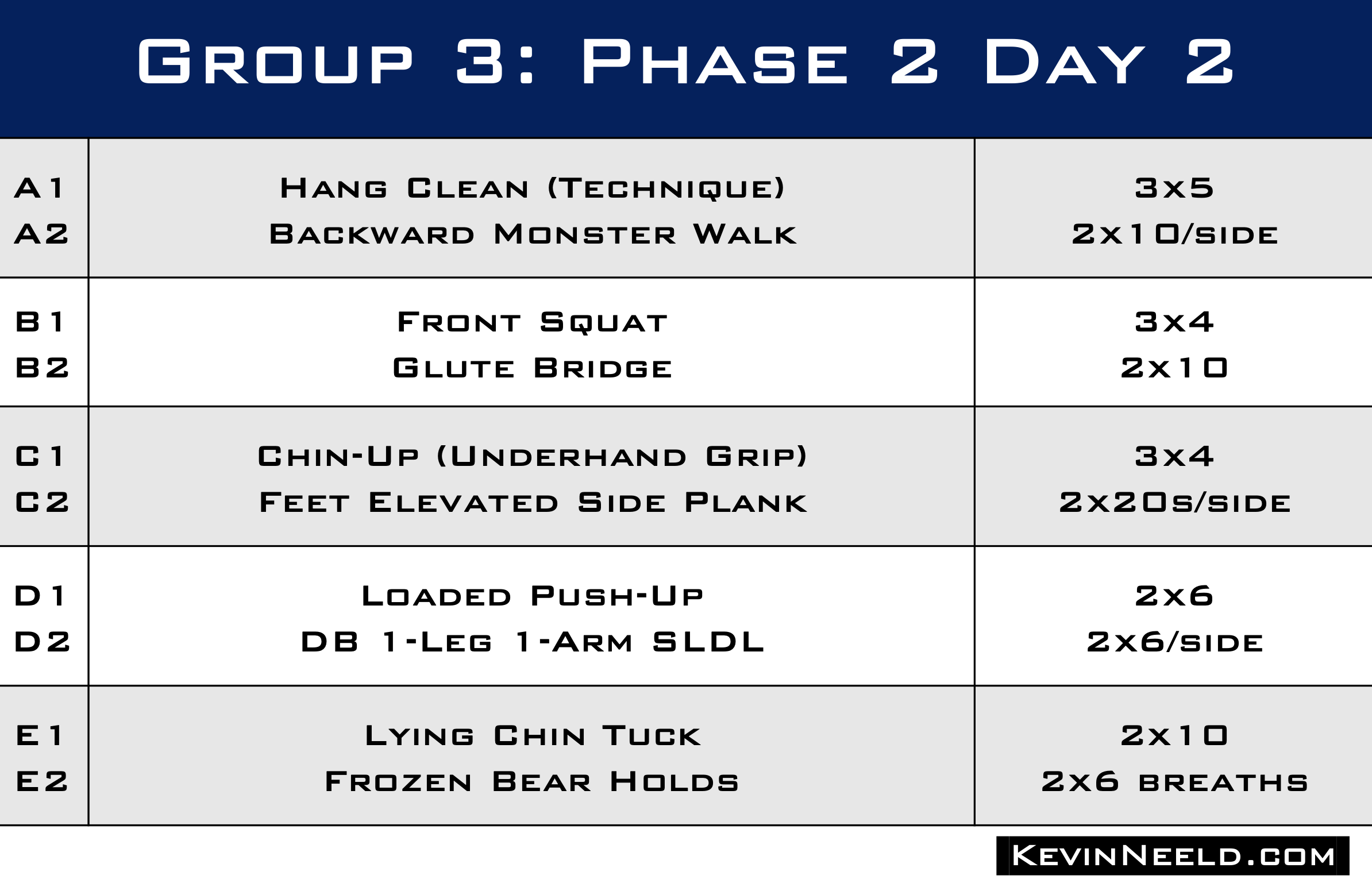
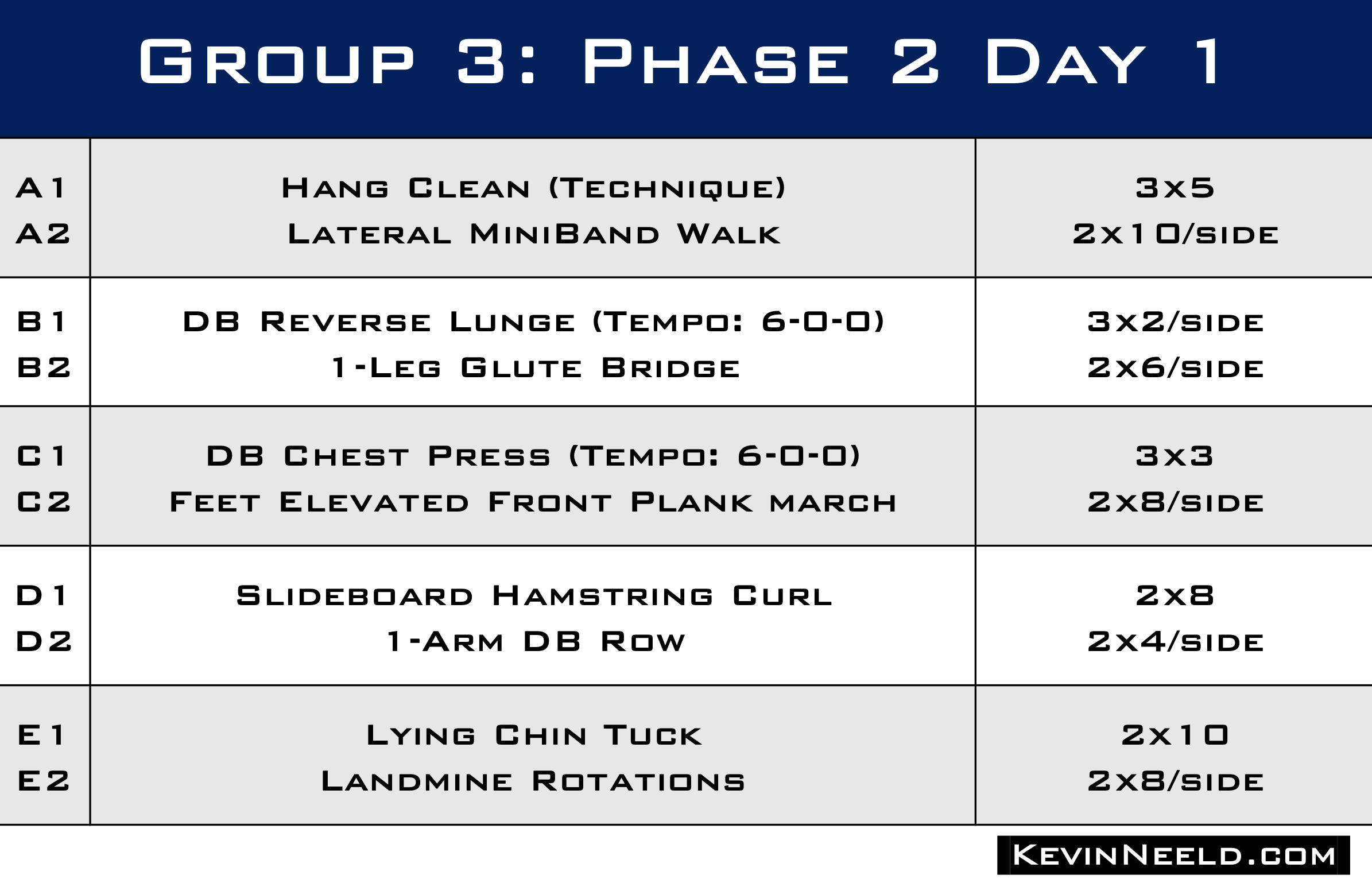
Here’s another sample in-season off-ice training program for youth hockey players from ~15-18 years old (Bantams and Midgets).

A few notes:

✅ This is Phase 2 of the in-season program, so the main exercises have been progressed to over the course of the previous few weeks. The program is designed so the whole team goes through the ‘A’ block together, and then half the team starts on the ‘B’ block, and the other half can start on the ‘C’ block, and then switch.

✅ The general focus of this phase is on developing strength, with an emphasis on eccentric strength on Day 1. The volume for the main lifts is relatively low, particularly for the exercises with 6s eccentrics (e.g. B1/C2 on Day 1).

✅ Day 2 of this week is closer to the weekend games, so the volume stays low, but the intensity remains high.

✅ With every exercise, the primary goal in this environment is on teaching/coaching perfect technique. Loads are only progressed when the athlete demonstrates they can perform the exercise correctly.

Feel free to post any comments/questions below. If you found this helpful, please share/re-post it so others can benefit.

To your success,

Kevin Neeld
SpeedTrainingforHockey.com
HockeyTransformation.com
OptimizingAdaptation.com

P.S. If you’re interested in year-round comprehensive hockey-specific training programs for players at different ages, check out Ultimate Hockey Transformation.

Enter your first name and email below to sign up for my FREE Sports Performance and Hockey Training Newsletter!
Over the last few weeks I’ve gotten a lot of questions about training phase length and sequencing for youth hockey players.

This image is of the periodization template I put together for a youth organization I worked with in the past.

For that organization, we divided the teams into 3 groups by age: Group A: U-12 (Mites & Squirts), Group B: ~12-14 (Peewees & Bantams), Group C (Midgets).

Group A’s program was more game-based, so we didn’t have a formal periodization model in place.

The focus for Groups B&C are slightly different, but in both cases, we used the first several weeks of the season to establish a foundation of our expectations for the training process – showing up on time, warming up as a group, how to read a training program, fundamental movement patterns, etc. Overall training stress is low while the players acclimate to higher on-ice loads.

Group B transitions back and forth between accumulation (relatively higher volume work) and intensification (relatively lower volume/higher intensity work). This is done primarily as a teaching strategy – allow the players to accumulate “practice” reps and perfect movements before emphasizing load.

Similarly, Group C starts with 2 weeks each of an eccentric and isometric phase, which are used to help the players learn (and the coaches to teach) more advanced exercises by slowing down the motion and strengthening the “sticking point”, respectively.

In general, exercises would progress or transition to a new variation in each phase.

Feel free to post any comments/questions below. If you found this helpful, please share/re-post it so others can benefit.

To your success,

Kevin Neeld
SpeedTrainingforHockey.com
HockeyTransformation.com
OptimizingAdaptation.com

P.S. If you’re interested in year-round comprehensive hockey-specific training programs for players at different ages, check out Ultimate Hockey Transformation.

Enter your first name and email below to sign up for my FREE Sports Performance and Hockey Training Newsletter!

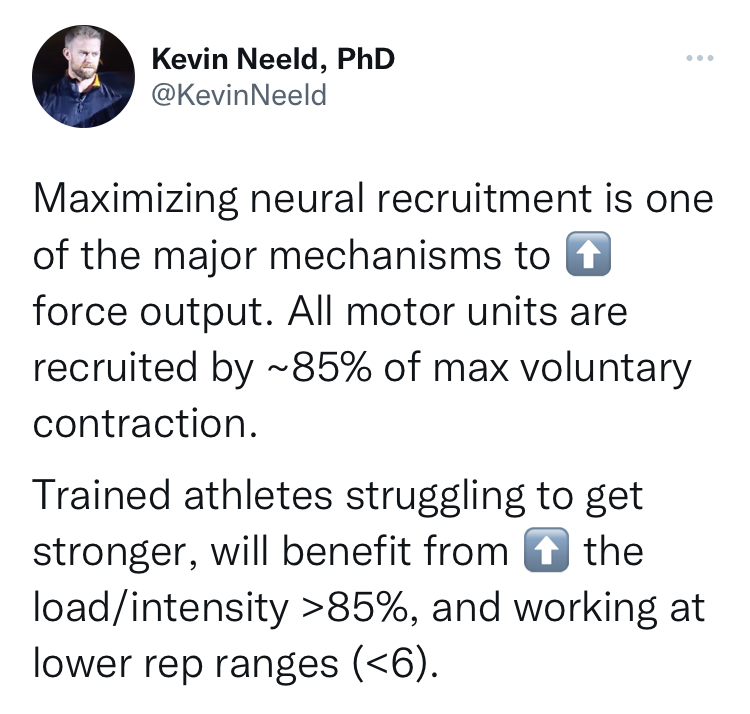
Once athletes reach a certain training age, improving maximal strength requires using near-maximal loads.

Loads above ~85% will maximize recruitment of the involved motor units (nerve and connected muscle fibers), and also lead to positive adaptations in rate coding (i.e. the firing frequency of the nerves), both of which lead to improvements in force output.

Feel free to post any comments/questions below. If you found this helpful, please share/re-post it so others can benefit.

To your success,

Kevin Neeld
SpeedTrainingforHockey.com
HockeyTransformation.com
OptimizingAdaptation.com

P.S. If you’re interested in how strength training fits into a hockey-specific training program, check out Ultimate Hockey Transformation.

Enter your first name and email below to sign up for my FREE Sports Performance and Hockey Training Newsletter!
Use CODE: "Neeld15" to save 15%