Today’s “Thursday Throwback” is a quick one from 2009. This continues to be a trend we see in our assessments today and I think, while basic, highlights that you can go wrong on both ends of the flexibility continuum. Those that are too immobile at one joint are likely to move excessively at another. Those that are too mobile at one joint may be more likely to suffer from injuries as a result of a lack of stability and/or constant attempt to manage the instability (e.g. muscle injuries). This is why optimizing movement is such an important concept!

Optimizing Movement DVD Package


Enjoy the post below:

Does Flexibility INCREASE your risk of injury?

A couple weeks ago I did an audio interview with Joe Heiler for SportsRehabExpert.com, one of the most underrated membership sites on the web. I’m really humbled that he asked me to contribute.

If you’ve never been there, check it out. Joe’s a really bright guy and has compiled a lot of great information from other smart, successful coaches and therapists.

SportsRehabExpert.com

One of the things that came up during the interview was what we can do to prevent “groin” (adductor) strains. We’ve been fortunate in that we haven’t had too many adductor injuries in our athletes. This is probably, at least in part, due to the hip mobility and hip muscle activation exercises we use.

We did have a couple athletes complain of adductor pain though, and they all had ONE thing in common:

OUTSTANDING ADDUCTOR FLEXIBILITY!

This trend flies in the face of the “you got hurt because you didn’t stretch or aren’t flexible enough” way of thinking.

In these athletes, we were able to resolve their pain relatively quickly, by having them STOP STRETCHING their adductors, start stretching their glutes a few times a day, and by doing isometric adductor strengthening exercises by crushing a medicine ball between their knees for time.

The rationale was simply that their adductors were weak relative to their abductors (to be overly simplistic: weak groin, strong glutes).

By stretching their glutes and strengthening their adductors, we were able to shift the strength and stiffness relationship between those muscles into more balance and get rid of their pain within a week or two.

To your success,

Kevin Neeld
OptimizingMovement.com
UltimateHockeyTraining.com

Please enter your first name and email below to sign up for my FREE Performance Training Newsletter!

Get Optimizing Movement Now!

“…one of the best DVDs I’ve ever watched”
“A must for anyone interested in coaching and performance!”

Optimizing Movement DVD Package

Click here for more information >> Optimizing Movement

Last year, during my first season as the Strength and Conditioning Coach for the Philadelphia Flyers Junior Team, the team’s media guy asked me to do an interview providing an inside look at what the off-ice development program looked like.

Flyers Logo

I was excited to do the interview because I think the team has a unique situation off the ice, in that they essentially have a dedicated S&C staff in myself and the other guys at Endeavor, and access to me for manual therapy on a weekly basis.

Shortly after completing the interview, the media guy started a new job at a different company and the interview was essentially lost in transition.

I dug around a bit and found a copy of it, which I wanted to share with you today. The interview discusses how we structure our services at Endeavor, the program for the Flyers Junior Team, differences between in- and off-season training, and what defines “success” for the players.

Check out the interview and post any questions/comments you have below!

An Inside Look at the Flyers Junior Hockey Team Training Program

Talk about Endeavor Sports Performance in general…what you do, what you provide, etc.

Endeavor Sports Performance is a ~6,500 sq ft private training facility located in Pitman, NJ, that features a wide range of equipment to suit the needs of today’s aspiring athlete.

While we do offer personal training and do a lot of team training, the core of our training business is our semi-private training. With our semi-private training model, we take the athlete/training client through a comprehensive assessment based on their sport (if applicable), age, and training goals.

We use a combination of assessment techniques taken from the Postural Restoration Institute, Functional Movement Screen, Selective Functional Movement Assessment, and other more traditional orthopedic measures to identify any restrictions in mobility or stability, and side-to-side imbalances that may increase the individual’s injury risk and/or influence exercise selection. We’ll also use a battery of performance tests to identify where the individual stands in terms of power and strength development, and one of a few specific conditioning tests that help us assess the individual’s endurance, but also collect heart rate information to identify training zones for their future conditioning work.

Simply, the goal with this process is to create a movement and physiological profile of the individual we’ll be working with, which allows us to design a program best suited for the unique needs and goals of that individual.

All of that said, the most valuable asset we have at our facility is our staff. Matt Siniscalchi, Matt Sees, and Miguel Aragoncillo are all incredibly well-trained at noticing slight flaws in movement efficiency and exercise technique. Within a training context, it’s important that athletes and non-athletes alike learn the importance of moving well before they move faster, further, more often, or under greater load. I’m proud of how hard our staff has worked to refine their eye for these movement impairments. You won’t find a harder working and more caring group of coaches anywhere!
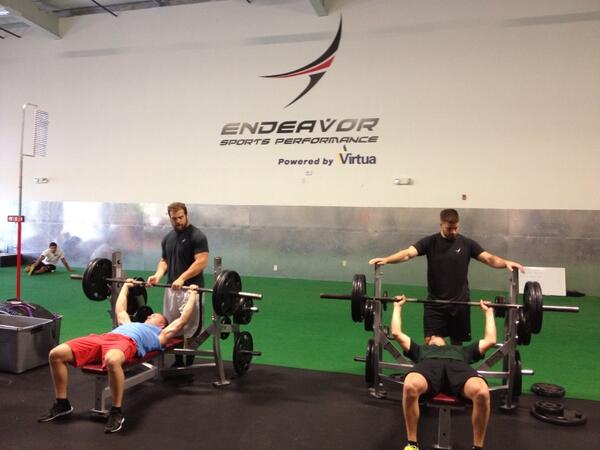
USPHL Flyers Testing

The “Matts” spotting the players during pre-season testing

 On a personal note, I’m also a licensed massage therapist, and hold a few other manual therapy and corrective exercise certifications (Full Body Active Release Techniques ® Certified, Functional Range Release ® Certified, Postural Restoration Trained). Using these assessment and treatment techniques, in combination with my background in exercise, I also offer “Corrective and Manual Therapy”, which serves to help facilitate the restoration of optimal mobility and control that may be limiting training progress or performance, and address nagging aches and pains that aren’t quite significant enough to qualify for physical therapy.

What specifically do you do for the USPHL Flyers? 

I serve as the Strength and Conditioning Coach and Manual Therapist for the USPHL Flyers. We started the season at the end of August by taking all of the players through a comprehensive assessment and profiling process, as I described above, and also included a quick body fat analysis. I also gave a 2-hour presentation to the guys describing my training philosophy, and covering a wide range of topics including nutrition, supplementation, and cooking, footwear, signs of overtraining and recovery strategies.
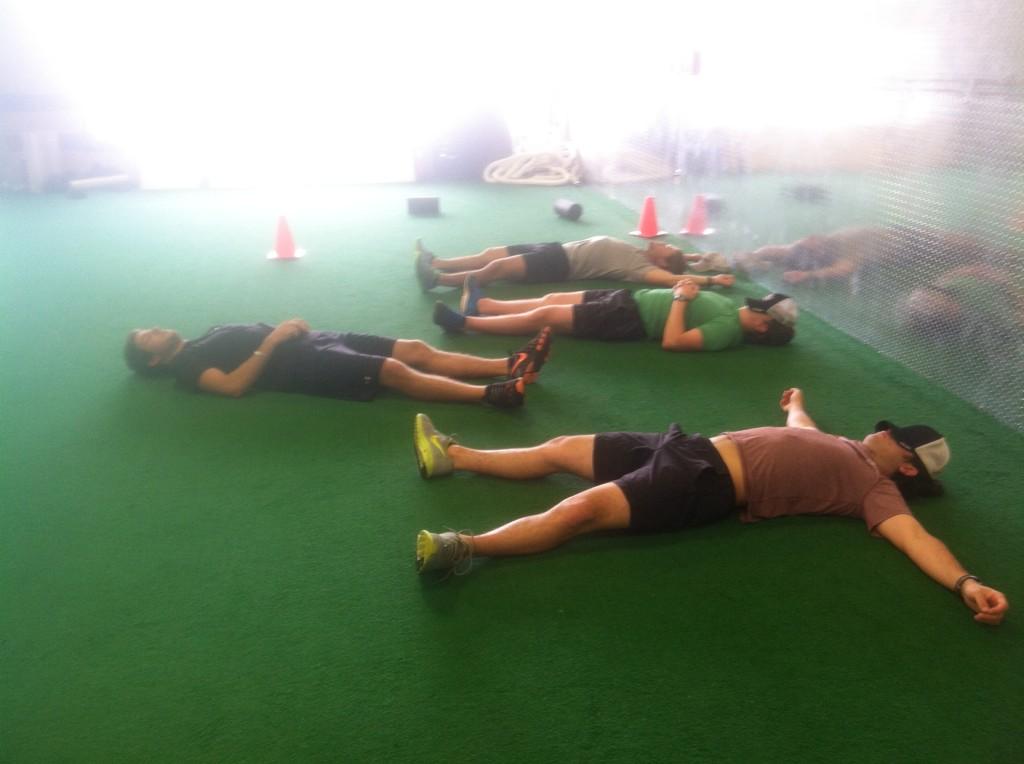
USPHL Flyers HR Testing

Getting resting heart rates from the team

 The training during the pre-season was fairly light. My goal for the team was primarily to get them to understand the training process at our facility and to begin teaching the foundational movements/exercises that they’d be using throughout the season and in college.

Coach Beach and I have talked a lot about this in the past. I think one of the big mistakes that coaches and off-ice professionals alike make during pre-season is they try to whip the team into shape in a week or two.

The reality is that there may be some psychological benefit to setting a hardworking tone early on, but there is very little physiological benefit. The pre-season camp is characterized by a substantial increase in skating loads for most of the players, which means the off-ice training load has to decrease to accommodate. Crushing the player on and off the ice is a recipe for early season injuries and significant fatigue accumulation. The time to prepare for the pre-season is the off-season; the pre-season is the time to help transfer the physical capacities developed in the off-season to on-ice improvements, and to start building chemistry with the team. The bottom line is that training is a progressive process that requires advanced planning to prepare for a specific season. As my mentor Mike Boyle says, “you can’t speed farm.”

Once we got out of camp, we started our in-season training schedule, which involves training twice per week (typically Monday and Wednesday), conditioning and corrective work once per week (typically Tuesday) and open hours for manual and corrective therapy throughout the week, but typically on Thursday or Friday. Training loads, corrective exercises, and conditioning work is all individualized based on the players’ pre-season testing and the ongoing reassessments/retesting we’ve done since then.

How has the training evolved from preseason to now? Are things different in-season?

The focus of in-season training is to help develop or maintain (depending on the player) physical capacities that compliment those that are being “trained” on the ice. For example, the players will get a lot of speed and acceleration work on the ice each week through practices and games, so adding more of that work off the ice would be unnecessary, and would likely set the players up for more hip flexor and adductor strains.

Similarly, most players get more than enough lactic conditioning work, so we avoid training that off the ice. In contrast, specific qualities like high load, medium velocity power, strength, and various aerobic capacities aren’t as highly trained on the ice, so developing these qualities off the ice can help support on-ice development. Adding in specific mobility and stabilization exercises for the hip and spine can also help maintain structural balance and minimize the players’ risk of injury.

I sometimes joke that in-season training is “anti-hockey-specific training”, as we avoid almost all of the training strategies typically thought of as being most appropriate for hockey players (e.g. slideboarding, rotational med ball throws, lateral sprint starts, etc.)

Each phase of in-season training has a specific emphasis, builds upon the previous phase and prepares the player for the next phase. As the season progresses, so too will the training in terms of the targeted physical qualities, training intensities and volumes, and exercise selection.

Do you work with each specific player? Do you help them set goals?

I met with each player at the beginning of the year to discuss their testing, talk to them about their personal goals, and get an idea of what they feel like the limiting factor is to them competing at the next level. This was a great opportunity for me to learn more about the players and what I may or may not be able to do to help them. While there were several players that expressed that improvements in body composition, speed, and/or strength would help them excel this season and provide better opportunities for them in the future, there were others that noted their biggest limitations related to psychology or on-ice technical or tactical abilities. Nonetheless, I like having these conversations because it gives me a better appreciation for the players’ mentality, and helps us work together to put together an off-ice strategy that best allows them to achieve their goals.
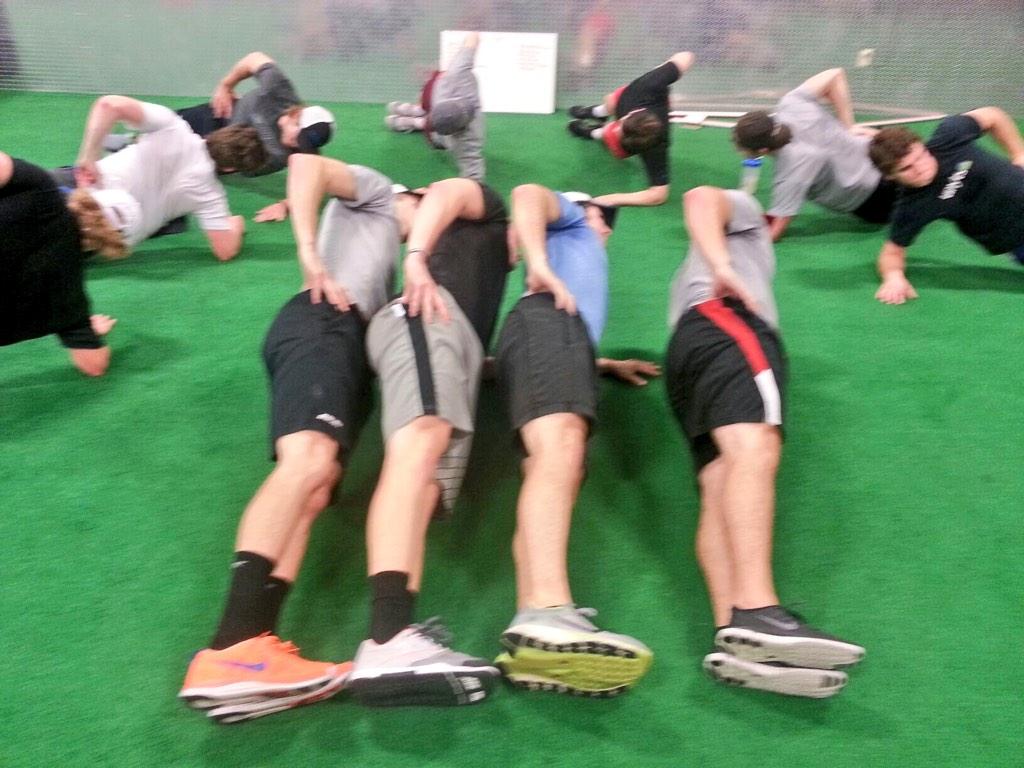
USPHL Flyers Team Side Plank

I also like to think that a well-run program is good for team building

Any specific “success stories” to share?

We’ve had a couple players drop significant amounts of body fat in-season, which I’m really proud of, and several players beat their pre-season vertical jump numbers when we retested a couple weeks ago. In-season retesting can be tricky, especially on a Monday after weekend games, as fatigue accumulation can often mask true maximum performance.

In other words, players having the same vertical jump the day after a game as they did in the pre-season may actually be indicative of an improvement. Almost all of the players were the same or slightly better, which is a positive sign.

All of that said, the real “test” for players at this time of year is on the ice. While the junior level has a strong focus on development, the primary goal of in-season off-ice training, as I mentioned above, is to prepare the players to best express their abilities on the ice. I’m proud of how hard the players continue to work off the ice and how they maintain a high level of focus, even when I know they’re exhausted. This mentality will serve them well in the future, as they continue to fight for spots at the college level.

To your success,

Kevin Neeld
HockeyTransformation.com
OptimizingMovement.com
UltimateHockeyTraining.com

Please enter your first name and email below to sign up for my FREE Athletic Development and Hockey Training Newsletter!

Get Ultimate Hockey Transformation Now!

Year-round age-specific hockey training programs complete with a comprehensive instructional video database!
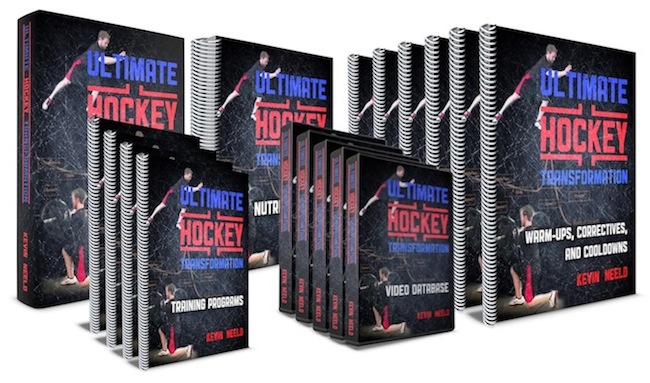
Ultimate Hockey Transformation Pro Package-small

Get access to your game-changing program now >> Ultimate Hockey Transformation

“Kevin Neeld is one of the top 5-6 strength and conditioning coaches in the ice hockey world.”
– Mike Boyle, Head S&C Coach, US Women’s Olympic Team

“…if you want to be the best, Kevin is the one you have to train with”
– Brijesh Patel, Head S&C Coach, Quinnipiac University

With the release of my new Ultimate Hockey Transformation system, Jeff Angus asked to do a quick interview for his site, which he posted early last week.

Read the interview here >> Ultimate Hockey Transformation: Improve Your Game off the Ice

The interview dives into:

  1. What the Ultimate Hockey Transformation package includes
  2. The real keys to improving speed
  3. Age-specific hockey training
  4. The two major types of overtraining and how to recover from each
  5. The impact nutrition plays on training and on-ice performance
  6. An inside look into two athletes that have come up through my system

Read the interview here >> Ultimate Hockey Transformation: Improve Your Game off the Ice

As a quick update, I’ve now made all of the videos included in the Ultimate Hockey Transformation programs available for download so you can access them instantly, at any time, without needing an internet connection.

Now, in addition to having year-round age-specific training programs that you can use for YEARS, you also have instant access to your own copy of the video library featuring the most effective off-ice exercises out there!

Check out Ultimate Hockey Transformation and take your off-ice training to the next level!

Ultimate Hockey Transformation Pro Package-small

To your success,

Kevin Neeld
HockeyTransformation.com
OptimizingMovement.com
UltimateHockeyTraining.com

Please enter your first name and email below to sign up for my FREE Athletic Development and Hockey Training Newsletter!

Testing is an important part of the training process. Not only does it help coaches profile the athlete, and therefore make decisions about which areas require more attention from a training perspective, but it also provides a mechanism to track progress over time.

In a previous post, which followed all of the controversy surrounding one of the upcoming NHL Draft’s top prospects not being able to perform a single pull-up at the most recent NHL Combine, I presented averages on how our youth and junior hockey players performed on a chin-up rep max test, one indicator of upper body strength. If you missed that, you can check it out here: Ultimate Pull-Up Transformation

While there are many ways to test power in athletes, we started using a Lateral Bound Test in addition to some of the more traditional tests (e.g. Vertical Jump, Broad Jump, Hang Clean, etc.). Compared to other tests, this test provides:

  1. An indication of power in a lateral/horizontal pattern, which is extremely specific to ice hockey, but also relevant to almost all team sports
  2. An opportunity to identify side-to-side differences

As you can imagine, the lateral distance one can travel jumping off of one leg and landing on the other will be influenced by a few other confounding factors that need to be accounted for, namely:

  1. Limb length
  2. Hip structure
  3. Lateral “flexibility”

Instead of attempting to measure all of these things individually, we simply calculate a “split” distance (as far as the athlete can spread his/her feet without putting hands on the ground) and normalize all jump distances to this. In this way, we account for how all of those factors affect the lateral movement.

The equation I used to calculate normalized lateral bounds was:

LB Norm = LB Avg/Split where LB Avg = (Lateral Bound Left + Lateral Bound Right)/2

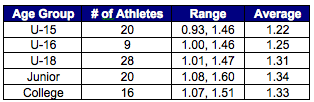
The results from our pre-Summer testing are presented below:

Hockey Power Testing-Lateral Bound

The general story is that athletes become more explosive as they get older (not surprising). It is interesting to the note ranges at each age group, as there are plenty of examples of junior- and college-aged players jumping on a “U-15 level” and vice versa.

Of even greater note is that the correlation between vertical jump height and the normalized lateral bound distance in our junior and college players (we did a broad jump with the younger kids for logistical reasons) was only 0.28. For those of you that shutter at the thought of analyzing statistics, that is essentially “not a very strong relationship”. In other words, the link between vertical jump and lateral bound performance is quite weak, suggesting that power is dependent upon which pattern it’s being expressed in.

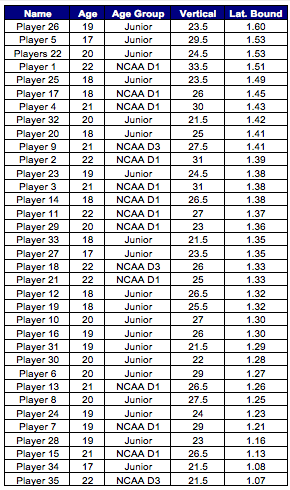
I took the results from our Junior and College players and ranked everyone from best to worst according to their vertical jump height. The player with the best VJ was renamed “Player 1”, and each player was renamed accordingly until the player with the last VJ, who was named “Player 35”. I then re-ranked everyone according to their normalized lateral bound distance.

Hockey Power Testing-Lateral Bound vs. Vertical Jump

Lateral Bound vs. Vertical Jump Performance

As you can imagine, this list isn’t entirely random. The player with the best VJ (Player 1) had the 4th best normalized lateral bound. Similarly, the two players with the worst VJ were also dead last in normalized LB distance. That said, there are some notable outliers. The players with the 6th, 7th, and 8th best vertical jumps are all toward the bottom of the list for normalized LB. Likewise, the 3 of the top 5 best normalized LB performances were handed in by the 26th, 22nd, and 25th best vertical jump performers.

There are a few important take homes here:

  1. Power is pattern specific, so it’s important to select testing methods that provide the most appropriate information for your sport and/or training situation
  2. Ranking players according to a single testing variable is likely to give very cloudy results.
  3. There are high and low performers at every age group, but this doesn’t necessarily indicate that one player is better off than the other, as it’s extremely difficult to factor in genetic capacity. Testing results, especially at these age levels, need to be used to track individual progress and NOT to compare players against one another.

As always, if you have any questions, please post them in the comments section below!

If you’re interested in following a structured hockey training system to improve your speed, power, strength and conditioning, be sure to check out my new Ultimate Hockey Transformation system today!

Ultimate Hockey Transformation Pro Package-small

To your success,

Kevin Neeld
HockeyTransformation.com
OptimizingMovement.com
UltimateHockeyTraining.com

Please enter your first name and email below to sign up for my FREE Athletic Development and Hockey Training Newsletter!

As hockey continues to grow in popularity, so too does the number of adults that refuse to hang up the skates. It’s been very interesting to see how many adult players not only like to keep playing, but will reach out to me to see what they can be doing to help be in better “hockey shape” for their games.

As with younger players, some are interested in improving their performance. Others simply want to avoid nagging injuries or do enough to not be so sore after they play.

Naturally, those with full time jobs (and possibly kids) don’t usually have as much time or energy to dedicate to the training process.

With that in mind, I wanted to share a few simple strategies adult players could use to modify the programs within the Ultimate Hockey Transformation package to cater it to their specific needs:

1) Spend a week JUST doing the warm-up everyday

The warm-ups within Ultimate Hockey Transformation are comprehensive. They are meant to fully prepare your body to perform at your best. At first, they may seem a bit daunting and time consuming, but once you get into a routine they’re much quicker. This is one reason why spending a week just going through the foam rolling, mobility work, and dynamic warm-up will benefit you. It will let master the process so it only takes ~10 minutes instead of 20-30.

For some, this will also feel like a workout in itself. By doing it everyday for a week (or most days of the week for a couple weeks) you’ll build up a foundation of fitness for you to progress on from in the future.

Lastly, getting a lot of practice with these things will help you feel which exercises really cater to your specific needs. I realize you’re probably not going to go through a full warm-up before every adult league game, but mixing in a few of the most beneficial mobility exercises before you hop on the ice can go a long way in maintaining your flexibility over time and preparing you to play better on the ice.Ultimate Hockey Transformation Training Programs-Small

2) Start with the U-14 programs

Every adult is a little different, but as a general rule, I wouldn’t recommend adult players jumping into programs that have Olympic lifting variations and other complex movements. If you’ve been out of training for a while, the first step is to get back to mastering the basic movements. This is the same goal we have for our younger athletes. It’s important to get very good at the basics before progressing to more difficult exercises.

The programs at this age also have less of a time commitment, so you won’t feel like you’re falling behind if you can’t train 4 times per week.

As a result, the U-14 programs are a perfect starting place for most adults.

3) Cut back on the number of sets

Depending on the phase, sometimes an exercise may have anywhere from 2-5 sets. More sets not only means a longer day in the gym, it means more stress to the body. If you’re working all day, and trying to squeeze in a quick lift before running home to eat dinner with your family and then heading out to play a game, you may not have the time or the “stress reserve” to do the full program.

Shaving off a few sets so you’re only doing 2-3 sets of all the main exercises and 1-2 sets of all the supporting exercises is a great way to adjust the program to fit your needs better.

Ultimate Hockey Transformation Pro Package-small

Get your training programs today>> Ultimate Hockey Transformation

4) Stick with the in-season programs

All of the in-season programs are designed to train 2 days per week with relatively few exercises, sets and reps. While our players continue to develop strength and power during this time, the reality is that the focus during the season is on maximizing on-ice performance so the total volume of training needs to be cut back a bit to account for the increase in on-ice work. For the reasons mentioned above, sticking to these programs (or at least starting here) will be a great option for most adult players.

5) Focus on the nutrition strategies recommended in the manualUltimate Hockey Transformation Nutrition Guide-Small

When I talk to the players on our youth teams about their nutrition, I’ll tell them, “Some of you have terrible eating habits. The rest of you are even worse.” And we all laugh. The reality is, most adults aren’t much better.

There is some research that connects BCAAs (protein) to decreased soreness. I strongly believe dehydrated muscle tissue is more likely to tear (or “tweak) than hydrated tissue. Carrying around extra body fat isn’t good for anything.

Brian St. Pierre did an incredible job delivering a TON of easy to implement strategies to help you improve your nutrition, which ultimately will help you improve your body composition, perform better, and recover faster. This information, and the habits you develop following it, will benefit you and your family for the rest of your lives, on and off the ice!


To your success,

Kevin Neeld
HockeyTransformation.com
OptimizingMovement.com
UltimateHockeyTraining.com

Please enter your first name and email below to sign up for my FREE Athletic Development and Hockey Training Newsletter!

Use CODE: "Neeld15" to save 15%