Last Friday we wrapped up post-Summer testing with one of our college guys and one of our pro guys, as it’s time for them to return back to their teams.

Endeavor Banner
Today I wanted to dive into the program of the pro player to illustrate the types of results that can be achieved with individualized programming, even in a very-well trained athlete. In this case, the player had just graduated from college and signed with an AHL team at the end of the year.

A few notes from his intake assessment (6/17/15):

Movement Assessments

  1. Hip Extension: Limited bilaterally
  2. Hip Adduction: Limited bilaterally
  3. Hip Abduction: Limited on R
  4. Left Hip External Rotation: 24; Internal Rotation: 24; 48 total
  5. Right Hip External Rotation: 24; Internal Rotation: 22; 46 total
  6. Shoulder Horizontal Abduction: Limited bilaterally
  7. Shoulder Flexion: Limited bilaterally
  8. Left Y-Balance Posteromedial Reach: 102cm; Posterolateral Reach: 94cm
  9. Right Y-Balance Posteromedial Reach: 99; Posterolateral Reach: 97cm

Performance Assessments

  1. VJ: 31”
  2. Lateral Bound: Average of 87.5”
  3. 1-Leg DB Goblet Squat: 100×5
  4. Bench Press: 185×6
  5. Chin-Ups: 237×5 (192 body weight + 45lbs external load)
  6. *We did a repeat shuttle test, but we didn’t retest at the end of the Summer, so I didn’t include it here.

Post-Summer Assessment (9/4/15):

Movement Assessments

  1. Hip Extension: Unlimited bilaterally
  2. Hip Adduction: Unlimited bilaterally
  3. Hip Abduction: Unlimited bilaterally
  4. Left Hip External Rotation: 30 (+6); Internal Rotation: 31 (+7); 61 total (+13)
  5. Right Hip External Rotation: 31 (+7); Internal Rotation: 31 (+9); 62 total (+16)
  6. Shoulder Horizontal Abduction: Unlimited bilaterally
  7. Shoulder Flexion: Unlimited bilaterally
  8. Left Y-Balance Posteromedial Reach: 113cm (+11); Posterolateral Reach: 98cm (+4)
  9. Right Y-Balance Posteromedial Reach: 116 (+17); Posterolateral Reach: 108cm (+11)

Performance Assessments

  1. VJ: 35” (+4”)
  2. Lateral Bound: Average of 91” (+3.5“)
  3. 1-Leg DB Goblet Squat: 125 for 2 sets of 5 during training
  4. Bench Press: 225 for 2 sets of 3 in training
  5. Chin-Ups: 237 for 3 sets of 5 in training (192 body weight + 45lbs external load)

Overall, I was very pleased with the results of his program. Below is a birds-eye view of the programming strategy we took with him.

This progression is one I use with a lot of our higher level hockey players in the off-season, but where we start (e.g. how much time and how we go about developing the aerobic system) and exercise selection is always based on my individual assessment of the player.

Looking at the structure of his program:

  1. Total Training Time: 12 Weeks, 5 Days/Week
  2. Days 1, 3, & 5 are developmental days; Days 2&4 are aerobic or recovery days
  3. Day 1 typically has a lower body emphasis; Day 3 an upper body emphasis, and Day 5 a full body emphasis

Phase 1: 3 Weeks

  1. Movement Restoration: Teach posterior pelvic tilt OUT of anterior pelvic tilt with stabilization strategies to control it
  2. Exercise Selection: Primarily unilateral lower and upper body patterns as a result of significant bilateral limitations
  3. Phase Emphasis: Deceleration and eccentric strength
  4. Energy Systems: Primarily aerobic with an emphasis on improving aerobic abilities of fast twitch muscle fibers

Phase 2: 3 Weeks

  1. Movement Restoration: “Untwist” pelvis by restoring L adduction and R abduction with remedial stabilization strategies to control it
  2. Exercise Selection: Continued with unilateral lower and upper body patterns, but introduced Chin-Ups and Trap Bar Deadlifts (despite not doing them in 1st phase, he hit 415 for a triple in Week 3)
  3. Phase Emphasis: Concentric strength/power
  4. Energy Systems: Combination of alactic power and aerobic work

Phase 3: 4 Weeks

  1. Movement Restoration: Progress exercises to more challenging variations with same stabilization intent, while integrating multiple strategies into a single exercise (e.g. L adduction control, abdominal integration and R abduction movement)
  2. Exercise Selection: Primarily unilateral lower and upper body patterns, but introduced/kept more bilateral movements (e.g. bench press, chin-ups, trap bar deadlifts)
  3. Phase Emphasis: Significantly increased volume of sprint work; Lifting transitioned into French Contrast Training 2x/week with heavy emphasis on speed of movement across all three developmental days.
  4. Energy Systems: Alactic power and capacity work, with tempo or max aerobic speed work in between

Phase 4: 2 Weeks

  1. Movement Restoration: Integrate acquired stability into reciprocal movement patterns
  2. Exercise Selection: Mix of unilateral and bilateral lifts
  3. Phase Emphasis: Maintain speed and strength while targeting improved lactic capacity
  4. Energy Systems: Decreased volume of alactic capacity work; heavy emphasis on lactic capacity work

Movement Restoration

One interesting thing to point out about the “movement restoration” process is that the improvements in more isolated hip motions (e.g. Hip extension, adduction, abduction, external and internal rotation) were mirrored by improvements in the integrated patterns (e.g. Y-Balance Posteromedial and Posterolateral Reach distances).

For those that aren’t familiar with the Y-Balance Test, the Posteromedial Reach pattern pretty closely resembles a forward skating stride, and the Posterolateral Reach pattern is reasonably close to a cross-over pattern.
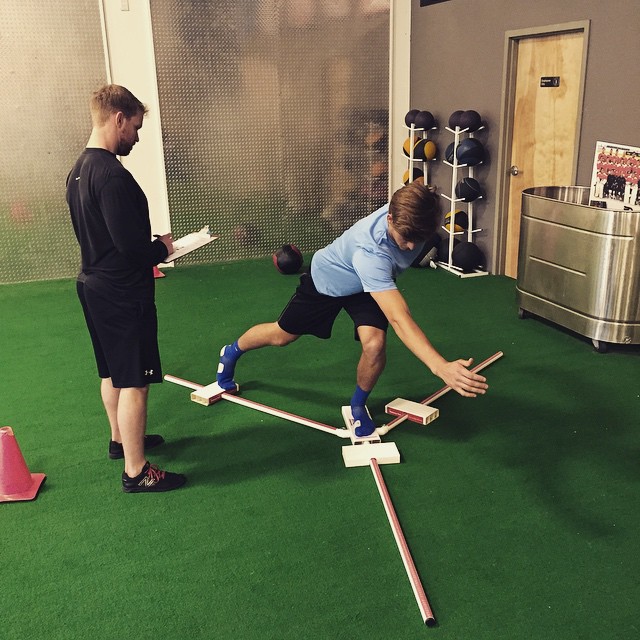
Y-Balance PL

Y-Balance Posteromedial Reach Pattern

These are the best proxies we have for assessing stride length potential off the ice, and the measures can be displayed visually to help illustrate asymmetries.
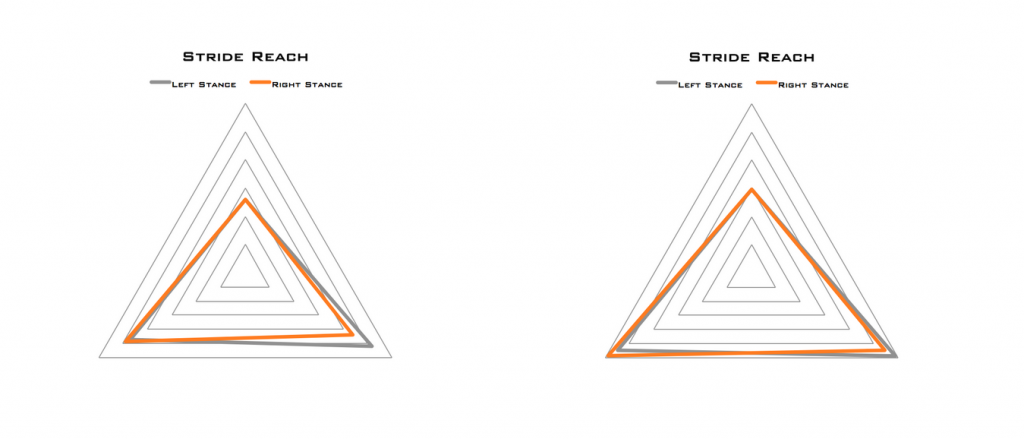
Stride Profiles

Can you pick out the player recovering from an MCL sprain?

This provides some validation for the approach of stripping down global movement limitations (e.g. a short right stride length) to their most fundamental parts (e.g. limited Right Hip Abduction and External Rotation) and addressing those. Further validating this approach via on-ice tests is one area I hope to pursue through my doctorate research.

Unconventional Aerobic Training

From a conditioning standpoint, aerobic training has experienced a return to the spotlight over the last few years, but many still have the believe that aerobic training is only characterized by long-duration steady state work. In this player’s program, he did cardiac output work (which is characterized by long-duration steady stay work) 4 days, total, over the course of his 12 weeks. The rest of his “aerobic” conditioning work involved pushing sleds, continuous jumping, tempo runs/slideboards, and airdyne rides, none of which really looks like aerobic training. I think this approach is one of the reasons why his power measures increased so much and why he ran a 1.51 10-yard sprint (measured with photocell start and finish) at the end of the Summer.

Lactic Work Last Priority

Building on the aerobic discussion, one thing that may stand out to those with a background in hockey is how little lactic work we did. I don’t have post-Summer conditioning numbers for him, but more important than those, he said he feels great on the ice. There are a few reasons for minimizing lactic work.

  1. The best forwards accumulate around 20 minutes of playing time across 3 hours. Average shifts are in the 45-second range, with several minutes of rest between shifts. There is definitely a lactic component in the game of hockey, but it’s important to watch what the players actually do on the ice, not just their on and off times. Each 45-second shift has periods of gliding, repositioning, standing, etc. It’s rare that a player is skating nearly as hard as they can for the entire shift. As a result, the energy system profile changes fairly drastically toward a more alactic-aerobic stereotype.
  2. Lactic work is known to interfere with the development of speed, power, and strength. The off-season provides a small window to make improvements in specific physical capacities that will transfer to improved on-ice performance. In hockey, speed is often the top priority, and restoring strength is a close second. Spending too much time on lactic work will slow progress in these other areas. You can read more about this here: In-Season Training: Capacity Maintenance
  3. Making significant improvements in lactic capacity doesn’t take very long, and funneling a lot of lactic work into a two-week window creates a sufficient adaptation to help make the transfer into pre-season.
  4. Most players skate several times per week throughout the last half of the Summer, so they’re improving the local muscular endurance and lactic capacity to some degree for several weeks leading up through the end of the off-season already.

This is really just an introductory discussion into this topic. Gaining a better understanding of the specific energy system profiles of different roles within different positions and the genetic predispositions of specific players within those roles may be the single largest area for improvement within hockey training.

To your success,

Kevin Neeld
HockeyTransformation.com
OptimizingMovement.com
UltimateHockeyTraining.com

Please enter your first name and email below to sign up for my FREE Athletic Development and Hockey Training Newsletter!

Get Ultimate Hockey Transformation Now!

Year-round age-specific hockey training programs complete with a comprehensive instructional video database!

Ultimate Hockey Transformation Pro Package-small

Get access to your game-changing program now >> Ultimate Hockey Transformation

“Kevin Neeld is one of the top 5-6 strength and conditioning coaches in the ice hockey world.”
– Mike Boyle, Head S&C Coach, US Women’s Olympic Team

“…if you want to be the best, Kevin is the one you have to train with”
– Brijesh Patel, Head S&C Coach, Quinnipiac University

Before jumping into today’s content, I just wanted to give you a quick reminder that the 4th of July Sale ends in two days. Check out the links below if you’re interested in saving some loot:

  1. Ultimate Hockey Training ($35.95 $19.95)
  2. Ultimate Hockey Transformation (Pro: $147 $77 Elite: $117 $57)
  3. Optimizing Movement ($97 $47)

Several months back, Devan McConnell and I attended the MIT Sloan Sports Analytics Conference in Boston. If you’re not familiar with the event, it’s essentially a weekend of panel-based discussions with industry experts on topics pertaining to the use of data in sports, all in the pursuit of gaining a slight edge over the competition. Many of the panels were divided by sport, but there were several others on topics like wearable technology, agents/negotiations, developing a career in the industry.

MIT Sloan Sports Analytics Conference

Every panel had a slightly different feel to it, but if I had to sum up the weekend, the general message was:

Ask better questions. Make more informed decisions.

If you’ve read my work before, you know that I frequently say “If we want better answers, we have to ask better questions.” Below are 3 examples of questions I get frequently, and how they can be reframed to drive move productive discussions and programming decisions.

1) What’s the best way to develop speed?

Reframed Question: What is limiting MY development or expression of speed?

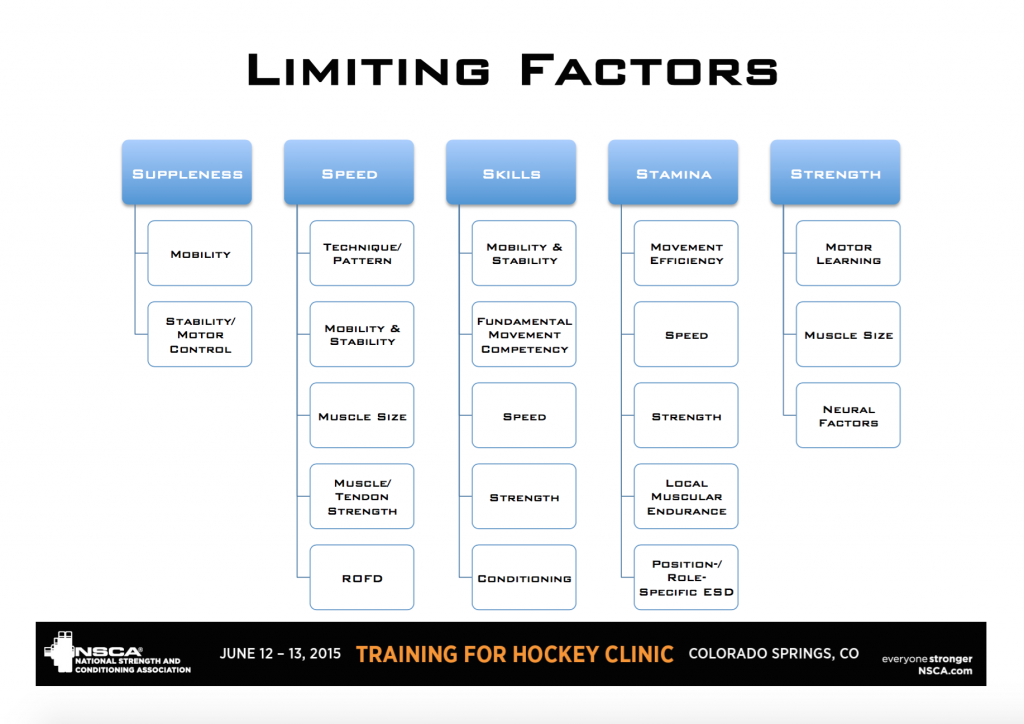
This, as with all of these examples, is not just an argument in semantics. The way these questions are phrased will drive different answers/discussions and potentially very different programming strategies. Consider the chart below from my talk at the 2015 NSCA Training for Hockey Clinic:

Limiting Factors to Sport Performance

Programming for speed development will, or at least should, differ depending on the needs of the athlete. A young athlete with a poor strength base will make significant leaps in speed through strength training. Many athletes have significant room for improvement by working on their technique (e.g. stride efficiency in hockey). In contrast, an older athlete that has spent years focusing on their strength will benefit from an increased focus on rate of force development training (ROFD), will require a highly focused training phase (e.g. a block, not concurrent periodization model) and will likely need longer periods of rest between sprints to ensure full recovery and maximal output.

These are all programming decisions that can make a huge impact on the design of the program and the eventual training adaptation.

2) Is squatting (or any exercise) good?

Reframed Question: Is squatting (or any exercise) the most optimal exercise based on the desired adaptation and MY structure and movement competency?

There are a few different ways to approach exercise selection, but the goal of the exercise and the movement competency of the athlete ALWAYS need to be considerations. If the athlete does not have the ability (whether it’s for structural or functional reasons) to get into a good squatting position, squatting likely isn’t a good exercise choice to develop physical capacities. In other words, it’s not wise to overload a pattern that the athlete can’t perform well. This is not rocket science; it’s borderline common sense.

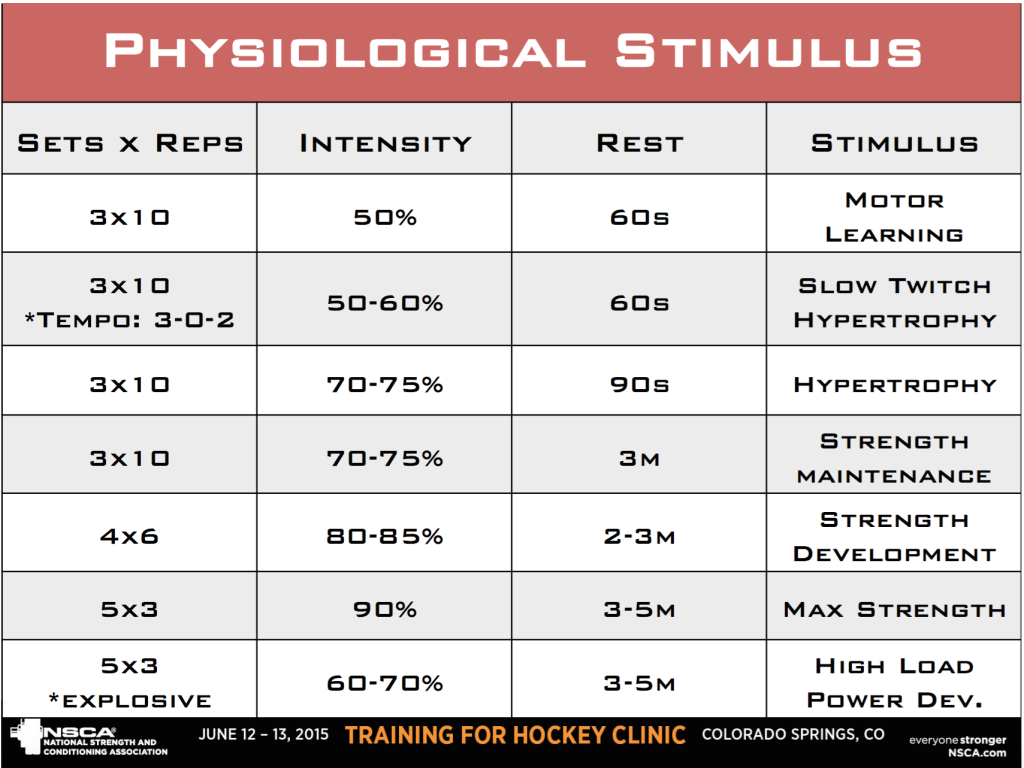
Having said that, I think people get way too enamored with exercises and forget that the loading parameters are going to dictate the physiological stimulus, and therefore how the athlete adapts to the exercise. See the table below:

Resistance Training Loading Parameters

This is far from a comprehensive look at programming strategies, but it provides an illustration of how ANY exercise can be loaded to drive very different adaptations. Mike Boyle recently posted a quick Q&A on his site on a related topic: Can You Gain Mass With Split Squats?

Before choosing any exercise for a program, you should answer these two questions:

  1. What am I trying to accomplish?
  2. Can I (or the athlete) do the movement properly?

Once again, reframing the original question leads to a very different outlook on the program design process.

3) Is “insert player name” in shape?

Reframed: Is the player physically prepared and adequately recovered to fulfill the role the coaching staff needs of them on this night?

Asking if a player is in shape illustrates a very superficial understanding of physical preparation. Intuitively, I think we all recognize that “in shape” needs to be operational defined. In other words, in shape for what?

Many would assume that a marathon runner is in shape, and that a heavy set baseball reliever is not. “In shape” seems to be defined, arbitrarily, by some unstated combination of aerobic endurance and body composition. This is not to say that there is no value in these two metrics-there is a lot of value in both-but determining whether a player is in shape needs to be defined within the context of the role that player needs to fill. Consider these examples.

A few years ago I worked with an NHL guy that was in and out of the line-up and filled a 4th line role when he played. He averaged around 5-6 minutes a night and most shifts were short. From an energy system development standpoint, this players needs are VERY different from a 1st line player that also logs PP and PK minutes to play ~20 minutes/night. The 4th line player plays shorter shifts, has more rest between them, and accumulates less fatigue over the game. In other words, the program could have a greater emphasis on developing alactic power (think pure speed and power with full recovery) and less of an emphasis on developing lactic capacity. I’d want this player to perform well on short sprint tests and reasonably well on an aerobic test like a beep test, but poorly on a 300-yard shuttle repeat test.

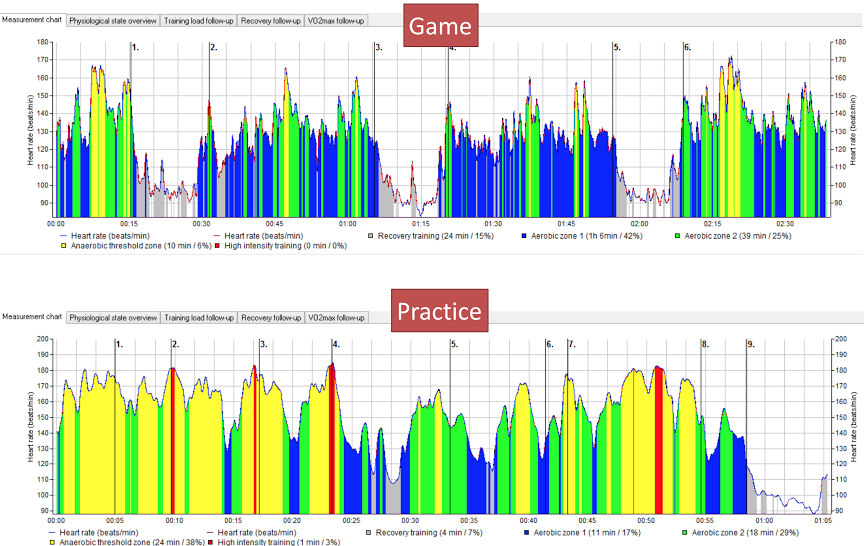
Unfortunately, a lot of times practices aren’t set up to prepare players for their on-ice roles, at least not from an energy system development standpoint. There are a different ways to look at this idea, but the easiest one is to consider the demands of the goalie position. Take a look at the graphs below from Devan McConnell, which display heart rate data for a goalie in a practice and in a game. Goalie Game Data

As a general statement, the game is characterized by highs and lows: Move explosively, recover fully (similar to the 4th line player example above). In stark contrast, practices are characterized with middle-high work loads continuously over the course of several minutes. You don’t need a PhD in biochemistry to recognize that the two graphs don’t look alike, and that a player continually being “trained” with the demands of the bottom graph will lead to adaptations that don’t optimally prepare them for performance in tasks like the top graph.

Similarly, in the absence of actual testing data, coaches may comment that a player looks slower or out of shape. As is the theme of this article, this type of remark requires context. Is a player slow because they’re under-prepared and/or de-trained or because they’re over-stress, over-fatigued, and/or under-recovered? A poor night of sleep (or several poor nights of sleep) will absolutely impair a player’s speed and conditioning, as will accumulated fatigue from a string of hard practices of games. In this case, assuming the player is under-prepared would lead a coach to increase their training, which would have the polar opposite effect of its intention. This really highlights the importance of monitoring workloads, perceived exertion, and subjective recovery. This information will help make more informed training decisions. With two players that look slow, one may require a focused training block on speed/power; another may require an ice bath, massage and day off from practice.

Wrap-Up

Making more informed decisions starts with asking better questions. Often times questions need to be reframed within the context of a specific situation or for a specific individual. Making subtle adjustments in how you ask common questions can have a profound impact on how you program, both from a training and a recovery standpoint.

To your success,

Kevin Neeld
HockeyTransformation.com
OptimizingMovement.com
UltimateHockeyTraining.com

Please enter your first name and email below to sign up for my FREE Athletic Development and Hockey Training Newsletter!

Get Ultimate Hockey Transformation Now!

Year-round age-specific hockey training programs complete with a comprehensive instructional video database!

Ultimate Hockey Transformation Pro Package-small

Get access to your game-changing program now >> Ultimate Hockey Transformation

“Kevin Neeld is one of the top 5-6 strength and conditioning coaches in the ice hockey world.”
– Mike Boyle, Head S&C Coach, US Women’s Olympic Team

“…if you want to be the best, Kevin is the one you have to train with”
– Brijesh Patel, Head S&C Coach, Quinnipiac University
Over the last couple of weeks, I’ve come across a few interesting articles I know you’ll enjoy. Check them out below:

1) No More Pulled Hamstrings by Mike Robertson

Mike continues to punch out great information on a consistent basis. This article highlights a multi-faceted approach to minimizing hamstring strain risk. While this is focused on hamstring strains, this same thought process can be applied to muscle strain prevention across the entire body. Great stuff from Mike.

2) Three New Core Exercises for Goalies by Maria Mountain

Maria is one of the few people writing about hockey training on the internet that can back her recommendations with actual real-world experience. As a result, her site is one of the only ones I consistently look to for new information on the topic. In this post she shares a few new core exercises that she’s been using to train goalies. I’d extend the exercises to say they’re appropriate for hockey players at all positions (and almost all other team sport athletes). We use variations of all of these at our facility regularly.

3) Athlete Monitoring on a Budget – An Experience by John Abreu

This is an article that I originally learned about from Devan McConnell, and I’m glad he shared it. This approach is very similar to what I’ve introduced with the Flyers Junior Team and our off-season hockey players at Endeavor, and what our staff has implemented with the US Women’s National Hockey Team. The key is to really boil down your metrics to things that have meaning to you (and/or your coaching staff) and preferably things you can influence (e.g. training loads, sleep hours, soreness, etc.).

Finally, below is a video from the 2014 MIT Sloan Sports Analytics Conference featuring a panel comprised of Malcom Gladwell (Author of Outliers: The Story of Success, among others) and David Epstein (Author of The Sports Gene: Inside the Science of Extraordinary Athletic Performance). It’s a long video, but it makes for a great listen if you can cue it up on your phone and listen (please do not watch) while you drive.

Feel free to post any comments you have below!

To your success,

Kevin Neeld
HockeyTransformation.com
OptimizingMovement.com
UltimateHockeyTraining.com

Please enter your first name and email below to sign up for my FREE Athletic Development and Hockey Training Newsletter!

Get Ultimate Hockey Transformation Now!

Year-round age-specific hockey training programs complete with a comprehensive instructional video database!

Ultimate Hockey Transformation Pro Package-small

Get access to your game-changing program now >> Ultimate Hockey Transformation

“Kevin Neeld is one of the top 5-6 strength and conditioning coaches in the ice hockey world.”
– Mike Boyle, Head S&C Coach, US Women’s Olympic Team

“…if you want to be the best, Kevin is the one you have to train with”
– Brijesh Patel, Head S&C Coach, Quinnipiac University
Today’s Thursday Throwback discusses a few tips related to “the art of coaching” that will help you get the most out of your athletes. Despite originally publishing this over 4 years ago, these things continue to be staples in how our entire staff at Endeavor approaches coaching our athletes. These are timeless principles that can be applied in environments with athletes at almost every level. Enjoy!

5 Ways to Get the Most from Your Athletes

Piggy-backing on last week’s post on the importance of developing great coaching skills to compliment a sound knowledge base (refer here: Become a Great COACH!), I thought I’d share 5 ways I’ve found to get the most out of our athletes.

5) Make Exercises/Instruction Specific to the Athlete
In a strength and conditioning setting, there are appropriate degrees of specificity to incorporate into an athlete’s training program, and more appropriate training qualities to incorporate movements that more directly mimic sport movements. For example, speed and power work are more appropriate opportunities to teach foot patterns, body positions, and proper rotational power generation; whereas strength work that mimics sport specific movements would be fruitless/counterproductive.

Goalie-specific training exercise. Note the rapid eye movement that precedes the jump and the rebound.

In all cases, you can gain a lot of ground with your athletes if you can explain why what they’re doing will apply to their sport. This doesn’t need to be overly complex. When we kettlebell (novice) or trap bar (less novice) deadlift our athletes, we’ll explain that maintaining a neutral spine or “flat back” is important because it teaches the body to have a stable core, which will allow them to transition quicker in their sport. In reality, the athlete probably hears some Charlie Brown esque modification of what we’re saying: “wha wha wha wha CORE wha wha transition wha quicker”. “You mean this will help make me faster?!” “Yes.” Sold.

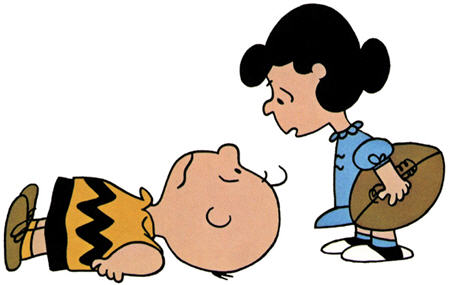
Maybe I wouldn’t have picked you last if you would pack your neck while you’re blocking Charlie Brown!

4) Be Flexible with Dress Code
When I started at Endeavor, one of the first things I did was establish an “acceptable” dress code. Shirts with inappropriate language/insinuations weren’t acceptable, nor were shirts that lacked sleeves (a tough sell in New Jersey!). The last thing I want is a bunch of kids that think they’re stronger than they are flexing in front of the mirror in between sets.

I wonder if people would still flex and lift up their shirt to check out their abs in the mirror wipe the sweat off their face if this was going on in the background

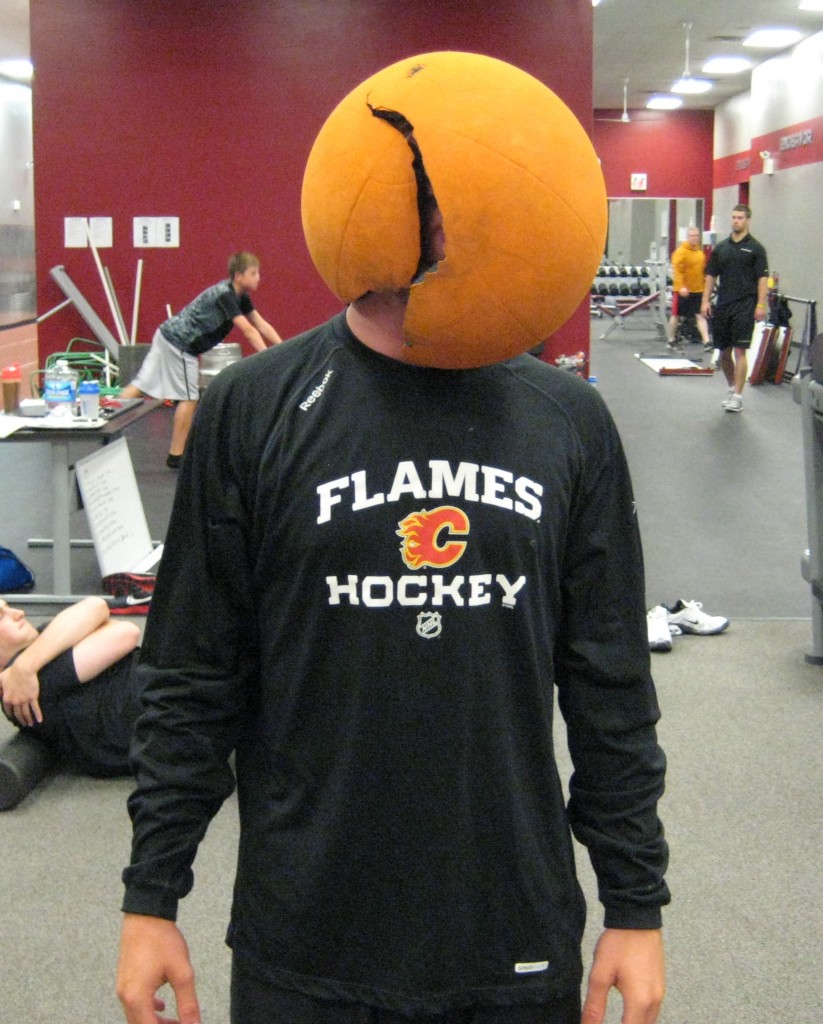
That said, there are times when it’s appropriate to bend the rules a little to meet your athletes half way. If your athletes want to wear the medicine ball that they just obliterated against the wall over their face, they should be free to do so.

Nice.

3) Don’t be an asshole. If you’re an asshole, apologize.
This will go hand-in-hand with the last point of this article, but strength coaches stereotypically have the reputation of being hard assess. I think there is a fine line between being a source of inspiration and motivation and just being an asshole. Why are you coming down so hard on an athlete? Is it because you really care about them and have a hard time watching self-destructive behavior? Is it because your personality just doesn’t mesh well with his/hers? Is it because you slept like hell the night before and are just generally irritable? Is it because you think that’s your job?

It’s worth being conscious of your own mood and recognizing how it may influence the way you coach. I also think it’s important to recognize that no one is infallible, even the coach.  It’s okay; rather it’s recommended that you admit when you make a mistake and apologize to your athlete(s). It’s not a sign of weakness, it’s a sign of humanity.

Just last week I had a morning where a few little things kind of pissed me off, and I ended up taking it out on a player whose effort was a little “unmotivated” that day. After he finished training, I pulled him into my office apologized, said I was wrong to come down on him like I did, explained exactly what I was looking for from him and why I thought it was important/beneficial for him to adopt certain behaviors. He understood where I was coming from, we’re on the same page, and I think we’re both better off for it.

2) Play Music they Like
Music plays an irreplaceable role in building a high energy environment. In an ideal world, the athletes and coaching staff would both be inspired by the same genres of music. This isn’t always the case. Last Summer we had a couple groups of hockey players that absolutely thrived on Phil Collins. This started as a joke, but manifested into what I refer to as audible steroids. When Phil came on, everyone turned it up a notch.

Despite everything I learned from Tony Gentilcore while at Cressey Performance a few years back, I never personally took to techno music. But a few of our athletes requested a “Techno Tuesday” to break up the monotony of Metallica Monday, and Rise Against Tuesday, Wednesday, Thursday, Friday, Saturday, and Sunday. I hesitantly allowed it. Now Techno Tuesday has become Techno Weekdays. “Club Endeavor” wasn’t exactly what I had in mind, but if it gets everyone to work harder, I’m all in. We even have a player that enters the morning group with a general sense of disdain, whose mood I can instantly turn by playing:

At least 20 of the 14,000 views are from my iphone at 8:15am. 

1) Let Them Know You Care!
Save the best for last. NOTHING else matters if your athletes don’t know much you care about them. “Care” in this sense refers to both wanting the best for them as athletes AND as people. Become personally invested in their success. I can’t tell you how many 1-on-1 meetings I’ve had with players just to get a better understanding of what their personal goals are and to ensure I’m doing everything I can to help move them in that direction. I’m exceedingly flexible with scheduling to accommodate beach trips and visits from out of town girlfriends.

It’s imperative that the athlete makes a commitment and demonstrates a dedicated effort to their own progress, but I don’t think this needs to happen at the exclusion of all things fun, especially not in the Summer, and not with hockey players that are stuck indoors for the majority of the year. I (only half jokingly) tell our players to soak up as much Vitamin D as they can over the weekend because Vitamin D is thought to be helpful in improving maximum strength levels in deficient individuals (most hockey players).

At the most foundational level, getting athletes to buy in to your program comes down to them understanding that you have their best interest in mind. Sometimes this comes down to reanalyzing your intentions with the program, but most times it comes down to the way you build your relationship with your athletes. Once they know how much you care them, they’re much more likely to respond to your advice.

To your success,

Kevin Neeld
HockeyTransformation.com
OptimizingMovement.com
UltimateHockeyTraining.com

Please enter your first name and email below to sign up for my FREE Athletic Development and Hockey Training Newsletter!

Get Ultimate Hockey Transformation Now!

Year-round age-specific hockey training programs complete with a comprehensive instructional video database!

Ultimate Hockey Transformation Pro Package-small

Get access to your game-changing program now >> Ultimate Hockey Transformation

“Kevin Neeld is one of the top 5-6 strength and conditioning coaches in the ice hockey world.”
– Mike Boyle, Head S&C Coach, US Women’s Olympic Team

“…if you want to be the best, Kevin is the one you have to train with”
– Brijesh Patel, Head S&C Coach, Quinnipiac University

EMG (electromyography) is the measurement of the electrical input to “activate” a muscle, and is often used as an indication of how much force the muscle will produce. It can be a useful research tool, and one that I’m very familiar with, having spent my two years of grad school working in the Exercise Neuroscience Lab at UMass Amherst. That said, the results from EMG-based studies, especially surface EMG, are frequently misquoted, misinterpreted and poorly applied.

Today’s Thursday Throwback discusses some of the limitations to EMG, and what you should be on the look out for as someone that is likely to read someone else’s interpretation of these studies. As I always say, if you want better answers, you have to ask better questions. Today’s post (and the linked article) will help you do just that.

Were You Duped by EMG?

Last week I got an email from my friend Rob McLean with the Colorado Avalanche in reference to an exercise that is considered the “best” because it produces higher EMG levels than other exercises. Rob’s question was, simply, “what do you think?”

A couple years ago, I wrote an article for StrengthCoach.com that Coach Boyle was gracious enough to allow me to re-post at my site here: EMG for Strength Coaches

This article identifies and explains a lot of the common myths associated with interpreting EMG-driven research and is a great starting place for people new to EMG altogether. There are additional considerations when interpreting EMG research that I think are relevant to those in training and sports medicine professions and to the general “fitness enthusiast”, as it will allow you to better spot bullshit (and bullshit interpretations) when you see them.

False Assumptions

1) Force Production = Force Expression
People tend to equate EMG activity with instantaneous force production. Because of the time course associated with the electrical input signal stimulating a mechanical action, this is an inherently misguided notion. That said, even with this assumption, force production does not always equate to force expression.

Force production is the mechanical tension developed in the muscle. Force expression is how that force translates into movement or the control of movement. The two differentiate primarily based on activity of synergistic and antagonist muscle groups and structures. As an oversimplification, envision the biceps brachii producing 5 units of force and the triceps brachii producing 0. You can imagine that the elbow would flex at an appropriate speed based on the force production of the biceps. Now envision an identical situation, but with the triceps producing 4 units of force. The elbow would still flex, but now it wouldn’t be 5 units of expressed elbow flexion force, it would be 1. This example removes all syngerists and the concept of connective tissue tensegrity and mechanical force dispersion, but provides a simple illustration of the difference between force production and force expression.

Isolation without integration is never the goal of a hockey training program

Often times it’s force EXPRESSION that we’re most concerned with, not force production. The major take home here is that EMG studies that focus on the comparison of activity within a single muscle and compare this amongst different exercises completely overlook the importance and inevitably of antagonist and synergist activity.

2) More is Better
The underlying assumption and arguably largest misinterpretation of EMG is that MORE activity is a GOOD thing. In reality, EMG activity always needs a contextual qualifier to rationalize whether increased activity is beneficial or detrimental. My friend Jim Snider from U of Wisconsin did a great job of explaining this in his presentation over the weekend at BSMPG’s Hockey Symposium. Not every muscle plays the same role within the body. There are segmental stabilizers that create a stable base from which more global mobilizers can function. More EMG activity in these stabilizers, especially at the expense of coordinated firing patterns relevant to their true function in movement, is likely detrimental to performance.

This is about as functional for hockey as smoking cigarettes

Secondly, it is often the case that the goal of any given muscle is to use the absolute bare minimum of activity necessary to accomplish a given task. This is true in the interest of energy preservation. This is one of the reasons why we don’t coach a “hard brace” during plank exercises. In this situation, we’d be encouraging a high threshold strategy for a relatively basic task. Instead, we aim to optimize body position and ensure proper breathing patterns and simply allow the nervous system to appropriately interpret the force needs to provide accordingly. Utilizing high threshold strategies for low threshold tasks has a number of other deleterious implications, but that of excessive energy use is not to be overlooked.

Wrap-Up
I fully understand why some interpret EMG studies the way they do, but isolating an individual muscle in EMG is no better than attempting to isolate individual muscles in training. There are likely more implications for this research in a rehabilitation setting than in a training setting, but in both environments it’s important not to overlook the vast mechanical and neurological integration of human movement. Getting back to Rob’s question, my rationale for including some exercises and excluding others goes well beyond isolated gross neural input signals. Every exercise we use serves a specific purpose and fits within a linear and/or parallel progression. In other words, my interpretation of an exercise’s proficiency is based on my particular training philosophy and system, which is likely quite different from most others. As always, it’s important to critically analyze information as it becomes available and not get caught up in something just being “new”. Remember, hyped up garbage is still garbage!

To your success,

Kevin Neeld

Please enter your first name and email below to sign up for my FREE Athletic Development and Hockey Training Newsletter!

Use CODE: "Neeld15" to save 15%