This week I posted two new articles related to understanding, assessing for, and training around hip injuries or structural abnormalities that a significant proportion of the hockey population suffers from. My friend Dr. Jeff Cubos wrote a follow-up to Monday’s article for his site. All three have received a ton of great feedback so if you haven’t had a chance to read through them, check them out at the links below:

1) Training Around Femoroacetabular Impingement

2) Hockey Hip Assessment Questions

3) So Your Athlete Has FAI, Now What?

Jeff also added an awesome video series to Hockey Strength and Conditioning. His videos detail a progression to help reinforce single-leg stability and really ingrain requisite dynamic internal rotation control. As I recently mentioned, players that have poor single-leg stability tend to ride their inside edge during the gliding phase of skating. Even if they don’t exhibit this fault, they surely waste power and suffer from a compromised ability to give and withstand contact. This exercise would fit into a program as part of a dynamic warm-up, extra hip mobility/stability work, and/or core training. Check it out at the link below:

Click here to watch >> The Hip Airplane from Dr. Jeff Cubos

Sean Skahan also added a couple videos of sled/sprint contrast work he uses for a phase of the off-season program. Theoretically, contrast work should help maximize recruitment of movement-specific motor units and therefore provide a bigger engine for the secondary exercise that follows the “primer”. Sean’s videos demonstrate one way to apply this concept in a linear movement and lateral movement format, but he alludes to a couple other ways that he uses these during this phase of his program.

Click here to watch >> Sled and Sprint Contrast from Sean Skahan

If you have any questions about these articles or the videos, hop on the Hockey Strength and Conditioning forum and ask. That’s the quickest way to reach me and I know Sean, Darryl, Mike, Jeff Cubos and a couple other really bright guys are pretty active on them as well.

As always, if you aren’t a member yet, I encourage you to try out Hockey Strength and Conditioning for a week. It’ll only cost $1, and if it’s not the best buck you’ve ever spent, I’ll personally refund you!

To your continued success,

Kevin Neeld

Please enter your first name and email below to sign up for my FREE Athletic Development and Hockey Training Newsletter!

Following Monday’s post on Training Around Femoroacetabular Impingement, I got this email from a fellow coach:

Dear Kevin,

I really enjoyed your webinar about assessment and totally agree with most of it. Congrats on your great work.

I have few questions:

1) When you mentioned the Tyler et al study you talked about that maybe skating could change the length-tension curve to the right and said that could be good to work the adductors in shorter length. Can you explain better this concept please?

2) If I understand this well, if an athlete has excessive anterversion or retroversion, it is not good to work end range right?

3) I am excited to know how you program a prevention plan for adductor strains as I read that you reduced these injuries in your athletes over the last couple of years: probably a multifactorial approach right?

Thanks!

First off, I appreciate the kind words and the inquiry for more information. Q&A’s make for great articles because usually a lot of readers/listeners will have the same questions and explanations can help clear things up for everyone. With regards to these questions specifically:

1) As a muscle’s length changes, so does its ability to produce force. Every muscle, and every joint due to the collective influence of all the muscles that cross it will have a point in the ROM where it can produce a peak force.
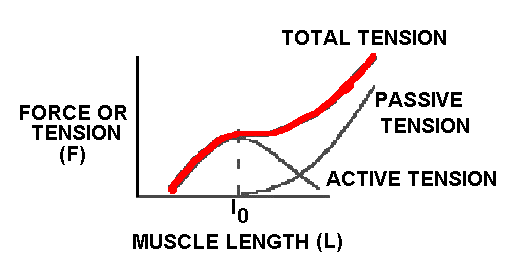
Length-Tension Curve

As the figure illustrates, during active tension (neurally-driven muscular contraction) the force producing ability of the structure will change in a U-shaped fashion, so that there is an optimal length for maximal force production and a decreased ability to produce force at shorter and longer lengths. This force producing ability coincides with the quantity of overlapping sarcomeres. While this figure, and most of its kind, represent the behavior of an isolated muscle fiber, when tension is represented relative to joint angle, a similar curve presents.

Muscles will adapt to the demands placed on them. Simply, this means that muscles trained in shorter lengths will shift their peak tension toward shorter lengths (to the left on the figure above), whereas muscles trained in longer lengths will shift their peak tension toward longer lengths (to the right). Because the adductors are under maximal tension toward the end of forward skating stride, where they are required to decelerate a high velocity hip extension, abduction, and external rotation at near maximal lengths, I’m suggesting that the high volumes of skating characteristic of most hockey players causes the strength of the adductors to shift to the right, toward longer lengths. As a result, these muscles will test weak if tested in a shortened position.
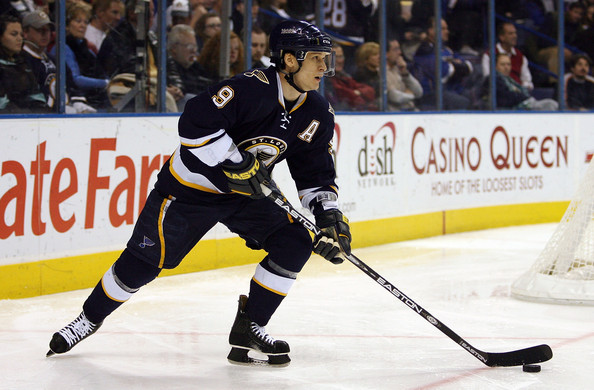
A great demonstration of a typical forward skating stride position

In the Tyler et al study (The association of hip strength and flexibility with the incidence of adductor muscle strains in professional ice hockey players), they assessed adductor strength in a sidelying position with the hip adducted so that the foot was ~12 inches off the table. They assessed abductor strength with the leg positioned slightly above horizontal. In my opinion, this biases the adductors significantly further to the left on their length-tension curve. This certainly isn’t to discount the results of their study, but I believe their results are more indicative of identifying players who have experienced the shift in peak tension more so than a true strength imbalance. In either case, the training initiative is to restore adductor strength in shortened lengths, a strategy that the same research group demonstrated efficacy with in a follow-up study.

2) Forcefully driving through end range is never good, but that’s not the whole story. When a player hits end range and still needs additional range of motion to complete the movement, they’re going to continue their momentum at another joint, usually an adjacent one. This isn’t a “compensation” per se, it’s just what the body needs to do to achieve the end goal. Knowing whether the athlete has excessive ante- or retroversion will be helpful in ensuring that we avoid forceful end range, but it also gives us a better understanding of what foot positions correspond with a neutral hip position. Typically a slight toe-out position puts the hips in a neutral alignment. If an athlete has severely anteverted hips, a slight toe out could be near end-range hip external rotation for them, which will effect their movement quality, especially in rotation-based movements.

Just as importantly, understanding version angles will provide insight into probable pathological compensations. Continuing with the example of an athlete with severely anteverted hips, pushing backward with their foot at a ~45° angle to skate forward requires a great deal of external rotation of the stride leg, which this athlete will not have. Because external rotation is linked with a tendency for the femoral head to translate anteriorly, it’s reasonable to be suspicious of athletes with excessive anteversion also presenting with anterior hip capsule laxity and/or hip flexor pain/weakness. To use the Postural Restoration Institute’s parlance, we can build in exercises meant to improve the function of “ligamentous muscle”, which simply means using muscles to help reinforce ligamentous integrity/function.

3) The prevention of all injuries requires a multi-factorial approach. Everything we do is leading us closer to or further away from optimal. This is one of the reasons why Charlie Weingroff’s DVD set Training = Rehab, Rehab = Training resonated so much with me. It’s all the same. We’re seeking to improve quality, and then gain capacity by systematically adding quantity. Breakdowns occur with excessive quantity and/or poor quality.
One of the best resources for performance training and rehabilitation professionals ever created

In more specific regards to adductor injuries, we have made a few simple program adaptations for high-risk athletes that has had a profound difference on the incidence and recurrence of these injuries. I don’t think these changes, in isolation, are the solution, but I think they fit into our overall system well to create the response we we’re after. I wrote an article detailing this approach about a year ago for Hockey Strength and Conditioning that you can find here: A New Approach to Handling “Groin” Strains

To your success,

Kevin Neeld

P.S. If you missed the webinar that these questions are in reference to, you can check it out at either (or both) of two of my favorite sites:  Strength and Conditioning Webinars, Sports Rehab Expert

Please enter your first name and email below to sign up for my FREE Athletic Development and Hockey Training Newsletter!

As I mentioned on Friday, I gave a webinar last week called “Hockey Hip Assessments: An in-depth look at structural abnormalities and common hip injuries.” Over the last couple years, I’ve become known as a “hip guy”. In reality, I’m not sure how I could train high level hockey players without being a hip guy. Almost half of our players this off-season presented with a hip structure considered “abnormal”, and I think it’s fair to say that every single one of them is flirting with the overuse/under-recovery threshold of their adductor and hip flexor musculature. And these are all “healthy” players. Knowing how to spot individual structure differences and program/coach accordingly is of paramount importance in my setting.

One structural abnormality that is gaining momentum with regards to research attention is femoroacetabular impingement or FAI. I’ve trained several players that have FAI, a couple of which were unaware of their affliction. A 2007 study by Philippon et al. demonstrated that 100% of the 45 professional athletes (24 hockey players) that came to their office with FAI had labral tears. Unfortunately, there is a strong association between labral damage and subsequent osteoarthritis. Recognizing FAI early can help minimize labral damage and the rapidity of osteoarthritis onset, which has the potential to facilitate both short- and long-term performance improvements for the player.

FAI Basics
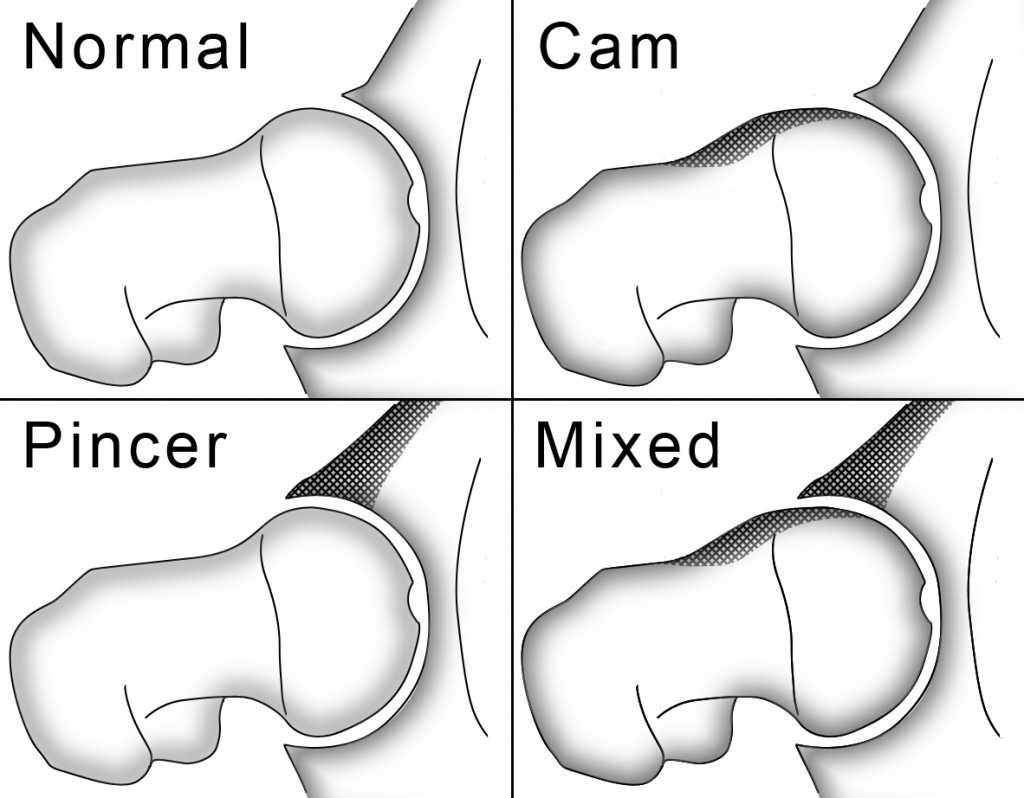
FAI results in a limitation of hip flexion to around 90 degrees and presents in one of three ways:

  1. CAM impingement: A decrease in the offset between the femoral head and the femoral neck. Hip flexion is limited by the bony overgrowth butting up against the top of the acetabulum.
  2. Pincer impingement: An overextension or growth of the acetabular hood. The femoral neck contacts the overgrowth at a lower degree of hip flexion.
  3. Mixed impingement: A combination of the CAM and pincer structural deviations.

FAI Assessment
Because the common denominator in all forms of FAI is a limitation in hip flexion ROM, you can use a basic quadruped rock to get an idea of whether the athlete has a limitation or not.

Quadruped Rock

Just have the athlete set-up on all fours with their knees under their hips, hands under their shoulders, and spine in a neutral position. Have them push their hips toward their heels while attempting to maintain a neutral spine and note the position of hip flexion that causes a “tucking” of the hips and rounding of the lumbar spine. Ask the athlete where they feel the restriction. If they feel it more in the front/middle part of their hip (“groin” area), it’s more likely a bony limitation than a soft-tissue one. Athletes with FAI will tap out around 90 degrees of hip flexion and feel it primarily in the anteromedial border of their hip.

You can follow up this test by having the athlete lie on their back and take the “suspicious hip” into flexion, adduction, and internal rotation. A significant limitation and/or pain with this movement supports the thought that the athlete has some sort of FAI.

Training Approach
If I suspect an athlete has FAI, we’ll make some very basic adaptations to their training program. Underlying everything we do with these athletes is Mike Boyle’s profoundly simple idea of “if it hurts, don’t do it.” In these cases, I think the athlete’s success has as much to do with what they don’t do, as it does with what they do.

Teach the athlete to perform EVERY movement without flexing the hip past 90 degrees
This is by far the greatest service we can offer these athletes. Every time a player jams through their end range, they put excessive stress on their labrum, and likely cause compensatory problems at neighboring joints. Coaching hockey players with this problem to skate lower or squat deeper will invariably worsen their symptoms and expedite the degeneration process. Range of motion is very individual specific, and these athletes need to be taught how to move within their own structural limitations. This can lead us to making some simple exercise modifications like having the athlete performing 1/2 kneeling exercises with their back knee on a 12″ box to minimize hip flexion of the front leg, and program modifications such as not allowing the athlete to do any lifts off the floor (e.g. deadlifts, trap bar deadlifts, Olympic lifts, etc.).

Favor Single-Leg Exercises
This isn’t a huge change for us because we already place a premium on single-leg training, but it offers the additional advantage for players with FAI of providing more degrees of freedom should the athlete “accidentally” approach hip flexion end range. With bilateral exercises, end range hip flexion is coupled with lumbar flexion, which is an undesirable position for a heavily loaded exercise. In contrast, unilateral exercises allow the hip to tilt in the frontal plane AND usually necessitate lighter external loads, sparing the spine from unnecessary additional stresses associated with compensatory movement.

Augmented Emphasis on Medial Soft-Tissue Work, and Lateral Hip and Posterior Chain Strength/Control Work
Players with FAI tend to have very dense and stiff adductors. Paying extra attention to soft-tissue work to the high adductors, especially where the posterior adductor magnus merges with the medial hamstrings, can help bring some relief to the constant tension these players feel. In theory, the adductors may become overly dense because they adopt a role of tonic stabilizers, functioning to compress the hip joint in an effort to gain stability. Lateral hip work in the form of miniband walks and single-leg exercises can help improve the strength and function of the smaller, dynamic stabilizers of the hip and remove some of this burden from the adductors. Lastly, these players tend to present with an anterior pelvic tilt and poor posterior chain strength. Shifting a greater proportion of their lower body training toward a poster chain emphasis can help restore balance in passive and active strength across the hips.

This is just the tip of the iceberg when it comes to assessing for and training around common hip structural abnormalities. I went into a lot more detail into our assessment and training system in my presentation, which is now available at two of the best strength and conditioning and injury prevention sites out there. If you’re not already a member, I highly recommend you check out Strength and Conditioning Webinars and Sports Rehab Expert.

To your success,

Kevin Neeld

P.S. Both of these sites offer trials for $1. If you’re on the fence, shell out the two bucks and test drive them both to see which may be more appropriate for your needs! Strength and Conditioning Webinars, Sports Rehab Expert

References:

Philippon, M., et al. (2007). Femoroacetabular impingement in 45 professional athletes: associated pathologies and return to sport following arthroscopic decompression. Knee Surg Sports Traumatol Arthrosc. 1597, 908-914.

Please enter your first name and email below to sign up for my FREE Athletic Development and Hockey Training Newsletter!

I have a lot of updates for you from the past week. For starters, on Wednesday I gave a 45-minute presentation titled “Hockey Hip Assessments: An in-depth look at structural abnormalities and common hip injuries” that will be available at two of my favorite membership sites: Anthony Renna’s Strength and Conditioning Webinars and Joe Heiler’s Sports Rehab Expert. In the presentation, I went over the exact hip assessments we use at Endeavor, what we’ve found in the ~40 elite level athletes we’ve tested over the last couple of months, how we approach training around structural abnormalities, and what steps we can take to prevent soft-tissue injuries around the hips. Valuable info for anyone in the hockey training world.

My friend Pete Friesen, the long-time Head Trainer/Strength and Conditioning Coach for the Carolina Hurricanes, recently sent me an email about this year’s Friesen Physio-Fitness Summit. Last year, David Lasnier and I drove down to Raleigh for the event and it was awesome. Pete put together an incredible line-up of speakers, and gave each a 30-minute time slot, which allowed us to soak up a lot of information from different professionals in a single day. The line-up for this year’s event looks even better. If you’re interested, this year’s summit is Saturday August 13th, and is probably the lease expensive 1-day seminar of this quality I’ve ever come across. Check out the brochure at the link below:

2011 Friesen PhysioFitness Summit

Getting into this week’s updates in hockey strength and conditioning, Darryl Nelson posted Phase 3 of his U-17 Off-Season Training Program. If you’re interested in how guys that train hockey players for a living design programs or just want to follow along at home, check out the program at the link below:

Click here for the program >> Summer Program Phase 3 from Darryl Nelson

Mike Potenza posted a youth core training program. Whether you train youth hockey players (or are a youth hockey player) or not, this is a great line-up of quality core exercises. Most of these exercises will be foreign to the majority of the youth hockey world, which still seems to be stuck in the stone age of core training (e.g. crunches/sit-ups, “Russian” twists, supermans, etc.), so Mike posted videos of everything. Great stuff as always from Mike.

Click here for the program/videos: Youth Core Training Program Phase 1 from Mike Potenza

Sean Skahan added a terrific article on the importance of training in improving a player’s durability. This article really resonated with me because I think it speaks to the rationale for a focused training effort even from the players that don’t have a history of injuries, but do have a history of incredible on-ice success. In other words, when the super-talented say, “I don’t need to train”, Sean’s article provides a great insight into why they do. I’m fortunate that I get to work with a lot of young high school players that are en route to D1 hockey programs, a few of which will probably make careers out of playing at some level of pro. Invariably, training and/or making dietary changes is a new and potentially undesirable experience for them. With these kids, I make an effort to educate them on the benefits, from both a short- and long-term performance and injury prevention standpoint, of getting their act together in terms of off-ice training and improving their nutrition. The habits players develop will allow them to succeed up to a given point, at which point they need to be refined. It’s likely that every player has areas they can improve on, and that these improvements will help them take their game to the next level, or at least allow them to compete at their current level for prolonged periods of time. Because Sean gets players from all backgrounds (e.g. US colleges, Canadian major junior, US juniors, overseas, etc.), he has a unique perspective on the quality of the off-ice development systems of these various organizations. Check out the article at the link below:

Click here for the article >> It’s All About Durability from Sean Skahan

As always, if you aren’t a member yet, I encourage you to try out Hockey Strength and Conditioning for a week. It’ll only cost $1, and if it’s not the best buck you’ve ever spent, I’ll personally refund you!


To your continued success,

Kevin Neeld

P.S. If you’re involved with youth hockey and are looking for an off-ice training program, check out my Off-Ice Performance Training Course! I continue to get great feedback from players, parents, and coaches just like you!

Please enter your first name and email below to sign up for my FREE Athletic Development and Hockey Training Newsletter!
A while back I mentioned I was in the final stages of writing a hockey training book that I strongly believe will be the best available resource on hockey development to date. The release of that project has been delayed and re-delayed as it takes longer than I originally anticipated to build a DVD with ~300 exercise videos.

My goal with the new book was to lay out my entire system, from age-appropriate development guidelines to comprehensive exercise progressions and program design strategies. It’s all there. I’ll fill you in on more of the details as we finalize everything and get ready to release it to the public.

In the meantime, I get regular email inquiries from parents or youth coaches that want their kids to start doing some type of off-ice training and just don’t know where to start. Most of these emails come from people with no background in exercise science or prescription, minimal if any equipment, and are generally looking for improvements in speed and power.

Regardless of the training goal, success is built on a foundation of proper training habits and proper movement. The player that half-asses or skips their warm-up and goes right into high-intensity sprints or jumps is both limiting his/her own performance and priming themselves for injury, short- or long-term. The player that doesn’t condition because it’s hard, and instead does extra arm work because they think big or “toned” (gender-specific) biceps will make them more attractive to the opposite sex, will inevitably fall short of the player that takes a better training approach.

In this regard, you don’t need much equipment to start developing proper training habits and optimal movement patterns (Just grab the equipment I mention here: Three Things Every Hockey Player Should Own). It’s important for young hockey players to learn (read: be taught how to) move correctly, not just fast or at a high intensity. It’s just as important that players learn what NOT to do. Many youth hockey training programs are still characterized by excessive volumes oF sprints and jumps, hundreds of crunches/sit-ups, push-ups with terrible form, and laps around the rink.

While I think the hockey training industry has evolved substantially since I was a player, the truth is that most of the information hasn’t trickled down to the youth levels, where it’s needed most. A few years back, I wrote an ebook called Hockey Training University’s Off-Ice Performance Training Course.

My training philosophies and systems have certainly evolved since that time (as has my regret for choosing such a stupid title!), but the systems I describe there are still extremely beneficial for youth players and it’s a great starting point for those new to training. It’s one of the only off-ice training resources that outlines how a player can train with no equipment, lays out an entire training system (not just “speed training” or “core training”), teaches exercise progressions (and how to do them WELL), and introduces the idea of periodization, or altering the focus of a training stimulus to make maximal progress.

I continue to get great feedback about the course from parents and coaches at the youth level that have implemented the training programs with their kids.

A hockey dad recently emailed me with:

“Hi Kevin, I bought your program last year and used it with my son and a couple of his friends (11 year olds).  My son became one of the best players on the rep team and has credited the course for his development.  Thanks for that. This summer the coach has asked me to include the rest of the team. I could sure use those additional bonuses you offer now.”

Feedback from a customer with a more advanced training background:

“I recently purchased Kevin Neeld’s Off-Ice Training Course. To say it is a valuable resource for ice hockey players and coaches is an understatement. The manual that Kevin has put together is excellent. It is a must have for all youth and high school ice hockey players and coaches. The manual breaks down every phase of training for an athlete with well-illustrated photos as well as a series of progressions for athletes. Having trained a lot of ice hockey players, I can say without hesitation that this program will guide you through a series of movements that will enable you to improve your level of play once the season starts. Do yourself a favor and pick up a copy of this program and I guarantee that you will not be disappointed.” – Kevin Miller, CSCS

If you’re starting from scratch like the majority of the youth hockey community and looking for a program that will help improve speed, lower body power, core strength, and conditioning, I highly recommend you check out my Off-Ice Performance Training Course. It’s a zero-risk endeavor. The course comes with a default 60-day money back guarantee, but because I never want to mislead or disappoint anyone, I’m happy to extend it to a lifetime guarantee for you.  Click the link below for more information!

Click here >> Off-Ice Performance Training

If you have any questions, just post them in the comments section below and I’ll get back to you ASAP!

To your success,

Kevin Neeld

P.S. The information in my Off-Ice Performance Training Course can be applied in individual and team settings, and during the off-season, pre-season, and in-season, so you didn’t miss the boat just because the off-season is half over!

Please enter your first name and email below to sign up for my FREE Athletic Development and Hockey Training Newsletter!

Use CODE: "Neeld15" to save 15%