Over the last year, concussions have plagued all levels of hockey more than any other injury. While much attention is now being paid to the prevention of concussions and following more appropriate return to play protocols, the fact is that these injuries, and the other causes of related symptoms, are relatively poorly understood.

Last week I filmed a 30-minute presentation titled “The Truth About Concussion-Like Symptoms”. The presentation starts by discussing the basics regarding symptoms and the return to play process, which is incredibly important information to minimize the risk of repeat occurrences, and exponentially more profound long-term consequences. However, the real value of this presentation lies in identifying the most commonly overlooked predisposing factors and causes of concussion-like symptoms. As you’ll quickly see, we may have many players sitting out with concussion-like symptoms that don’t or no longer have a true concussion.

I strongly believe this is the most powerful collection of practical concussion information for hockey players that has ever been compiled. To make the information more manageable, I’ve divided the presentation into four parts. The first two are presented below. Please share this with everyone you know in the game of hockey. Information is power.

As a disclaimer, I’m a strength and conditioning coach. I’m not a physician, nor am I an expert on brain injuries. The information in these videos is NOT meant to be taken as medical advice, nor does it suggest that concussions are being mishandled in any way by medical professionals in hockey. My interest in concussions stems solely from wanting to ensure that I can help the players I work with find the best care via the most appropriate referrals to medical professionals, to help make sure they aren’t missing unnecessary time.

The Truth About Concussion-Like Symptoms: Part 1

The Truth About Concussion-Like Symptoms: Part 2

*This information is by no means a replacement for medical advice or diagnosis, nor does it suggest that any of the players whose names or images were presented in the videos had cases that were mishandled in any way. It’s simply meant to provide additional potential causes of symptoms so players are aware of what other injuries they may need to get checked out by a medical professional.

To your success,

Kevin Neeld

P.S. It has often been said that injury prevention is just good training. Now you can get access to a comprehensive hockey training system that can be altered to help improve the performance of U-10 players all the way up through the pros: Ultimate Hockey Training.

Please enter your first name and email below to sign up for my FREE Athletic Development and Hockey Training Newsletter!

I hope you had a great week. This has been a really exciting week for me personally. If you follow me on Twitter and/or read this site regularly, you may have noticed that I frequently allude to the fact that there is a lot more to the concussion story than is being recognized. At the beginning of last week, I got the idea of putting together a presentation on the topic, which I had an opportunity to record a few days back. Other than my garbage mic making me sound like a pre-pubescent boy, it came out pretty well. Look for that early next week.

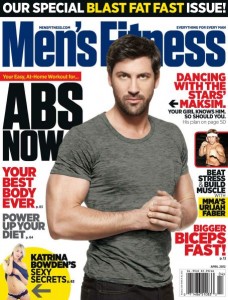
Yesterday I got an email from an old teammate of mine saying he was flipping through a Men’s Fitness while waiting for a haircut and saw a hockey training piece that I wrote. I didn’t even know it was printed! Pick up a copy of the April issue of Men’s Health (see pg 104).

Finally, early in the week I was asked to contribute to a chapter in the new Men’s Health Book of Abs. I’m sincerely humbled to have an opportunity to work on this project and am really looking forward to seeing the finished product. I’ll keep you in the loop as it nears completion.

Just as a final reminder, today is the LAST DAY to test run the Elite Training Mentorship for $1. As I’ve said over the last couple of weeks, to have an opportunity to learn from Eric Cressey, Mike Robertson, BJ Gaddour, and Dave Schmitz for a buck is a no-brainer. Eric and Mike are two guys I’ve regularly looked to for great training information over the last 5 years. I still bounce ideas off Eric on a regular basis. I’m really happy these guys are doing this. Any way their information can reach more people is a positive in my book. Check out this link for more information: Elite Training Mentorship

On to this week’s hockey training updates…

If you haven’t already, check out these posts from the last two weeks:

  1. Athletic Development Things You Should Read
  2. Elite Training Mentorship
  3. Metabolic Training (Free Video!)
  4. Dissecting Muscle Function: Force Production
  5. Dissecting Muscle Function: Influence

We’ve been busy at Hockey Strength and Conditioning over the last two weeks.

To kick things off, I added our final youth program of the year. The focus of this program changes somewhat drastically toward more mobility and regeneration work in the interest of recovery. The goal is to taper and generally unload the body so that the kids can hit the playoffs full steam ahead. Now is not the time to push off the ice; it’s more a time to showcase the hard work the players have been putting in over the season.

Get the program here >> 2-Day In-Season Training Program: Phase 5

Darryl Nelson added a video of what I would classify as a low load high velocity power exercise. These types of exercises have a lot of carryover to different components of hockey, but I generally frame it within the context of shooting. High speed hip rotation and core transfer are two keys to shooting power.

Watch the video here >> Medicine Ball Baseball Pitcher

Anthony Donskov wrote a terrific piece on the state of youth hockey. This is a message that I don’t think can be shouted too frequently. Things are NOT okay in youth sports, and youth hockey has been one of the front-runners in leading the craziness. I’m proud of USA Hockey for stepping up and taking serious action to help right the ship with their new ADM model. Ultimately, though, it’s up to us-coaches, parents, educators, etc. to adopt what they’ve put forth. Anthony’s article is filled with a lot of simple facts about the odds of a youth player reaching the pro ranks, and has guidelines for 60-minute practice that maximize development and fun. This is a MUST READ!

Read the article here >> Adult Values + Child Activities = Burnout

Mike Potenza added a video with two interesting exercises. Both strike me as great ways to train and/or test (or “audit”) multi-segmental stability. I’m looking forward to playing around with these over the next couple weeks and potentially mixing them in to future programs.

Watch the video here >> Leaning Tower

Sean Skahan wrapped things up with an All-Star Break Program. This is a great program for those in youth hockey to look at, not to simply steal it and use it as is, but because the program is built around body weight exercises. The only pieces of equipment this player had was a foam roller and stability ball. In all of the years I’ve worked training youth teams, I’ve only had any appreciable equipment for this past season. It’s important that these players to learn how to move properly and to get a training effect, both of which can be accomplished with relatively basic body weight exercises if they’re programmed and coached well. Sean’s program is a good template for that.

Get the program here >> All-Star Break Program

Don’t forget to log-in and check out the forum as well. Check out these discussions:

  1. Flexibility Help
  2. Post Game Snack Variety
  3. NHL Concussions
  4. United States Anti-Doping Agency
  5. Hockey Skill Warm-Up Drills
  6. Planning and Periodization for Playoffs

That’s a wrap for today. As always, if you aren’t a member yet, I encourage you to try out Hockey Strength and Conditioning for a week. It’ll only cost $1, and if it’s not the best buck you’ve ever spent, I’ll personally refund you!

To your success,

Kevin Neeld

P.S. I have lots of great stuff coming your way next week, so make sure you check back. In the mean time, test drive the Elite Training Mentorship and let me know what you think!

Please enter your first name and email below to sign up for my FREE Athletic Development and Hockey Training Newsletter!

In Part 1 of this “Dissecting Muscle Function” series, I outlined many of the characteristics of muscle that dictates its function. While this was far from a comprehensive look on muscle function, it does illustrate a few of the major concepts that dictate how we produce force, and how these components can be manipulated to improve performance. If you missed it, check it out here: Dissecting Muscle Function: Force Production

In Part 2, I want to demonstrate the vast influence that muscle can have on surrounding structures. Many of these concepts can be described within the paradigm of regional interdependence, which I touched on in a recent post.

Origins and Insertions vs. Attachments
When I first learned about muscle anatomy, it was very simple. Each muscle originated on one bone, inserted on another, and when movement was warranted, the origin stayed fix while the muscle moved the insertion. I’ve come to appreciate that this is a GROSSLY over-simplified view of functional anatomy. In reality, muscles don’t have “origins and insertions” as much as “attachments”. This distinction is important, as it implies that either end of the muscle segment is prone to stability or mobility. Certainly specific joints lend themselves more toward a specific end of that continuum, but there are countless examples of “origins” moving while “insertions” stay still, and excessive motion at joints thought to be stable is a common cause of injury. As a simple example, consider that the biceps bring the forearm to the shoulder in a typical curling movement, but bring the shoulder to the forearms in a chin-up movement. This is the same muscle and same movement (elbow flexion), but with a different point of stability in each exercise.

Functional Anatomy
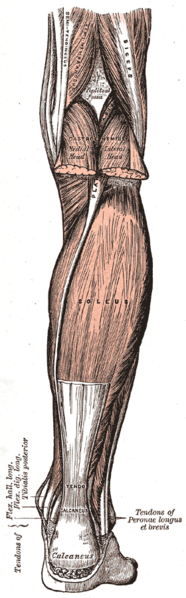
Even in adopting a new appreciation for the appropriateness of using attachments in place of origins and insertions, there is still much more complexity to the muscular system’s influence on movement than is taught in traditional anatomy classes. Muscles almost always have influence in multiple planes, and express different movements depending on whether the movement is open- or closed-chain. For example, most people are familiar with the fact that the soleus, one of the calves, serves a primary role in plantar flexion (pushing up onto your toes). However, when the feet are fixed on the floor, as in a squatting/deadlifting pattern, the calcaneus is relatively fixed, and therefore the soleus will function to pull the tibia posteriorly. Although this is technically plantarflexion, this directly translates into knee extension, and in the presence of a stationary pelvis, hip extension. In this way, the soleus is a knee extensor in closed chain movement, and also influences the hip.

Soleus: Plantarflexor, knee extensor, hip extensor?

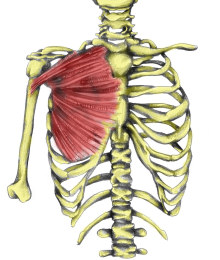
Similarly, muscles play a significant role in joint orientation. While this is somewhat implied by the understanding that muscles move bones, the totality of this relationship is frequently overlooked. For example, fibers of the pectoralis major extend from the sternum, horizontally across the ribs, and insert into the intertubercular groove of the humerus. When describing the function of the pec major, it’s role in glenohumeral flexion, horizontal adduction, and internal rotation is often emphasized. However, the force transmitted to the humerus to produce these motions is dually transmitted to the sternum. The pec major is a major influencer of sternal position (no pun intended), and therefore of the positioning of the opposing pec major. In this way, muscles can influence the positioning and consequent function of bones and muscles.

Note the strong connections of the pec major to the sternum

Interestingly, it is often (but not always) the muscle that is eccentrically loaded that people subjectively feel as tight. In the above example, this would mean that the short or excessively stiff pec major that biases the sternum in one direction may feel relatively normal, whereas the opposite pec major that is under increased tension because of the sternal orientation may feel tight. Stretching, in this case, is not desirable and could even be harmful, as the muscle is already in a lengthened state, and pushing through this could result in compensatory movement of other segments and/or lead to laxity of surrounding tissue.

Postural Restoration Institute
Fortunately, many of these orientations are fairly predictable via the Postural Restoration Institute methodology, which seeks to drive the body toward a more neutral orientation as a means of restoring reciprocal motion between the left and right halves and therefore of improving performance and decreasing injury risk.

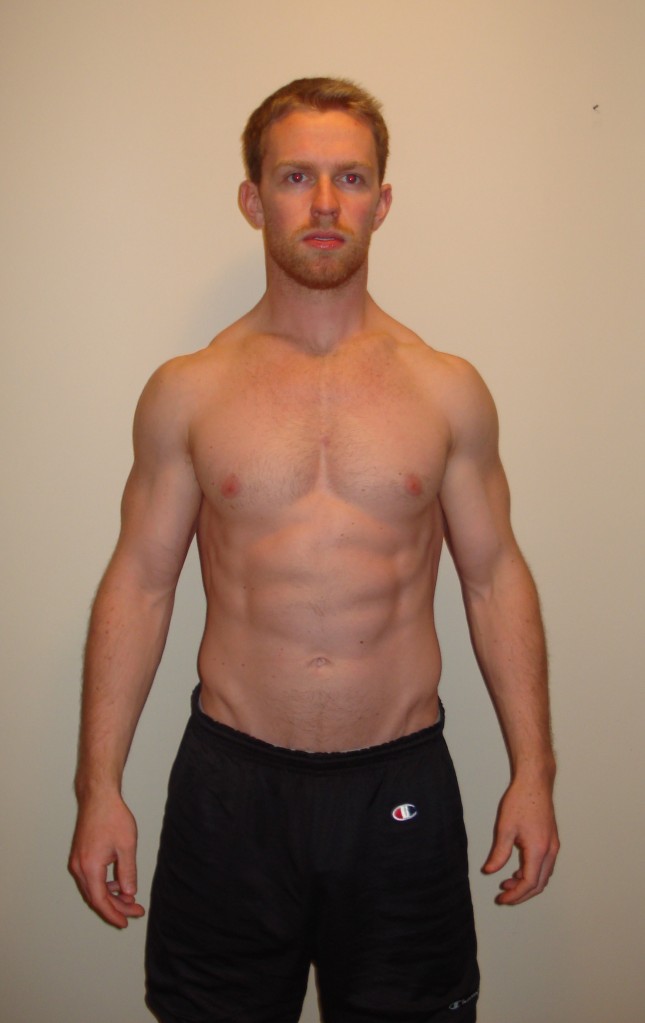
I was able to dig up a picture from a couple years ago that I took as part of a new diet experiment. Check out the picture below and note any side-to-side differences. What do you see?

While some of these things can be difficult to pick up at first if you don’t have a well-trained eye, the fact that my skin is pale to the point of borderline translucency should help. You may notice that my hips are rotated to my right (note the difference in the position and prominence of my obliques), my upper torso is rotated back to the left (note how my right hand is positioned in front of my left hand, and how the left pec major appears to be rotated back and more stretched out), and I’m slightly side-bent to the right (note how my right hand is about an inch lower than my left). You can see that these asymmetries extend up to the orientation of my head (see how much more apparent my right ear is?).

This is a textbook illustration of what PRI would describe as a Left AIC, Right BC position, and, assuming no ligamentous laxity, I would expect to see a decrease in left hip adduction and extension, right glenohumeral internal rotation, and left glenohumeral flexion and horizontal abduction secondary to poor positioning. In other words, it’s not necessarily that short/stiff muscles are limiting the range of motion, it’s simply the position of the underlying skeleton that is positioning the muscles poorly to perform their role. This is evidenced by the fact that in most cases almost complete symmetry can be restored in less than a minute with any number of relatively simple exercises that use active muscle contraction and breathing to re-orient specific bones into a more neutral position. Simply, in one minute, almost full range of motion can be restored. Do you think a baseball pitcher could benefit from 15-20 more degrees of internal rotation on his throwing arm? Can you appreciate how a hockey players stride and crossover ability will be affected by improved hip extension and adduction on the left side?

Wrapping Up
Hopefully you see the importance of understanding the integrated nature of our musculoskeletal/connective tissue and neural systems, and the power in a system that addresses these systems collectively. Relating back to the introductory topic, a muscle’s function is largely dictated by its position, which can be heavily influenced by the role other muscles play in driving and responding to skeletal positioning. The ability to view the body as an integrated system is invaluable, and a failure to do so can have frustrating and even tragic consequences.

To your success,

Kevin Neeld

P.S. Don’t forget, you have only have a few days left to get access to a TON of information to help make you stronger, faster, and get you in drastically better shape for only $1! Click here now >>  Elite Training Mentorship

Please enter your first name and email below to sign up for my FREE Athletic Development and Hockey Training Newsletter!

It’s finally here. As you’ve heard me mention over the last week, Eric Cressey, Mike Robertson, BJ Gaddour, and Dave Schmitz have been working on a HUGE project over the last year known as the “Elite Training Mentorship“.

If you missed my previous two posts, you can check them out here:

  1. Lower Body Assessment
  2. Metabolic Training

If you’re in the fitness industry at all (strength coach, personal trainer, sports rehab professional, or general fitness enthusiast), you owe it to yourself to check this out. Each of these guys have unique specialties ranging from maximum strength training to sport specific training to bootcamp training, and with the Elite Training Mentorship, they share their “secrets” with you!

If you’re on the fence, I have good news. Until Friday (3/9) at midnight, they’re offering a pretty amazing $1 1-month trial. Eric has already added three staff in-services, one webinar, two exercise tutorials, and two articles, IN ADDITION to all of the stuff that Mike, BJ, and Dave have added. $1 for a ton of great information. Seems like a no-brainer!

Check out this link for more information >> Elite Training Mentorship

To your success,

Kevin Neeld

P.S. I made a promise when I first started this site to keep you in the loop about resources that can help you achieve your goals. This is one. I hate sales pitches as much as anyone (probably more). If it’s not for you, it’s not for you. But for a $1, you’d be crazy not to at least check it out! Elite Training Mentorship

Please enter your first name and email below to sign up for my FREE Athletic Development and Hockey Training Newsletter!

Training muscles is a large focus of strength and conditioning programs. In fact, when most people think of strength training, they typically only recognize the sole benefit of muscle development. Naturally, optimizing the function of any organ system necessitates that you understand how it works. In this regard, the multiplanar function of muscle tissue is fairly under-recognized.

The powerful influence of muscle in movement, joint stability, and bony orientation will be the subject of a follow-up post. For today, I just want to dive into how muscles work to produce force.

Neural Input
There are a few basic principles of muscle that are relatively well-accepted. First, muscles contract in response to some nervous system stimulation. The two most common sources of this signal are the motor cortex in the brain, and any of the various spinal reflexes. The stronger the signal, the stronger the contraction of the muscle. The nervous system has a number of built-in “checks and balances” to continually modulate the intensity of the input signal, but addressing those is beyond the scope of this article. Suffice it to say that augmenting the input signal is an important component of training programs, and is a major explanation for why people can get so much stronger despite not gaining any appreciable muscle mass. This is the equivalent of turning up the volume to make the music louder, opposed to having a bigger ear.
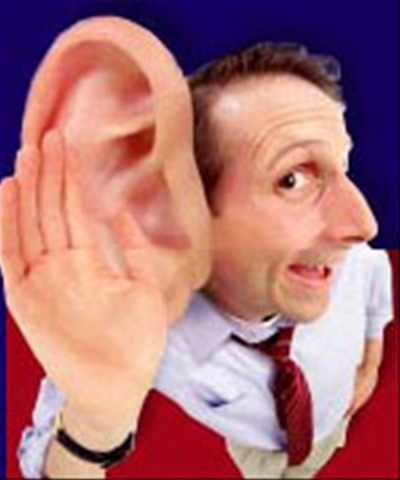
 

Big ears don’t equate to loud music if the volume is off. (Chalk this up as one of my top 5 weirdest analogies of all time)

As with everything, more isn’t always better when it comes to neural input. The signal always needs to be contextual. If max effort is necessary, than a max signal is optimal. If max effort is not necessary, and a max signal is given, this creates excessive force and therefore excessive fatigue. In other words, it teaches the body to use high threshold or max effort strategies when a lower threshold or submax effort is sufficient. This is one of the reasons why athletes should NOT be taught to squeeze their glutes as hard as they can and strongly brace their abs during exercises like front planks. Proper positioning should be maintained, and muscle contraction should be self-regulating based on the demands.

As a broad over-simplification, muscles can be broken down as having tonic (frequently active at low levels to maintain posture and produce subtle movements), or phasic (more used for movement) roles, which can, to a degree, be paralleled to the idea of low and high threshold roles. When phasic groups (typically higher threshold) are called on for tonic roles, hypertonicity develops. Simply, muscles that should be switched on and off are left on, and typically develop some sort of adhesions, trigger points, or other dysfunction. Again, every component of the nervous system must be qualified. There is no good or bad, only more or less appropriate.

Length-Tension Relationship
Another important characteristic of muscle can be found in its length-tension relationship. Simply, when a muscle becomes too short or too long, it’s ability to produce force decreases. On a mechanical level, muscle fibers produce force via cross-bridge formation of myosin heads to actin bridges. With longer lengths, overlap between these segments decreases, providing less opportunity for cross-bridging and therefore force production. With shorter lengths, opposing segments of the fiber collide with each other and disrupt some of the existing cross-bridges. This is illustrated well in the image below, which demonstrates how tension (force) changes with different sarcomere (contractile component of muscle fiber) lengths. Note how with long lengths (#1), there is no overlap between the myosin filament in the middle and the actin filaments on the left and right, opposed to shorter lengths (#5) where the actin filaments begin to collide and disrupt cross-bridging.
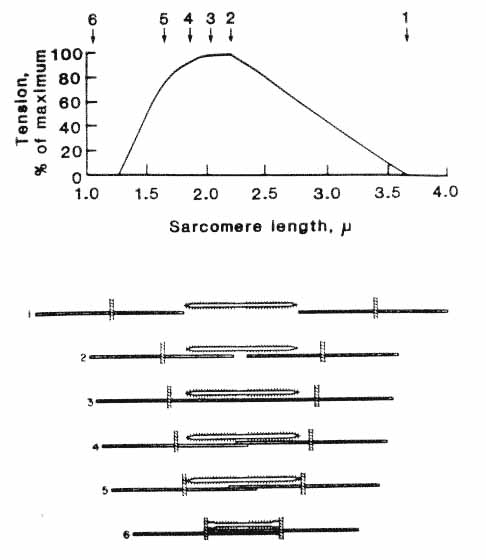
This graph illustrates the contractile components of muscle, the parts that are driven by the nervous system. Muscles also have non-contractile elements, which are described as “series elastic components” and “parallel elastic components”. Without going into too much detail, these elements explain one reason why there is a delay between the input signal to the muscle and the expression of force (it takes time to take up the slack in the series elastic components of the musculotendinous complex), and why even an inactive muscle can produce force that resists lengthening (force to stretch the parallel elastic components). A better depiction of these elements is provided below:
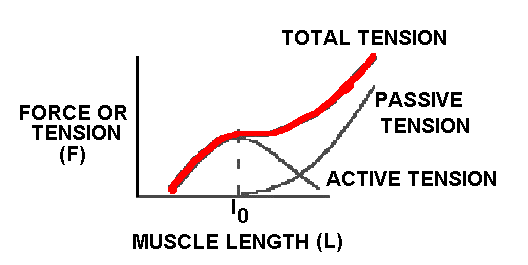
 

 The “parallel elastic component” is represented by “passive tension” in the graph above. Note how passive and active tension summate to produce higher levels of total tension

Importantly, within this paradigm, muscles can shift their peak tension to slightly shorter or longer lengths depending on the demand placed across them. When muscles are trained at longer lengths, which can result from being held in longer lengths for prolonged periods of time (e.g. posture) or through being worked in longer lengths, their force curve shifts to the right (toward longer lengths). In fact, it is often the case that strengthening in a lengthened position leads to more pronounced and sustainable increases in range of motion than stretching. This goes the other way too. Training can be used to strategically shorten over-lengthened muscles (or those whose length-tension curve has shifted to the right).

As an applicable example to hockey players, there was a 2001 study from Tyler et al. that demonstrated that elite hockey players were 17x more likely to sustain an adductor/groin strain if his adductor strength was 80% of his abductor strength. Interestingly, they tested adductor and abductor strength in positions where these muscles were shortened.

If you think of the nature of the hockey stride, concentric force is produced throughout the duration of the stride by the abductors, whereas the adductors are called upon to decelerate and reverse the direction of the leg at the end of the stride. In other words, the adductors are maximally stressed at longer lengths. I suspect that the authors of this study were able to identify, not necessarily which athletes were weak, but those who had an excessive shift in their length-tension relationship toward longer lengths of the adductors and shorter lengths of the abductors. This is one of the reasons we do so much med ball crushing work in the early off-season. We need to restore strength to shorter adductor lengths and shift their length-tension relationship back to the left. I spoke about these concepts as they pertain to hockey hip injuries in great detail in my presentation “Hockey Hip Assessments” for Sports Rehab Expert.

Force-Velocity Relationship
Isolated muscle fibers also exhibit a force velocity relationship. This relationship is somewhat different depending on whether the contraction is eccentric (muscle producing force while attempting to resist lengthening), isometric (force production with no change in muscle length), and concentric (force production with active shortening of the muscle segment). These relationships are displayed in the image below:
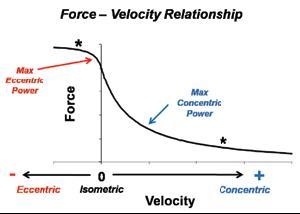
 

Note the drop-off in force production with faster concentric (muscle shortening) velocities, and the relative maintenance of force with eccentric contractions.

The force-velocity curve displayed above illustrates the behavior of ISOLATED muscle fibers. While most people assume this relationship is preserved in musculotendinous segments within the body, it’s actually much more complicated than that. For example, there is evidence in certain movements that while the total muscle length is increasing (appearing to be an eccentric contraction), the muscle fibers are in fact contracting concentrically (shortening), with the discrepancy being made up in the lengthening of the non-contractile elements of the muscle. Because force production is largely determined by the current length of the muscle based on its length-tension relationship, this is not irrelevant information. If the contractile elements can hold an isometric contraction and the elastic components store and release energy in response to length changes to the segment as a whole, it’s likely the body can optimize performance while minimizing energy expenditure. This is one of the mechanisms through which plyometric activity improves performance.

Wrapping Up
The body is constantly adapting to the stimuli we provide it, for better or worse. The integration of the muscular organ system with the other systems of the body is much more complex than most care to recognize. Understanding these interactions and consequent adaptations to specific stimuli will help improve the quality of off-ice training and in cuing specific exercises.

To your success,

Kevin Neeld

P.S. If you train or rehabilitate athletes, I STRONGLY encourage you to check out Sports Rehab Expert. It features regular content from many of the brightest, most accomplished, and experienced professionals in the sports performance and rehabilitation industries.

Please enter your first name and email below to sign up for my FREE Athletic Development and Hockey Training Newsletter!

Use CODE: "Neeld15" to save 15%