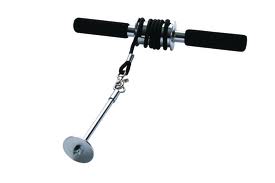
As long as I’ve been around the game, I’ve heard players and coaches preach about the importance of wrist strength. As a player, I bought in hard. I had an old skate lace wrapped around a broken stick, with a weight plate at the far end. I actually had a few, with different weights at the end. At some point, a coach had convinced me that doing that exercise would improve my wrist strength, which would improve my shot power. I still hear players talking about this now. And, although the athletes at Endeavor have come to expect my skepticism regarding mainstream training practices, many are still surprised to hear me dismiss the importance of doing extra exercises to improve the wrists/forearms. Let me explain.
Will this improve your shot power? Not likely.
Where does the power come from?
There are several specific ways to train off the ice for improved shot power. Naturally, if we’re training with a specific goal in mind (as we always should be), we need to have a comprehensive understanding of the movement patterns and involved musculature that we’re targeting. Simply, if we can’t see the target, we’re unlikely to hit it.
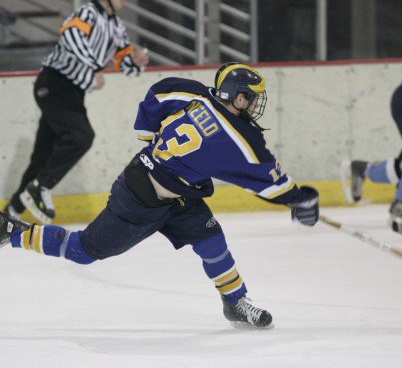
When most players think of shot power, they think of the wrists. The wrists are an important piece of the puzzle, but they’re FAR from the primary power generators. The overwhelming majority of the power comes from the hips and core, which is then transferred through the shoulders, arms, and refined by the wrists. The relative and absolute amount of power generated through the hips and core differs depending on the type of the shot. This power path is easy to visualize in a slap shot, but it’s still present in snap shots, wrist shots, and back hands. In realizing this, consider the amount of musculature involved in the hips, core, and shoulder musculature, and then compare it to that of the forearms.
The wrists are more active in force transfer and directional refinement than power generation.
If you want to improve shooting power, you need to develop massive legs and hips, a strong core, and maintain appropriate mobility through the hips and thoracic spine. The benefit of this approach is that it’ll also make you substantially faster on the ice.
I had a conversation with Mike Boyle several years ago where he only half-jokingly said something along the lines of “it doesn’t matter how strong their wrists are, they’re too slow to get to the puck anyway.” Conveniently, the best approach for the overwhelming majority of players to develop a stronger shot is also the same approach they should take to get faster.
Diaper and partial convulsions optional. Heavy training mandatory.
Movement vs. Muscles
Another major argument against players performing extra wrist work lies in the lack of specificity in the movement pattern. For starters, the velocity of traditional exercises (e.g. all forms of wrist curls) doesn’t come REMOTELY close to that of shooting. Also, with the understanding that shooting power is largely synonymous with rotational power, performing repeated wrist flexion/extension exercises doesn’t seem very appropriate. A better option would be to use a variety of rotational medicine ball exercises to develop this quality.
Med Ball Shotput w/ Rapid Step Behind & Partner Toss
Front Standing Med Ball Scoop w/ Partner Toss
These videos are a couple years old. As an aside, 5 of the 6 kids in the first two videos have moved on to play NCAA D1 hockey (the 4th is playing D3). Of the players in the third video, one advanced to play in the ECHL (as a former D3 player), one was already playing D1, two more have moved on to play D1, and one has a full ride commitment to Boston College and is playing in the USHL. Simply, training hard works.
Overlooked Forearm Work
Finally, most players do drastically more forearm work than they probably realize. If your program encompasses exercises like trap bar deadlifts, stiff-legged deadlifts, dumbbell reverse lunges, dumbbell RFE split squats, farmer’s walks, and any other exercise that involves holding something heavy in your hands, like it should, the stimulus to the forearm and wrist musculature is huge. I’m aware there are different forms of grip, but in general I think performing these exercises in parallel with some periodic puckhandling and shooting on or off the ice is sufficient to meet the needs across the wrist joint.
Take Home Message
Doing some extra forearm work throughout the off-season likely won’t hurt, but it’s far from necessary and should NEVER take the place of more purposeful off-ice training. If your goal is to improve your shooting power, focus on improving lower body and core strength, maintaining good mobility through your hips and thoracic spine, and on rotational power exercises, such as those in the videos above.
To your success,
Kevin Neeld
Please enter your first name and email below to sign up for my FREE Athletic Development and Hockey Training Newsletter!
Strength and Conditioning Internships
Over the past several months, we’ve had more internship applications flood in for this Summer than we’ve had for any term in the 4 years that I’ve been at Endeavor. This, I believe, is a result of some of the networking we’ve done with local universities/colleges and the fact that Endeavor has become increasingly visible in the area and on a national scale, as we’ve received applications from students all over the country and a few from abroad. I’m always humbled when someone wants to intern and/or spend time observing at our facility, and am happy to see students being proactive about their future.
Throughout my interactions with these prospective interns, I’m realizing more how much of a wake-up call some students need. It seems that some students are more interested in making $8/hour standing on the floor of their local gym than they are about making sacrifices to pursue a quality learning experience. This is something that I’ve heard other coaches reference in the past, but I hadn’t seen much of it. I recognize that it isn’t always easy for students to volunteer their time in unpaid positions for several months. That said, not easy and not worth it are completely different things. It’s interesting that students will spend between $20,000-$150,000+ in a college education, much of which won’t directly translate into improved ability in a strength and conditioning setting, but can’t find a way to muster up a roughly $1,500 sacrifice in living expenses to intern. My friend, colleague, and former internship supervisor Eric Cressey wrote a great article on this topic that I highly recommend reading:
To backtrack slightly, I think some students view internships as a necessary evil to get college credits and finish their degree. “Why do I have to work for free?” In reality, internships are, by far, the best opportunity to learn training theory, program application, the art of coaching, and build a network of professionals in the field, all of which are critical to finding quality job opportunities in the future. If you want to get a decent job in collegiate or professional strength and conditioning, you’ll have to pay your dues.
For what it’s worth, I’m not preaching here. Over the course of my college experience, I interned at the University of Delaware working with football, men’s basketball, women’s volleyball and field hockey, at a private high school working with the athletes in every sport (where I was provided with an opportunity to write the programs and run the sessions), UMass Amherst with men’s ice hockey, women’s basketball, men’s soccer, and men’s and women’s skiing, and finally at Cressey Performance, where I gained exposure to training in a private setting with a wide range of clientele, from high school athletes to bad-ass senior citizens. Throughout those years, I’ve also taken advantage of opportunities to visit and observe at Michael Boyle Strength and Conditioning, Boston University, Holy Cross, Quinnipiac, and Nick Tumminello’s place in Baltimore.
The summer I interned at Cressey Performance I passed up an opportunity to run a series of hockey clinics in the Delaware area, and paid out of pocket to take a Functional Anatomy class that was part of BU’s DPT program. It’d be tough to directly quantify this, but I’d estimate that this decision, to live in Worcester, take a class at BU, and intern at CP was probably a $10,000-15,000 swing in the negative direction. And I can say, without hesitation, that it was the single best decision I’ve ever made. My only regret is that I didn’t wise up and start interning earlier.
To provide a quick illustration of the power of networking through these experiences, I volunteered under Chris Boyko at UMass Amherst. Chris introduced me to Eric at a seminar that Eric was speaking at, and Chris and I attended. This is where I talked to Eric about interning, which I received in part because of Chris’ recommendation. During my internship at CP, Eric introduced me to Mike Potenza, who was and still is the Strength and Conditioning Coach for the San Jose Sharks. Mike has become a friend, an incredible resource, a business partner, and has provided me with an opportunity to come out to help with their prospect camp and pre-season training camp. Eric also put a great word in about my coaching ability to Mike Boyle, who later provided me an opportunity to work with the USA Women’s National Hockey program. In other words, just about every experience I’ve had in professional and national team programs can be traced back to an introduction made through an internship experience I pursued. And this is strictly a discussion of the power of networking, let alone the indescribable amount I learned in all of these experiences about strength and conditioning, coaching, business, and family, among other things. I’ve also neglected to message the number of other coaches I’ve been fortunate to be introduced to, who collectively have been a huge educational resource for me, many of which have also become friends.
Everything I’ve been able to accomplish I owe to the terrific mentors I’ve had over the years, many of which I met directly or indirectly through internships. My situation isn’t at all unique. Almost every coach I know has a similar history of internships, volunteer experiences, and assistantships that have provided them with what they needed to be successful at jobs they enjoy, to live their dream. So when I hear students say things like “I can’t afford to spend a Summer interning”, I can’t help but think, “you can’t afford not to.”
To your success,
Kevin Neeld
Please enter your first name and email below to sign up for my FREE Athletic Development and Hockey Training Newsletter!
This Week in Hockey Strength and Conditioning
We’re wrapping up another busy week at Endeavor. I’m really excited for the weekend. Tomorrow morning I’ll be heading up to Boston with David Lasnier, Matt Siniscalchi, Anthony Vittese (a local PT that we’ve worked with a bit), and Ryan Podell (the Assistant Strength and Conditioning Coach for the Flyers) for the Boston Sports Medicine and Performance Group‘s Summer Conference. This has been the highlight of my continuing education endeavors for the last 4 years, and this year’s event will be the best to date. I’m looking forward to all of the presentations, and catching up with a lot of friends/colleagues that will also be in attendance. Hopefully I’ll see some of you there!
Over the last week I wrapped up a two-part segment on structural and functional barriers to optimal skating performance, and a simple coaching cue to help improve players’ confidence on the ice. If you haven’t already, check them out at the links below:
Also, I encourage you to check out this article on USA Hockey’s American Development Model if you didn’t last week: Understanding USA Hockey’s ADM
It was a slower week for us over at Hockey Strength and Conditioning content wise, but a few really good discussions are going on in the forums. Check out this off-season training program and video of two great barbell complexes to help improve lifting technique, while warming up the athletes:
Also, make sure you check out these discussion threads on the forum:
BioForce and First Beat HRV
How many days per week?
BSMPG
The Strength Coaches Combine
Recovery and Performance Compression Apparel
Whose Program to Implement
Shoulder Injury and Core Training
On-Ice Warm-Up/Cool-Down for PeeWee’s
Finally, don’t forget to weigh in on our new poll: “In the players you work with/see, what do you feel is the major limiting factor to their game speed?”
That’s a wrap for today. As always, if you aren’t a member yet, I encourage you to try out Hockey Strength and Conditioning for a week. It’ll only cost $1, and if it’s not the best buck you’ve ever spent, I’ll personally refund you!
To your success,
Kevin Neeld
Please enter your first name and email below to sign up for my FREE Athletic Development and Hockey Training Newsletter!
The Illusion of Invincibility
What percentage of performance is mental? I was first posed this question while taking a class at the University of Delaware on the mental aspects of peak performance. Every one of my classmates responded somewhere between 50-90%. Since that time, I’ve asked dozens of people the same question, and the responses almost invariably fall within that same range.
Now, what percentage of your preparation is targeted toward improving mental performance? This is an interesting follow up question. Given the almost unanimous agreement that mental performance dictates at least half of an athletes overall performance, it’d be reasonable to assume that a proportionate amount of time should be dedicated to improving this quality. If you’re like the overwhelming majority of athletes, you likely don’t spend any (or exceptionally minimal) time focusing on mental performance.
Confidence, specifically, is a huge part of mental performance. It provides players with the gumption to make the best play, even if it’s not the safest. It gives players the upper hand when battling for pucks. Confidence is often referred to by hockey players as “swag”, and, not coincidentally, is one of the things that players, parents and coaches report observing the most noticeable improvements in after players have dedicated their off-season to training hard.
Improved confidence and mental toughness is frequently a haphazard byproduct of organized training programs. This is the case for two major reasons:
Athletes gain confidence from feeling like they’re doing more to pursue their goals or improve their performance than the athlete they’re battling against.
Athletes gain confidence by experiencing success in challenging situations.
Naturally, there are ways to augment the degree to which confidence is improved through training, one of which I’ll get to shortly. What gets overlooked in this discussion is that confidence is often relative to the environment. As a quick example, it’s easy for a player to express high levels of confidence in a battle against a passive or less confident opponent. It’s much more difficult against another player that is expressing a high level of “swag”. Said another way, there is a degree to which intimidation affects confidence. Put yourself in this scenario:
You’re completely gassed. It’s the middle of the third period in a championship game and your legs are failing you. They feel heavy, sluggish, and seem to start burning almost immediately. You’re focused, determined, and attempting to play aggressively, but your tank is on empty. You fight through the end of a shift, the whistle blows, and you lean your stick down on your thighs to support your weight and catch your breath. You take a few breaths and peer upward, only to see…
You see an opponent. Standing up tall. Proud. Seemingly un-phased by the intensity and duration of the game. Ready to go. You feel disheartened. How is this possible? How can he/she not be tired?
The reality is that fatigue has many roots, including those of mental origin. When was the last time you saw anyone look tired while celebrating a championship? Never. The losing team, though, portrays a different story. In the above example, the confident opponent could have felt exactly like the completely tanked player. Physically shot. Mentally shot. But they stood up tall, and when the other player looked up, they saw an opponent that appeared invincible. Interestingly, holding your body in a more “confident” position also has positive benefits to your own psychology, and can have an energizing effect. The old adage “fake it till you make it” seems appropriate here.
This scenario demonstrates an opportunity that every hockey player will experience in almost every game they play, and is the reason I find myself saying
Don’t let them see you tired!
to all of our athletes at Endeavor. It’s okay to be tired, but not defeated. Choose to present yourself with confidence. Stand up tall. Proud. Develop this habit on and off the ice. It will have a positive effect on your own performance, and will make you a more intimidating player to play against. It will create the illusion of invincibility.
To your success,
Kevin Neeld
Please enter your first name and email below to sign up for my FREE Athletic Development and Hockey Training Newsletter!
Limitations to Optimal Skating Performance
I wanted to kick this week off by following up on an article from last week on a few tips to help hockey players improve their skating technique. If you missed it, you can check it out here: 3 Keys to Developing Optimal Skating Technique
In that article, I alluded to the fact that players often have limitations that aren’t purely a failure to express their full capacity. In other words, they can’t simply be “cued” into skating better, they have some other issue that needs to be addressed to either remove a barrier to optimal performance or improve their capacity for optimal performance.
Barriers to Optimal Skating Depth Achieving an optimal skating depth is important for maximize stride length/power, as well as stability and resilience to unexpected contact or obstacles. That said, there is a significant number of players that don’t skate lower because they flat-out cannot get there. The two most common culprits are:
Femoroacetabular Impingement (FAI)
A lack of strength
Of these two limitations, FAI is structural and typically affects older more advanced players that have put a lot more mileage on their bodies, whereas a lack of strength is more functional and can affect players at all levels but typically affects younger players.
I’ve written a lot about FAI on the past (See: Training Around FAI; Performance Training: Adaptations for FAI; and An Updated Look at FAI), so I’ll keep it simple here, but the idea is that there is a BONY limitation to hip flexion range of motion. In other words, the player cannot and never will be able to achieve a deeper skating stance (without surgery) and attempting to force a lower depth, or even spending significant amount of time near end-range will almost definitely shred the labrum. In these cases, the players essentially have two options: 1) Get surgery; 2) Skate slightly higher. Given that these limitations tend to be cumulative over time, I wouldn’t be quick to jump to surgery unless the player is noticing significant symptoms. There are a ton of players competing at the highest levels in the world that are simply working around these limitations. That said, it’s still important to be aware of them, so you don’t attempt to “drive through” them on or off the ice.
A lack of strength is one of the most common issues we see in youth players who cannot achieve or maintain a deep skating stance. This is pretty straight-forward; they can’t skate in a deep position because they don’t possess the strength to hold themselves there. Hopefully the coaches reading this will understand the difference between “choosing not to” and “not possessing the capacity to do so”. One, the former, may justify some enthusiastic reminders to get into a deeper stance; another, the latter, involves a different approach. At youth levels (squirts through bantams), you’re likely to see a lot of the latter, meaning you can save yourself some throat irritation and mental anguish by just training the kids to improve their strength off the ice, instead of yelling at them on the ice.
If you lack equipment, as in most youth settings, an easy way to do this is with what I call “IsoHolds”. We generally do these in two positions: Squat IsoHolds and Split Squat IsoHolds. Split Squat IsoHolds are a more advanced variation, as they require single-leg strength, but ultimately I think this is the more advantageous option because of the benefits of single-leg training as well as the improvements in flexibility of the back leg. A Squat IsoHold is essentially a “Wall Sit” without the wall. I haven’t had an athlete do a Wall Sit in over 10 years; I stopped once I realized that the athlete did very little to hold the wall up, but the wall did a lot to hold the athlete up. It’s interesting how few youth players can even achieve a quality squat position, let alone hold it for prolonged periods of time (e.g. 30s). Most start the full body quiver around 20s, but few even get there since the form/technique breaks down before then. For other benefits of IsoHold work, check out this video:
Barriers to Optimal Power Transfer
Achieving an optimal skating depth and full stride length (including the toe flick, as I mentioned in the previous article) will help ensure optimal power generation with each stride. Ultimately, however, skating speed is dependent upon both optimal power generation AND optimal power transfer to the stance leg. This is the old shooting a cannon out of a canoe analogy. It doesn’t matter how explosive the cannon is if it’s stationed on an unstable base. More relevant to hockey, the most common “energy leaks” I see in players involve poor positioning and stability at the foot, hip, and lumbar spine (lower back).
Foot Stability The foot is often an overlooked piece of the puzzle in hockey players because it’s locked away in a hard boot. That said, the foot is incredibly important in maintaining stability of the skate, as it’s the final link between the body and the blade. I’ve learned a lot from Jim Snider, the Strength and Conditioning Coach at the University of Wisconsin, over the last several years, but when he told me that players that have collapsed arches in their feet (or, quite differently, arches that collapse) tend to ride their inside edges a big light bulb went off for me. The bottom line is that over-pronation of the foot on the glide leg translates into a mild collapse of the skate blade toward the inside edge. This increases the friction of the skate on the ice, decreases glide efficiency and ultimately dampens the power generated from the opposing leg.
An inward collapse of the foot also tends to cause an inward collapse of the knee, which can cause problems higher up. Just because the foot is locked into a skate boot doesn’t mean it’s not important. At Endeavor, we’re constantly looking at how our players’ feet position and respond to loading off the ice, and try to sift out which players have collapsed arches (which are typically better candidates for orthotics) and which have arches that collapse (which can typically be trained back to optimal function).
Hip Stability Just as an inward collapse of the foot can cause an inward collapse of the knee, poor hip stability can cause the femur (and knee) to collapse inward too. In other words, these stability issues travel both ways, from the foot up and from the hip down, and can have similar consequences. When the knees collapse in, it can cause a player to ride the inside edge on their glide leg, but it can also limit the power capacity of the stride leg. It’s a double-edge sword. David Lasnier filmed a video demonstrating this inward collapse during a Box Jump. Can you see it?
This is EXTREMELY common in female athletes and in younger athletes in general, and provides another great example of how off-ice training can transfer to on-ice improvements. Because this collapse is evident in a lot of off-ice exercises (almost every double- and single-leg jumping or strength training exercise), we have ample opportunity to improve this pattern off the ice. In the case of the box jump, the high levels of power generated by the hips are being transferred down to the ground through a wobbly base (which also limits power production of the muscles that attach to the knee, such as the quads, hamstrings, and gastrocnemius, one of the “calves”). You can address this by both cuing the athlete into more optimal alignment and by including exercises to improve their hip stability such as glute bridges, lateral miniband walks, and backward monster walks.
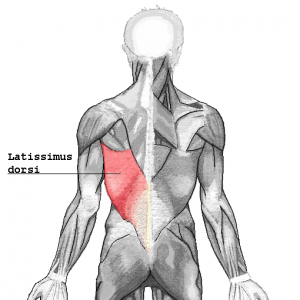
Lumbar Stability While skating, it’s important for players to maintain a neutral lumbar spine position, meaning a slight inward curve. As with sprinting off the ice, maximal speed on the ice utilizes diagonal force transfer between your glutes and opposite lats (or hip and opposite shoulder).
Note how the left “Lat” in red has fibers that appear to connect almost directly into the right gluteus maximus.
As one hip flexes, so does the opposite shoulder (stretching this lat-glute connection); at the same time, as one hip extends, so does the opposite shoulder (shortening this lat-glute connection). This connection provides an incredible opportunity for force transfer between the upper and lower body. Maximizing force transfer is predicated upon maintaining the transitional segments (e.g. the lumbar spine) in an optimal position, neutral, to do so. While I’ve seen hockey players that err both ways (too much extension and too much flexion), the majority tend to round excessively through their lower back (excessive flexion). This not only dampens efficient force transfer between the upper and lower body, it also can be a source of pain in itself. Know a hockey player with low back pain? This could be a reason why.
Once again, this is a positioning/movement fault that can be aggressively trained off the ice. It’s important for players to learn what “neutral spine” is and feels like, possess the ability to maintain it under load, and be able to transfer it to the skating position. Without question, every player is going to flex and extend through their lumbar spine during the course of every practice and every game. The goal here is to help them find a neutral position and make this their norm, so they don’t constantly gravitate or bias toward an excessively flexed position. One way to help bridge the gap between traditional off-ice exercises and on-ice work is through the use of slideboards. When a player is on a slideboard, you can help them find their optimal skating depth and a neutral lumbar spine position and see how they respond with a movement similar to skating and with fatigue.
Split Squat IsoHold into Slideboard
Note how Jeff Buvinow, who recently wrapped up a great 4-year career at Brown University, maintains a good skating posture and neutral spine throughout the exercise on the first slideboard. This video was taken the first time these guys had been introduced to this type of training, so the first day was a little sloppy, but they improved significantly over the next few weeks.
Wrap Up There is a lot to consider in maximizing skating performance, which is a positive. It means there are lots of areas for potential improvement. The players and coaches that have this information are better prepared to address all components of skating performance, including technical, structural, and functional factors. Not every player has the same potential, but the player who maximizes a lesser potential has an opportunity to out play the player that fails to maximize a greater potential.
Please enter your first name and email below to sign up for my FREE Athletic Development and Hockey Training Newsletter!
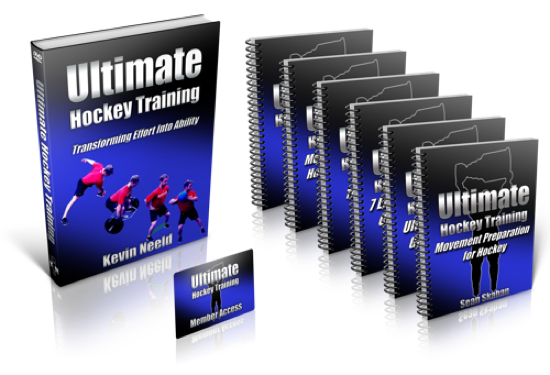
Get Ultimate Hockey Training Now!
“…an extremely rare comprehensive look at the present state of ice hockey training.”
“…a must-have for coaches and strength professionals at all levels of hockey.”






 Use CODE: "Neeld15" to save 15%