
Last Tuesday I got a picture message from a friend of mine at the Flyer’s game. The Flyer’s were airing another one of the “Fit as a Flyer” video segments I filmed with their Strength and Conditioning Coach Jim McCrossin.

Coach McCrossin and I filmed 12 video segments of common exercises or exercise progressions that we use with our hockey players. This wasn’t the first time a friend sent me a picture. Check this one out from the first segment they ever played!
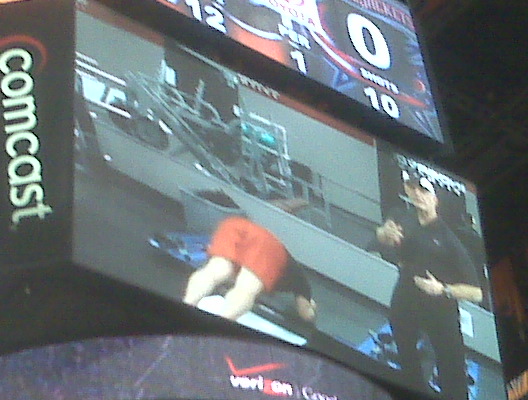
Philadephia Flyers Fit as a Flyer Hockey Training-1

You guessed it. That’s my big red ass sticking up in the air. Flattering, I know.

Needless to say, I was somewhat surprised when I got THIS picture on Tuesday:
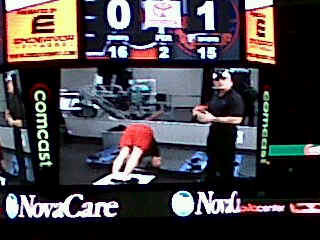
Philadelphia Flyers Fit as a Flyer Hockey Training-2

The fans have spoken. Years of glute bridges and deadlifting has won over an entire city of hockey fans:

Philadelphia Flyers Fit as a Flyer Hockey Training 3

Yep. That’s the ONLY explanation.

Every time I post videos I get a great response from you. Videos are a great way for you to learn new exercises and watch how they’re supposed to be performed. I have videos over 230 hockey training videos up at my Ice Hockey Training site that you can get access to for only $4.99/month. Let’s be honest here: they’re basically free. $5/month is nothing. Many of the exercises I have videos of I’ve spent thousand of dollars and countless hours on books, DVDs, seminars, and volunteering to learn. Some I’ve never seen anyone do except us at Endeavor. Since my new hockey training expert site has officially merged with HockeyStrengthandConditioning.com (and the videos haven’t been transferred yet), the ONLY place you can get access to these incredible videos is here: Hockey Training Videos

Go subscribe to my Hockey Training Videos section now. If you don’t feel like you’re stealing from me by getting so much info for some cheap, then just cancel. You can cancel at any time, no questions asked!

To your continued success,

Kevin Neeld

Please enter your first name and email below to sign up for my FREE Athletic Development and Hockey Training Newsletter!

Before reading this post, check out the two preceding posts on hockey conditioning:

Hockey Conditioning: To Bike or Not to Bike!

Hockey Conditioning: Shuttle Runs and Slideboards

As you may have noticed, I’m not a huge supporter of hockey players riding exercise bikes, but I am a huge supporter of slideboarding.

My opinion changes slightly when hockey players are in-season.

When players are on the ice for hours a week, they probably don’t need as much work in lateral and diagonal movement patterns because they get enough of that on the ice. To this extent, slideboarding consistently throughout the season could over-stress (or not allow for sufficient recovery) the hip adductors (“groin”) and lead to overuse (or under-recovery) injuries.

If Not Slideboards, Then What?

I generally think shuttle runs are a better alternative than exercise bikes if players NEED to condition (read below). With that said, one of the Hockey Strength and Conditioning Coaches I’ve learned the most from is Michael Boyle. He has his players ride exercise bikes in-season to decrease the risk of hip overuse injuries, as described above. However, he uses Schwinn Airdyne Exercise Bikes, which allow upper body movement and a more upright posture. These bike design changes remove many of the downsides of using exercise bikes for conditioning hockey players.


Do Hockey Players Need to Condition In-Season At All?

The amount of in-season conditioning players need depends on the amount of ice time they get and the composition of that ice time. There is nothing more hockey-specific than skating intervals. If coaches build conditioning-type drills into their practice or go through familiar drills at a high tempo, it’s likely that many players won’t need ANY off-ice conditioning.

Train Hard. Train Smart.

Kevin Neeld

P.S. If you want to use a PROVEN ice hockey training system this off-season to guarantee you enter tryouts and next season at your best, check out my Off-Ice Training course.

Please enter your first name and email below to sign up for my FREE Athletic Development and Hockey Training Newsletter!

If you play hockey, coach hockey, or train hockey players, this is for you!

If you’ve been reading my blog recently, you know that I recently launched Hockey Training Expert, a site that I knew would training hockey player development forever.I have great news!

In an effort to truly raise the bar for providing the hockey community with the best information in the world, I’ve recently teamed up with Michael Boyle (Boston University), Sean Skahan (Anaheim Ducks), and Mike Potenza (San Jose Sharks) to develop HockeyStrengthandConditioning.com!

We’ve literally put together the greatest collection of hockey strength and conditioning coaches in the world! Check out the incredible list of contributors:

-Michael Boyle (Boston University)
-Sean Skahan (Anaheim Ducks)
-Mike Potenza (San Jose Sharks)
-Chris Pietrzak-Wegner (Minnesota Wild)
-Chuck Lobe (Tampa Bay Lightning)
-Jim Reeves (Mind to Muscle)
-Brijesh Patel (Quinnipiac)
-Cal Dietz (Univ. of Minnesota)
-Chris Boyko (UMass Amherst)
-Maria Mountain (Revolution Sport Conditioning)
-Tim Yuhas (Yuhas Performance)
-Matt Nichol (former Toronto Maple Leafs)
-Kim McCullough (Total Female Hockey)

I’m blown away by the amount of incredible information already on the site. There are articles on a variety of topics, including Strength and Conditioning, Programming, Youth Training, Injuries, Female Training and Coaching.   There are webinars, audio interviews and videos up as well, all about hockey!

Each week, we’re going to add videos, articles, and programs. None of these coaches are shy about questioning the norm, so I know the Coaches Forum will be hopping right from day 1. We also have plans of adding hockey-specific webinars and audio interviews every month!

To let you test drive HockeyStrengthandConditioning.com we’re offering a $1 30-day membership, after which it’s only $9.95/month! This offer only lasts until March 31st and the $9.95 price may jump up soon, so don’t wait. Head over to HockeyStrengthandConditioning.com and sign up today. It’s only a buck!

I look forward to seeing you inside the site!

To your continued success,

Kevin Neeld

P.S.  If you have a Hockey Training Expert membership, check your email! I personally sent you an email letting you know the details about the change. As of Friday, March 19th, Hockey Training Expert will officially merge with Hockey Strength and Conditioning!

P.S.S. It’s only a buck! To get access to over a thousand years of collective hockey training experience, you only need to INVEST $1. Go to HockeyStrengthandConditioning.com and sign up now!

Please enter your first name and email below to sign up for my FREE Athletic Development and Hockey Training Newsletter!

A couple days ago, I wrote a post on why hockey players shouldn’t use exercise bikes to condition.

If you missed it, check it out here: Hockey Conditioning: To Bike or Not to Bike!

So if you aren’t going to bike, what should you do?

The main two conditioning modalities that I recommend are:

Shuttle Runs

Pros:
This full body high intensity movement requires similar energy system characteristics as skating.

Shuttle runs require direction changes, which are inevitable on the ice.

Hockey players will produce force into the ground in a free movement pattern in order to accelerate, decelerate, and change direction.

Sprinting involves full hip extension and core control of this extended posture, which helps reverse the hunched over posture that hockey players spend too much time in.

Sprinting necessitates single-leg stability, just like skating.

Cons:
Shuttle runs minimally stress lateral movement patterns and the involved hip musculature that is used in skating.

Slideboards

Pros:
Slideboarding is a high intensity movement that requires similar energy system characteristics as skating.

Slideboarding involves constant lateral loading and direction changes, which reinforces the direction changes hockey players perform on the ice and strengthens the muscles on the lateral and medial (outside and inside) aspects of the hip. This helps decrease skating-related injuries (hip flexor and groin strains), while improving single-leg stability.

Slideboarding can easily be progressed to wearing a weight vest without interfering with the pattern, which mimics the loading and thermoregulatory changes that upper body equipment places on hockey players.

On-ice stride patterns can be improved off the ice using a slideboard. Specifically, hockey players can groove a proper skating posture and recovery mechanics on a slideboard. I’ve helped many players alleviate back pain from skating due to excessive rotation at the lower back simply by bringing it to their attention while they are on a slideboard.

Slideboards are awesome.

Cons:
Slideboards can be expensive and aren’t available at common gyms. If you’re lucky enough to be around Endeavor Fitness, we have slideboards AND a skating treadmill. If you’re not, you can build a slideboard for less than $50. Actually, I built two when I was younger for less than $50. It took about 2 hours and was a great father-son bonding experience. Nothing says family togetherness time like building high intensity hockey training equipment!

Reread the above paragraph. There are no cons.

Check back in the next couple days to learn how these rules change based on whether you’re in-season or out of season.

To your continued success,

Kevin Neeld
P.S. If you want to use a PROVEN ice hockey training system this off-season to guarantee you enter tryouts and next season at your best, check out my Off-Ice Training course.

Please enter your first name and email below to sign up for my FREE Athletic Development and Hockey Training Newsletter!

In an interview I did with Maria Mountain, I told her that I never have my hockey players ride bikes.

If you missed the interview, you can listen here: Hockey Training Interview with Maria Mountain

Given traditional hockey training practices, this comes as a pretty big surprise to most players and coaches.

Let’s take a second to compare three commonly used hockey conditioning tools. Quick side note: All three of these modalities would be used in an interval training fashion only. I don’t think traditional steady-state aerobic training has any merit for hockey players at all. This includes “recovery rides”, which may have a mental benefit for hockey players, but probably lack any physiological benefit in light of the long known fact that nearly ALL lactic acid is processed within about an hour of ceasing activity (1,2,3). I realize this may offend some of my European Hockey Friends. I apologize in advance.

Exercise Bike

Pros:
Leads to similar “burning” feeling of the legs as a long shift. Improves local muscular endurance of thigh musculature.

Cons:
Biking involves MORE time in an unwanted hunched over posture (same as sitting in a desk or in a car). One of the main goals of our training programs is to REVERSE this terrible posture as it leads to range of motion limitations, undesired compensations, decreased performance and increased injury risk.

The upper body is relatively still while biking. Aside from the obvious fact that your arms move while playing hockey, because biking only uses your lower body it is more difficult to get your heart rate up to the near-max levels characteristic of a high intensity shift. Interval failure is more likely to result from localized muscular fatigue in the legs than from a more global energy delivery failure.

When players get tired on a bike, they begin to pull up on the foot straps, which puts more stress on their hip flexors. Sitting on a bike and pulling repetitively with your hip flexors reinforces the hip flexor tightness that too many hockey players already suffer from.

Biking involves putting force downward into floating pedals with a pre-determined range of motion. Skating involves putting force into the ice in a free range of motion. The force production and joint stabilization characteristics of biking and skating are completely different.

Should hockey players bike? I don’t think so. If you need a good leg burn, do split squat iso-holds. If you want good conditioning, use the modalities I’ll explain in my next post. Check back soon!

To your success,

Kevin Neeld

P.S. If you want to use a PROVEN ice hockey training system this off-season to guarantee you enter tryouts and next season at your best, check out my Off-Ice Training course.

References:

1) Gollnick PD, Bayly WM, & Hodgson DR. (1986). Exercise intensity, training, diet, and lactate concentration in muscle and blood. Med Sci Sports Exerc, 18(3): 334-40

2) Hermansen L, & Stensvold I. (1972). Production and removal of lactate during exercise in man. Acta Physiol Scand,86(2): 191-201

3) Freund H, & Gendry P. (1978). Lactate kinetics after short strenuous exercise in man. Eur J Appl Physiol Occup Physiol, 39(2): 123-35

Kevin Neeld

Please enter your first name and email below to sign up for my FREE Athletic Development and Hockey Training Newsletter!

Use CODE: "Neeld15" to save 15%