I get questions almost daily about what supplements I think people should be taking. Realistically, the complexity of someone’s supplementation depends on a number of things:

  • Training Goals
  • Diet
  • Training History
  • Supplement History
  • Age/Development

Having said that, I generally think everyone should be taking a fish oil supplement and a greens supplement. I think it’s pretty hard to argue against the long list of benefits of fish oils at this point (increases everything that’s awesome, decreases everything else…I read that in a research paper). Greens supplements aren’t as well-supported because people say, correctly, that it’s better to get all your nutrients from real food like fruits and vegetables.

I agree. Unfortunately, whether the barrier is finance- or lethargy-based, the truth is that people AREN’T eating fruits and vegetables (many people aren’t eating ANY on a regular basis).

With that understood, no one likes spending unneccessary money on supplements. I’ve done a ton of research on these two supplements and have found two resources (one that most people don’t know about!) consistently come up with the lowest prices.

You can get Greens+ (the Wild Berry Burst flavor…the other stuff is gross) at Amazon.com for around $27. It’s well worth it and significantly cheaper than other retailers, which sell it for around $40. I’ve included a link to Amazon’s page for your convenience. Just click the image below.

Supplements-Greens+

Carlson Lab’s Fish Oil (my go-to brand) is available in capsule and liquid form at Vitacost.com at around 50% off. I go for the liquid stuff (they have lemon and orange flavor that tastes like a fruity syrup…not as bad as you think!) because it’s easier to get high doses in without popping a ton of capsules.  Currently Vitacost is listing Carlson Lab’s Liquid Fish Oil for around $22! I don’t know how they do it, but I’m glad they do. Image linked below.

Supplement-Carlson Lab's Fish Oil

Hope this helps you save a few bucks! With the $20+ you save on fish oils every month or so, now you can afford the $9.95/month it takes to get a membership to the GREATEST HOCKEY TRAINING SITE EVER! Yes, it’s that incredible. And you still have a few days until the $1 30-day trial ends! Click the image below to get instant access to the world’s largest collection of hockey training expertise!

Hockey Strength and Conditioning

To your continued success,

Kevin Neeld

P.S. Please forward this along to anyone that likes saving a few bucks on great supplements!

Please enter your first name and email below to sign up for my FREE Athletic Development and Hockey Training Newsletter!

On Monday I mentioned that myofascial restrictions may prevent your stretching from being effective. If you missed the post, check it out here:

3 Reasons Not to Stretch Tight Muscles

Through my work at Endeavor, I’ve found that most people still aren’t familiar with foam rolling.


When they ask me what it does, I use the same explanation I’ve heard Michael Boyle use:

Your muscles have similar elastic properties as a rubber band. Think about tying a knot in a rubber band. What happens when you pull it from both sides (stretch it)? If you actually take a rubber band and do this, you’ll notice that the knot will get tighter and the areas on both sides of the knot will become thinner/weaker.  In other words, the whole thing will elongate, but the knot gets worse and the areas on both sides of the knot become damaged.

If you simply remove the knot (untie the band), the overall length of the band will increase and it will extend much more efficiently. This is a more desirable alternative, and the reason we foam roll.

Rolling out knots/myofascial restrictions will improve the length and extensibility of the muscle without stretching it in the traditional sense.  It will also cause you to respond better to stretching.

Seems like a win-win to me!

To your success,

Kevin Neeld

P.S. Are you still not a member to HockeyStrengthandConditioning.com? What are you waiting for!  The 30-day trial offer for $1 ends March 31st! If you’re serious about training for hockey, you NEED
to be a part of the site!

P.S.S. Please forward this along to anyone you know that will
benefit from better hockey speed training information!

Please enter your first name and email below to sign up for my FREE Athletic Development and Hockey Training Newsletter!

Our interns at Endeavor have been firing questions at me the last couple weeks. They’re definitely keeping the gears grinding as I try to think back to all the things I read as a student, and explain why so much of the information we’re taught in school is only partially true (at least in my setting).

Book Collection

Recently, one of my interns brought up when it is and isn’t appropriate to stretch muscles that feel tight. As I mentioned in my presentation “Innovative Practices in Strength and Conditioning” for SCWebinars.com, I think static stretch has some validity in training programs and is necessary for almost all athletes. Having said that, it’s not always the best solution for “tightness”.

Consider these examples:

Muscular Deficiency

Psoas deficiency will increase the workload of other hip flexors (e.g. tensor fascia lata and rectus femoris) to flex the hip past 90°. Because these muscles are required to perform extra work while they’re in a shortened position, it’s likely they’ll feel tight afterwards. Stretching may help short-term, but if the psoas deficiency isn’t addressed, you’ll keep stretching/tightening yourself in circles. Address the cause, not the symptom.

Sub-Threshold Injury
All of us suffer bumps, bruises, aches, and pains throughout the course of our lifetimes. Some of these injuries necessitate medical attention, others may be “sub-threshold”, meaning they aren’t severe enough to require medical attention, and will hopefully resolve on their own.

As a hypothetical example, consider an athlete with a very slight medial meniscus tear. The body could naturally compensate by shifting weight off of this meniscus. As a result, muscles that cross the lateral aspect of the knee (e.g. TFL-> IT Band) and prevent genu varum may feel tight. Stretching could alleviate this tightness, increase the load to the medial meniscus, and increase the severity of the tear. Oops.

Myofascial Restriction

Some people just don’t respond to stretching. They stretch and stretch, but always feel tight and the muscle never seems to improve its extensibility. Many times, this has to do with myofascial restrictions that are better addressed through soft-tissue manipulation through foam rolling, Active Release (A.R.T.) or graston. On a personal note, I’ve gained more range of motion from a single A.R.T. session that I have from hours of stretching.

Stretching can help, but it’s not always the BEST solution. If you aren’t responding well to stretching, consider looking into some of the other possibilities presented here.

To your success,

Kevin Neeld

P.S. The 30-day trial offer for $1 at HockeyStrengthandConditioning.com ends March 31st! The feedback we’ve gotten about the site has been incredible. Don’t drag your feet on this. If you’re serious about training for hockey, you NEED to be a part of the site!

P.S.S. Please forward this along to anyone you know that will benefit from better hockey speed training information!

Follow me on Twitter!
Follow me on Facebook!
Follow me on YouTube!
Connect with me on LinkedIn!

Please enter your first name and email below to sign up for my FREE Athletic Development and Hockey Training Newsletter!

In case you missed this post, check out the most exciting change to hit hockey training ever. This site will be BY FAR the best hockey training resource ever created, and unlike books or dvds that quickly become outdated, this one will ALWAYS be packed with current information. Read the post below:

The Ultimate Hockey Strength and Conditioning Site!

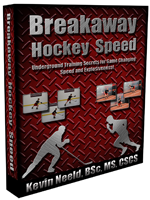
Speaking of hockey resources, I’m officially releasing my new hockey-specific speed training manual “Breakaway Hockey Speed”.

Breakaway Hockey Speed

Breakaway Hockey Speed outlines the exact speed training methods I’ve used with hundreds of hockey players to help them DRASTICALLY improve their speed and develop the game-changing speed that catches the eyes of coaches and scouts and wins games.

Inside Breakaway Hockey Speed, you’ll discover:

– Why your speed training rest intervals could be killing your progress
– How much time you REALLY need to spend on speed training
– How to incorporate speed training into your training program
– The power of Dynamic Starts and Transitional Speed Training Drills

You’ll also get EXCLUSIVE access to videos of the 6 Linear Speed Drills and 15 Transitional Speed Drills that will be the foundation for your speed training programs! You won’t find these videos ANYWHERE else (not even youtube!).

You can download Breakaway Hockey Speed AND get LIFETIME access to the Breakaway Hockey Speed training videos for only $9.97! The price may jump any day now so take advantage of this offer now!

Click Here to Develop Breakaway Hockey Speed Today!

Please enter your first name and email below to sign up for my FREE Athletic Development and Hockey Training Newsletter!
David Lasnier recently made the trek down from Quebec (in the middle of a snow storm) to start an internship with me at Endeavor Fitness. Aside from how to taunt the Endeavor staff following a Canadian sweep over the Americans at the Olympics, David has learned a lot of valuable lessons since he’s come to Endeavor. Check it out below!

From David:

“Four weeks ago, I started an internship at Endeavor Fitness in New Jersey under Kevin Neeld.  To give you a little background on who I am, I would say that I graduated from College in 2006 with a major in kinesiology, I have been working in a commercial gym for the past 3 years in Quebec, where I am from and I am French speaking.  Since graduating from College 4 years ago, I have done my best to keep up with continuing education; buying books, attending seminars, searching the internet for interesting articles and chatting with other strength coaches and personal trainers around me.

Making the move down to New Jersey was probably one of the best move I could ever do for my career; first, because the environment at Endeavor is much better than in any commercial gyms out there and, also because I am working with great strength coaches who are very brilliant and know a lot.  I have only been here for 4 weeks and I can honestly say that I already learned a lot on strength and conditioning and on other things as well.  Here are some of the things I learned in the last four weeks.

– I already knew this before, but it really struck me hard in the last few weeks; the more learn, the more you realize you know very little. I hate to admit it because I am the kind of guy who wants to know everything, but you really need to be modest in this field and admit that you will never know everything.  If you think you know everything, this is a big mistake and you are the ones who probably know the least.  Why? Simply because when you think you know everything you stop learning, you are not aware of what’s changing and the new trends in your field.  Let’s face it, we are in a field that is constantly changing and you simply can’t assume you know everything you need to be a good coach or trainer.

– Short muscle vs stiff muscle.  I actually thought I knew the difference between the two, but I actually didn’t.  A muscle that is short simply doesn’t have the range of motion as compared to a muscle that is stiff has the range of motion, but has a hard time achieving that same range of motion. A good example would be 2 athletes who don’t appear to have the necessary range of motion to squat when you ask them to squat with their body weight only.  But when you load them with a barbell on their back with let’s say 185 pounds, the athlete who’s muscles are stiff will be able to achieve the full range of motion compared to the one who’s muscles are short just won’t be able to achieve it.

– On a related note, I realized that sometimes we (at least for me) focus too much on muscles instead of movements when trying to improve flexibility or range of motion.  When training athletes you need to realize that they need most is a better range of motion on athletic movements like sprinting, lunging and squatting and not only better isolated flexibility in their Tensor Fasciae Latae(one of the hip flexors), for example.  Don’t get me wrong here. I am not saying that you shouldn’t stretch the TFL, but maybe spend more time working on their hip flexion/hip extension range of motion.

– This has nothing to do with strength and conditioning, but Archer is a great TV show! It is so hilarious I can watch the same episodes over and over again. This is by far the thing I enjoy the most on American television!

– Deadlifts can solve shoulder problems! Before coming to Endeavor, I haven’t been deadlifting in probably 3-4 months.  Not because I hated them (actually I love deadlifts), but because I was playing hockey and flag football 2-3 times a week, and I didn’t want my performances on the ice or the on the field to be affected. At the same time I was also focusing on increasing my front squat numbers, so it turned out I left the deadlift aside for a while.  I began dealing with some posterior shoulder pain on my left side at the beginning of the month of January.  I then started to look at it more closely and tried a lot of different approach to solve the problem; more stretching, more thoracic spine mobility, more soft tissue work, more scapular stability work, you name it.  But nothing was helping get rid of that shoulder pain that was getting pretty irritating.  Then I came to Endeavor, started to deadlift a lot (twice a week as an average) and noticed my posture was getting better by doing so.  And all of a sudden, no more shoulder pain!  Then it struck me; my upper back and spinal erectors muscles got stronger which improved my posture and led to a more upright standing position, which put less stress on my rotator cuff muscles.

– On another non strength and conditioning related note, I like that I can blame the fact that I am French for pretty much everything I don’t understand or whenever I make a mistake!

– People in New Jersey go totally crazy when there’s snow falling down! No, but seriously I really like the fact that there is not a lot of snow here (compared to what I’ve seen in Quebec) and that the temperature is a lot more comfortable during winter.

I have only been here for four weeks and I already learned a lot on strength and conditioning as well as general  American culture; which I already love!”

Thanks David!

For the current and future interns out there, you should also check out these two great posts from Eric Cressey:

Top 10 Mistakes Intern Applicants Make: Part 1

Top 10 Mistakes Intern Applicants Make: Part 2

Kevin Neeld

Please enter your first name and email below to sign up for my FREE Athletic Development and Hockey Training Newsletter!

Use CODE: "Neeld15" to save 15%