
There are many ways to individualize a training program to make it more specific to an athlete’s needs.

One simple way is to skip phases of an off-season program NOT relevant to the athlete’s needs to create additional time for the athlete to cycle through phases more specific to their goals.

This table is from a paper I published in the Strength and Conditioning Journal in 2018. In it, you’ll find an example of a typical phase-by-phase progression of an off-season program for ice hockey players.
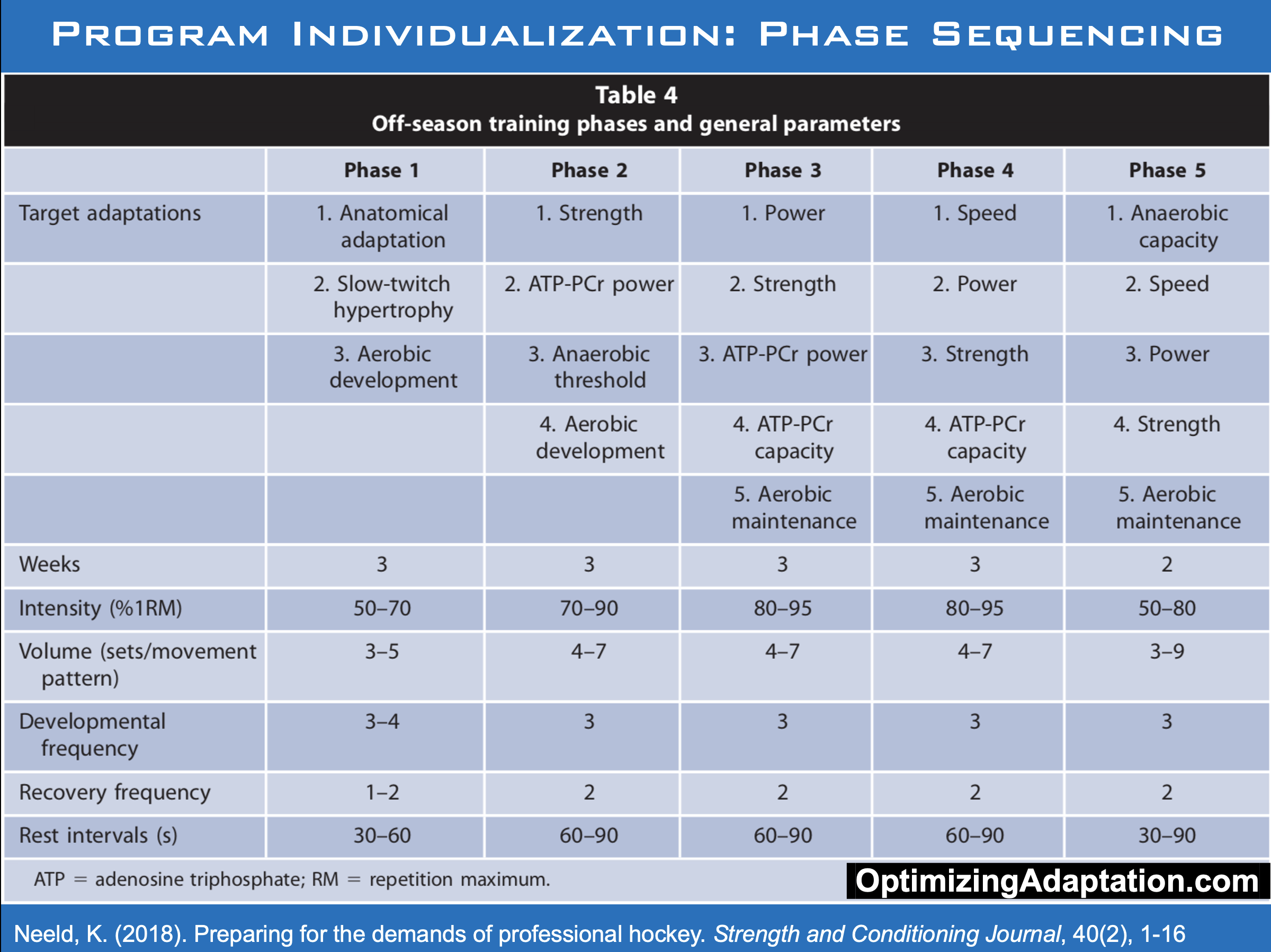
Using this as a reference, an athlete who wants to focus on speed/power could use Phase 1 as a hybrid anatomical adaptation/strength phase, progress to a power emphasis in Phase 2, Speed in Phase 3, Speed/Power Phase 4, and then transition to more anaerobic capacity work in the two weeks preceding training camp.

This would provide ~9 weeks where speed and power are the primary targets, opposed to 6 in the table.

In team settings, it’s helpful to build out several off-season templates (e.g. hypertrophy/strength emphasis, speed/power emphasis, conditioning emphasis) with specific phase progressions to ensure that athletes are safely and logically progressed in terms of exercise selection, intensity, volume, synchrony of the training program and “conditioning”, etc.

Feel free to post any comments/questions below. If you found this helpful, please share/re-post it so others can benefit.

To your success,

Kevin Neeld
SpeedTrainingforHockey.com
HockeyTransformation.com
OptimizingAdaptation.com

P.S. If you’re interested in more information about how to profile an athlete’s needs and use the profile to individualize a training program, check out the videos at Optimizing Adaptation & Performance
Enter your first name and email below to sign up for my FREE Sports Performance and Hockey Training Newsletter!
Over the last few months, I’ve shared examples of how an athlete’s speed or conditioning can be limited by different factors, and how game demands vary by position in ice hockey.

The reality is that every athlete is starting from a unique place, and therefore requires a specific path to get from where they are to where they want to go. As a result, the more a training program can cater to the specific needs of the individual, the more effective (or efficient) it will be in helping that athlete achieve his or her goals.

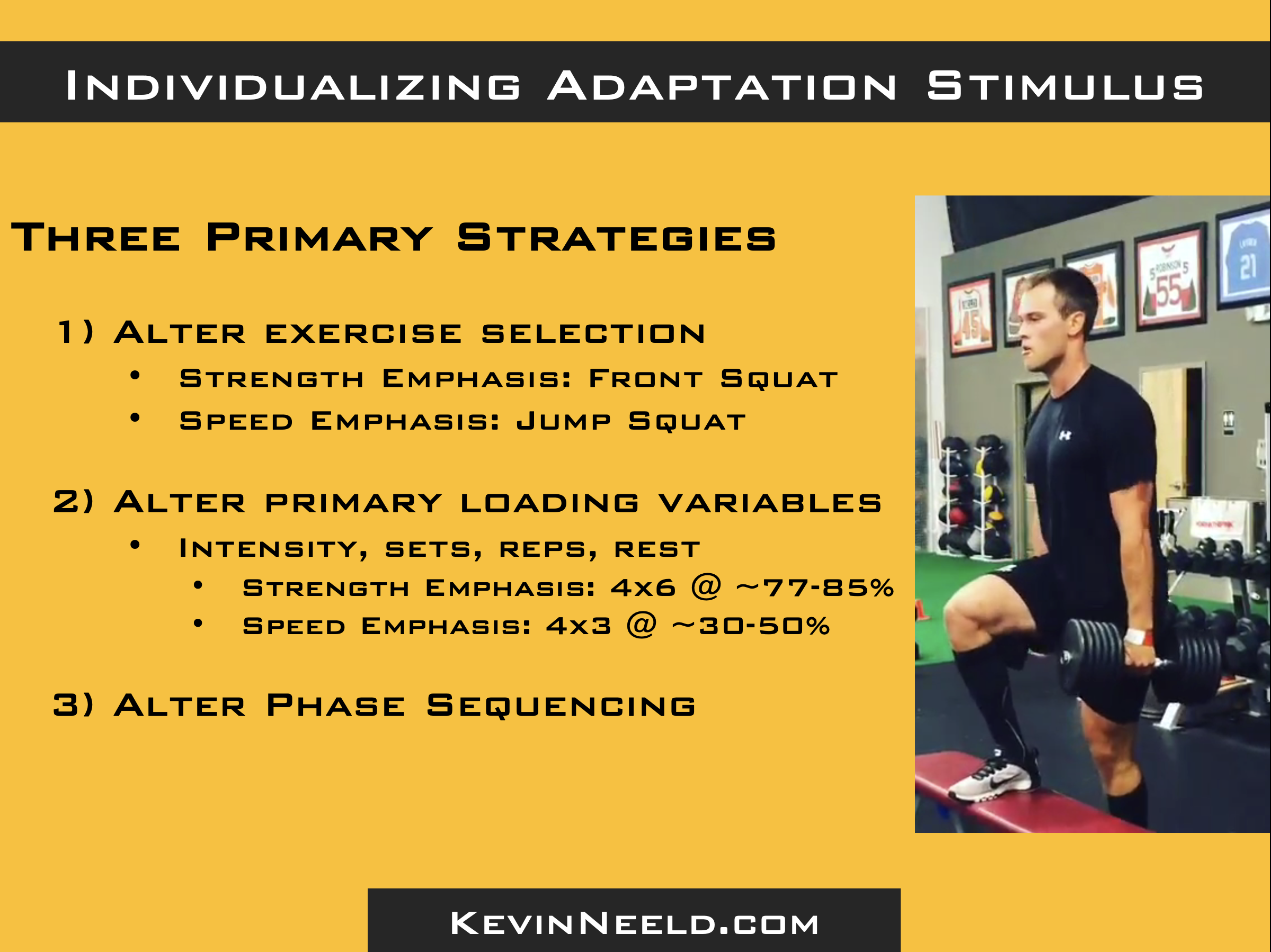
Making individualized adjustments can be challenging in a team or group environment, but here are 3 simple strategies:

  1. Alter Exercise Selection
  2. Alter Sets, Reps, Rest, etc.
  3. Alter Phase Sequencing

There are countless ways to use there 3 strategies, but the first two can be particularly helpful when the facility requires players to be in the same area (e.g. in a squat rack) at the same time.

Feel free to post any comments/questions below. If you found this helpful, please share/re-post it so others can benefit.

https://OptimizingAdaptation.com.

To your success,

Kevin Neeld
SpeedTrainingforHockey.com
HockeyTransformation.com
OptimizingAdaptation.com

P.S. If you’re interested in more information about how to profile an athlete’s needs and use the profile to individualize a training program, check out the videos at Optimizing Adaptation & Performance

Enter your first name and email below to sign up for my FREE Sports Performance and Hockey Training Newsletter!
Over the years I’ve received a lot of questions worded something like “What’s the best exercise I can do to improve speed (or power, or lower body strength, etc.)”. The allure of the “best exercise” also appears in mainstream media, where we regularly see articles with titles that start with “Top 10 exercises for…”

There are two different ways to approach training program design when it comes to exercise selection:

  1. Start with the exercise: Build the program based on pre-determined exercise progressions (e.g. double-leg variation, progress to static single-leg, progress to dynamic single-leg)
  2. Start with the intended outcome: Identify a desired training goal, then determine the exercise ALONG with the loading parameters to achieve that specific goal

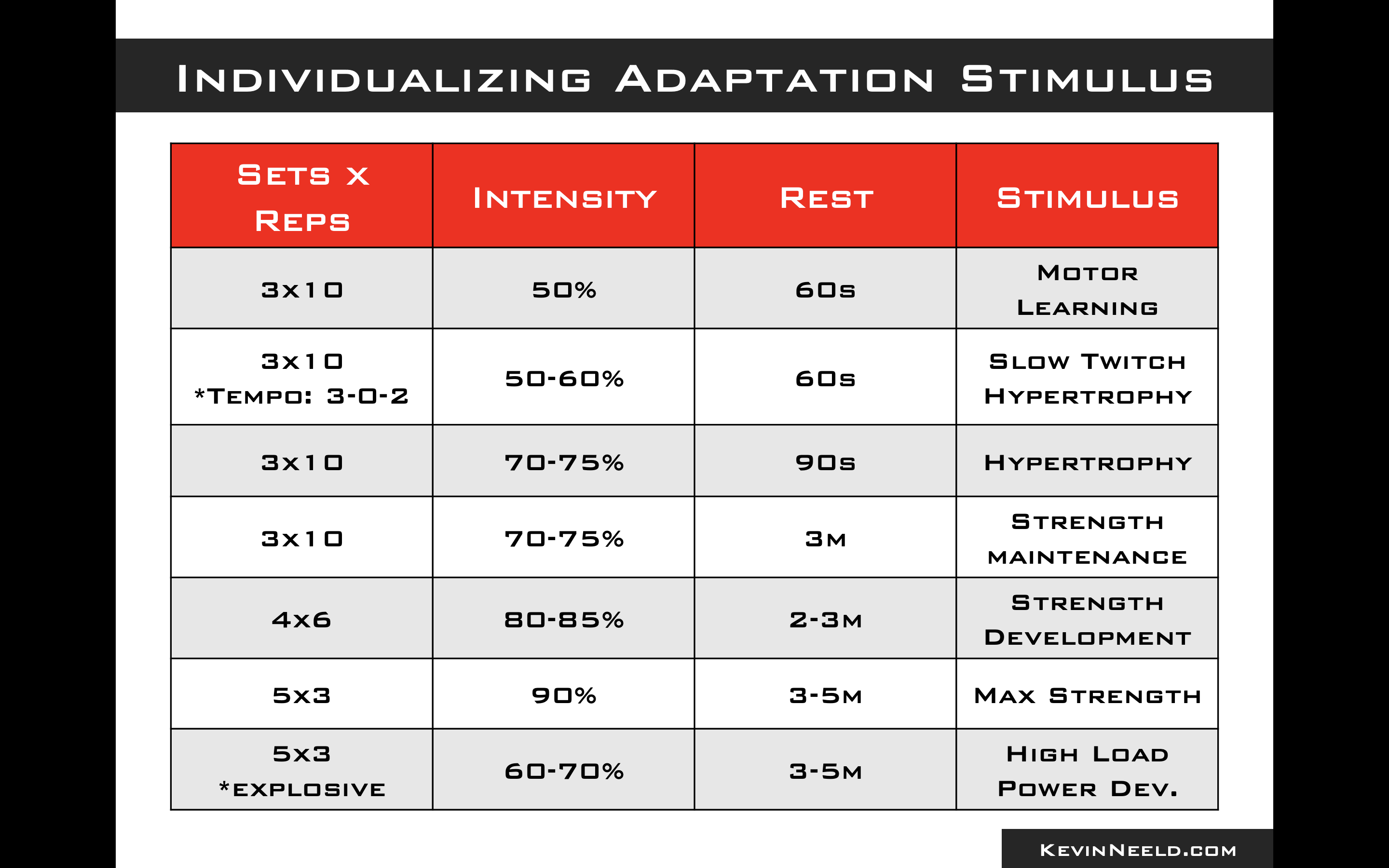
The reality is that exercise selection alone does not drive the training adaptation, all of the loading parameters do. These include sets, reps, load, tempo, intended speed of movement, actual speed of movement, and rest.

The table above demonstrates how a single exercise can be manipulated to produce significantly different outcomes.

Main take-home: Start with the goal, and reverse engineer from there.

Feel free to post any comments/questions below. If you found this helpful, please share/re-post it so others can benefit.

To your success,

Kevin Neeld
SpeedTrainingforHockey.com
HockeyTransformation.com
OptimizingAdaptation.com

P.S. For more information on in- and off-season program design, training and reconditioning for injured players, and integrating sports science into a comprehensive training process, check out Optimizing Adaptation & Performance

Enter your first name and email below to sign up for my FREE Sports Performance and Hockey Training Newsletter!
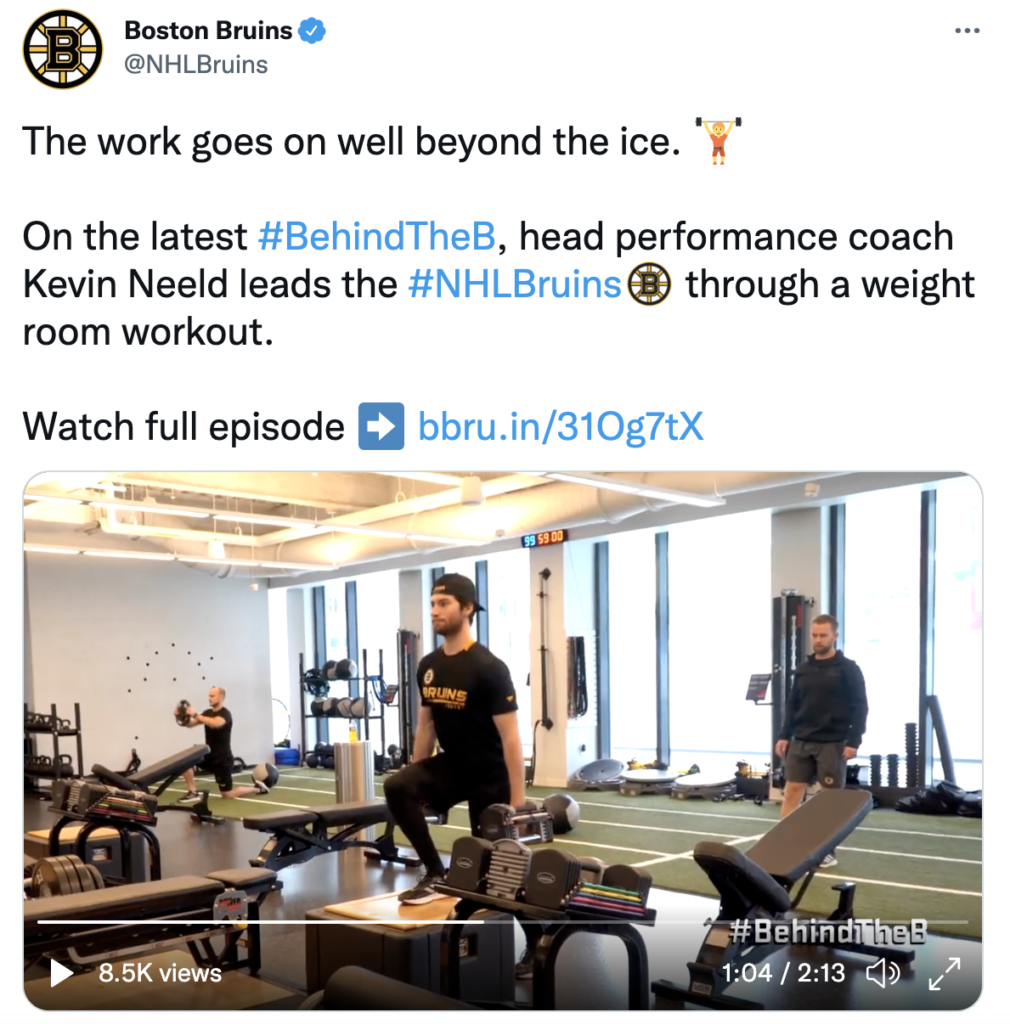
Quick segment providing a look at some of the elements of the Boston Bruins performance training program.

Full episode available here: Behind the B

Appreciate the Behind the B team (@penzy24_7) highlighting the work that goes on behind the scenes!

Feel free to post any other comments/questions you have below. If you found this helpful, please share/re-post it so others can benefit.

To your success,

Kevin Neeld
SpeedTrainingforHockey.com
HockeyTransformation.com
OptimizingAdaptation.com

P.S. For more information on in- and off-season program design, training and reconditioning for injured players, and integrating sports science into a comprehensive training process, check out Optimizing Adaptation & Performance

Enter your first name and email below to sign up for my FREE Sports Performance and Hockey Training Newsletter!
On Friday, Eric Cressey published an article I wrote on the biggest mistake people make when designing training programs.

Before I get into that, I wanted to let you know that we’ve extended the launch sale for our new video series Optimizing Adaptation & Performance through this Friday (11/9) at midnight EST.

With Halloween in the middle of the week, and articles (like the one I’m sharing today) going up late in the week, Mike, James, and I wanted to make sure you didn’t miss an opportunity to save some loot.

This image has an empty alt attribute; its file name is Optimizing-Adaptation-and-Performance.png

Get your copy and save $50 here >> Optimizing Adaptation & Performance

The Biggest Mistake in Program Design

This article shares the largest driving factors in the evolution of how I’ve designed training programs over the last 10 years.

Specifically, there was one question that completely changed how I look at program design.

Click here to read >> The Biggest Mistake in Program Design

Designing maximally effective training programs involves more than just picking “good” exercises.

The best prescription starts with an accurate diagnosis.

When I changed how I was analyzing testing data, it became clear that I needed to change how I designed programs.

Check out the article for more information!

Click here to read >> The Biggest Mistake in Program Design

To your success,

Kevin Neeld
HockeyTransformation.com
OptimizingMovement.com
UltimateHockeyTraining.com

Enter your first name and email below to sign up for my FREE Athletic Development and Hockey Training Newsletter!

Use CODE: "Neeld15" to save 15%