First things first. I want to personally thank you for continuing to come here to read up on various aspects of hockey development and for your help in spreading the word about this site. Last week, the site hit a milestone that a year ago I would have thought was impossible: over 10,000 visits in the previous 30 days.

If you’re involved in some aspects of fitness or business, this number is probably staggeringly low. However, for a hockey-specific training and development site with an array of content ranging from basic exercises to advanced scientific theory, I’m psyched! A year ago it was less than half that and growing extremely slowly. As I’ve said in the past, this site exists because of you. As you continue to help spread the word and communicate with me about what you want to me to write about, the site will continue to evolve into a better resource for you.

Random Thought 1: After my post last week on my Soft-Tissue Stress Overflow Theory, I got an email from a parent with a few kids that we’ve trained at Endeavor that read:

Her coach is so old school and is demanding at 12 years old that they only play soccer.  Otherwise they aren’t committed to the team. Yeah we’ll, we’re on our third kid.  Nice try but we aren’t buying it.  Hopefully your article will help the parents of the first borns not to believe that stuff and feel like their kid is going to be behind other kids or not “make it” because they haven’t given up their life to a travel team.

This example doesn’t pertain to hockey, but I think we all know there are hockey coaches out there like this. With every year that passes I gain an increasing appreciation for the importance of active recovery. Playing sports certainly plays a large part in developing the personality and characteristics of our youth. Things like courage, confidence, leadership, and teamwork are all life-skills that people develop through sports that will benefit them in other aspects of life. That said, sports should be a piece of a kid’s life, not all of it. Coaches, in all sports, need to remember that there’s more to life than playing sports.

Son. It’s time you stopped messing around with those “other sports” and really started focusing on hockey.


Random Thought 2: Last week I had a meeting with the president of a local youth hockey organization about a year-round development plan I had worked on. We had a great meeting. Luckily he and the coaches within that organization recognize and appreciate the importance of training as it pertains to developing elite level hockey players. They also know that it’s not a quick fix solution, but a long-term process. Because Endeavor is a private training facility, we get a lot of the “make my kid faster yesterday” parents. I wish more understood that short-term improvements in performance can be expected, but that shouldn’t be the goal. Especially with younger athletes, performance doesn’t matter nearly as much as instilling proper training habits and reinforcing proper movement patterns.

Random Thought 3: At this meeting, the idea of testing was brought up. I still whole-heartedly believe that doing performance testing with middle school and most high school athletes is completely senseless and it amazes me that so many people disagree. It is UNARGUABLE that athletes at this age are maturing, and at different rates. We’ve all seen PeeWee, Bantam, and Midget teams with players that look like giants AND players that look like they’re too small to be on the same ice. What do you think is going to happen if you compare the test results of someone that develops early and somewhat that develops late? The early maturer wins, every time. What is this system rewarding-rapid maturation? Even if you’re only comparing testing results within an athlete to monitor individual progress, which is a much more valid and desirable approach, it’s still impossible to rule out what proportion of gains are related to training and what is the result of natural maturation. Athletes naturally get stronger and faster as they get older. We need to remove the emphasis on testing and improve the emphasis on training.
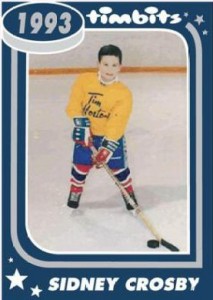
“I don’t care how good you say this Crosby kid is. His 40 time was below our team average; I can’t take him.”


Random Thought 4: Over the last year I’ve gotten some hate email about some old posts I had on the NHL combine (NHL Combine Testing Results and NHL Combine Test Results Revisited).  I should probably write an article about this, but I haven’t made the time to do it. It’s not just the NHL combine that doesn’t make sense to me; the NFL one is just as bad. Last week Stephen Paea broke the NFL combine bench press test record by pressing 225 lbs 49 times. This is an amazing feat, but what does this test even tell us? Is it a strength test? Not if he’s doing over 8 reps. Is it an endurance test? Maybe in this case. Do any of these things even matter as it pertains to on-field performance? Not likely. Check out the top performers in NFL combine tests from the last 10 years. How many of those guys are NFL stars right now? A few, but certainly not enough to justify the “if you do well on this test than we’ll pay you lots of money” approach that the NFL has taken, a direction that youth sports is mimicking. The most important test is how players perform on the ice, NOT how strong, fast, or well-conditioned they may look off the ice.
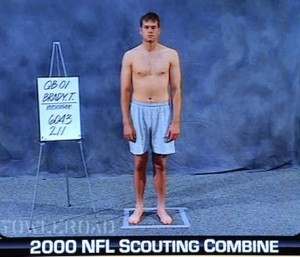
This guy doesn’t look like he’d finish near the top of the pack for waterboys in combine testing. Yet, he’s an inevitable hall of fame quarterback. Maybe there’s more to success than just strength and speed for Mr. Brady?


That’s all for today!

To your success,

Kevin Neeld
Please enter your first name and email below to sign up for my FREE Athletic Development and Hockey Training Newsletter!

This week at Hockey Strength and Conditioning was one of those “forum weeks”. Every now and then we intentionally slow down the amount of content we add in the form of articles, programs, videos, etc. so that our members have an opportunity to catch up on some of the stuff we’ve posted over the previous few weeks.

Last week we added Brian Burke’s presentation, which I think echos the hockey development sentiments of the HockeySC team, and (as you know) is one that I think everyone involved in hockey should take an hour to watch. On that note, I understand that some of the Maple Leafs fans out there are reluctant to listen because of a lack of satisfaction with the direction the organization has taken in recent years, but that is not the focus of his presentation-it’s on what changes need to occur in youth hockey to improve the development process. His words are equally applicable to current norms in both the U.S. and Canada!

YOU MUST WATCH THIS!! >> Youth Hockey Presentation

We added a 2 day/week in-season program that I’ve used with our players at Endeavor. In it, you’ll see a new sprint start technique we’ve been experimenting with recently and a new method of conditioning in-season (which we do our best to cycle through to avoid overworking any one pattern).

Check it out here >> In-Season Hockey Training Program

When you sign in, make sure you’re checking in on the forums. The discussions over the last week have been awesome, and Darryl Nelson posted a great video (in the thread “Psychology vs. Physiology) from Dr. Larry Lauer on building/restoring confidence in your team. It’s only five minutes, but there are some important messages in it.

Lastly, my dad emailed this video to me a couple weeks ago and I wanted to share it with you. It’s amazing what people can accomplish when we work together!

[windowsmedia] http://kevinneeld.com/videos/Stick-Figure-Punter.wmv [/windowsmedia]

If the video does not appear above, click this link to watch it >> Stick Figure Punter

I have some great stuff lined up for you for next week so make sure you check back in!

Click Here for the best in Hockey Strength and Conditioning

To your continued success,

Kevin Neeld

P.S. Try HockeyStrengthandConditioning.com for 7 days for only $1! It’ll be the best dollar you’ve ever spent.

Please enter your first name and email below to sign up for my FREE Athletic Development and Hockey Training Newsletter!

Yesterday Karl (our first intern at Endeavor Fitness) and I went through the Functional Movement Screen together.

I’m proud to say, as the mentor, that I came out victorious with a score of 18 (over his measly 17!).

He “lost” because his hamstring extensibility (or flexibility) was terrible. While most of our athletes have decent hamstring extensibility we do have a few that are pretty locked up.

With Karl, and some of our athletes, I’ll have them do this quick stretching activity to improve hamstring extensibility.  When someone is available, we’ll usually do this with a partner, which allows “on the fly” adjustments to leg positioning, but often times I want our athletes to do this at home, using a wall as their partner.

Please ignore the music in the background!

The protocol is:

1) Set up with one leg raised in a “hamstring stretch” position with your knees of both legs fully extended and the toes of both legs pulled toward your shins. In this position, your lower back should be flat (or with a slight curve), and you should feel a good stretch in your hamstrings on the raised leg. Hold this position for 10 seconds.

2) If you feel like you can, shift your body a little closer to the wall to increase the stretch on your hamstrings.

3) Actively raise your heel off the wall and hold for a few seconds. Return to the wall and rest a few seconds. Repeat 2-3 times.

4) If you feel like you can, shift your body a little closer to the wall to increase the stretch on your hamstrings.

5) Actively press your heel into the wall as hard as you can without it lifting your hips or moving your body at all (or breaking your heel through the wall!). Keep pressing for 3-5 seconds, then rest a few seconds and repeat 2-3 times.

6) If you feel like you can, shift your body a little closer to the wall to increase the stretch on your hamstrings and hold this final position for 10 seconds.

Most people notice a substantial improvement in their hamstring extensibility after performing this circuit. If you’re really locked up, try doing this twice a day for a couple weeks and see how much you improve.

Please enter your first name and email below to sign up for my FREE Athletic Development and Hockey Training Newsletter!

A few weeks ago I started working with a Division 1 bound high school baseball player.

During his first session, he was able to do a set of Dumbbell Reverse Lunges with 40s for 6 reps/side.

2 weeks later he did a set of 4 reps/side with 75s, and he did 70s for 6/side the following week.

There are multiple possibilities to explain this drastic strength increase:

1) Becoming more comfortable with the movement pattern

2) Increased neural drive to the involve musculature

3) Better night of sleep before the training sessions later in the program

While I won’t rule any of these things out, I’ll say that these strength increases aren’t abnormal here.

With all of our athletes, there seems to be one common theme:

When our athletes learn to brace/stabilize their core during the lifts, their weights go through the roof!

Simply coaching athletes to “get up tall” and/or (depending on the lift) “keep their core tight” while they lift has an incredible impact on their ability to transfer force through their core, and therefore the weight they can lift.

Many athletes pick this up from simple coaching cues. For the athletes that need a little more help, I teach them how to brace their core with these instructions:

1) Put their hands on their stomach

2) Tighten up their core, which contracts the stomach musculature

3) Take a deep breath “in through their belly”, without releasing the core tightness

4) Practice taking mini-breaths in and out without losing their core tightness

After teaching them this skill in a static environment, most are able to transfer that to their lifts.

Please enter your first name and email below to sign up for my FREE Athletic Development and Hockey Training Newsletter!

Last Christmas my face lit up like a 6-year old ripping through wrapping paper to discover a toy fire truck (or iPhone in today’s kids) when I opened my presents. I got 5 AWESOME Physical Therapy textbooks.

It was probably the most excited I’ve been about Christmas presents in over a decade. My family thinks I’m strange, and they’re right, but that was all I wanted!

So for the fellow Athletic Development Enthusiasts out there that can never have enough great training information (or the significant others/family members of such enthusiasts), here is a list of some of the incredible books, DVDs, and websites I recommend to everyone:

1) Assess and Correct by Bill Hartman, Mike Robertson, and Eric Cressey: I just wrote a review on this. If you don’t have it already, get it now!

2) Precision Nutrition by Dr. John Berardi. This is still BY FAR the best nutrition resource for EVERYONE, competitive athletes to stay at home parents.

3) StrengthCoach.com with Michael Boyle. Coach Boyle’s membership site has the most current information from the Strength and Conditioning Industry’s most successful coaches.

4) SportsRehabExpert.com with Joe Heiler. This is a great resource for physical therapists and athletic trainers to stay current on the practices of some of the greatest minds in the world.

5) StrengthandConditioningWebinars.com with Anthony Renna. This is one of the most brilliant advancements in the history of strength and conditioning continuing education. Without taking credit away from any of the other great sites out there, this is my favorite site on the internet. Learning great education from incredible presenters without leaving my home..what’s not to love?

There are a ton of great products out there. Among others, I can attest that anything from Nick Tumminello, Kim McCullough, Brijesh Patel, Eric Cressey, Michael Boyle, Mike Robertson, and Bill Hartman will be packed with incredible information.

If you have specific questions about other products, please don’t hesitate to email me.

Happy Holidays!

Please enter your first name and email below to sign up for my FREE Athletic Development and Hockey Training Newsletter!

Use CODE: "Neeld15" to save 15%