There’s no denying the importance of developing strength and power for optimal sports performance. In fact, strength and power really create the foundation for speed, which is one of the key qualities that determines whether an athlete will be successful at any given level. Unfortunately, most training programs leave a lot to be desired and may be missing a few key ingredients that are preventing you from making the progress you’re after.
Fortunately, Mike Robertson is back with another webinar to fill you in on some of the training secrets to help you develop the strength and power that will distinguish you in your sport!
How fighting your body to get stronger is actually making you weaker and more prone to injury.
Why a poor training foundation has robbed you of strength and power – along with ways to fix it quickly!
Exercise progressions and regressions to make sure you’re using the right exercises for you.
Why everyone should be training power – whether you’re 18 or 85.
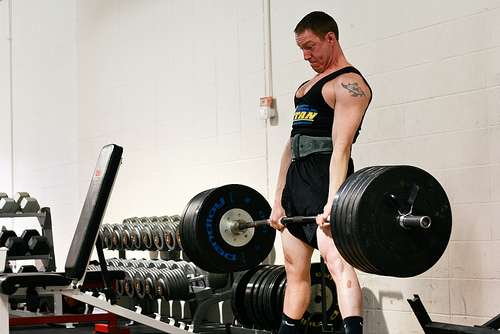
This guy knows a thing or two about strength training!
In addition to hundreds of high school and college athletes in a wide range of sports, Mike has successfully trained powerlifters and Olympians, the two extremes of strength and power. If you want to take your strength and power to new levels, this is a must-watch video! As with his video on mobility, this one is 100% FREE, but will only be around for a couple days. Don’t miss it!
Please enter your first name and email below to sign up for my FREE Athletic Development and Hockey Training Newsletter!
Off-Season Hockey Training Program
The last 4 weeks have been a whirlwind. In mid May I started to get extremely busy at Endeavor as we started filling our morning groups with hockey players that were returning home from their junior teams (which means assessments, designing programs, and lots and lots of coaching). Simultaneously, we started up with our off-season programs for Team Comcast at our satellite facility in Pennsauken, NJ. The result was, and continues to be, 12-13 hour days for David Lasnier and I. We also had 3 new interns start at Endeavor (doing a great job so far!).
Mixed in with all of that, I flew to Colorado Springs for USA Women’s National Team 6-day Performance Camp, flew back for a day to work 10 hours (felt like a half-day), then woke up at 5am the next morning (3am in Colorado time…where my body was still residing), and drove up to northern New Jersey for a 4-day Active Release Technique course. It’s always a great experience working with the incredible staff and players with the USA Women’s National Team, and I’m proud to say that I’m now ART certified!. Needless to say, though, things have been pretty busy, and I haven’t had much time to write.
Off-Season Hockey Training Program: Strength Phase
Every month I post the exact hockey training programs I wrote for our players at Endeavor to a special “Insider’s” membership section of Ultimate Hockey Training. Today, I wanted to share one of the programs that will be going into the Insider’s Section shortly, and highlight some of the most important features of the program.
This is “Phase 2” of our 4-day off-season program for players that trained with us during the “early off-season phase.” In contrast, players that are joining us now and weren’t with us for the early off-season have a different program, and players training 2 or 3 times days per week, naturally, have a different program as well.
Dissecting the Program
Population
In general, the players that train 4 days/week with us are competing at levels from Tier I U-18 through the NHL. As a result, they almost all have at least a couple years of training experience, and have gone through their major growth spurts (important consideration for long-term athletic development recommendations). The more advanced training age and stage of development are two reasons why the phases are only three weeks long. It provides an opportunity to emphasize more physical qualities with a stronger emphasis than a typical 4-week phase structure, which more advanced athletes need to continue to develop. In contrast, a novice lifter could do, for example, 3 sets of 8 reps on the same exercises for a year and continue to make progress in muscle size, strength, power, speed, etc.
Purpose
To be overly simplistic, this phase is meant to improve strength. To dig a little deeper, strength depends heavily on the alactic energy system. This can be further divided into alactic power (short duration high intensity efforts with complete rest) and alactic capacity (short duration high intensity efforts with incomplete rest). If you recall from previous posts I’ve written, it’s important to keep in mind which physical qualities send conflicting physiological messages to the body. This isn’t to say that conflicting qualities (e.g. alactic power and lactic capacity) need to be completely segregated, but too large an emphasis on conflicting qualities will impair adaptations to both stimuli.
As a result, an effort was made to keep the “conditioning” in-line with the energy systems emphasized throughout the rest of the phase.
Program Comprehensiveness
It’s still common for players to be subjected to the marketing of programs geared solely toward a specific quality (speed training program, conditioning program, etc.). As I mentioned in the below video, no program should be comprised entirely of a single physical quality, as most qualities compliment each other. Doing only, for example, speed training exercises will not only cause you to detrain a number of other important qualities (e.g. strength, power, conditioning), but it’s not even the best way to develop speed. Programs should be comprehensive, and need to emphasize multiple, complimentary qualities.
PRI
I’ve gotten a lot of questions from people about how we’ve been integrated exercises from the Postural Restoration Institute into our training. With the elite hockey players, David Lasnier or I take them through a comprehensive assessment process and each player gets a few specific exercises that they need to do before and after their training sessions (and preferably also on off days). We also build some of the most powerful PRI exercises into EVERYONE’S program, and progress them from phase to phase. As the off-season goes on, we decrease the volume of these exercises pretty significantly. The idea is that they’re meant to be “corrective”, so we impart the change we’re after, and then cut back to simply maintain the change we’ve created.
Wrap-Up
While I know many will be tempted to download the program and attempt to use it as is, it’s important to realize that our programs are really just templates. We’re constantly making changes at Endeavor to accommodate the individual needs of our players, in terms of exercise selection, loading, and volume (amongst other things). I wanted to share this program with you so you could get an idea of how I approach program design for a strength phase of training. Hopefully you can pull a couple new ideas to integrate into your own programs.
To your success,
Kevin Neeld
P.S. If you want more information on designing effective off-ice hockey training programs, check out Ultimate Hockey Training!
Please enter your first name and email below to sign up for my FREE Athletic Development and Hockey Training Newsletter!
This Week at Hockey Strength and Conditioning
Great posts this week at Hockey Strength and Conditioning!
Awesome article from Sean. This is one of those “must-reads” for parents of young hockey players and any coach (or strength coach) that works with young players. Sean does a great job of explaining how we need to broaden our look on what strength training encompasses and how it will impact development.
I’m always interested to see what other coaches are doing for goalies. Mike put together two video series of really interesting jumping progressions that he uses in San Jose. I really like the thought process behind these and will probably start to incorporate these exercises into my future programs for both players and goalies.
The forum has stayed pretty active with some great questions on the rationale for specific exercises (and their order) within bar complexes and some off-ice skating technique exercises.



 Use CODE: "Neeld15" to save 15%