At least year’s Boston Hockey Summit I had an opportunity to briefly meet Charlie Weingroff. Charlie used to work with the Philadelphia 76ers and was there to present on the basketball track of the seminar. I heard so many good things about him from other attendees that I signed up for his newsletter when I got home and have been following his work closely ever since. In that time, Charlie has been an incredible resource (he provided a ton of guidance for this Hockey Injuries: Sports Hernia Case Study, and introduced me to Dr. Michael Tancredi who is an invaluable referral resource for me) and become a friend.

When I found out he was working on a new DVD set I shot him a quick email to ask when it would be released. As soon as it was available, I bought a copy. With the chaos of the holidays, and working through other books I was in the middle of, I didn’t have an opportunity to sit down and watch it until last week.

My first impression was…wow.
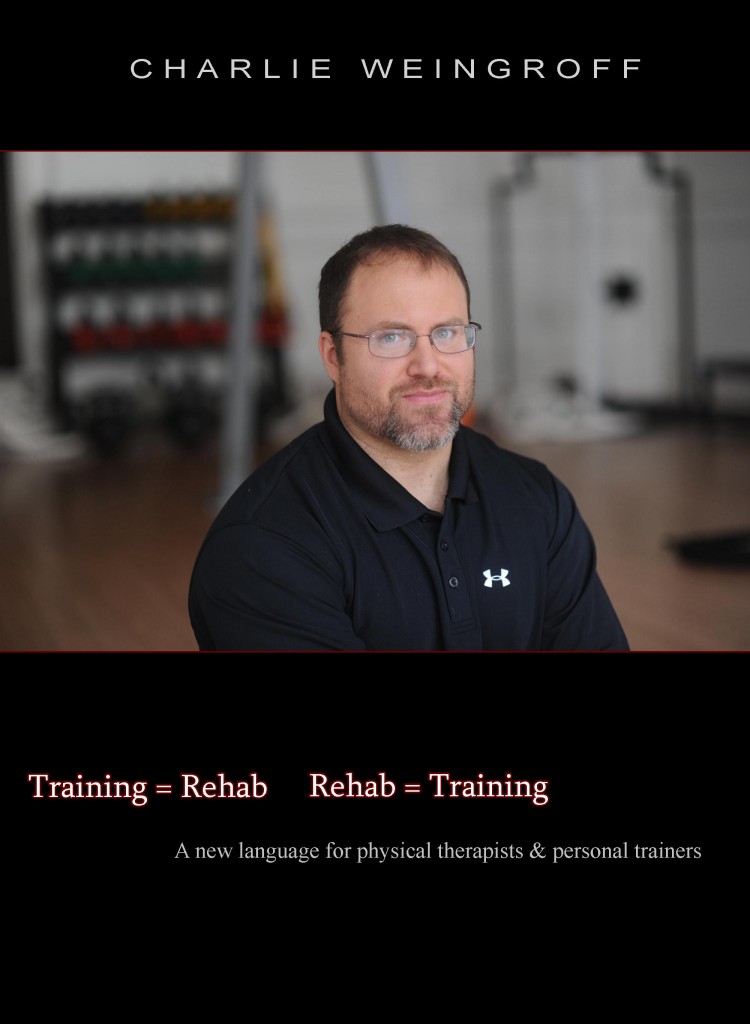
Training = Rehab, Rehab = Training is the most insightful (dare I say groundbreaking!) strength and conditioning resource since Cressey and Robertson’s Building the Efficient Athlete. To give you the quick run-down, there are 12 hours of film split up over 6 DVDs that really dive into how the human body functions and how to train to optimize this function AND minimize injury risk. The novelty of this information stems from the uniqueness of Charlie’s background-part physical therapist, part strength and conditioning coach, part manual therapist, and part powerlifter. The ultimate mad scientist combination for creating a performance enhancement expert.

And with the final ingredient…we’ve done it! He’s ALIVE. MUHAHAHAHAHA.

Over the next week, I’m going to dive into a few of the things that really stuck out for me, starting with:

Click here now to get your copy >> Training = Rehab, Rehab = Training

Redefining Stability
With the popularity of the Mike Boyle and Gray Cook’s “joint-by-joint approach to training” also comes a bit of misunderstanding. Stability has become a garbage term that gets thrown around to mean a lot of different things. Typically, stability is used within the context of “core stability” which usually refers to exercises that involve maintaining a neutral position. Admittedly, I’ve been guilty of this in the past, but have since moved away to defining stability not as neutral, but as control. This is why Charlie’s definition resonated so much with me. He defined stability as:

“An ability to control movement in the presence of change”

With this clear, accurate definition in place, it’s important to recognize the profound implications this has on the joint-by-joint approach to training. Now instead of a “stable” joint being thought of as not wanting to leave neutral, we can see that it’s more a matter of being able to control the movements of the joint, especially in undesired planes (e.g. frontal and transverse plane movements of the knee-specifically the junction of the femur and tibia, and at the elbow, specifically the humerus and ulna).
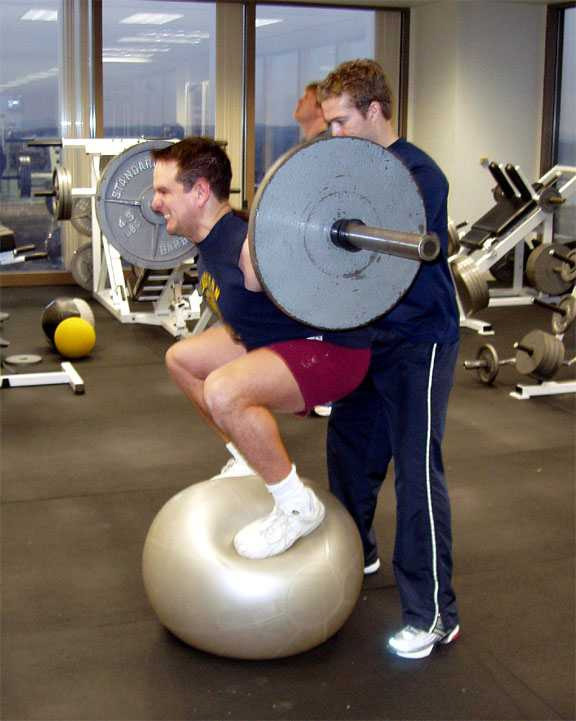
According to Charlie’s new definition of stability, this exercise would be considered…well, still stupid.

Core Pendulum Theory
The “Core Pendulum Theory” is a term Charlie coined to emphasize the importance of maintaining full joint mobility. To paraphrase, a joint needs to have full mobility for two major reasons:

  1. Full mobility allows the joint to naturally recognize it’s center/neutral location, known as joint centration.
  2. Full mobility provides optimal neural feedback to the nervous system, which can then send more appropriate signals to the surrounding muscles

As an oversimplified example, let’s suppose a hip has 40 degrees of internal rotation and 50 degrees of external rotation, and recognizes it’s central/neutral position as 0 degrees of rotation. If 20 degrees of internal rotation is lost (not uncommon, especially in hockey players), the joint may associate it’s “neutral position” in a few degrees of  external rotation. Or, probably more accurately, the femoral head would shift slightly within the joint, which would affect both the ability of the surrounding muscles to operate optimally AND force transfer through the joint. Also, because the mechanoreceptors no longer provide appropriate feedback to the nervous system, the nervous system is unlikely to appropriately activate the muscles that CONTROL (there’s that word again!) internal rotation (e.g. the external rotators).

Movement vs. Exercise
In many cases, the words movement and exercise can become blurred. After all, wouldn’t functional exercise use functional movements? Well, not exactly. As I alluded to above, Charlie highlights the importance of all joints having full range of motion. Related to a current hot topic in core training, he notes that the lumbar spine should have FULL flexion range of motion. However, repeatedly flexing the lumbar spine as an exercise can damage the discs. In this case, you need full MOVEMENT, but you shouldn’t use it as part of an EXERCISE.

Another example is with valgus collapse of the knee.
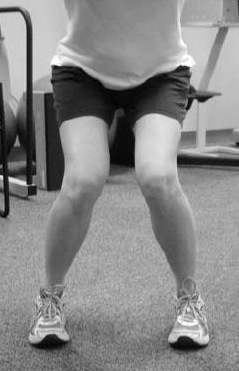
Assuming this picture was taken during a jump landing, this picture illustrates:

  • A demonstration of a hip internal rotation MOVEMENT
  • An incredibly dangerous EXERCISE

To elaborate, landing from a jump isn’t inherently dangerous. Landing as in the picture is absolutely dangerous. The point is that there are times to EXPRESS movement capabilities and times not to. In the case of the lumbar spine, there should be full flexion and extension range of motion to ensure proper joint centration, force transfer and a stable dock for attaching muscles, but because the discs begin to fail when they go through a certain number of flexion/extension cycles, that range of motion should not be included as a part of regular exercise.

Training = Rehab, Rehab = Training is not for everyone. In my enthusiasm for a new product or resource I sometimes forget this part. While Charlie brilliantly breaks down all of his training philosophies and concepts, there is a certain requirement for an underlying prerequisite knowledge in functional anatomy and biomechanics (or kinesiology). If you’re a hockey mom or dad, this wouldn’t be a good allocation for your money. If you train or rehab people for a living, this is a MUST have.

Click here now to get your copy >> Training = Rehab, Rehab = Training

To your continued success,

Kevin Neeld

P.S. Did you remember to sign up for this? 2011 Sports Rehab to Sports Performance Teleseminar
Please enter your first name and email below to sign up for my FREE Athletic Development and Hockey Training Newsletter!

This is it…the final HockeyStrengthandConditioning.com update for 2010. Things have been pretty slow for the last couple weeks as we all try to dial back the workload to relax and enjoy the holidays with our family. Hopefully you’ve had an opportunity to do the same.

Mike Boyle posted the first phase of a 4 day per week off-season training program without Olympic lifts. As I’ve mentioned in the past, I think looking at another coach’s program provides incredible insight into their training philosophies. This was especially interesting because Coach Boyle is a big proponent of Olympic lifts. Although, as any good coach does, he clearly recognizes that no lift is perfect for every athlete and that certain circumstances warrant making program adjustments. Check out his program at the link below:

Click Here >> 4-Day Summer Phase 1 without Olympic Lifts from Mike Boyle

There are also a few great forum discussions you should check out. Look for these three specifically:

  1. Coconut Water (interesting discussion on a potentially more effective and “natural” replacement for sports drinks)
  2. 1-Leg Squat (discussion on single leg training progressions)
  3. Female ‘Tendies (how to balance performance enhancement and injury prevention in goalies, with a special focus on female players)

Click the link below for more information about Hockey Strength and Conditioning!

Also, I just wanted to send you a final reminder that today is THE LAST DAY to save 25% on all Generation UCAN products. Go to the link below to take advantage of this one-time offer before it’s gone!

>> Generation UCAN <<

To your continued success,

Kevin Neeld

P.S. Remember, it’s only $1 to try HockeyStrengthandConditioning.com for the first week. You will never find more hockey training content anywhere for $1…trust me (I’ve looked!).

P.S.S. I have an important announcement for you tomorrow. Whenever you roll out of bed, come check it out!

Please enter your first name and email below to sign up for my FREE hockey training newsletter!

I really enjoyed Michael Boyle’s article on Monday. In case you missed it, check it out here: Becoming the Best and then come back and finish reading this post.

Today’s culture seems to be very much driven by instant satisfaction. This certainly isn’t a bad thing. The advances in technology over the last decade have been exceptional, and lead to profound improvements in our ability to share information. As a result, we have more information at our fingertips than ever before. Louis CK explains…


“How quickly the world owes him something, he knew existed only 10 seconds ago.”

In many ways, this incredible information revolution has also made us very lazy. I don’t mean lazy in the obesity “epidemic” way; I mean that it’s lead some to expect success equally as quickly. Having worked in a teaching setting recently, interacting with interns and young athletes, and emailing back and forth with young aspiring strength and conditioning professionals, this “I want to be the best right now” idea is everywhere. While I whole-heartedly appreciate the enthusiasm, I feel they may be missing the big picture.

This is why I thought Mike Boyle’s article was so insightful. He reinforces that being the best, in anything, takes time, work, and a ton of practice. On a personal note, Eric Cressey has been a great mentor for me. He established himself as a authority in strength and conditioning at a very young age and quickly opened his own training facility, which was something I also wanted to do at the time. On the surface, he appeared to be an “instant success”.

When I met him, Eric was far from an “instant success”. He, even now, reads and studies more than anyone else I know, and is constantly putting what he learns into practice. He finds a way to squeeze 25 hours of progress into every 24 hour day and never slows. Frankly, I’m not convinced that he sleeps every night. Instant success? Pretty far from it.

Undoubtedly, young professionals can expedite their path to success by exposing themselves to and retaining as much QUALITY information as possible. This can come in the form of books, articles, dvds, seminars, talking with colleagues and other professionals, and observation hours. This will begin to provide the foundational knowledge necessary to be successful.

The part you can’t “expedite” is developing the wisdom to know when to use this knowledge. This is only developed through thousands of hours of coaching and controlled “experiments”. As a few examples:

  1. High intensity interval training is hands down the most efficient way to burn fat, but that doesn’t mean it’s the best for everyone. Some people simply aren’t in good enough shape to train at sufficiently high intensity and/or aren’t mentally tough enough to sustain a program built around interval training. The best program in the world isn’t so good if a person can’t sustain it!
  2. Knees collapsing in during squatting, jump landing, or lunging movements is typically the result of a lack of femoral internal rotation control. It can also result from an overpronated foot, which can be related to bone structure or some sort of muscular restriction (e.g. a tight soleus). It’s possible to identify which is the major factor by watching athletes move (and by performing a few simple assessments), but it takes time and practice. Nothing in training is as simple as “If this happens then you need to do this.”
  3. Coaching is more of an art than a science. Experience teaches which athletes need to be “pushed aggressively” and which need to be “encouraged politely”.
  4. There are very few inherently bad exercises and equally few absolutely essential exercises. In most cases, the right exercises need to be applied to the right person at the right times. After all, exercises are only stressors. There is undoubtedly multiple exercises that will serve a similar function, or create a similar stress to the body.

Ultimately, experience develops the wisdom to put information into the appropriate context, to realize that the “perfect program” will be different depending on the coach, the environment, and the athletes. The same can be said for athletic excellent. Many times it will come down to hundreds of hours of QUALITY preparation time (training, practicing skills, studying the game at your level and the next, etc.).

To wrap up, one of the best ways to “become successful” in any field is to find a couple people that have accomplished what you want to, and then develop the same habits they did.

To your success,

Kevin Neeld

Please enter your first name and email below to sign up for my FREE Athletic Development and Hockey Training Newsletter!

Last week I read a great article from Mike Boyle that I wanted to share with you. While the article is largely oriented to how he became one of the best coaches in strength and conditioning, the theme of this article could be applied to any endeavor (e.g. becoming a great strength coach, becoming a great hockey player, becoming a great employee/manager/boss, etc.)

Check it out:

“It must be New Years resolutions and goal setting time because recently I have received more than a few Facebook messages asking how I got started. Rather than half-ass a quick post I thought I would take a moment to tell a story that might inspire a few of you. I have been lifting weights since around 1973 or 74. Like many my age I started with the York 110 pound set with the wall chart in the basement. My father was a teacher-coach and Hall of Fame football player in college and I was going to be just like him.

To cut to the chase my football career was ended by two serious problems that afflict far too many athletes. Lack of size and lack of talent were two things I just couldn’t overcome. What I did learn was that I had some fast twitch muscle fiber and liked lifting. Lifting kept me sane after giving up football and I pursued athletic training in college. In true Outliers fashion I was lucky enough to have a dorm director named Mike Woicek my first two years of college Mike, for those who don’t know, is the current New England Patriots strength and conditioning coach and the man with the most Super Bowl rings in the history of the NFL. What luck. Another guy at Springfield College at that time was Rusty Jones, current Chicago Bears strength and conditioning coach. Very early on I had great mentors and role models.

I left Springfield College after five years with a Masters degree and took a job at Boston University as an assistant athletic trainer. In the back of my mind, I knew I wanted to be a strength coach. It was 1982 and I was about 185 lbs, soaking wet. I didn’t look like a strength coach and still don’t. After six months of athletic training I took the plunge. I quit my full time, paid job as an athletic trainer and became the volunteer strength coach.  I gave up a salary and benefits for a volunteer job and started my journey. Very few schools even had full-time strength and conditioning coaches at the time. I tended bar 4-5 nights a week to pay the bills and threw myself into the job.

I was a former football player and a competitive powerlifter but I became a “hockey expert” at the urging of the hockey coaches at BU. For those unfamiliar BU is to college hockey what Notre Dame or USC is to college football. I figured hockey out and also figured out that there was no one training professional hockey players in Boston. I had found my niche. I met a hockey agent and talked him into sending me a few minor league clients. I told him no NHL guys. I needed desperate guys that would listen to a “football guy” tell them how to make it to the NHL.  I also started training some high school hockey players because, in truth, I needed the money. That may have been the smartest thing I ever did.

To make a long story shorter, some of my new minor league clients did make the NHL and the Boston Bruins offered me a part time job as their strength and conditioning coach. With a little money from BU and some from the Bruins, I gave up the bar business and was now a full time strength and conditioning coach with two jobs. I worked from 8:30 AM to 11:30 AM with the Bruins and then drove to BU and opened up the weight room at 12. I coached every day at BU from 12-7 with some 6 AM football stuff thrown in during the winter before Bruins practice. I would then either go to a BU game or go back to the old Boston Garden at 7 PM and train the injured players or those who didn’t dress. After the game I would try to coerce a few players to work out. I’d get home about 11 PM. Not a bad day for an eight month season.

At the roughly the same time I began my speaking career by accepting the invitation to speak at everything but the opening of an envelope. Most of my “speaking engagements” were to middle school hockey players in groups of 10-12. Obviously an audience that foreshadowed things to come. Chris Poirier and Perform Better gave me a break when they began their Perform Better clinics. I was one of the first speakers and like any good job, I never left.

I did this for 10 seasons and at the same time found time to leave my full time job at BU and open Mike Boyle Strength and Conditioning. We were one of the first for-profit centers opened in the country. As Alwyn and Jason so aptly described in their article The Business, I was rapidly becoming an overnight success one twelve hour day at a time.

The rest is simple. I just kept doing what I was doing. I worked in my business. I put in my 10,000 hours. I coached athletes and I coached coaches. I think the big key is that I took chances and was willing to work long hours. It was not easy. Except for my brief athletic training job at BU ( six months) I did not have a full time job with health insurance until I was thirty years old. I read this quote in a book the other day.

“Most people give up right before the big break comes”

Don’t let that person be you. Keep moving forward. Remember, the big break might be around the corner.”

To your success,

Kevin Neeld

P.S. Mike Boyle’s best project ever? http://tiny.cc/fkr0h

Please enter your first name and email below to sign up for my FREE Athletic Development and Hockey Training Newsletter!

I remember the anxious anticipation I used to feel leading up to Christmas when I was younger. The holidays have come to take on a different meaning as I’ve gotten older, but then, it was all about getting new hockey stuff. Whether it was new gloves, new pants, a new jersey, or new rollerblades, I almost always strictly wanted something that would help make me a better player or replace old gear that I had bought myself. Somewhere I have a picture of me as a little porker, fully clothed, wearing my new hockey pants and flexing (a hockey strength and conditioning coach in the making); if I can dig it up I’ll throw it up on here.

Santa’s shooting technique is eerily resemblant of Mark Messier’s

One of the things I love so much about the hockey community is how passionate everyone involved is. I’ve found that, as much or more than any other sport, hockey players, parents, and coaches are always looking for ways to get better. This, in combination with the rapid growth of the sport over the last decade, has done wonders in improving the quality of the game at all levels.

With the Holiday Season upon us, you may be in a rush to finish up your shopping for the hockey enthusiasts in your life. With that in mind, here are a couple recommendations:

For the Players:

Because my focus has been primarily on the training side of things over the last few years, I don’t talk very much about skill development. Many are surprised to know that this is actually where a lot of my background originated-running on-ice power skating and puckhandling clinics. One of the most overlooked aspects of hockey training is how much improvement a player can make in his/her hands from spending some time handling a puck or ball and taking a few hundred QUALITY shots everyday. The key is to find the right equipment to do so. I’ve been really impressed with what HockeyShot has to offer. Go to the link below and check out the “Top 12 Must-Haves” under the Hot Gifts tab on the left. A good net and shooting board allow you to bring the feel of a rink anywhere you want. I also recommend picking up one of the stickhandling balls in the Stocking Stuffers section.

Click Here >> HockeyShot: Your #1 Source for Hockey Training Aids!

The thing that most consistently limits a player’s performance is how they fuel themselves. From talking to hundreds of players over the last several years, hockey players aren’t able to consistently identify any “good” foods except for chicken. Essentially, the idea of pre-, during-, and post-training/competition meals are completely lost on them. Generation UCAN has a simple, and extremely effective solution to this problem. Their SuperStarch drinks are perfect for pre- and during- training, practices, and games, and their SuperStarch/Protein drinks are prefer for afterward. I highly recommend picking up a case of each. They have a special deal right now offering 25% off all their products, but only through the link below.

Click Here >> Generation UCAN Sports Drinks

For Parents and Coaches

There are countless products out there that may appeal to you, many of which I’ve talked about in the past. Having said that, I still think the #1 thing every parent and coach should do is watch Mike Boyle’s presentation from USA Hockey’s ADM conference. It won’t cost you a dime, and will have a profound impact on what you do with your sons/daughters/players. The general feedback I’ve gotten from parents that have watched it so far is “I can’t believe how wrong of an approach I’ve taken.” This presentation address things ranging from whether or not players need to play in “prospect camps” (which many parents push their kids to play in for fear of not getting “noticed”) to what players should be doing from a training standpoint to give themselves the best chance of success (not what most coaches have their youth teams doing). You can watch the entire presentation for free here:

>> The Truth About Developing Elite Level Hockey Players <<

Strength Coaches, Trainers, and Sports Medicine Professionals

One thing I’ve noticed over the last year is that it’s easy to get busy and let continuing education stuff slip under the radar. Many strength and conditioning coaches work in excess of 10 hour days on a regular basis. In an effort to keep up with current trends in hockey training, it’s important that continuing education isn’t ignored. In an effort to maintain some semblance of a social life, it’s important that you only look to the best resources for this information. In this regard, HockeyStrengthandConditioning.com is the top resource for hockey training information on the internet. The diversity of the contributors allows for great information on new exercises and training progressions, injury prevention and rehabilitation techniques, coaching cues, nutrition and supplementation, and more. Even better, the contributors aren’t “internet gurus”; they all have real-world experience developing hockey players (many at the NCAA D1, Major Junior, Olympic, and Professional Levels)! A year-membership makes a perfect gift!

Click Here >> Hockey Strength and Conditioning


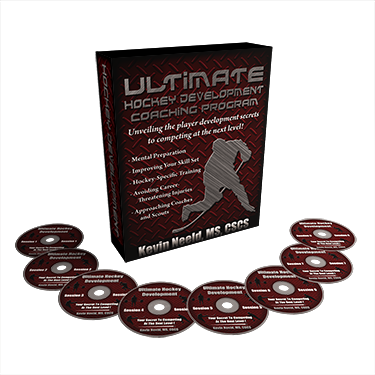
As an added bonus (and incentive), if you sign up for a 1-year membership by tonight at midnight (12/15), I’ll throw in my Ultimate Hockey Development Coaching Program as a free gift. You can listen to the 14 Coaching Calls with some of the hockey development industry’s top experts on your drive in and out of work or while you shovel! Just send me an email after you’ve registered with your name and login id and I’ll shoot you over a download link after I confirm.

That’s a wrap for today. If you have any questions about the things I’ve mentioned here, feel free to post a comment below and I’ll get back to you.

To your success,

Kevin Neeld

P.S. Forward this along to your friends, family, teammates, and coaches…and hurry, shopping time is running out!

Please enter your first name and email below to sign up for my FREE Athletic Development and Hockey Training Newsletter!

Use CODE: "Neeld15" to save 15%