Mike Boyle is one of the foremost experts in the fields of Strength and Conditioning, Functional Training and general fitness. In 1996 he co-founded Mike Boyle Strength and Conditioning, one of the first for-profit strength and conditioning companies in the world, training athletes from junior high school students to All Stars in almost every major professional sport.

Prior to Co- founding Mike Boyle Strength and Conditioning, Coach Boyle served as the Head Strength and Conditioning Coach at Boston University for 15 years, and as the Strength and Conditioning Coach for Men’s Ice Hockey at Boston University for 25 years.  He also served as the Strength and Conditioning Coach for the Boston Bruins for 8 years, the Boston Red Sox during their world series winning campaign in 2013, and for the US Women’s Olympic Ice hockey team during 2 Olympic cycles, helping the team win Gold in 1998 in Nagano and Silver in 2014 in Sochi.  He also served as a consultant in the development of the USA Hockey National Team Development Program in Ann Arbor, Michigan.

Mike has been a featured speaker at numerous strength and conditioning and athletic training clinics across the world, has produced 20 instructional videos in the area of strength and conditioning available through Perform Better, and published his book Functional Training for Sports for Human Kinetics.

In the episode, we discuss:

✅ The “big rocks” of training that outlast fads and technologies
✅ What separates athletes who make it from those who fall short
✅ The right age to start formal strength and conditioning
✅ Key physical and psychological readiness signs in young athletes
✅ Misconceptions about youth training and growth stunting
✅ Advice for parents on year-round sports and specialization
✅ Why most youth athletes don’t need to “play up” to get better
✅ Signs of overuse and burnout in young athletes
✅ How to identify appropriate coaching and training environments
✅ The importance of consistency and long-term planning in development
✅ Why early success doesn’t always lead to long-term achievement

📲 Connect with Mike: StrengthCoach.com | Instagram: @michael_boyle1959

🔥 If you enjoy the episode, please leave a 5-star rating and share it with friends, teammates, colleagues, etc.

Supporting High Performance

Special thanks to this podcast’s sponsor Metabolic Elite. Metabolic Elite’s entire product line is designed to specifically support the health, performance, and recovery of high performers. Each product is formulated using research-supported ingredients and dosages using the highest quality ingredients, so you can be confident that every product you take will deliver the maximal benefit and effect.

Check out why Metabolic Elite’s Liposomal Tablet delivery system is a game-changer: LPT White Paper

Save 15% using the code ‘neeld15’ at checkout here: Metabolic Elite

A few of my personal go-to’s:
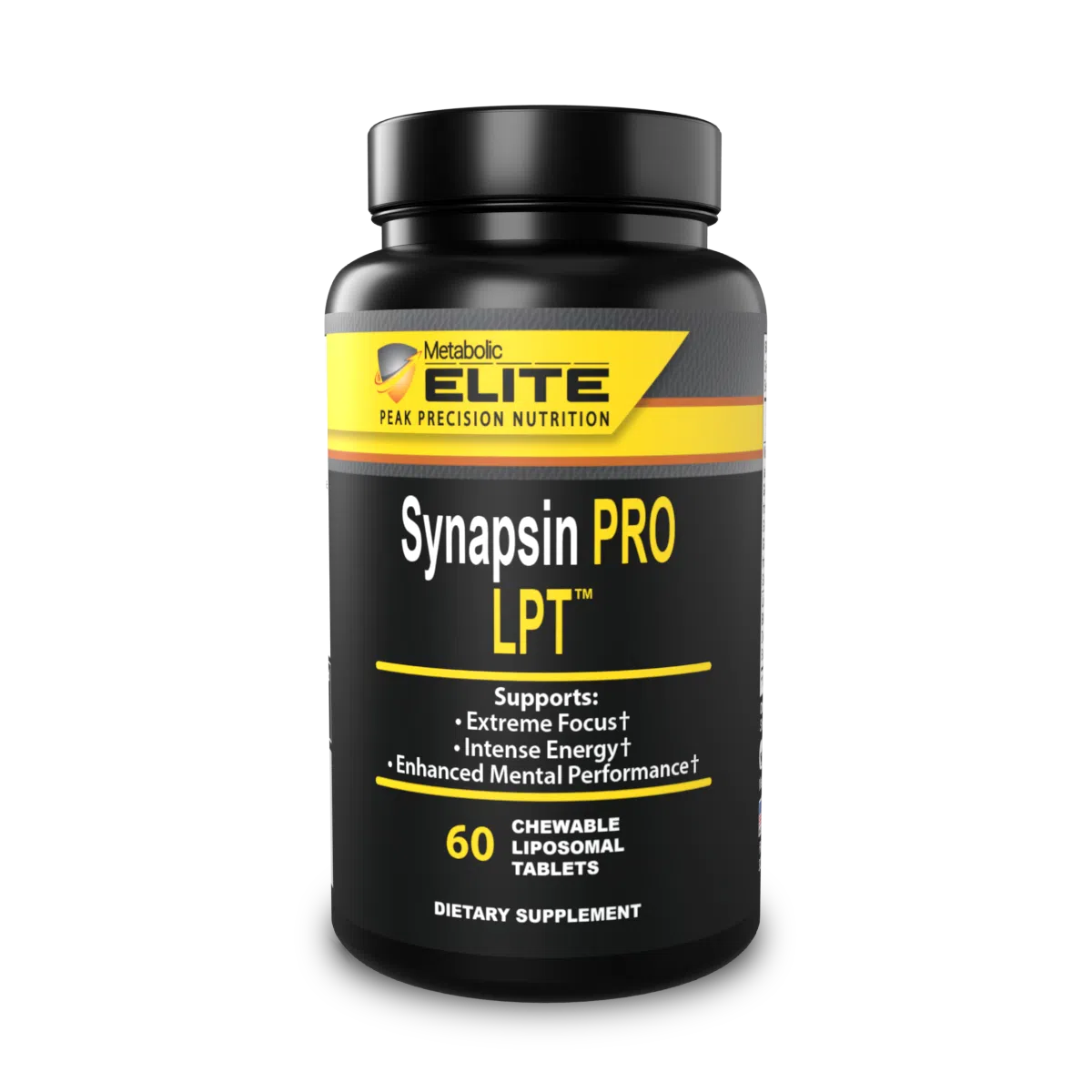
  • To improve focus, decision making, and coordination: Synapsin
  • To improve circulation, exercise output and recovery: EndurO2
  • To improve inflammation and recovery: Tetra Cur
  • To support the immune system and weight management: Viraxall

The picture below is a throwback to (2012?) USA Hockey Women’s National Team Camp in Blaine, MN.

Great memories working with this group alongside @michael_boyle1959, @anthonydonskov, and @smcstrength.

Yesterday I shared a quote from the @hph_podcast discussing how testing can be used to both drive and assess a groups commitment and culture. You can check it out here >> Testing & Culture

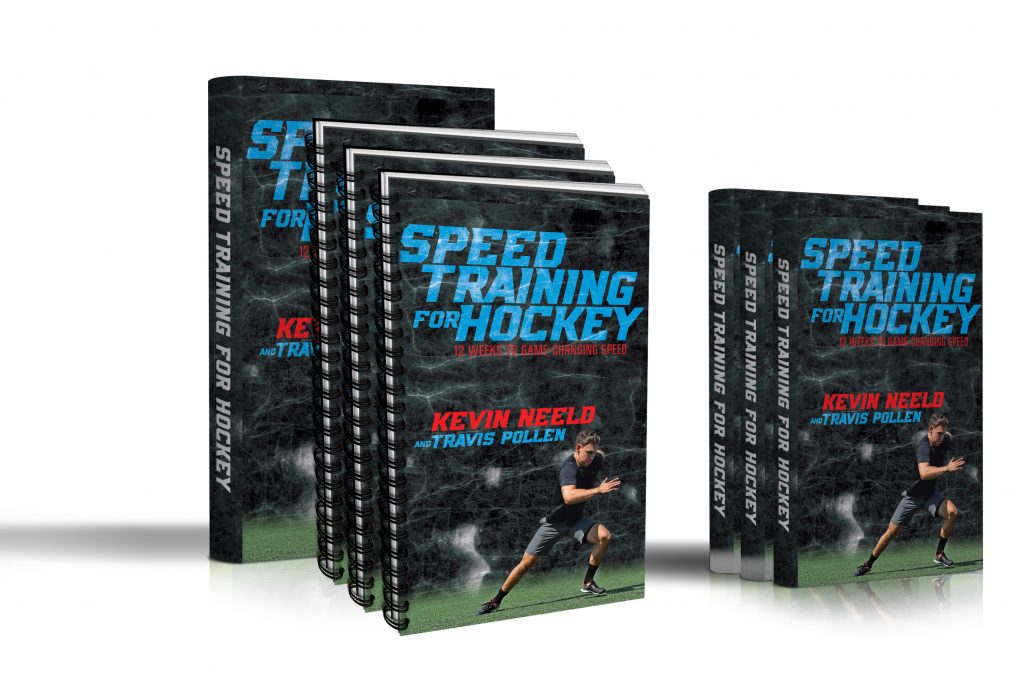
The above picture is an excerpt from my book Speed Training for Hockey, and shows the progress one of the Women’s National Team players made through an Olympic cycle. Most notably – the player added 8″ to her vertical jump and substantially decreased her on-ice acceleration/sprint time.

Incremental gains made consistently over time leads to substantial, career-changing progress.

One of the key features of a winning culture is that the players are continuously pushing for the next level. When enough players adopt this mentality, it becomes the dominant voice in the room – the expectation for the group.

Performance testing certainly isn’t the only barometer for this type of commitment, but it is a simple, effective way of establishing standards, reinforcing expectations, and providing an opportunity for players to own an area of their performance that is COMPLETELY within their control.

Feel free to post any comments/questions below. If you found this helpful, please share/re-post it so others can benefit.

To your success,

Kevin Neeld
SpeedTrainingforHockey.com
HockeyTransformation.com
OptimizingAdaptation.com

P.S. For comprehensive hockey training programs to improve your speed AND repeat sprint ability, check out: Speed Training for Hockey

Enter your first name and email below to sign up for my FREE Sports Performance and Hockey Training Newsletter!

I had a great discussion the other week with @Rocky_Snyder for his Zelos podcast, and one of the things that came up was the influence of an athlete’s build on exercise selection.

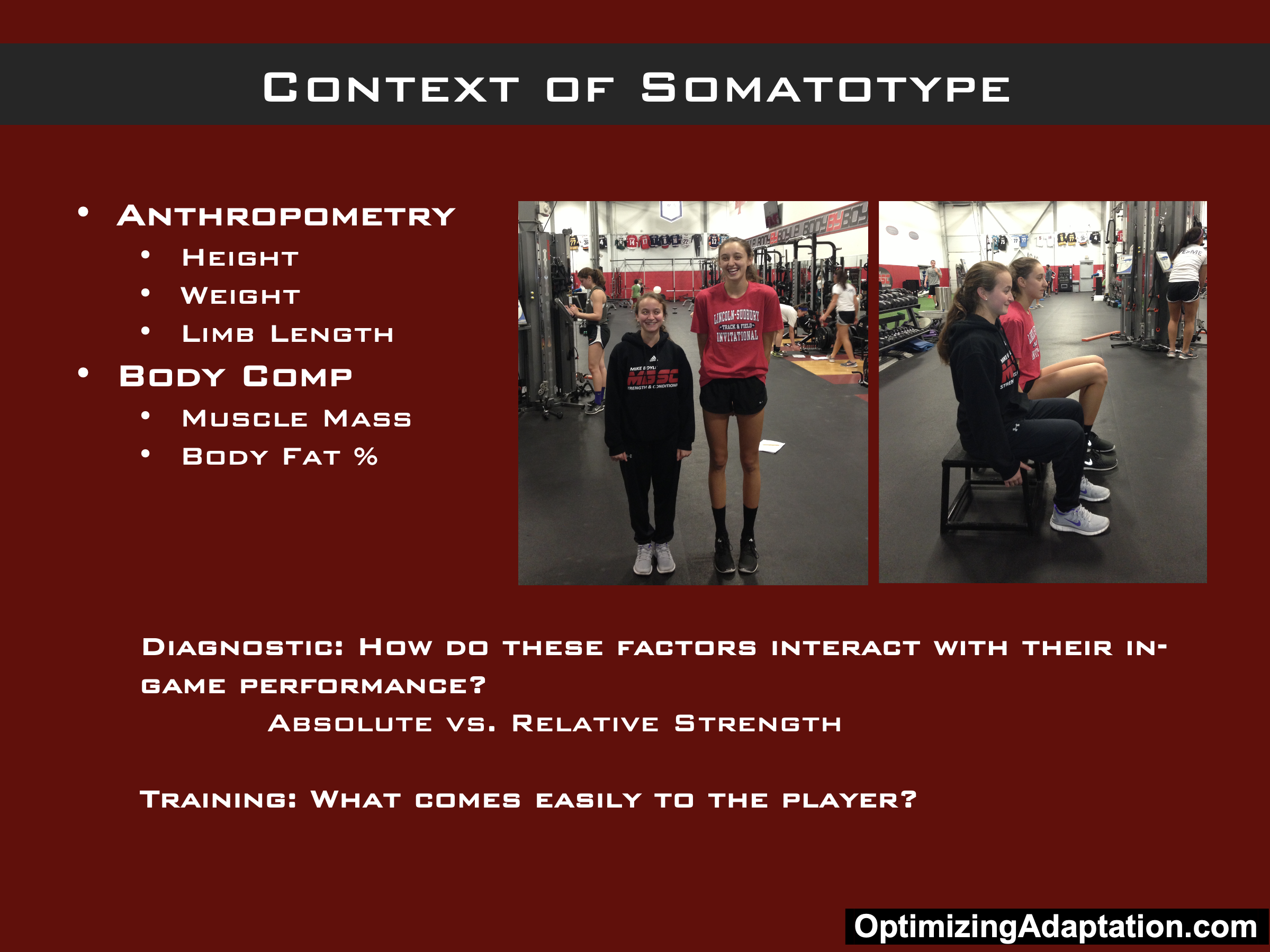
It reminded me of this slide from my “Performance Profiling as a Platform for Program Design” talk from our Optimizing Adaptation & Performance seminar series. These are pictures @michael_boyle1959 sent me a few years back of 2 girls that trained at @mbscofficial.

Seated, they’re about the same height. Standing, it’s a much different story. The thigh to torso length relationship will have a significant impact on how these athletes move.

In squatting, for example, the bar needs to stay centered over your mid foot. If the load of the bar is centered too far toward the heel, the athlete will fall back; too far toward the toes, the athlete will fall forward.

Longer femurs relative to torso length (as with the taller athlete here) will require the athlete to lean significantly further forward to maintain the bar over the mid foot. In these cases, the bar isn’t loading DOWN through the spine, it’s loading FORWARD and pushing the torso further toward the thighs. This both changes the loading pattern (e.g. more posterior chain dominant to prevent folding forward), but also increases shear forces across the spine.

Taken together, squatting for the taller athlete is probably training a different pattern than intended AND increasing injury risk. Risk/Reward isn’t favorable for that exercise for that athlete.

Simply, not every athlete is a good fit for every exercise.

There are a lot of different factors that should affect program design and exercise selection. Looking at the athlete in front of you and making adjustments based on their build is low hanging fruit.

Feel free to post any comments/questions below. If you found this helpful, please share/re-post it so others can benefit.

To your success,

Kevin Neeld
SpeedTrainingforHockey.com
HockeyTransformation.com
OptimizingAdaptation.com

P.S. If you’re interested in more information about how to profile an athlete’s needs and use the profile to individualize a training program, check out the videos at Optimizing Adaptation & Performance

Enter your first name and email below to sign up for my FREE Sports Performance and Hockey Training Newsletter!

Last week I was a guest on the Strength Coach Podcast with Anthony Renna. During our conversation, we talked about:

  • Speed training misconceptions
  • Key differences between running speed and skating speed
  • The importance of transitional speed work (not just running straight)
  • Strategies to monitor rest to maximize speed development, on and off the ice
  • Transitioning from the private sector to the NHL, then from an Assistant to a Head role
  • A behind the scenes look at our new video series Optimizing Adaptation & Performance

Listen here >> Strength Coach Podcast: Boston Bruins Strength Coach Kevin Neeld- Speed on the Ice and Optimizing Adaptation

A lack of speed is one of the most common limiting factors holding back athletes in all sports.

As a result, speed training is one of the most essential elements of a training program, but still one of the most poorly understood, particularly in hockey.

Identifying the athlete’s limiting factor to speed development is important.

Exercise selection is important.

Programming appropriate rest is important.

Integrating all of these factors, among others, is essential to optimizing speed development and transfer from off-ice training to on-ice speed. We dive into all of this in the podcast!

Listen here >> Strength Coach Podcast: Boston Bruins Strength Coach Kevin Neeld- Speed on the Ice and Optimizing Adaptation

This image has an empty alt attribute; its file name is Optimizing-Adaptation-and-Performance.png

If you want to learn more about how to use assessments to identify limiting factors in your athletes’ performance, check out our new Optimizing Adaptation & Performance video series, which is available at a huge discount until Friday!  

Click here to grab your copy and save $$$ >> Optimizing Adaptation & Performance

To your success,

Kevin Neeld
HockeyTransformation.com
OptimizingMovement.com
UltimateHockeyTraining.com

Enter your first name and email below to sign up for my FREE Athletic Development and Hockey Training Newsletter!

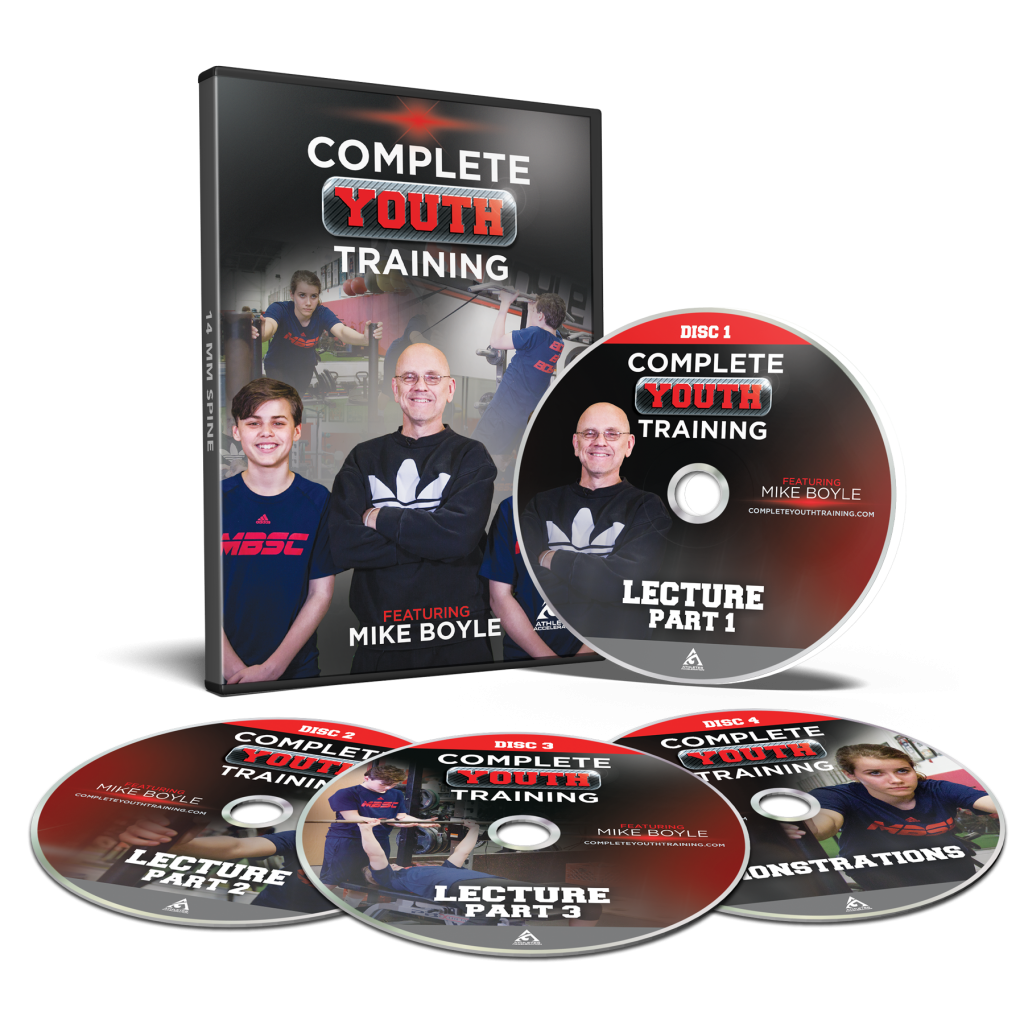
Today marks the release of Mike Boyle’s newest product: Complete Youth Training

When I ran Endeavor Sports Performance, much of the way we designed our programs for youth athletes was guided by things I had learned from Coach Boyle. In short, he’s had a profound impact on how I view the training process.

This is a great resource (for coaches, sports training professionals AND parents) that addresses many of the most impactful misconceptions of training youth athletes, and how following popular advice will absolutely lead to blunted long-term performance.

Given his 25+ years of experience training kids, I asked him to put together a quick post highlighting the three most common mistakes he sees in training youth athletes. Check out the article below:

Click here for more information >> Complete Youth Training

Top 3 Mistakes in Training Youth Athletes by Mike Boyle

A friend asked me to try to sum up what I considered the top three mistakes in training young athletes, so after giving it some thought, here goes:

Mistake 1- Seeing kids as mini-adults. 

I’m amazed at how many trainers will write or email and talk about the troubles they are having getting into the youth strength training market ( think 11-14 yrs old).  I always say something along the lines of “what does your program look like” and I constantly hear back about all the latest ideas. Breathing, corrective exercises, screening etc.

My response is always the same. Kids don’t need that stuff, they need the weight room basics. Much like elementary school is about reading, writing and math, training kids is about throwing, sprinting, jumping and lifting. I love the KISS principle. Keep It Simple Stu_ _ _.

Kids want to move and have fun. Breathing, screening and corrective exercises are neither fun, nor particularly useful for kids.

Mistake 2- Not Seeing That Practice Covers a Lot of Bases

I was discussing agility with Jim Kielbaso from the IYCA the other day and my comment was “we don’t do much agility.” As coaches, we have to remember that most of these kids are practicing 3-5 times a week, but get no strength work, no power work and no speed work. We need to, as I like to say, fill the empty buckets. The agility/change of direction bucket is getting filled at practice, but the strength, power and speed buckets are usually empty.

In addition, practice takes care of conditioning. I think there is no need for conditioning with kids, and that lots of what we try to do just makes kids slower.

Think speed. Read Tony Hollers Feed the Cats.

Mistake 3- Thinking that Talking is Coaching

Kids don’t want to hear you talk. I have a ten second rule. I don’t want coaches talking for more than ten seconds. I really like the John Wooden idea:

Do this, not this, this.

Show them what you want them to do, don’t tell them. Show them what not to do and then, show them the correct technique again.

Then, let them do it. Kids learn through doing, not through listening. That’s tough for coaches to hear, but it’s true.

The best teacher is a great demonstrator.  The best learning comes from doing.


Click here for more information >> Complete Youth Training

To your success,

Kevin Neeld
HockeyTransformation.com
OptimizingMovement.com
UltimateHockeyTraining.com

Please enter your first name and email below to sign up for my FREE Athletic Development and Hockey Training Newsletter!

Get Ultimate Hockey Transformation Now!

Year-round age-specific hockey training programs complete with a comprehensive instructional video database!

Ultimate Hockey Transformation Pro Package-small

Get access to your game-changing program now >> Ultimate Hockey Transformation

“Kevin Neeld is one of the top 5-6 strength and conditioning coaches in the ice hockey world.”
– Mike Boyle, Head S&C Coach, US Women’s Olympic Team

“…if you want to be the best, Kevin is the one you have to train with”
– Brijesh Patel, Head S&C Coach, Quinnipiac University

Use CODE: "Neeld15" to save 15%