As I write this I have a player waiting for me to work on him, so I’m going to keep it short and sweet. Last week I did an interview for the “Hit the Gym with the Strength Coach” segment of the Strength Coach Podcast. The Strength Coach Podcast has been one of my go-to audio resources for several years, as it features many of the most innovative professionals in strength and conditioning and sports rehabilitation.

Strength Coach Podcast

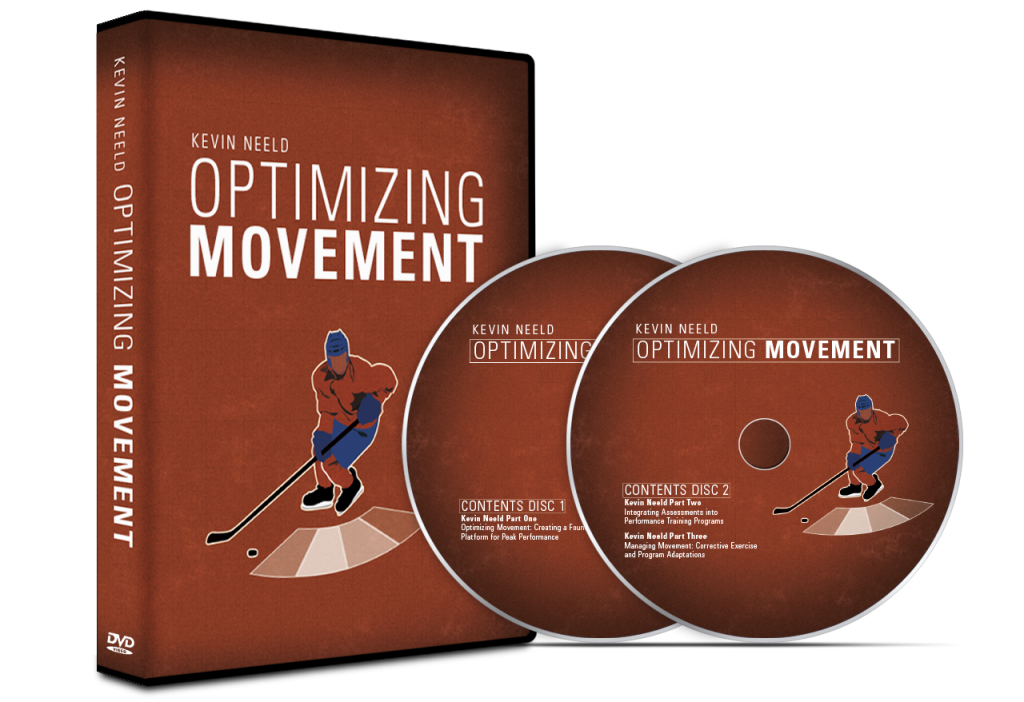
In the interview, we covered a lot of topics from my new DVD-set Optimizing Movement, including:

  1. Foundations of optimal movement
  2. Ways to determine if a joint is neutral or centrated
  3. How being naturally asymmetrical influences assessment findings
  4. How we incorporate breathing work into our programs and how I introduced it to a new team I train
  5. Several “big rocks” from DNS and PRI, and how it influences the way we view and coach our exercises

This is a great episode as Coach Boyle, Mark Verstegen and Charlie Weingroff are also on to share their insight. Check it out at the link below!

Listen to the episode here >> Strength Coach Podcast: Episode 140

To your success,

Kevin Neeld
OptimizingMovement.com
UltimateHockeyTraining.com

P.S. If you haven’t signed up, for FREE, for the 2014 Sports Rehab to Sports Performance Teleseminar, do it now here: Sports Rehab to Sports Performance Teleseminar

Please enter your first name and email below to sign up for my FREE Athletic Development and Hockey Training Newsletter!

Get Optimizing Movement Now!

“…one of the best DVDs I’ve ever watched”
“A must for anyone interested in coaching and performance!”

Optimizing Movement DVD Package

Click here for more information >> Optimizing Movement

Today’s “Throwback Thursday” post covers three powerful strategies to maximize recovery. Interestingly, I wrote another post on this exact topic recently that almost identically mirrors my thought process from 2009. In other words, over 4 years after this post was written, what I view as three of the most powerful recovery strategies has not changed at all! You can check out the more recent post here: 3 Powerful Recovery Strategies for Athletes

You may be surprised by how simple these are. It’s not a matter of cracking some magic code; it’s a matter of taking care of the things you already know are important.

1) Drink PLENTY of water. Maintaining proper hydration has positive implications on both mental and physical performance.Bluntly, it means you’ll be smarter and feel better if you drink enough water.  Plenty is not 6-8 cups a day.  That’s BARELY adequate for completely sedentary people on low caloric diets; you should be drinking AT LEAST double that.If you’re like most people, you’re not even close.It’s never too late to start. Increase your water intake significantly.You’ll likely be making many more trips to the bathroom than you’re used to, but that will cut back within a couple weeks when your body gets used to being fueled properly.

2) Sleep! Everyone’s sleep needs are different, but in general, most people should be getting 7-9 hours of QUALITY sleep.As in wake up in a pool of drool sleep.Wake up with no feeling in your arm because you didn’t move all night sleep.DEEP, QUALITY sleep.If you get 7 and you consistently wake up feeling tired, you need more sleep to recover from the stresses you’re experiencing (through training or other aspects of your life). Remember that this should be consistent from night to night.Your body doesn’t adjust well to 5 days of a lack of rest during the week, and then two days of excessive sleep on the weekend.Make it a priority to get a good night’s sleep every night.

3) Proper Nutrition. This comes in two parts: General Nutrition, and training-specific nutrition.With regards to general nutrition, it’s important that you eat adequate calories from QUALITY sources.This includes as many servings of vegetables as you can tolerate throughout the day, fats from olive oil, nuts, and cold-water fish (e.g. salmon), and carbohydrates from whole grain/high fiber sources.As a reminder, your carbohydrate intake should be determined by your activity level.The more medium-high intensity activity you do, the more carbohydrates you need.Training-specific nutrition is pretty straight forward.Consuming a liquid source of simple carbohydrates and rapidly digesting protein (e.g. whey protein) immediately after your training helps replenish glycogen (read: carbohydrate) stores within the body and stimulate protein synthesis (read: rebuilding).It shouldn’t be hard to see why this would be advantageous.There’s now research to support consuming these “shakes” immediately before and/or during your training, so the nutrients are readily available as your body begins to break down.Think of it as “on the fly” recovery.Personally, I usually make a half shake and sip it while I train, then make another half shake and drink it immediately after.  For the complete nutrition guide, check out John Berardi’s Precision Nutrition program.

Following these three simple (well, at least they’re simple conceptually…maybe not so simple to implement) strategies will help you maximize your rate of recovery, allowing you to get the most out of your training.

Keep training SMART!

To your success,

Kevin Neeld
OptimizingMovement.com
UltimateHockeyTraining.com

Please enter your first name and email below to sign up for my FREE Athletic Development and Hockey Training Newsletter!

Get Ultimate Hockey Training Now!

“…an extremely rare comprehensive look at the present state of ice hockey training.”
“…a must-have for coaches and strength professionals at all levels of hockey.”
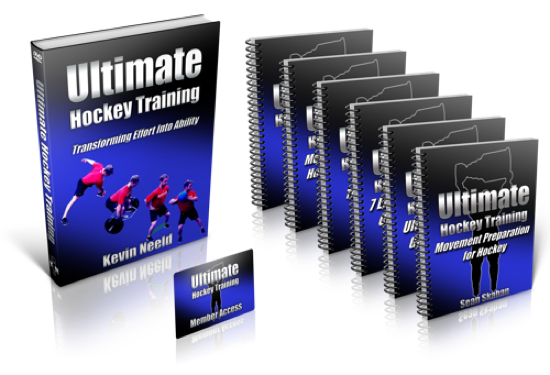

Ultimate Hockey Training

This “Thursday Throwback” features an article I wrote over 4 years ago that overviews what may prevent someone from squatting deeply, and an assessment you can use to check your squat depth. Over the last several years, I’ve read a ton of research on hip anatomy and progressive structural changes. In the end, it seems that structural limitations are becoming more of the norm than the exception and it is incredibly important that coaches AND athletes/lifters recognize that what was previously considered a full squat may not apply to everyone/you. Symptoms of squatting past your range can manifest in many ways, but two of the more common ones are low back pain and anterior hip pain. I’ve also seen pretty significant discomfort in the piriformis, adductor complex, and TFL as a result of this pattern.

Check out the post below, as well as the article I link to, and please feel free to post any comments or questions you have below. This is an important topic that affects just about everyone that trains (or moves)!

The Truth About Deep Squatting

About a month ago, my article “Battling Anatomy: Implications for Effective Squatting“, was published at SBCoachesCollege.com, a website I couldn’t say enough good things about.

The other day I received an excellent question from Jason Price, Founder and CEO of Athletes Equation.

“Hello Kevin,
I read you article on SB Coaches College today and really found it informative and enjoyed it very much.  I did have a few questions after reading that I was hoping you could provide me with some further information or clarification.  What I have noticed with many of the youth athletes that I am training is that their hip mobility is terrible. I too have utilized the “touch and go” method to control how much depth they can attain until they have improved their mobility.  I have found this to be a fantastic method for most athletes.  But, I was thinking after reading your article about athletes which are dependent of being in the deep squat position in their sport.  I train several weightlifters and one of them still suffers from a very similar condition as the individual in your videos.  I am wondering what suggestions you would have for me in coaching this individual.  In the sport of weightlifting as I am sure you are aware you must get into the deep squat position to effectively clean and snatch significant weight.  My athlete does not have the significant discrepancy one side to the other.  But, he does have the tuck under at the bottom of the deep squat position.  So how can I effectively train him to receive the barbell deep in the squat with this technical flaw without placing him in this potentially hazardous position?  Should he not squat deep? Do you know of any methods outside of orthopedic evaluation for anatomical abnormalities?

Again, fantastic article i really enjoyed it and felt you gave many of the readers an alternative viewpoint as to why some of these technical breakdowns happen.  I appreciate your time and any response.”

My immediate thought is to first consider that everyone is not built for deep squatting.  Despite the increasing usage of pictures of babies in a deep squat position as evidence for this ability, the hip joint and associated ligaments change as a natural/circumstantial part of development, that may result in a range of motion (ROM) limitation in some people.  Having said that, it’s always better to assess than guess.

With regards to the lifter in the article video, the side-to-side discrepancy simply indicates that only one of his hips, the right one, lacks full ROM.  In his case, I was able to recommend he see a hip specialist because he had multiple signs of CAM impingement.  Notably, he lacked internal rotation ROM on the right side compared to the left and flexion/adduction on the right side was extremely painful.

Getting more to your question about the bilateral hip tuck, the first thing you could try is to coach him to push his knees out while he’s going down and to keep his knees out while driving up.  This opens up the hips to allow for maximal hip flexion while avoiding bony contact between the trochanters of the femur and the “spines” of the hip bone.  Mark Rippetoe wrote a great article called “You Don’t Know Squat without an “Active Hip”” about this topic.

If that doesn’t clear things up, there is a pretty straight forward assessment you can use to see whether this is a soft tissue restriction or a joint anatomy restriction.  A few months ago I had the pleasure of talking to Shirley Sahrmann about this issue.  She recommended using quadruped rocking to assess their ROM.

Quadruped rocking involves putting the lifter in a quadruped position, with their knees under their hips, top of their feet flat against the floor, and hands under their shoulders.  The lifter should set up in a neutral lumbar spine position, then use their arms to push their hips back (pushing into hip flexion) so as to sit on their heels, while MAINTAINING the neutral lumbar position.  Note the angle that the hips begin to tuck.  Stop them there, have them return to the starting position and try again.  Dr. Sahrmann basically said that 8-10 repetitions of this should improve their hip ROM.  If it doesn’t, their hip joint anatomy doesn’t allow  for it and never will.  Any attempt to push beyond this point will lead to lumbar flexion, and invariably some sort of back pain.

I’ve found this assessment to be incredibly useful.  In less than 30 seconds I’m able to see what kind of hip flexion ROM someone has.  If their hips start to tuck at 90 degrees every time, and it doesn’t improve with more repetitions, I know that’s the extent of their ROM and stop them at that point during all exercises (squats, lunges, etc.).  Depending on the severity of the restriction, this may also mean that they can’t perform a deadlift off the floor, in which case I’d move them to a rack pull from a height slightly above their end range.

Ask your athlete where they feel the restriction while quadruped rocking.  If they feel like they’re tight on the back side, some mobility work may clear that up, but it’s also likely that quadruped rocking will clear that up.  If they feel restricted in the front or any type of grinding in or around their “groin” area, it’s likely a hip joint limitation.  I don’t recommend forcing lifters through positions their hip joints don’t allow for.  That is, unless they’re looking for low back pain and a hip labral tear.  Hope this helps.

To your success,

Kevin Neeld
OptimizingMovement.com
UltimateHockeyTraining.com

Please enter your first name and email below to sign up for my FREE Athletic Development and Hockey Training Newsletter!

Get Ultimate Hockey Training Now!

“…an extremely rare comprehensive look at the present state of ice hockey training.”
“…a must-have for coaches and strength professionals at all levels of hockey.”

Ultimate Hockey Training

As a quick note, the extended Extended Holiday Sale for my Optimizing Movement DVDs ends this Saturday (12/14). If you’re interested in grabbing a copy, you can save 20% until Saturday here: Optimizing Movement

In this “Throwback Thursday” segment, I wanted to bring back a few exercises that I think can be extremely effective in challenging core stabilization patterns in athletes as well as a lot of fun. The exercises are what I describe (all the way back in 2008!) as reactive core training exercises. We continue to apply this concept in a variety of ways in our current programs, including with partner perturbations and active arm or leg movements both with and without external resistance. We’ve also used stability balls (or physioballs) in place of medicine balls and have used tall kneeling and half-kneeling positions for the belly press (e.g. Pallof Press) and overhead stabilization patterns shown below.

One more reason why I like these posts (I combined 4 short posts below), is that it mentions the fact that a side plank, in additional to being a lateral core stabilization pattern, is also a great shoulder stabilization exercise. The key here is to not just “sit” in that shoulder, but to actively push yourself away from the ground. When you do this, the muscles around your scapula (shoulder blade) and shoulder engage to help support the position. Since this video was filmed, we’ve also transitioned to having all of our athletes go palm(s) down on front and side plank variations, and typically use a slower perturbation rate than what is displayed here. Enjoy the videos and feel free to post any questions/comments you have below!

Reactive Core Training

Core training receives more publicity than any other aspect of training.  The fact is, even people with a great understanding of how to train the core for its true functions, stability and force transfer, still miss out on one thing.  In many instances, the core functions reactively.  In other words, some movement (sensory input) causes the core muscles to fire (motor output) to produce stability.  While I love planking, those exercises are limited in their ability to train the core to be reactive.

[quicktime]http://kevinneeld.com/videos/Side%20Plank%20Perturbation.mov[/quicktime]
Adding a partner perturbation turns this basic core stabilization exercise into a reactive core (and shoulder!) stabilization exercise.  It also ties in a team dynamic, as your athletes learn to work in pairs or small groups.  The goal is the same as the regular side plank: maintain a neutral position.  The only thing that’s changed is the sensory input.

[quicktime]http://kevinneeld.com/videos/Pallof%20Press%20Perturbation.mov[/quicktime]
Are you noticing a theme here?  These are all the same exercises I’ve shown you before, but with a more advanced external sensory stimulus added.  The greater the challenge to stability, the more carryover to athletics.  I love these exercises for a couple reasons, but mostly because they are so simple to progress.

  1. Start with the Pallof Press Hold (holding in the extended position).
  2. Progress to Pallof Press for reps (extend your arms, then bring them back to your chest, then extend, etc.)
  3. Progress to Pallof Press Hold with perturbation
  4. Progress to Pallof Press with perturbation

Another one of my favorite reactive core training exercises is the overhead medicine ball perturbation.  Same concept as previous exercises: maintain a stiff, stable core in the presence of an external force or perturbation.  Holding the med ball overhead maximizes instability as it raises your center of mass (higher COM=greater instability).  Check it out:

[quicktime]http://kevinneeld.com/videos/Overhead%20MB%20Perturbation.mov[/quicktime]
To maximize the functional carryover, you can combine a couple different core med ball exercises.  For instance, you could pair an overhead floor throw with the overhead med ball perturbation.  Check out the overhead med ball floor throw:

[quicktime]http://kevinneeld.com/videos/Overhead%20MB%20Floor%20Throw.mov[/quicktime]
It would work like this.  You would explosively slam the ball into the ground 3 times.  After the third time, you’d freeze in the start position, with your arms extended overhead, squeezing the ball hard with both hands.  At this point, a partner would provide small perturbations to the ball, and you would try to prevent all movement.  This would continue for 5-10 seconds, then you’d perform 3 more slams, 5-10 more seconds of perturbations, 3 more slams, and 5-10 seconds of perturbations.  That would be the end of one set.

See how it works?  You just combine an explosive upper body/core power exercise with a reactive core stabilization exercise.  Now you’re alternating being explosive and stable.

To your success,

Kevin Neeld
OptimizingMovement.com
UltimateHockeyTraining.com

Please enter your first name and email below to sign up for my FREE Athletic Development and Hockey Training Newsletter!

Get Optimizing Movement Now!

“…one of the best DVDs I’ve ever watched”
“A must for anyone interested in coaching and performance!”

Optimizing Movement DVD Package

Click here for more information >> Optimizing Movement

Over the last couple of weeks I shared a 3-part series on optimizing movement that dove into the importance of recognizing individual structural differences, what you need to know about “corrective” exercise, and how to individualize exercise in a group or team setting. If you missed those posts, I’d encourage you to check them out at the links below:

  1. Structural Adaptations Are Not Just A Hockey Problem
  2. The Truth About Corrective Exercise
  3. Individualizing Exercise In A Group Setting

Earlier today, Patrick Beith published a guest post on his “Athletes Acceleration” site that discusses the system we use in assessing our athletes and making decisions on where to start from a movement improvement/correction perspective. The article also sheds light on why having symmetrical range of motion may not be desirable and why not every mobility restriction can be corrected. Check it out at the link below!

>> Optimal Movement: Dissecting the System <<

After Pat told me he was going to post the article this week, I decided to extend the holiday sale of my new DVD set Optimizing Movement through this Saturday (12/14). If you’ve been dragging your feet, you have another week to grab a copy and save 20%!

Get Optimizing Movement Now!

“…one of the best DVDs I’ve ever watched”
“A must for anyone interested in coaching and performance!”

Optimizing Movement DVD Package

Click here for more information >> Optimizing Movement

To your success,

Kevin Neeld
OptimizingMovement.com
UltimateHockeyTraining.com

Please enter your first name and email below to sign up for my FREE Athletic Development and Hockey Training Newsletter!

Use CODE: "Neeld15" to save 15%