Hockey is by far the most physically demanding sport out there. If you’re an athlete/coach of another sport, here me out before you send me hate mail.

I DON’T mean hockey players need the highest level of anaerobic or aerobic conditioning. I DON’T mean that hockey players need to be the strongest. I DON’T mean that hockey players need to be the most coordinated.

I DO mean that when you consider every aspect of athleticism, hockey is the most demanding sport. Think about it: All of the hand-eye coordination necessities of sports like lacrosse and basketball are present in puck handling in hockey. All the metabolic demands of most team sports are present in hockey (although there are some obvious slight differences between more aerobic-based sports like soccer and basketball and between more strictly anaerobic-based sports like football). All the strength requirements of high-speed contact team sports are required of hockey players.

So what sets hockey apart? All of these physical demands are tacked on top of mastering the art of skating-maneuvering on a thin metal blade with a forward-backward rocker and side-to-side hollow. Skating is an incredibly challenging activity by itself. Need proof? Throw an athlete from any other sport on a pair of skates and watch them learn (read: fall…hilariously).

Despite the limited surface area of the skate blade on the ice, I think many hockey players are making a huge off-ice training mistake. More on this soon…

Kevin Neeld
Please enter your first name and email below to sign up for my FREE Athletic Development and Hockey Training Newsletter!

At Endeavor Fitness, our Summer Hockey Training Programs just started. One of the kids in my Pro Hockey Group, that I have Monday-Thursday for 2 hours, felt lightheaded and sick about 90 minutes into the 2nd training session of the first week. This is somewhat common as deconditioned athletes jump back into intense regimented training.

Having said that, feeling sick should never be a training goal. There’s nothing funny or boast-worthy about working to the point of throwing up. It’s pathetic that some coaches encourage this. I’ll clear up any confusion here: The training effect you get from pushing yourself to the point of projectile sickness is NOT better (and is, in fact, worse) than the training effect you get if you stop prior to this point.

So when my athlete hit the point that he thought he may be sick, I shut him down for the day. He was disappointed that he couldn’t finish the session. I helped him understand that it was Day 2, and he had plenty of time to make the progress he wanted. He basically had the option of being in one of two places:

1) He could be deconditioned, or
2) He could be deconditioned and sick

It’s that simple.

The take home messages:

1) If you’re training to the point of sickness you’re doing yourself a disservice.
2) If your coach takes pride in pushing you to the point of sickness, find a new coach.

Smart hockey training revolves around appropriate starting points and progressions.

– Kevin Neeld

Please enter your first name and email below to sign up for my FREE Athletic Development and Hockey Training Newsletter!

One of the reasons that I like training hockey players is that they’ll do whatever it takes to take their game to the next level. As a general statement, the only other athletes I’ve ever worked with that share that kind of work ethic and drive are rowers. Especially with kids, though, it seems like the two markers of a good training sessions are:

1) Being exhausted/borderline sick at the end
2) Being extremely sore the next day

I’ll touch more on these things in the next few days, but I want to leave you with two of my favorite sayings:

1) Any idiot with a whistle and loud voice can make a group of kids tired. That doesn’t make it effective training.
2) Playing in traffic will make you sore. That doesn’t make it effective training.

– Kevin Neeld

Please enter your first name and email below to sign up for my FREE Athletic Development and Hockey Training Newsletter!

One of main topics of the Boston Hockey Summit was the growing problem of sports hernias and “groin” strains within the sport of ice hockey. These injuries are affecting an increasing number of high-level hockey players. I wrote Dissecting the Sports Hernia last summer for StrengthCoach.com outlining some of the research on the topic.

The anatomy involved with these injuries can be very complex, but the concepts involved in preventing them are relatively simple: Maintain balanced strength among the muscles connecting to the pelvis and maintain adequate hip range of motion. Admittedly, these concepts are “simple” in theory, but difficult to implement.

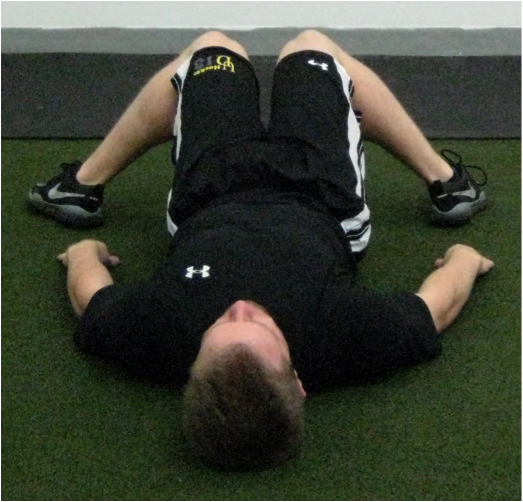
One of the factors associated with hip and lower abdominal injuries is a loss of hip internal rotation range of motion. This can be the result of excessive tightness of the hip external rotators. The stretch below is a great one to maintain hip internal rotation range of motion. Basically you just plant your feet, pull your stomach down toward the floor, and pull your knees toward each other. You should feel this deep in your hips.


Knee-to-Knee Stretch


Kevin Neeld

Please enter your first name and email below to sign up for my FREE Athletic Development and Hockey Training Newsletter!

Brijesh Patel, my friend and colleague from Quinnipiac University, spoke at the Boston Hockey Summit about training program design for ice hockey players. During his talk he went through several yoga-based isometric circuits that can be incorporated into off-ice training warm-ups. Everyone, including myself, that I’ve seen do these circuits has the same reaction: They feel loose AND strong. The circuits are well-designed to improve range of motion around the hips and thoracic spine (spine around your upper back…this is a good thing), and activate the hip abductors/external rotators and muscles around the posterior shoulder (muscles on the outside of the hip that don’t get the training attention they deserve).

I started using two of these circuits with all of my athletes. In both of these circuits, each position is held for 10 seconds.

3-Way Squat Circuit
1) Deep squat while pushing your knees out with your elbows to stretch out the muscles on the inside of your thigh
2) Maintain the deep squat, but move your hands behind your head, interlock your fingers, and pull your elbows back together. It’s important to keep your back flat (don’t let it round forward) and actively pull your knees outward using the muscles on the outside of your hip.
3) Maintain the deep squat while extending your arms straight overhead and continuing to pull your knees out.

3-Way Split Squat Circuit
1) Split squat position with arms extended straight overhead. Focus on squeezing your butt on the back leg and pulling down into the floor through the ball of your foot on the front leg.
2) Maintain the position while performing a triceps stretch on the arm on the side of your back leg and leaning toward the side of your front leg.
3) Maintain the position while twisting toward the front leg and reaching back with the arm on the side of your front leg and following this hand with your eyes.

As I type these descriptions, I’m realizing how simple these are when you see them, but how confusing it is to try to explain it. If you’re simple-minded like I am and have no idea what any of those descriptions mean, your best bet is to head over to myfittube.com and watch the videos that Brijesh put together for them. I’m confident you’ll be able to wrap your mind around them as soon as you see them.

When you get to myfittube.com, look for Brijesh Patel’s Deep Squat Series, and Warrior 1 Series.

Please enter your first name and email below to sign up for my FREE Athletic Development and Hockey Training Newsletter!

Use CODE: "Neeld15" to save 15%