I’m still pumped up from USA’s win over Canada yesterday. When Ryan Kesler dove to score that empty net goal, I dove across the couch onto my girlfriend Emily in celebration (Amazingly, no Emilys were harmed in the making of that celebration). What a game.

The good news for Canada fans: I think the US just woke up a sleeping beast. I’d be surprised if Canada didn’t rebound with an incredible performance in their next game.

Even if they don’t, YOU can still win. Watching good hockey puts me in a good mood. I’ve decided to extend my 3 free bonuses giveaway for new Hockey Training Expert members.  Sign up for a membership and you can instantly download a copy of Breakaway Hockey Speed, Hockey Nutrition 101, and Hockey Training Expert’s Mental Performance Package.

Hockey Training Expert

I’m in, sign me up!

I’m obviously a huge proponent of off-ice training to improve a hockey player’s performance. Having said that, it would be irresponsible and…well…stupid of me to say that a good training program is ALL you need.

Dominant hockey players aren’t just fast, or strong, or well-conditioned. They see the ice well. They read the play. They create time and space for themselves.

See the Ice Better
One of the single most effective habits a hockey player can have is to take a quick scan of the ice BEFORE they get the puck. As a pass is on its way, pick your head up and get an idea of your surroundings. Is someone from the other team bearing down on you? Do you have time to collect the pass and make a play or do you need to just tip the puck to a safe area? Has one of your teammates slipped behind the other team, looking for a quick pass from you?

Scanning the ice before you get the puck will help you make smarter, quicker decisions.

Read the Play Better
Reading the play comes down to knowing the game of hockey. You need to be able to anticipate the developing play so you can make the smartest decision, with or without the puck. As I mentioned in a previous post, one of the best ways to become better at reading the play is to WATCH a lot of hockey. Pick a team around your age but at a higher level, and an older team at an elite level and follow a single player around that plays your position. Watch how he/she responds to certain plays and anticipates others.

Learning from players at higher levels will allow you to become more familiar/comfortable with a variety of game situations and respond faster on the ice.

Create More Time and Space
Creating time and space gives you the freedom to make better passes and take better shots. It decreases the pressure on you. Knowing your surroundings and reading the play are paramount to creating time and space for yourself (that’s why this is the last of the three). One easy way to create time and space for yourself WITH the puck is to take 2-3 quick strides immediately after receiving a pass. Naturally this will somewhat depend on your positioning on the ice and your surroundings, but in general this is an effective habit to develop.

Taking 2-3 quick strides after receiving a pass will help create separation between you and your opponent, allowing you the time and space to make a better play.

Train Hard. Play Smart.

Kevin Neeld
Please enter your first name and email below to sign up for my FREE Athletic Development and Hockey Training Newsletter!

Congrats to the U.S. Women’s Ice Hockey Team for getting off to a great Olympic start!

In an effort to get more incredible contributors to Hockey Training Expert, I’ve been talking a lot with hockey coaches and instructors with hundreds of years of combined experience.

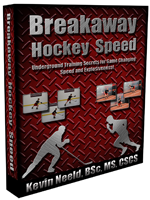
Hockey players and coaches recognize the benefits of having a fast team. When it comes to individual skill, nothing is more important than speed. This is EXACTLY why I put together “Breakaway Hockey Speed”, so players and coaches could learn to how develop game changing speed, and get access to the exact drills that I use with my players.

Breakaway Hockey Speed

Breakaway Hockey Speed

Breakaway Hockey Speed is a 25-page manual that outlines how to change your body position to maximize the power of your stride and reveals the truth about which stride pattern is better: short choppy strides vs long powerful strides (this will surprise you!). Breakaway Hockey Speed includes 6 Linear Speed Drills, 15 Transitional Speed Drills, and the information you need to integrate a comprehensive speed training program into your current training program.  This manual is exactly what you need to become faster and more explosive on the ice! Speed is your 1st key to ice hockey success.

This is a FREE gift for everyone that signs up for Hockey Training Expert before Friday!

Click here to sign up now!

Hockey Nutrition 101

Hockey Nutrition 101-2

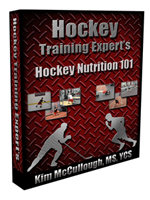
All the speed in the world won’t matter if you don’t give yourself the fuel to use it. Proper nutrition is the most commonly recognized, but least practiced aspect of high level athletic performance. My colleague and friend Kim McCullough wrote Hockey Nutrition 101 to give you practical information on how to improve your diet to improve your performance. Kim brilliantly discusses how proper eating and hydration can have a huge impact on your performance, recovery, and overall development. Hockey Nutrition 101 gives you all the tools you need to figure out what you should be eating/drinking, how to make simple changes in your current diet, and how to track your intake so you can monitor your new high-performance diet! Proper diet and hydration habits are your 2nd key to ice hockey success.

This is a ANOTHER FREE gift for everyone that signs up for Hockey Training Expert before Friday!

Click here to sign up now!

Mental Performance Package

Mental Performance Package-2

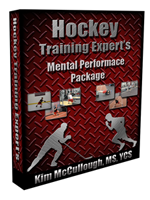
Now you have the tools to develop incredible speed and give yourself the fuel you need to dominate. You’re one step away. Most players recognize that between 50-90% of their performance is mental. Most players admit that 0-10% of their training time is spent on mental preparation. Kim McCullough developed ANOTHER incredible resource for you, the Mental Performance Package, that gives you step-by-step instructions on how to develop the focus and confidence of a champion. This is your 3rd and final key to ice hockey success!

Guess how much this incredible resource will cost you? NOTHING! This is a ANOTHER FREE gift for everyone that signs up for Hockey Training Expert before Friday!

Click here to sign up now!


P.S. For only $9.95/month you get these THREE incredible bonuses IN ADDITION to the customized hockey training programs, hundreds of innovative hockey training exercises, incredible articles and access to some of the greatest minds in ice hockey player development. Joining Hockey Training Expert is a NO BRAINER and you know it. Stop dragging your feet and join our dedicated community today!

Click here to sign up now!

Please enter your first name and email below to sign up for my FREE Athletic Development and Hockey Training Newsletter!

Part 3 of the return to normal in-season hockey training following knee surgery…

If you missed the first two posts, check them out below:

Training Hockey Players with Knee Injuries

Hockey Training with a Knee Injury

Following the first 4 weeks of training (described in the previous two posts), the player visited Shattuck St. Mary’s so he missed a week of training. When he returned, he said he’d been doing loaded, full range of motion exercises on both legs at physical therapy. His brace had been removed and he was cleared to do normal full range of motion movements, just not jump or sprint work.

I was told he had two more weeks of physical therapy, then he’d probably need another month before he’s able to return to full speed running, cutting, jumping, and skating.

Phase 3 (Weeks 5-7): Upper Body/Non-Operative Leg (Heavy)/Operative Leg (Light)
Program Goals:

  • Improve upper body strength and power
  • Improve core strength and power
  • Improve strength/coordination of the non-operative leg/hip
  • Improve single-leg stability on operative knee while minimizing compression
  • Make him work hard so he still “feels” like an athlete
  • Use exercises that won’t piss off PT or surgeon

A sample training session would look like:

A1) 1-Leg Squat: 4 x 12/side
A2) DB Incline Chest Press: 3 x 8
A3) 4-Way Stability Ball Front Plank: 3 x (3×4)/side
A4) Scap Wall Slide: 3 x 8
B1) 1-Arm DB Row: 3 x 8/side
B2) Split Squat (Front foot on BOSU): 3 x 8/side
B3) Rice Digs: 3 x 60s
C) Lying Partner Multi-Planar Hamstring Stretch

The  major changes in this program were the addition of single-leg exercises (A1 and B2) performed on BOTH legs. He told me his balance was terrible since the injury, which is why I went with higher reps on the 1-leg squats and added the BOSU for the spit squats. He really struggled with these at first, but made a ton of progress from set to set.

Multi-planar hamstring stretch
Lastly, this player has great range of motion everywhere except in his hamstrings, so we added a long hamstring stretch emphasizing hip flexion in a neutral rotation position, in external rotation and abduction (leg going outside of hip), and in internal rotation and adduction (leg going toward opposite shoulder).

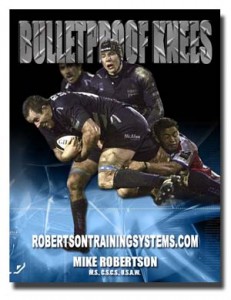
I’ve had success training hockey players with knee injuries, both in terms of improving their strength/performance and minimizing/preventing knee pain or further injury. A lot of what I know about preventing and training around knee injuries I learned from my colleague Mike Robertson. He put together an incredible resource, Bulletproof Knees, that I HIGHLY recommend to anyone with a history of knee pain/injury or currently dealing with knee pain. Bulletproof Knees details exactly how you can figure out what’s wrong with you (it may not be a knee problem causing your knee pain!) and gives you the exercises to fix it. Check it out below:

Bulletproof Knees

-Kevin Neeld

Please enter your first name and email below to sign up for my FREE Athletic Development and Hockey Training Newsletter!

A couple days ago I wrote about the training program I used for a hockey player that had recently undergone knee surgery. You can read that here: Training Hockey Players with Knee Injuries.

That post included a sample upper body training session that he used. After the first couple weeks, the general inflammation from the surgery was gone, and so was the pain and any hesitation about hurting his knee. Of course, the absence of pain doesn’t mean that his knee had completely healed, so it was important not to push his operative leg so far.

Phase 2 (Weeks 3-4): Upper Body/Non-operative Leg
Program Goals:

  • Improve upper body strength and power
  • Improve core strength and power
  • Improve strength/coordination of the non-operative leg/hip
  • Minimize compression on operative knee
  • Make him work hard so he still “feels” like an athlete
  • Use exercises that won’t piss off PT or surgeon

He again came in 2x/week for the next two weeks before taking a week break to visit Shattuck St. Mary’s Prep. One of his training sessions looked like this:

A1) Chin-Up: 5 x 6
A2) 1-Leg Stiff Legged Deadlift (non-operative leg only): 4 x 8
A3) Standing Belly Press Iso-Hold: 3 x 20s/side
B1) Weighted BOSU Push-Up: 3 x 10
B2) Standing Tight Rotations: 3 x 20s
B3) 1-Leg Squat (On box so operative leg can stay extended; non-operative leg only): 3 x 8
B4) Stability Ball Front Plank w/ Small Circles: 3 x 20s
B5) Rice Digs: 3 x 60s

The major difference between Phase 2 and Phase 1 is the addition of two lower body exercises (1-Leg Stiff-Legged Deadlift and 1-Leg Squat). Both of these exercises were performed only on the non-operative leg. As I’ve written in the past, strength improvements on one-leg are, at least in part, transferred to the other side. This is one of the brilliant adaptations of the nervous system.

I had him go slow on the way down in each of these exercises since more strength is transferred during contractions of longer “negative” or “eccentric” phases.

Stay tuned for Phase 3 of this progression, when we start to re-integrate our injured hockey player back to normal full-body training sessions.

-Kevin Neeld

P.S. I’m less than two weeks away from the official launch of my new hockey training membership site. You won’t want to miss the incredible bonuses that go to the action takers that sign up right away! Keep checking back for more information on the launch.

Please enter your first name and email below to sign up for my FREE Athletic Development and Hockey Training Newsletter!

A couple weeks ago, I mentioned that I was doing some work with a young hockey player that had recently undergone a meniscal repair surgery. You can read that article here: Doctors vs. Strength Coaches: A Difference in Perspective

After speaking with his surgeon and physical therapists, I put together a program for him.

Phase 1 (Weeks 1-2): Upper Body Only
Program Goals:

  • Improve upper body strength and power
  • Improve core strength and power
  • Minimize compression on operative knee
  • Make him work hard so he still “feels” like an athlete
  • Use exercises that won’t piss off PT or surgeon

He came in 2x/week for these weeks. With the above goals in mind, one of his training sessions may have looked like:

A1) DB Chest Press: 5 x 6
A2) Front Plank/Side Plank/Side Plank: 3 x 30s/each
A3) Scap Wall Slides: 3 x 10
B1) Chin-Up: 5 x 6
B2) Standing Tight Rotations: 3 x 20s
C1) DB Curls: 4 x 8
C2) DB Skull Crushers: 4 x 8

I realize how basic this program is, and that some of you may be surprised based on some of the things I’ve written about and programs I’ve posted in the past. The idea isn’t to overwhelm him with variation. The goal is to improve his upper body strength as much as possible without irritating his recently operated-on knee.

I steared clear of many of my favorite exercises (e.g. low pulley row, standing 1-arm db row, overhead mb floor slam…to name a few) to be extra cautious that he didn’t do ANYTHING that would bother his knee.

In the next couple days, I’ll write how we transitioned into “Phase 2” to get him working a little harder and strengthening his non-operative leg.

-Kevin Neeld

P.S. If you’re a hockey player or coach, check out my hockey training site for some great information on how to become a fast, strong, well-conditioned player.

Please enter your first name and email below to sign up for my FREE Athletic Development and Hockey Training Newsletter!

Use CODE: "Neeld15" to save 15%