Today, we’ll dive into the top Hockey Training and Exercise Videos of 2012. If you’ve missed the previous articles in this series, you can check them out at the links below:

  1. Top Hockey Training and Development Posts of 2012
  2. Top Performance Training and Injury Prevention Posts of 2012
  3. Top Hockey Nutrition Posts of 2012

1) Ultimate Hockey Training: Transitional Speed Training for Hockey

2) Ultimate Hockey Training: Hockey Conditioning

3) Ultimate Hockey Training: Comprehensive Off-Ice Training Programs

4) CAM Impingement: Training Implications

5) Hockey Strength and Conditioning: Thoracic Mobility Progression

6) Hockey Training: Mobility/Recovery Circuit

7) Hockey Training: 3-Way Split Squat IsoHold

8) Hockey Training: Sidestanding Med Ball Shotput w/ Cross-Under Step

9) Hockey Training: Split Squat IsoHold to Lateral Bound

10) Hockey Training: Squat Hold to Vertical Jump

Honorable Mention: Hockey Training: Hang Clean w/ Helmet

The “Best of 2012” series wraps up tomorrow with the Top Resources of 2012!

To your success,

Kevin Neeld
UltimateHockeyTraining.com

Please enter your first name and email below to sign up for my FREE Athletic Development and Hockey Training Newsletter!

As a follow-up to my previous post on creating off-season (or lock-out friendly) programs that coordinate on- and off-ice demands, today’s post presents the mobility circuit and conditioning programs referenced in the training schedule from that last post. The mobility circuit serves to help improve multi-planar hip mobility and thoracic mobility, two areas that are commonly restricted in hockey players, while also getting some blood flowing which will help facilitate recovery. After completing the circuit (twice), the player should feel loose and energized, but not fatigued at all. Circuits like these are a great way to get some low level aerobic work in without fatiguing the system. I also included an abbreviated mobility circuit with just the stationary mobility work, as I think these are important to mix in frequently throughout the week, and, frankly, I don’t think most players will do the entire circuit 6+ times per week in addition to their pre-existing dynamic warm-ups.

Hockey requires extremes of hip range of motion. Achieving and preserving optimal multi-planar hip mobility is an important off-ice training objective, year-round.

The conditioning programs are presented with three options so the player can still get the work in even without access to any given piece of equipment or space (e.g. field or ice), and to give the player some ownership over the program. They’re listed in order of preference, meaning in an ideal world the player would perform the 1st option, followed by the 2nd if the 1st isn’t an option, and finally, the 3rd. Each day is designed to be in accordance with the targeted energy system for that day’s lifting and on-ice work. Within Conditioning 2, I started to incorporate some work that somewhat diverges from the rest of the work for that day to prepare the player for an upcoming on-ice skating test.

Check everything out below, and please post any questions you have! In a future post I’ll put up a video with all the exercises in the mobility circuit for your reference. This can also be used as a substitute dynamic warm-up for players that need a change of pace. Enjoy.

Mobility Circuit

  1. Wall Ankle Mobilization: 3x(5x2s)/side
  2. Back Knee Elevated Quad Mobilization: 10x2s/side
  3. Back Knee Elevated Lateral Kneeling Adductor Mobilization: 10x2s/side
  4. Supported Hip Airplane: 10x1s/side
  5. Quadruped Cat/Camel: 10x1s
  6. Quadruped Thoracic Rotation: 10x1s/side
  7. Reverse Lunge w/ Hands Behind Head: 10/side
  8. Modified Yoga Push-Up: 10
  9. Lateral Lunge w/ Hands Behind Head: 10/side
  10. Scap Wall Slide: 10
  11. Inverted Reach: 10/side

Modified Mobility Circuit

  1. Wall Ankle Mobilization: 3x(5x2s)/side
  2. Back Knee Elevated Quad Mobilization: 10x2s/side
  3. Back Knee Elevated Lateral Kneeling Adductor Mobilization: 10x2s/side
  4. Supported Hip Airplane: 10x1s/side
  5. Quadruped Cat/Camel: 10x1s
  6. Quadruped Thoracic Rotation: 10x1s/side

Conditioning 1

  1. 50-Yard Shuttle Run (Lines at 0&25) on 60s (Run the shuttle as fast as possible and rest the remaining time until the next minute):
    1. Week 1: 10x
    2. Week 2: 11x
    3. Week 3: 12x
  2. Treadmill: 10s/50s (Put the treadmill at a low incline (2-4°) and put the speed at something you can barely maintain with good running mechanics for the full 10s. Straddle or put the speed to 3mph during the rest)
    1. Week 1: 10x
    2. Week 2: 11x
    3. Week 3: 12x
  3. Elliptical: 10s/50s (Pick a resistance that is hard, but that you can still move fairly quickly for the work intervals; push it all the way down for the rest):
    1. Week 1: 10x
    2. Week 2: 11x
    3. Week 3: 12x

Conditioning 2

  1. On-Ice Shuttle Skate (Goal and Blue) Work ~16s w/ 44s rest
    1. Week 1: 3 x (3×2 Laps on 60s) w/ 2 mins between reps
    2. Week 2: 2 x (4×2 Laps on 60s) w/ 2 mins between reps; 1 x 7 Laps
    3. Week 3: 1 x (6×2 Laps on 60s); 2 x 5 Laps w/ 5 mins between reps
  2. Off-Ice Shuttle Run (Lines at 0&25)
    1. Week 1: 3 x (3×100 yards on 60s) w/ 2 mins between reps
    2. Week 2: 2 x (4×100 yards on 60s) w/ 2 mins between reps; 1 x 300 yards
    3. Week 3: 1 x (6×100 yards on 60s); 2 x 250 yards w/ 5 mins between reps
  3. Airdyne
    1. Week 1: 3 x (3x20s/40s) w/ 2 mins between reps
    2. Week 2: 2 x (4x20s/40s) w/ 2 mins between reps; 1 x 60s
    3. Week 3: 1 x (6x20s/40s); 2 x 50s w/ 5 mins between reps

To your success,

Kevin Neeld

Please enter your first name and email below to sign up for my FREE Athletic Development and Hockey Training Newsletter!

A while back I wrote a post outlining the physical qualities that can be trained at the same time without creating too large of a conflicting stimulus to the body. As I’ve mentioned in the past, attempting to train conflicting qualities at the same time (think powerlifting and marathon training) will result in the training efforts interfering with the adaptation of the other, and ultimately a blunted response to both. There are a myriad of ways to design programs to minimize this interference and progress to peak for a certain quality or group of qualities (e.g. progress from hypertrophy -> strength -> power -> speed).
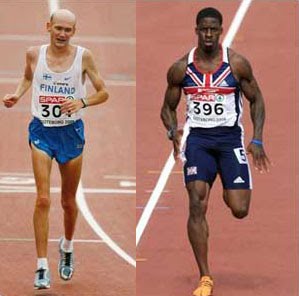
You can’t be both

While no periodization model (read: planning) is perfect, I think when an individual has a relatively advanced training age (e.g. 5+ years of structured strength and conditioning ), the more targeted a given training phase will need to be to continue to make progress. In other words, it’ll be that much more important that phases are designed using almost entirely complimentary qualities (as outlined here: A New Perspective on Program Design), using a minimum volume of conflicting qualities to help maintain previously built levels.

During the off-season, it’s ideal to frame on-ice work within the same targets as the off-ice work. In other words, if you’re focusing off-ice efforts on developing maximum speed or power, which primarily rely upon alactic energy systems, and then you bag yourself on the ice with a lot of lactic work, the on-ice work will actually impair your off-ice efforts. This certainly isn’t to say that you’d gain some on-ice benefits from skating and handling a puck, only that there is a more targeted/optimal approach to take.

Recently I’ve had an opportunity to consult with some high level players about this very topic. Below is an example of the plan I put together for one, based on a preexisting skating schedule.

Monday: Upper Body/Skill Work

  1. Off-Ice: Upper Body Lift 1
    1. Conditioning: Mobility Circuit (2x through)
  2. On-Ice: Low IntensitySkill Work
    1. Skating Technique Work
      1. Goal to Goal: Slow forward skating focusing on optimal body position, stride angle and extension. Progress in speed to ultimately ramp up to full speed by far blue.
        1. 50% x 2-3
        2. 75% x 2-3
        3. 100% x 2 (ramping up to 100%)
      2. Faceoff Circle: Crossover skating focusing on driving under with the cross-under leg. Progress to faster strides around the circle.
        1. 2-3 x ~20s/side
          1. Last Rep should ramp up to full speed for ~8-10s
      3. Goal to Goal: Inside and outside edge holds, forward and backward. Progress to tighter turns.
        1. 2x/edge/direction (2 on inside and outside edge each, forward and backward; 8 trips total)
    2. Puck Work
      1. Puck handling on all sides of the body (front, back, left, right). Ramp up speed, weight shifts, width of puck handling, and transition between positions.
      2. Stationary shots from different areas of the ice
      3. Quick movements into shots (< ~3 strides before shooting; should only take 2-3 seconds and shouldn’t be overly taxing)

Tuesday: Lower Body/Intense Practice

  1. Off-Ice: Lower Body Lift 1
    1. Conditioning 1 (Pick 1; Listed in order of preference)
  2. On-Ice: Practice
    1. Focus on short, high-intensity drills if possible.

Wednesday: Active Recovery

  1. Off-Ice: Active Recovery
    1. Foam Roll: Front, lateral, medial, and posterior thigh, glutes, lower back, upper back, lats/armpits
    2. Modified Mobility Circuit: 3x through
  2. On-Ice: NO SKATE

Thursday: Lower Body/Intense Practice

  1. Off-Ice: Lower Body Lift 2
    1. Conditioning 2 (Pick 1; Listed in order of preference)
  2. On-Ice: Practice
    1. Can incorporate longer (e.g. 10-20s) high-intensity drills

Friday: Upper Body/Skill Work

  1. Off-Ice: Upper Body Lift 2
    1. Conditioning: Mobility Circuit (2x through)
  2. On-Ice: Low IntensitySkill Work
    1. Same as above

Saturday: Active Recovery

  1. Off-Ice: Active Recovery
    1. Foam Roll: Front, lateral, medial, and posterior thigh, glutes, lower back, upper back, lats/armpits
    2. Modified Mobility Circuit: 3x through
  2. On-Ice: NO SKATE

Sunday: GAME

Hopefully this gives you an idea of how on- and off-ice work can be designed in a complimentary fashion to maximize development and avoid (to the extent possible) sending conflicting signals to the body, ultimately allowing for a deeper, more significant adaptation.

In a future post, I’ll post the “Mobility/Recovery Circuit” and Conditioning recommendations alluded to above so you can see how they line-up with the on-ice work. Stay tuned and, as always, please post your questions below!

To your success,

Kevin Neeld

Please enter your first name and email below to sign up for my FREE Athletic Development and Hockey Training Newsletter!

On Saturday I had an opportunity to present at the USA Hockey Level 4 Coaches Clinic in New Jersey. I was fortunate to sit in on the presentations from John Riley, Kerry Fraser, and Ryan Walter, all of which were insightful and inspiring. It makes me miss being on the ice!

As is often the case during events like this, the schedule was changed a bit and I had about 40 minutes to get through 60 minutes of material. While I was able to get through most of it, I did have to skim over some of the slides and skip over a few videos, a couple of which I think are extremely beneficial for coaches to see (e.g. the dynamic warm-up and lateral miniband walk videos). As a result, I wanted to post a copy of the power point (in PDF format), and the videos to the presentation below, so anyone in attendance that’s interested has an opportunity to review the material and post any questions they may have below.

Also, I know there was a lot of interest in where to buy some of the basic equipment I reference in the presentation (i.e. foam rollers and minibands). You can buy some of this stuff at any sporting goods store, but I’ve found the quality is pretty poor. The only company we use is Perform Better. Their stuff is high quality, inexpensive, and they have the best customer service out there. For your convenience, you can access the foam rollers (get 1′ 6″ round rollers for your whole team), and minibands (I recommend the yellow ones for younger teams, and green and blue for peewees and above) here: Foam Rollers, MiniBands.

I’ll be posting Q&As and a couple points of clarification on important training methods and their application to hockey performance throughout the week, so please post any questions/comments you have below.

You can download the presentation here: Physical Development for the Hockey Athlete

Videos are below. I also included a few that were in the talk I gave at the USA Hockey U-14 Regional Camp in Colorado Springs earlier in the Summer.

Enjoy.

Foam Roll Circuit

Dynamic Warm-Up

Quick Feet

Front 1/2 Kneeling Start

Side 1/2 Kneeling Start

Lateral Back Pedal to Sprint

5-Yard Sprint to 5-Yard Backward Back Pedal to 10-Yard Sprint

Lateral Bound

Hang Clean

Med Ball Shotput w/ Rapid Step Behind and Partner Toss

DB Reverse Lunge

Reverse Lunge (Front Squat Grip)

DB 1-Leg Stiff-Legged Deadlift

DB Chest Press

1-Arm DB Row

Wall March Hold

Lateral MiniBand Walk

Split Squat IsoHold to Slideboard

To your success,

Kevin Neeld

P.S. Get an inside look at how I design year-round comprehensive hockey training programs here: Ultimate Hockey Training

Please enter your first name and email below to sign up for my FREE Athletic Development and Hockey Training Newsletter!
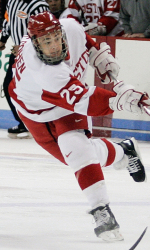
Last week I posted a video of a lower body work capacity exercise that we’ve used quite a bit at the end of this off-season. Today i wanted to share a companion exercise that encompasses somewhat of a more “hockey-specific” movement pattern.

On that note, I think it’s important to understand what hockey-specific means. It’s been funny over the last year to hear how many parents and coaches talk about our training at Endeavor Sports Performance as “hockey-specific”. In a lot of ways, it really is. We prepare our players for the demands of the game, and make sure that we peak their speed, power, and energy systems work to create the smoothest transition to pre-season as possible. That said, if you walked into our facility and watched our players train, you wouldn’t see anything that looks like hockey. In fact, a lot of what makes the programs I write hockey-specific is how I explain the benefits of various components to the players. In many cases, specific exercises and program design strategies are appropriate for a number (if not all) sports, but the explanation to the athlete about how it transfers is different.

Does this make it hockey specific?

(This is what happens when you hit yourself in the face with the bar while doing hang cleans…lesson learned)

All that said, this exercise does have direct application to hockey with regards to the body position, movement pattern, and involved energy systems. It’s also pretty funny to watch how long it takes them to get set up for, what they know will be, their very last video appearance of the Summer (watch for Gabe Antoni trying to sneak into the shot after being told he couldn’t just skip to the end of the training day to be in the video).

Split Squat IsoHold into Lateral Bound

We progressed it:

  1. Week 1: 3 x 3x(5s+3)/side …3 sets of 3 cycles of 5s holds with 3 max effort jumps each side
  2. Week 2: 3 x 4x(5s+3)/side
  3. Week 3: 4 x 4x(5s+3)/side

This is another great exercise to incorporate into the end of the off-season, once players have established sufficient strength and endurance to maintain the desired positions and speed of movement. If you missed it, check out my last post on another variation of this concept: Late Off-Season Conditioning

To your success,

Kevin Neeld

P.S. Get an inside look at how I design year-round comprehensive hockey training programs here: Ultimate Hockey Training

Please enter your first name and email below to sign up for my FREE Athletic Development and Hockey Training Newsletter!

Use CODE: "Neeld15" to save 15%