
Sidney Crosby’s concussion has been the cause of a bit of a stir within the hockey community. There has been an ongoing fear that Crosby, arguably the best player in the world, may be forced into an early retirement due to recurring symptoms from a concussion. Maybe on a larger scale, Crosby represents a larger problem in sports medicine in that a lot of athletes from different sports have suffered from longstanding concussion symptoms and there don’t appear to be easily identifiable solutions to these problems.
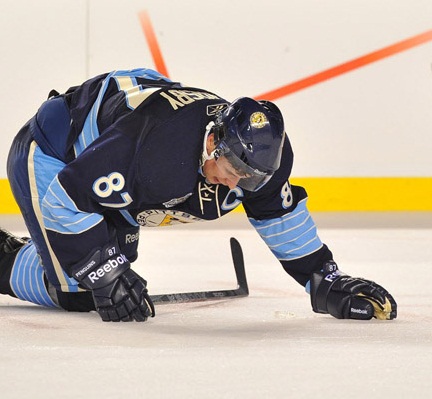
The Penguins recently posted a video from a press conference with Crosby and two of his doctors, Dr. Michael Collins and Dr. Ted Carrick, discussing his recovery process. The doctors do a great job of discussing his recovery and their approach to his rehabilitation.

Check out the video below:

One of the worst things a player can do is rush back too quickly. I picked up an alarming statistic from Dr. Josh Bloom at Pete Friesen’s Physio-Fitness Summit a couple years ago that 75% and 92% of repeat concussions occur within 7 and 10 days of the original incident, respectively. The recovery process and severity of symptoms tends to become increasingly worse with repeat incidences, which could be prevented with a more conservative return to play strategy. Understanding the nature of these repeat injuries has certainly been an instrumental part in prolonging the return to play recommendations. The doctors allude to the appropriate return to play process, but the general progression is:

  1. Sit out the remainder of the game
  2. No symptoms at rest
  3. No symptoms with light activity (aerobic only; no resistance training)
  4. No symptoms with more intense training
  5. No symptoms with non-contact sports participation
  6. No symptoms with controlled contact sports participation
  7. Return to play

In reality, most hockey players probably skip #1, half-ass #2, and then jump right to #7. Contrary to common practice, headaches are not supposed to be a normal part of the game, and the decision of whether or not a player is fit to play should never be left to the player, ESPECIALLY at the youth levels. Youth players simply don’t understand the severity if these injuries and will always err on the side of their competitiveness. It’s important that these injuries be taken seriously at ALL levels of play. The long-term implications can be severe and certainly warrant a more cautious approach than what has traditionally been taken. While no one would wish Crosby’s symptoms on anyone, I hope that his injury will bring an increased level of awareness to the severity of traumatic head injuries and that quality information will trickle down to youth, junior, college, and semi-pro levels where the quality of care may not be as thorough as what Crosby has access to.

To your health and success,

Kevin Neeld

Please enter your first name and email below to sign up for my FREE Athletic Development and Hockey Training Newsletter!

Last night I arrived back in Philadelphia after a great 8-day stay in San Jose. Adjusting to east coast time again is going to be rough. I can make the switch out there pretty easily, but coming back is a battle. Especially because I was up bright and early to head up to Montville, NJ for the FMS Level 1&2 courses. On my grind right now!

It’s been a while since I’ve done a hockey strength and conditioning update, but there have been a couple great additions over the last couple weeks.

Darryl Nelson added a new training program. This is a timely program as it’s the first phase of his Fall program. For those of you that are designing your pre-season and early in-season programs, this will be a great reference for you.

Check out the program here >> Fall Phase 1 Training Program

My new friend Chris Pietrzak-Wegner wrote a great article for coaches. While this was intended for training professionals, I think most of it applies to sport coaches as well. Chris was the Strength and Conditioning Coach for the Minnesota Wild for the last couple years and is a great guy that really knows his stuff. This article dials in on the basics of being a great coach. When I read it, it made me take a step back and do some self-examining. It can be difficult to go through the process, but it’s always beneficial.

Check it out here >> Three Questions Every Coach Should Ask Themselves

There are a bunch of great forum discussions worth looking into as well. Check out these threads:

  1. The Pros and Cons of Today’s Hockey Skates
  2. Creatine In-Season?
  3. Relative Importance of Hip Adduction
  4. Periodizing in-season and off-season: The general scope of things
  5. Concussion Protocol-Returning to play
  6. Darryl and others/Core Cooler?
  7. Injured players

It’s good to get questions from a variety of people with different perspectives. The above threads were started training professionals AND players and touch on important topics for everyone in hockey.

As always, if you aren’t a member yet, I encourage you to try out Hockey Strength and Conditioning for a week. It’ll only cost $1, and if it’s not the best buck you’ve ever spent, I’ll personally refund you!

To your success,

Kevin Neeld

Please enter your first name and email below to sign up for my FREE Athletic Development and Hockey Training Newsletter!

Last week my good friend David Lasnier wrote two great articles that are pertinent to both strength and conditioning coaches and any consumers of strength and conditioning information (athletes, parents, coaches, etc.). Take a few minutes to read through these.

This first piece is a must-read for coaches. I understand the tendency to want to be a “specialist”, but the movement toward people being a “crossfit” or “kettlebell” guy is downright stupid. There is no magical system that will meet everyone’s needs. The best coaches understand the development process and know when to apply certain tools to facilitate an adaptive stress (and recovery from these stressors). David’s article highlights the pros and cons of a couple really popular training methods and delivers a great underlying message.

Click here >> Having Different Tools In Your Toolbox

The second touches on another hot topic that affects us all in understanding the truth behind who lives under the internet veil. Internet marketing experts have made it easier than ever to establish yourself as a topic expert without ever having experience developing real-world results in that area. Frankly, it’s scary how deceptive people are online. It’s even scarier that they have large audiences of people that are drinking their koolaid.

This guy knows what I’m talking about

David presents a very level-headed view point on the research vs. real-world evidence debate, a much needed change from the excessively vocal extremists out there. (check out the cameo appearance from a half-nude santa clause)

Check it out here >> Who Do You Train? Putting Things in Perspective

I wrote a slightly more hockey-specific article on a similar topic that you can check out here if you’re interested:

Click here >> Internet Hockey Training Experts

To your success,

Kevin Neeld

Please enter your first name and email below to sign up for my FREE Athletic Development and Hockey Training Newsletter!

I hope you enjoyed your weekend. I’ve been glad to get out of the east coast rain for a few days and enjoy the seemingly perpetual perfect weather that the west coast offers. It’s been a great few days working with Mike Potenza at the Sharks camp. I haven’t had a ton of time to write over the last week so I thought I’d bring back two older articles that were really well-received when I first wrote them. Timely reads as hockey seasons are finally getting underway again.

Check out the two hockey development articles below and please pass them along to other players, parents, and coaches that you think would benefit from the information!

Click here >> Play the Underdog

And then here >> The Truth About Sidney Crosby

In a couple days I’ll have a couple other articles for you that my good friend David Lasnier recently wrote. Really great stuff on controversial topics!

To your success,

Kevin Neeld

Please enter your first name and email below to sign up for my FREE Athletic Development and Hockey Training Newsletter!

In a couple hours, I’m catching a flight to San Jose to go help Mike Potenza out with the Sharks camp. I had a great experience and learned a lot working with Potenza at the Sharks prospect camp last Summer, so I’m really looking forward to heading back out this year. I don’t have the best track record with flights over the last year:

  1. Last year I arrived at the San Jose airport at 4am for my 6am flight back, fell asleep, and woke up at 615am. No one thought to poke me, the first person in the terminal, to let me know the flight at the gate I had been at for 2 hours was leaving.
  2. The trip before that (the week before to be exact), I was stuck in the Philadelphia airport for about 8 hours before they cancelled the flight at 1am (I lived in Baltimore at the time, so this was pretty inconvenient, especially for a 4 day trip to Denver for 4th of July!).
  3. A couple weeks back, my flight from Philly was delayed a couple hours because of rain so I missed my connection in Atlanta and was a day late getting out to the US Women’s Camp in Minnesota.
  4. And most recently, my flight to Portland, ME to attend a Postural Restoration Course with Eric Cressey was cancelled because of rain so I missed the seminar altogether.

Needless to say, I’m hoping for a smoother trip this go around! On Monday, I laid out an example eating schedule for college hockey players. If you missed it, you can check it out here: Hockey Nutrition: In-Season Eating

About a year ago, after realizing that the athletes coming through our doors were completely clueless about what they should be eating (especially before and after they trained), I put together a “Training Nutrition Guidelines” sheet for all of our athletes. You can grab a copy of it at the link below:

Get your copy here >> Training Nutrition Guidelines

At the bottom of that sheet, there is a list of quality food choices broken down into macronutrient categories: Lean Protein, Vegetable, Complex Carbohydrate. This gives the kids a “plug and eat” menu for their pre- and post-training meals AND a better idea of what foods they should be eating anyway. A list of healthy fats isn’t included on this sheet because of the pre- and post-training nature of the meals. Coming back to Monday’s eating schedule, meal composition can be broken down as:

  1. Breakfast: 1-2 Hours Pre-Training Meal from sheet with option to swap fruit for vegetable
  2. Lunch: 1-2 Hours Pre-Training Meal from sheet
  3. Pre-Practice/Training Meal: 30-Minute Pre-Training Meal from sheet
  4. Post-Practice/Training Meal: Immediately Post-Training Meal from sheet
  5. Dinner: 1-Hour Post-Training Meal from Sheet
  6. Snack: Lean Protein, Vegetable, and Quality Fat meal

The above works for a player that was interested in maintaining their current body composition and/or increase body weight. Players with the goal of increasing mass would just need to eat more at each meal, especially earlier in the day and immediately after their practice/training.

For a player that was interested in losing body fat, I’d make a few small adjustments:

  1. Breakfast: 1-2 Hours Pre-Training Meal from sheet with option to swap fruit for vegetable
  2. Lunch: Lean Protein, Vegetable, and Quality Fat meal
  3. Pre-Practice/Training Meal: 30-Minute Pre-Training Meal from sheet
  4. Post-Practice/Training Meal: Immediately Post-Training Meal from sheet
  5. Dinner: Lean Protein, Vegetable, and Quality Fat meal
  6. Snack: Lean Protein, Vegetable, and Quality Fat meal

The only difference is that we’ve replaced carbohydrates with quality fats in two of the meals. The goal is not to ELIMINATE carbs, which they need to provide energy and facilitate recovery, only to funnel those carbs more into breakfast and during pre- and post-workout times. Using Generation UCAN will have a favorable impact on body fat, as it’s been shown to have a more time-release energy effect and avoids the blunted fat burning consequence of blood sugar and insulin spikes.

Take Home
Hopefully you can appreciate the relative simplicity in this approach. The two college players that I had the meeting with were given these guidelines at the beginning of the Summer, one more geared toward gaining weight (building muscle), the other geared toward losing fat. At the end of the Summer, the first player had put on nearly 20lbs (and was completely shredded, EASILY below 8% body fat), the second had lost 15lbs and went from 12% to <7% body fat (we measured). Not a bad transformation for a single off-season. Because it’s easier to maintain any level of body composition than it is to achieve it, these players will have a little more room to err in their habits during the beginning of the year as they re-establish a daily routine conducive to their needs without completely falling off the wagon (or is it on the wagon?).

To your success,

Kevin Neeld

Please enter your first name and email below to sign up for my FREE Athletic Development and Hockey Training Newsletter!

Use CODE: "Neeld15" to save 15%