
As I promised last week, we’ve gotten the new “youth hockey training program” addition of Hockey Strength and Conditioning underway by adding a team dynamic warm-up that players can use before every practice, off-ice training session, and game. Each exercise specifies the exact distance or repetitions to use and has a video. I thought adding a dynamic warm-up was the best place to start as this is something that EVERY player and team can implement immediately.

With warm-ups, consistency is key. The more players can internalize the process, the more it becomes part of their regular routine. This provides them an opportunity to go through something that is physically beneficial before games, but also allows them a time to mentally prepare for the game. Routines are great in this regard.

Get the warm-up here >> Team Dynamic Warm-Up

San Jose Sharks Strength and Conditioning Coach Mike Potenza added an interesting piece on post-game conditioning options. There is some room for debate regarding to what degree players should be conditioning in-season. This really depends on the player’s situation-number of ice slots per week, tempo of practices, playing time in games, and at the youth level-whether they’re playing other sports or not. Naturally, total stress to the body needs to be accounted for. The advantage of using a post-game conditioning strategy is that the team is already together and in “performance mode.” By clumping activity together during one time period of the day, you can maximize the recovery time throughout the rest of the day (at least, as much is possible in the professional setting). The thing I like about Potenza’s article is that he breaks down the conditioning protocols based upon the number of minutes his players play in a game. In this way, the conditioning is specific to the needs of the player and not just a one size fits all approach.

Check it out here >> Post-Game Conditioning

Lastly, my article “Dissecting the 1-Leg Squat” went up this week. The article outlines why I’ve completely abandoned the “pistol” variation of 1-leg squatting, how we lead up to 1-leg squats, and how we progress them. In my opinion, this version of the 1-leg squat is easier to perform, maintains a more optimal alignment of the involved segments and is easier to progress. The article spawned a forum rant about whether the traditional “thigh parallel” identifier of full squat depth is what we should be using.

Get the article here >> Dissecting the 1-Leg Squat

If you aren’t a member, go check out what you’ve been missing by clicking the link below. If you are a member, go check out all the content I mentioned above and hop on the forums to comment on the threads!

Click Here for the best in Hockey Strength and Conditioning

To your continued success,

Kevin Neeld

P.S. Remember, it’s only $1 to try HockeyStrengthandConditioning.com for the first week. You will never find more hockey training content anywhere for $1, and it’s only getting better.

Please enter your first name and email below to sign up for my FREE Athletic Development and Hockey Training Newsletter!
With the increased attention paid to “soft-tissue work” and “myofascial release” techniques, I think it’s important that everyone understands the basics that provide the underlying foundation for why these methods are effective and necessary.

I went into this at a very superficial level here: Foam Rolling Science Made Simple but I want to dive a bit more into the, well, slightly less superficial science behind it.

In laymens terms, these techniques are used to release or remove restrictions from the muscle. Most people are familiar with the feeling of having a “knot” in a muscle; that understanding will do for now.

Restrictions can be broadly categorized as adhesion or trigger point based. Wikipedia provides an easy-to-understand definitions:

Adhesions are fibrous bands that form between tissues and organs, often as a result of injury during surgery. They may be thought of as internal scar tissue.

In contrast:

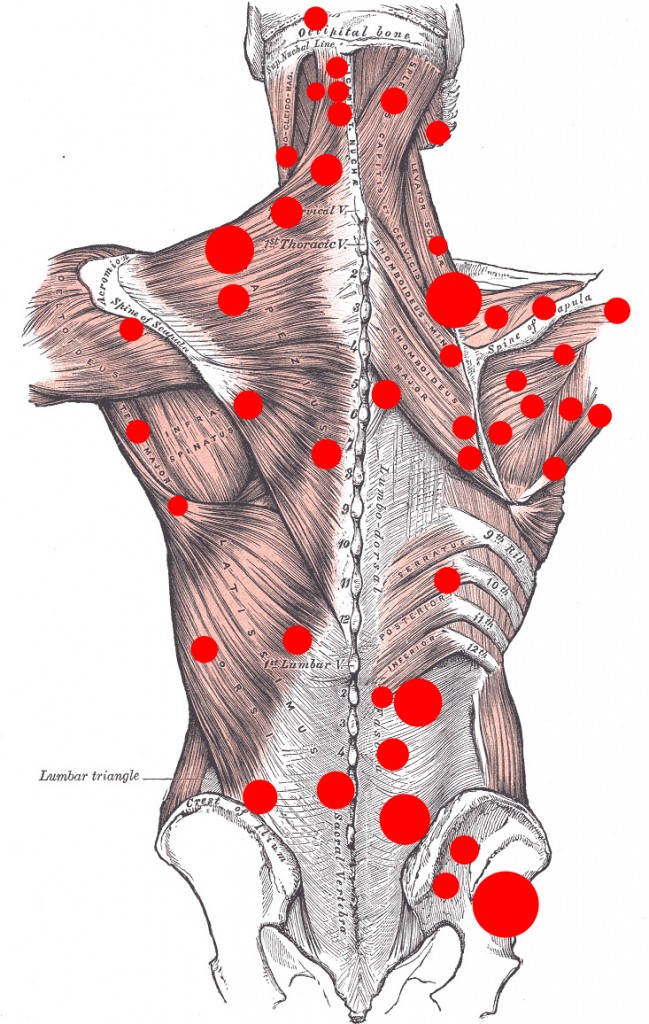
Trigger points are hyperirritable spots in skeletal muscle that are associated with palpable nodules in taut muscle fibers.

A display of potential trigger point areas

My understanding is that adhesions are more the result of damage (contact, improper muscle under-/over- use, injury, surgery, etc.), and that trigger points are more neurally mediated (excessive or inappropriate neural input to a localized area). In both cases, an adhesion or trigger point will pull on or otherwise affect surrounding areas in the presence of movement. This is ONE of the driving factors behind the idea that symptomatic areas aren’t always the cause of the problem.

Years ago, Michael Boyle provided a great illustration of this at a seminar one year where he put a band around someones neck and lightly pulled. “Where do you feel the pain?” “On the side of my neck.” General wisdom would say to ice, massage, and stretch the area. In reality, these methods may bring temporary relief, but as long as there’s a rope around your neck, it’s going to hurt. You could save yourself the ice, massage and stretching by just removing the rope (in this example).

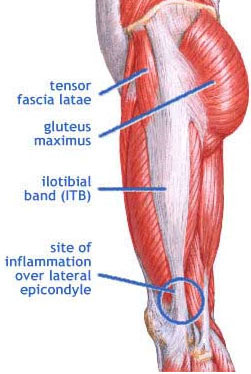
For something a little less abstract, let’s consider that the glutes and/or TFL can become restricted and increase the tension on the IT Band.

This scenario, which is pretty common in athletes from various sports, can lead to a host of painful symptoms including lateral knee pain (one of the locations of this potential pain is pictured above). Some manual therapy work to the TFL and glutes will release the tension and therefore return the athlete to a pain-free condition.

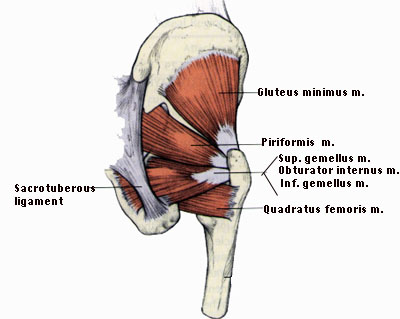
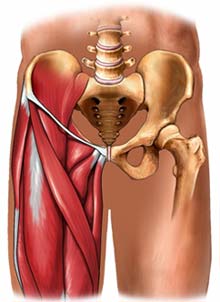
In many cases, adhesions and trigger points, which can be thought of as “soft-tissue restrictions” present because of positions we hold our bodies in for prolonged periods of time. For that reason, many people will have restrictions and common areas (e.g. hip flexors, pec major and minor, lats, cervical extensors, etc.). Because of the diagonal and rotational nature of the skating stride and the lateral nature of crossover patterns, hockey players tend to have pretty predictable restrictions in the hip rotators and the adductors.

Digging a lacrosse ball into these muscles will make most players yelp

The high, inner area can become especially problematic for hockey players

Both of these pictures are especially illustrative of how adhesions between any two structures or triggers points in any one structure could affect surrounding areas, as optimal movement is dependent upon proper extensibility of and gliding upon these individual and collective muscles. By the time hockey players are in high school, the muscles around their hips’ are completely gunked up. This will impede blood flow, lead to abnormal firing patterns, and generally increase the amount of resting tension put on surrounding structures. In other words, the associated changes aren’t just mechanical, they’re also circulatory and neural. Maybe more importantly, addressing these restrictions will make the athlete FEEL better.

With a basic understanding of what the restrictions are and the effect they can have on the body, the question becomes how to get rid of them. Adhesions tend to break up in response to localized pressure driven along the direction of the adhesion.  Trigger points, on the other hand, tend to respond better to sustained pressure in one location. Using foam rollers, medicine balls, lacrosse balls and other implements to perform self-myofascial release work (to address these restrictions) is a great way to minimize the risk of these turning into more substantial problems. With that said, these methods aren’t nearly as specific or effective as getting worked on by an experienced manual therapist.

Check out the video below of Cole Hamels talking about his experience working with my friend Dr. Michael Tancredi:


Cole Hamels Explains Benefits Dr. Tancredi Chiropractic Care from Harry Scheid on Vimeo.

The thing I like the most about this video is that it’s straight from the athlete’s mouth, meaning it’s not overly scientific. If players started getting regular work done from an Active Release practitioner or a great massage therapist like my friend Craig Bohn at Hockessin Athletic Club, I think a lot of the chronic groin and hip flexor strains and sports hernias that we’re seeing through the high school, college, and pro levels would start to disappear. I know our athletes have had tremendous success in warding off these injuries (and returning from soft-tissue injuries sooner) as a result of getting regular soft-tissue work done.

Whether you perform self-myofascial release work or go see an experience manual therapist is secondary in importance to not neglecting soft-tissue quality altogether. Because it can be difficult to enforce this stuff on a team-wide basis in most youth programs, it’s up to parents to go buy a foam roller or look up a manual therapist for their son/daughter. It’s well worth the investment; your kids will thank you later!

To your success,

Kevin Neeld

Please enter your first name and email below to sign up for my FREE Athletic Development and Hockey Training Newsletter!
For the last decade or so, the words “sport specific training” have frequented the marketing of people with services claiming (sometimes accurately) to develop athletes. The “sport-specific” movement was initially characterized by people taking identical movement found in sports (e.g. a baseball swing, a hockey shot, etc.) and providing some sort of resistance to the pattern.

The “Sport-Specific Training” Mistake
Unfortunately, the approach of loading skilled movement patterns is counterproductive. Whether or not you get stronger from doing these loaded repeated movements is somewhat debatable, but in the interest of optimism, let’s suppose that there is a strengthening effect. The problem is that the skilled pattern itself is negatively affected. The loaded movements ruin the movement pattern; usually in terms of both neuromuscular timing and outcome accuracy. This is just a fancy way of saying that the way your muscles control the movement and the accuracy of the movement are negatively affected. Think of the implications this has for ice hockey. Altered shooting form and accuracy can make a HUGE difference since most players only get a shot or two a game!

The other, less frequently acknowledged downside of this comes back to the idea of tissue stress accumulation I discussed a couple weeks back (Long Term Hockey Development and Injury Prevention). The more you move through a pattern, the larger the amount of stress the involved muscles and surrounding tissue take. Because we are a stimulus driven society and typically focus little, if at all, on recovery, doing extra work on top of playing your sport in these sport specific patterns can push you closer or over your injury threshold.

Do We Need “Sport-Specific Training” At All?
While the training was a bit off, the intention was great and it made a lot more people in the sports arena aware of the necessity of physically preparing to play. With that though, it gave the allusion that every sport had it’s own secret training protocol and that athletes need highly sport-specific training in order to get the results they deserve. In other words, hockeyplayers needed “hockey-specific” training, soccer players needed “soccer-specific” training, and so on.

In reality, most popular sports (soccer, baseball, hockey, football, lacrosse, basketball, field hockey, and volleyball, amongst others) share more athletic qualities than people realize. Maximizing athletic performance in any of these areas requires training to ensure:

  1. Appropriate multi-planar joint stability of the ankles, hips, thoracic spine (upper spine), and glenohumeral joint (shoulder).
  2. Appropriate stability of the knee, lumbar spine (lower back), scapulothoracic joint (shoulder blade), and elbow
  3. Improved full body power
  4. Improved strength of all major muscle groups in FUNCTIONAL movement patterns (e.g. lunge and squatting patterns, NOT machine work!)

With this in mind, over 80% of training will be almost identical for athletes of all the above sports. I remember hearing Mike Boyle joke once that he created the Boston University Field Hockey program by taking the Ice Hockey program, deleting “Ice”, and adding “Field”. I’m not sure if he actually did that or not, but his point was clear. The major differences in training programs between sports are:

  1. The proportion of work in the areas outlined above. For example, a lacrosse player may need more explosive upper body work than a soccer player because of the physicality and shooting in lacrosse
  2. The direction of the training stresses. For example, sports like volleyball and basketball necessitate more vertical power training (e.g. vertical jumping) than sports like soccer and ice hockey, which are predominantly (although not entirely) horizontal-based. Similarly, sports like baseball, golf, hockey, and lacrosse will necessitate more horizontal rotational power training than sports like football because of the importance of shooting in these sports.
  3. Conditioning. The metabolic demands between sports like football, volleyball, and soccer are completely different. As a result, so is the emphasis on conditioning. While almost all conditioning for sports should be interval-based, the frequency, intensity, and duration of the conditioning should be specific to the sport.

Sport- vs. Sports-Specific Training
The major take home from all of this is that athletes and parents should be actively seeking out “sports-specific” training, not “sport-specific” training. Sports-specific training creates separation from the largely irrelevant personal training and body building alternatives out there, but encompasses the important idea of training in the interest of athletic development.

Training for athletic development is the key to experiencing a long, successful sports career while avoiding the injuries imposed by so-called “sport-specific” training programs.

To your success,

Kevin Neeld

Please enter your first name and email below to sign up for my FREE Athletic Development and Hockey Training Newsletter!
Yesterday Karl (our first intern at Endeavor Fitness) and I went through the Functional Movement Screen together.

I’m proud to say, as the mentor, that I came out victorious with a score of 18 (over his measly 17!).

He “lost” because his hamstring extensibility (or flexibility) was terrible. While most of our athletes have decent hamstring extensibility we do have a few that are pretty locked up.

With Karl, and some of our athletes, I’ll have them do this quick stretching activity to improve hamstring extensibility.  When someone is available, we’ll usually do this with a partner, which allows “on the fly” adjustments to leg positioning, but often times I want our athletes to do this at home, using a wall as their partner.

Please ignore the music in the background!

The protocol is:

1) Set up with one leg raised in a “hamstring stretch” position with your knees of both legs fully extended and the toes of both legs pulled toward your shins. In this position, your lower back should be flat (or with a slight curve), and you should feel a good stretch in your hamstrings on the raised leg. Hold this position for 10 seconds.

2) If you feel like you can, shift your body a little closer to the wall to increase the stretch on your hamstrings.

3) Actively raise your heel off the wall and hold for a few seconds. Return to the wall and rest a few seconds. Repeat 2-3 times.

4) If you feel like you can, shift your body a little closer to the wall to increase the stretch on your hamstrings.

5) Actively press your heel into the wall as hard as you can without it lifting your hips or moving your body at all (or breaking your heel through the wall!). Keep pressing for 3-5 seconds, then rest a few seconds and repeat 2-3 times.

6) If you feel like you can, shift your body a little closer to the wall to increase the stretch on your hamstrings and hold this final position for 10 seconds.

Most people notice a substantial improvement in their hamstring extensibility after performing this circuit. If you’re really locked up, try doing this twice a day for a couple weeks and see how much you improve.

Please enter your first name and email below to sign up for my FREE Athletic Development and Hockey Training Newsletter!
A few weeks ago I started working with a Division 1 bound high school baseball player.

During his first session, he was able to do a set of Dumbbell Reverse Lunges with 40s for 6 reps/side.

2 weeks later he did a set of 4 reps/side with 75s, and he did 70s for 6/side the following week.

There are multiple possibilities to explain this drastic strength increase:

1) Becoming more comfortable with the movement pattern

2) Increased neural drive to the involve musculature

3) Better night of sleep before the training sessions later in the program

While I won’t rule any of these things out, I’ll say that these strength increases aren’t abnormal here.

With all of our athletes, there seems to be one common theme:

When our athletes learn to brace/stabilize their core during the lifts, their weights go through the roof!

Simply coaching athletes to “get up tall” and/or (depending on the lift) “keep their core tight” while they lift has an incredible impact on their ability to transfer force through their core, and therefore the weight they can lift.

Many athletes pick this up from simple coaching cues. For the athletes that need a little more help, I teach them how to brace their core with these instructions:

1) Put their hands on their stomach

2) Tighten up their core, which contracts the stomach musculature

3) Take a deep breath “in through their belly”, without releasing the core tightness

4) Practice taking mini-breaths in and out without losing their core tightness

After teaching them this skill in a static environment, most are able to transfer that to their lifts.

Please enter your first name and email below to sign up for my FREE Athletic Development and Hockey Training Newsletter!

Use CODE: "Neeld15" to save 15%