Last week I came across a recent research article that I think is a real breakthrough in the hockey training world. Before I get to that, I want to quickly touch on the importance (or lack thereof) of testing.

First, let’s distinguish between assessing (screening for ROM, structural, or movement impairments), and testing (assessing performance). I think assessing has a place in many training settings, especially with older athletes who have accumulated more soft-tissue trauma and have more firmly rooted, but still reversible movement impairments. I think assessing a 12-year old with no training background is unnecessary and that time could probably be better spent teaching the kid how to move well. Groove and improve!

With regards to testing, I think using performance on tests as a comparative tool amongst players is a ridiculous notion. I’ve always said that if Sidney Crosby had a 15″ vertical jump (which is brutal for a player at that level), he’d still be one of the best players in the NHL. The off-ice performance testing shouldn’t determine the selection of players.
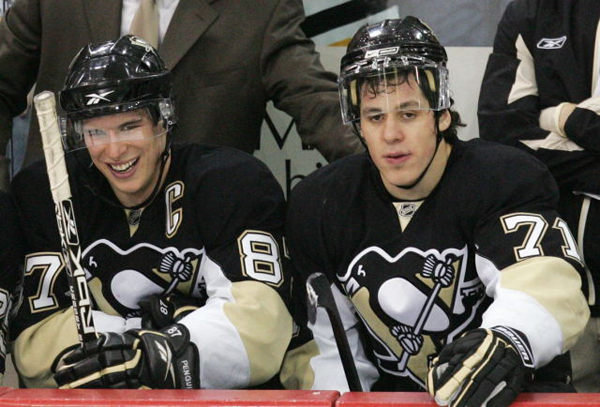
Think these guys have the best bench press on their team?

Simply, players should be evaluated on their on-ice ability. That said, using testing as a way for tracking and documenting a player’s off-ice development isn’t a bad idea. In fact, in the case of more elite players (more specifically, those with an “older” training age), it will help document the effectiveness of the program. In the case of players with a younger training (because any form of training will work for these players), showing objective progress will help them buy in to the importance of training, which is also worthwhile.

The big caveat with testing is that there has never been any real evidence that higher levels of off-ice athleticism lead to improved on-ice performance. In other words, we know that someone fast off the ice is likely to be fast on the ice (if they learn to skate well), but will that mean that they score more goals, have more assists, have a better +/- or are better than their peers at any other game-specific marker of performance? Intuitively I think we can all appreciate the importance of making improvements in athleticism (speed, strength, power, etc.). In fact, I make a living training hockey players to do just that. IMPROVEMENTS will lead to improved performance, but ABSOLUTES have never been linked to better performance.

“You can’t score goals in the weight room.”

That’s a running joke with me and a few of the players at Endeavor Sports Performance. While there is some truth to that, a new research article demonstrates, for the first time, that there is a connection between off-ice and on-ice performance.

Peyer et al. (2011) measured the Michigan State University Men’s Hockey Team’s (NCAA D1):

  • Age
  • Height
  • Body Mass
  • Body Fat %
  • Fat Free Mass
  • VO2 Max
  • Maximal Lactate Level
  • Max Heart Rate
  • Repeat Sprint Test Ability
  • Max Push-Ups
  • Max Chin-Ups
  • Max Leg Press Reps with 400lbs
  • Max Bench Press Reps with 155lbs
  • On-Ice Dot-to-Dot Sprint Time (Offensive face-off dot to far same side, but opposing end face-off dot)
  • On-Ice 1-Lap Sprint Time
  • On-Ice Lightening Drill Time (Start at blueline->redline->back to blueline->far blue line->back to redline-> finish at far blue line)
  • Plus/Minus throughout Season

Plus/Minus was used as the primary indicator of hockey performance because of it’s ability to effectively incorporate both offensive and defensive efforts. An argument can be made that a similar analysis should be performed with other performance measures, but we’ll leave that for future research. All things considered, plus/minus is the best single choice available.

Quick Editors Note: This study was conducted on MSU’s hockey team the year they won the National Championship. This may or may not mean anything to you, but I think it’s important to point out that this wasn’t performed on a team that got walked on through the year. This was an incredible group of players.

The Results

Notable findings included:

  • There were no significant differences in any of the measures between forwards and defensemen except for VO2Max, with the forwards having higher values.
  • Plus/Minus was ONLY significantly correlated with four of the other tests: Repeat Sprint Ability (12 x 110-m sprint every 45 s, off-ice), Chin-Ups, Leg Press, and Bench Press.
  • Interestingly, when forwards were dissected out and reanalyzed, only Chin-Up performance was significantly correlated with Plus/Minus (r=0.728, p=0.007)
  • When defensemen were segregated, body mass (r=0.651, p=0.041), fat free mass (r=0.682, p=0.030), and bench press (r=0.720, p=0.029) were all significantly correlated with Plus/Minus.
  • When the values significantly correlated with Plus/Minus were further analyzed using a step-wise regression technique, chin-up and repeat sprint performance were the best predictors of Plus/Minus (explaining 49% of the variance)

Interpreting the Findings

It’s not surprising to see that forwards had higher VO2Max values than defensemen. This is likely a combination of both an adaptation to the position and a natural selection precluding the athletes to start. In other words, players that have difficulty keeping up with the pace of forward play may be moved back to play defense at young ages and just stay there. This is NOT evidence that forwards need to do more aerobic training. Quite the contrary. The evidence is clear in that anaerobic interval training increases V02Max equally as well as aerobic training, and with hockey players interval training is much more sport-relevant. This is also reflected in the correlation between repeat sprint performance and plus/minus. Hockey players need to be fast, consistently.

While I don’t necessarily agree with all of the tests chosen, the authors explained that the tests were included as part of the team’s yearly testing and many are included in NHL testing procedures. This doesn’t make it right, but it allows me to understand why they chose the tests they did. That said, it was interesting to see that strength (lower body and upper body) and repeat-sprint ability were the two qualities most predictive of plus-minus. This should come as no surprise to most of you, but it certainly has some important implications. The authors summed up a major conclusion brilliantly:

“Aerobic fitness and body composition do not appear to be significant predictors of player performance as measured by the +/- system or coach evaluation. To maximize the efficiency of preseason testing, coaches may rely on strength (chin-ups, leg press, and bench press) and repeat sprint tests while decreasing the number of aerobic capacity and body composition analyses to minimize player burden…”

Hopefully this will provide further evidence for some of the coaches that have hesitated to take out their continuous run and VO2 tests that there are better ways of assessing a player’s conditioning.

One of the other interesting findings is that the coaches of this team independently ranked the players in order of ability. The authors took the top 6 (5F, 1D) and bottom 6 (3F, 3D) and found that the only variable that differed significantly between them was plus/minus. That is not surprising. You’d assume your best players have a better plus/minus than your worst. However, the authors noted that the top 6 players exhibited a trend toward being younger, heavier, faster in the repeat-sprint test, and stronger in their lower body. While you can’t draw massive conclusions from trends taken from a breakdown of a single team, I think this alludes to the importance of developing lower body mass and strength. This seems like a relatively intuitive concept, but the reality is that most high school players default to the “my legs are big enough” excuse for not lifting legs and focus primarily on their mirror muscles.

The big take home from this is that a hockey player’s training program CANNOT neglect strength work, and that interval-based work is more appropriate for conditioning purposes. It appears that strength and repeat-speed (e.g. hockey conditioning) are most predictive of on-ice success. That…and a clean sheet of ice:

To your success,

Kevin Neeld

Reference:

Peyer, K., Pivarnik, J., Eisenmann, J., & Vorkapich, M. (2011). Physiological Characteristics of National Collegiate Athletic Association Division I Ice Hockey Players and Their Relation to Game Performance. Journal of Strength and Conditioning Research, 25(5), 1183-1192.


Please enter your first name and email below to sign up for my FREE Athletic Development and Hockey Training Newsletter!

I’m wrapping up another busy week at Endeavor and it looks like things are only going to get busier in the next few weeks. This week I started running some hip evaluations on all of our older players and “red flagged” younger players. I’ll talk about this in more detail in the future, as I think it’s an important screening tool in preventing unnecessary, but common hockey injuries like adductor and hip flexor strains.

Luckily, I’ve been able to make some time at nights to catch some of the playoffs. Great hockey so far.

This week at Hockey Strength and Conditioning Jaime Rodriguez wrote a terrific article breaking down the importance of the Olympic lifts and how to teach them. Jaime was with Mike Boyle Strength and Conditioning for a while, but now is the Strength and Conditioning Coach for the AHL’s Worcester Sharks. He’s got a ton of coaching experience, so it’s good to hear how he uses/teaches Olympic lifts, which are tough for some athletes to grasp. Olympic lift variations are staples in our off-season hockey training programs so it’s a very time-relevant post.

Check out the article here >> The Hang Clean Breakdown and Other Olympic Lifts from Jaime Rodriguez

I also added the 2nd phase of our 4-Day/Week Early Off-Season Training Program at Endeavor Sports Performance. The program serves to continue making progress in reversing the deleterious adaptations of a long season, but has a greater emphasis on improving muscle strength and hypertrophy than the previous phase. Check it out at the link below.

Click here to see the program >> Early Off-Season Training Program (4x/week)

As always, there are a couple good discussions on the forum that you’ll want to check out too!

That’s all for today! If you aren’t a member yet, shell out the $1 to test drive Hockey Strength and Conditioning for a week. If it’s not the best buck you’ve ever spent, I’ll personally refund you!

To your continued success,

Kevin Neeld

Please enter your first name and email below to sign up for my FREE Athletic Development and Hockey Training Newsletter!

Well, it saddens me to say this, but the Flyers playoff run is officially over. And with that, so is the beard. I was hoping to make it to the Boston Hockey Symposium for the second straight year with the Flyers still making a run, but I guess it just wasn’t their year (maybe the 5 scheduled surgeries and 3 other probable surgeries have something to do with it?).

Playoff beard…final hours

The good news is I’m feeling rejuvenated from my trip out San Diego last week and have a lot of great content for you over the next few weeks. We added some great stuff to Hockey Strength and Conditioning that you’ll want to check out.

Darryl Nelson wrote an outstanding article on speed training for hockey. While I think that most of the people in the circle’s I run with have a great understanding of speed training principles, I think the topic remains poorly understood amongst the majority of the hockey world. Darryl’s article does a great job of outlining the most important principle in developing speed for hockey and provides several off-ice training methods to facilitate on-ice gains. Short and to the point. Check it out at the link below:

Click here >> Training for Speed from Darryl Nelson

Sean Skahan added a video of a leg circuit he uses with his players in the late off-season/early pre-season. This is a great video because it shows a training option that isn’t equipment-reliant. In other words, assuming movement pattern proficiency, anyone can do this. The important thing is to recognize where it fits into the bigger training picture. For younger players with a short training history, this method may be effective in developing increases in strength and size. For players with an older training age, a circuit like this would be great for developing work capacity in the hips and legs, but won’t help much in the way of strength improvements. This is likely the reason Sean mentions he uses the circuit to transition into the pre-season, where strength improvements take a back-seat in importance to ensuring the player has the work capacity to sustain the impending on-ice demands. Check out the video here:

Click here >> Leg Circuit from Sean Skahan

As always, there are a few great forum discussions that you’ll be interested in. Check out the one on the benefits of power skating instruction (or lack thereof?), a Q&A with Sean about his leg circuit video, and on the Graston Technique (a manual therapy technique that has some distinct benefits for hockey players).

That’s it for today! If you aren’t a member yet, shell out the $1 to test drive Hockey Strength and Conditioning for a week. If it’s not the best buck you’ve ever spent, I’ll personally refund you!

To your continued success,

Kevin Neeld

Please enter your first name and email below to sign up for my FREE Athletic Development and Hockey Training Newsletter!

I get a lot of inquiries about what training program I use. I have training goals that I’m in constant pursuit of, but I also use our staff training programs as an opportunity to experiment with new exercises, progressions, and program design strategies. In today’s post, I want to give you an inside look at a new program design strategy I’ve been experimenting with for the last couple months.

As a preface, one of the problems I battle with is finding the right balance between stress (in the true sense-meaning training, nutrition, work, and all other life-related stresses) and recovery. Simply, I’m far from proficient at walking away from uncompleted work, so I find myself trying to squeeze 25 hours into every day, for months at a time (time flies when you have your head up your ass!).

Sleep…my long lost friend

In the past, I’ve trained 4 days/week on a Lower/Upper split Monday-Thursday and just took Friday-Sunday off. There are some inherent recovery issues with this set-up, but it fill well with my time at Endeavor. About 6-months ago, I changed to a more traditional Monday, Tuesday, Thursday, Friday/Saturday split, which helped with recovery a lot (obviously). I also changed from going Lower, Upper, Lower, Upper to Upper, Lower, Upper, Lower. For me, a really heavy lower body day was completely debilitating for the upper body lift the next day, but the opposite was not true.

All of these things helped, but a couple months ago I made a change to the program that has accommodated both my increasing work demands and my unwavering pursuit of improved strength. I’m not exactly sure how I came across it (I suspect it was from one of Ben Bruno’s “Good Reads of the Week” posts), but I read a great article from Jason Ferruggia suggesting to take a 4-day program, but only train 3 days per week.

Old Schedule:
Monday: Day 1 Upper Body
Tuesday: Day 2 Lower Body
Thursday: Day 3 Upper Body
Friday: Day 4 Lower Body

New Schedule:
Monday: Day 1 Upper Body
Wednesday: Day 2 Lower Body
Friday: Day 3 Upper Body
Monday: Day 4 Lower Body
Wednesday: Day 1 Upper Body
Friday: Day 2 Lower Body

And it goes on like this. This schedule helps recovery for a few reasons:

  • It decreases the total training stress on any given week (3 sessions vs. 4)
  • It decreases the body-part specific training stress for any given two week period (3 vs. 4)
  • It decreases the lift-specific training stress for any two week period (more on this below)

To expand on this latter point, and this was one of the main messages of Jason’s original article, if I have a “primary” lift like a heavy chin-up or deadlift on Day 1 and Day 2, now I’ll only be performing that lift (with maximal loads) every ~10 days instead of every 7. Because these are the lifts that impose the greatest degree of neural fatigue, spreading them out a bit can have a profound impact on recovery.

Naturally, there’s a lot to consider when choosing a training frequency and overall program design schedule. As I alluded to in Program Design for Small Groups, recovery time is dependent upon both relative and absolute training loads, the latter of which will be lower in athletes with a “younger” training age.

This is the first time I’ve experimented with this training schedule and I’ve really benefited from it. I feel better than I did before and have set a few PRs in the process (as has our other coaches following the programs). It looks like I’ll be sticking with this schedule for the foreseeable future, at least until my schedule eases up a bit!

To your success,

Kevin Neeld

Please enter your first name and email below to sign up for my FREE Athletic Development and Hockey Training Newsletter!

Tomorrow afternoon, Emily and I will be hopping on a plane to head to San Diego for a few days of R & R. I’ve been in desperate need of a vacation since about September of last year, so this is long overdue. I’m really looking forward to getting away for a few days.

But before I go, I wanted to follow up my post from the other day on 3 Keys to Successfully Pairing Exercises with another post on program design, but this time for athletes training in small groups. In the constant search for the “perfect program” I think people lose sight of the fact that “perfect” is situation-dependent. In other words, what might be ideal for training one individual athlete may not be ideal for a group of athletes, and what may be ideal for a group in one setting may not be ideal for a group in another setting. There is a lot to consider, which is why it’s important for people to not judge the programs of other coaches until they’ve seen the setting that they work in, and the clientele they work with.

One thing we’ve done at Endeavor Sports Performance to accommodate larger groups and ensure a smooth-flowing session is move to quad-sets with two main, non-competing lifts. An example template of this looks like:

A1) Main LB Lift
A2) Non-Competing Core/Mobility
A3) Main UB Lift
A4) Non-Competing Core/Mobility

This allows us to take a group of 6-8 athletes and break them into two smaller groups. One group of 3-4 would start with A1 and cycle through; the other would start at A3 and cycle through. For Group 1, they would progress as A1-A2-A3-A4, etc. Group 2 would progress through as A3-A4-A1-A2, etc. In this way, we’re able to make better use of our equipment and keep a good training flow, but still abide but the fundamental principles we feel are important.

This isn’t a program design strategy that I would give a universal approval, but there are certain situations where it works great. The more “advanced” an athlete becomes, in terms of their training experience, the less effective this strategy is. Simply, as training experience increases, it becomes increasingly difficult to make substantial gains in size and strength and therefore every aspect of the program needs to be more meticulously designed and implemented. Naturally, this includes exercise order, intensity, and rest intervals.

In contrast, athletes new to lifting (or re-integrating back into a lifting program) and younger athletes in general progress more readily and recover quickly from any individual exercise. This means that the residual fatigue from any exercise, and therefore the deleterious effect on any subsequent exercise, will be inconsequential.  I’m not suggesting it’s appropriate to just run young athletes through circuits of exercises haphazardly and without consideration to fatigue accumulation or exercise order; it’s still imperative that athletes are sufficiently recovered, mentally and physically, before starting a new exercise. But given the recovery time these athletes require, altering the starting point of an exercise circuit as described above will not impair their progress in any way.

There are a million ways to skin a cat. The key is to know your athletes, and not lose sight of fundamental training principles.

To your success,

Kevin Neeld

Please enter your first name and email below to sign up for my FREE Athletic Development and Hockey Training Newsletter!

Use CODE: "Neeld15" to save 15%