David and I made the trek out to Chicago (just a quick 14-hour road trip) for Perform Better today. This is the first full Perform Better Summit I’ve ever been to, so I’m really looking forward to hearing all the speakers. It’ll also be great to catch up with people like Mike Boyle, Darryl Nelson, Maria Mountain, Kyle Bangen, Josh Bonhotal, and Charlie Weingroff (among others). If you’re in the area, shoot me a quick note and we can meet up for a beer protein shake.

I hope you’ve appreciated the value in this week’s posts. Hip assessments are really of paramount importance for hockey players. This week we had a new player start with us from Northwood Prep that I had never met before. Within 15 minutes of meeting him I was able to establish that he had CAM impingement in his right hip (and likely a more mild case in his left hip), instruct him on what “full” range of motion was for him, what feelings to avoid, how to move, and a focused soft-tissue/long duration stretching/breathing program for him to ensure that his CAM impingement doesn’t progress to a same-side sports hernia like they frequently do. Catching this early is huge. This player is now in a better position to avoid surgery secondary to a sports hernia and/or labral tear, and has an understanding of his mechanics that will help delay the development of osteorarthritis in that hip (which almost always follows CAM impingement). If handled correctly, this means improved performance levels and a longer, healthier career.

Unfortunately, the majority of the older players we see have some sort of anatomical “abnormality” that warrants consideration in their training programs. This week’s posts shed light on some of the anatomical asymmetries that predispose athletes to certain, somewhat predictable injuries. If you missed them, I encourage you to check them out here:

  1. The Myth of Symmetry
  2. Hockey Hip Assessment

We added a bunch of new content over at Hockey Strength and Conditioning this week.

Darryl Nelson added a video from USA Hockey’s American Development Model (ADM) conference a while back of him running a younger group of athletes through some off-ice training exercises that are more fun than regimented training in nature. The cool thing about the way Darryl runs this is that the kids probably don’t interpret it as a chore. It feels like playing to them, which is something a lot of kids miss out on the way that sports society has drifted over the last decade. For the youth programs that are looking to add an off-ice training component to their U-12 teams, this is a great place to start.

Check out the video here >> Off-Ice Games from Darryl Nelson

I posted the 2nd Phase of our 4-Day Off-Season Training Program at Endeavor Sports Performance. Many of our players will be entering this phase next week. This phase ramps up the amount of speed training work considerably, especially that geared toward improving transitional speed. We also increase the emphasis on conditioning. The resistance training aspect of the program is designed to improve maximal strength levels before we transition into more of a power-driven phase leading into pre-season camps.

Check out the program here >> 4-Day Off-Season Training Program: Phase 2 from me

Mike Potenza added a 4-day off-season training program with an emphasis on speed strength. This was cool to look through because there were a few things I was completely unfamiliar with, which will inevitably stimulate some good forum discussions in the near future. Mike writes his programs a little differently than I do in that he uses 3-week cycles instead of 4 and the speed, core, and conditioning work are pulled out. He has separate progressions for those things, so they aren’t included on his training sheets. Great learning opportunity for other hockey strength and conditioning coaches out there.

Check out the program here >> Speed Strength Phase of Training from Mike Potenza

Lastly, Cristi Landrigan, who is one of the most dedicated parents I’ve ever met, recently forwarded me a link to a great audio interview with Detroit Red Wings Head Coach Mike Babcock, which I added to our site. I think it’s a great opportunity for everyone in the hockey community to hear from the head coach of one of the top hockey organizations in the world and get an idea of his mentality. Despite all of his success, he’s still constantly looking for ways to improve as an individual and as a team. I think everyone would benefit from adopting that “never satisfied” mentality.

Listen to the interview here >> Mike Babcock Interview

As a parting message, I’ve talked with a handful of players that compete at the semi-pro level recently that strongly recommended that we make a stronger effort to let players at that level know about our site. Their feeling was that many players at those levels have trained in an organized hockey training setting before, but don’t have anyone to provide quality programs for them to use. Because we constantly post 4-day off-season programs and 2-day in-season programs throughout the year, a membership to our site would be a great option for players that would benefit from professional strength and conditioning instruction, but don’t have the resources (money, time, qualified professional) to hire someone locally. If you know of anyone currently playing at the OHL, ECHL, IHL, CHL, AHL, or any of the professional leagues overseas that you think would benefit from following a professionally designed hockey training program and from having forum access to high caliber coaches, please forward this along to them.

And if YOU aren’t a member yet, fork out the $1 to test drive Hockey Strength and Conditioning for a week. If it’s not the best buck you’ve ever spent , I’ll have David Lasnier personally refund you!

To your continued success,

Kevin Neeld
Please enter your first name and email below to sign up for my FREE Athletic Development and Hockey Training Newsletter!

A couple day’s back, I proposed the idea that the underlying assumption that hockey players (and athletes in general) are structurally and neurologically symmetrical was grossly misguided. In fact, structural asymmetries in conjunction with asymmetrical movement tendencies can be an underlying factor in a lot of the dysfunction our players present with and in common hockey injuries. This is true even of traumatic injuries; when a joint is in suboptimal alignment, stability is compromised. If you missed that post, I encourage you to check it out here: The Myth of Symmetry.

It’s no mystery to the hockey community that hip injuries are an epidemic. CAM impingement and sports hernias have been getting a lot of press over the last 5 years and adductor (“groin”) and hip flexor strains have become accepted as a necessary evil. I strongly believe that these injuries result because of a general lack of awareness of the predisposing factors that contribute to them and the necessary off-ice training strategies to prevent them. This belief isn’t at all theoretical; over the last two years we have completely eliminated adductor and hip flexor strains in our hockey players through off-season training alone. In other words, we have 2.5-4 months to “injury-proof” a player at Endeavor Sports Performance during the Summer, and then the player returns to his team and we don’t hear back from them until the next off-season. All of our players from last year have returned and we had ONE player sustain an injury to his hip flexors. It was a bilateral strain that resulted from an unexpected high speed collision to the back of his legs, which resulted in a rapid hip hyperextension and slight bilateral tear. It was a freak occurrence. This player will get struck by lightning on his way to cash in his winning lottery ticket before that happens again. Other than that, not a single game missed for hip-related injuries at all.

The overwhelming majority of hip injuries and nagging pains are completely unnecessary. Listen to one of our players describe his experience:

“Over the past few summers I have trained with Kevin in order to prepare my body for the rigors of professional ice hockey. Kevin was always organized and ready to lead our small group of elite athletes through intense, result-oriented workouts. Kevin’s ability to creatively and expertly create programs made training with Kevin at Endeavor Sports Performance a no brainer.

This past summer Kevin was also able to develop a program designed specifically for me to treat a sports hernia that prohibited me from doing most activities. Kevin was able to target the problematic area and not only strengthen it but got my body ready to perform at 100% and was the first season in a while that I was completely pain free.” – Jamie Carroll

When Jamie says “that prohibited me from doing most activities”, he means things like walking. He was generally able to lay in a bed pain free, but that was about the level of movement he could tolerate without pain, and getting out of bed was an unpleasant experience for him.

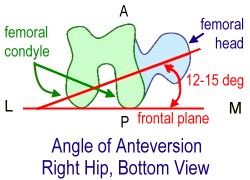
One of the keys in preventing unnecessary hip injuries is to have an in-depth understanding of the player’s anatomical/structural composition. In this regard, CAM impingement has received a lot of attention recently and rightfully so. Another frequent structural deviation that hasn’t received as much attention is femoral “version”. Femoral version is a measure of the angle of the femoral neck relative to a horizontal line through the two femoral condyles.

Demonstration of calculation of the angle of femoral version

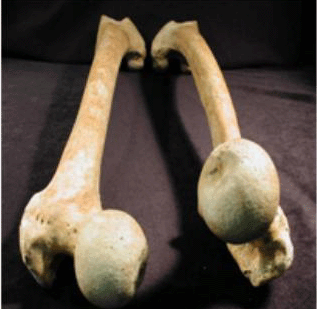
While I think the above cartoon schematic is instructive for understanding how femoral version is calculated, I think this picture from my friend Bill Hartman’s post (Hip Mobility: Femoral Anteversion) better illustrates the contrast between “normal” and excessive anteversion.

Can you imagine how the orientation of the knee, lower leg, and foot would change if the femur on the right was re-oriented so that the femoral neck was the same as the one on the left?

Excessive femoral version, in either direction, will have a significant effect on the performance of the entire body and a failure to recognize the presence of such a structural deviation may result in off-ice training exercises that appear “correct” externally to be damaging internally. As a result, it is worth the time to assess for femoral version angles in hockey players. Check out the video below for a quick walk through on how you can assess for excessive hip ante- or retro-version in just a few minutes.

An idea that didn’t come through sufficiently in the video is that EVERY femur has properties of ante- or retro-version. 8-15° is considered within normal limits and “excess” is generally considered anteversion > 30° and retroversion less than 5°. That said, any deviation outside of normal limits is going to have an effect on the availability of rotational movement. When I mentioned that I was thinking Matt’s left femur was retroverted and the right was anteverted (outside of the normal limits in those directions specifically), I probably should have said that left femur was more retroverted than right, or that his right was more anteverted than his left. Following Craig’s Test, it was apparent that his left femur was in fact “normal” (version within normal limits), but the right femur was anteverted.

An important take home from this assessment is that the total rotation ROM is the true indicator of unilateral limitations. Matt had more expressed external rotation ROM on the left than right, and more internal on the right than left, but the total rotation ROM between the two sides was relatively equivocal. This indicates that differences in either internal or external rotation ROM from one side to the other are either:

  1. An ossessous adaptation that should be recognized and appreciated, but cannot be corrected; or
  2. A positional change in the pelvic structures that causes a change in the expression of rotational ROM direction tendencies

In the case of the latter, Craig’s Test rules out that the findings of a tendency of a hip to have more internal or external rotation ROM in comparison to the other hip is a result of a change in the orientation of the pelvis because Craig’s Test is strictly a measure of femoral bony orientation relative to other femoral landmarks (pelvis is taken out of it altogether).

The assumption that all hips are created equally and that ROM norms can be blindly imposed on all hockey players is dangerously misguided. Of the first 30 elite level hockey players (primarily USHL, OHL, NCAA D1, and professional players)  I’ve assessed at Endeavor Sports Performance over the last few weeks, 10 (33%) have either a unilateral or bilateral femoral version angle outside of the norm. Spotting these structural deviations early will help prevent unnecessary damage directly to the femoroacetabular joint structures and indirectly to adjacent structures affected by rotational limitations at the hip. This is true during both on- and off-ice activities. By providing the player with an understanding of what corrective exercises they can do to maintain joint integrity and what positions/movements they should avoid, the player can stay within his/her individual limits, optimizing performance and minimizing injury risk.

To your success,

Kevin Neeld

Please enter your first name and email below to sign up for my FREE Athletic Development and Hockey Training Newsletter!

We’re wrapping up another great week at Endeavor. On a personal note, I’ve restored my eternal sense of optimism that tends to dwindle when I don’t eat, lift, or sleep as much as I’d like. It might also have something to do with the fact that I’ve watched this video at least once every day this week.

Turns out when you surround yourself with inspirational, unconditionally positive messages, you tend to be more positive! Although, I never thought Fresh Prince would be that source of inspiration. I’m also nearing the final stages (within 7 days) of completing a HUGE project, so stay tuned for announcements on that (you won’t want to miss it)!

There has been some exceptional content additions to Hockey Strength and Conditioning over the last couple weeks. In no particular order:

Video: International Hockey Panel with Igor Larionov
This is another USA Hockey American Development Model video that has leaked into our hands. Igor Larionov has about as impressive of a hockey success record as anyone, so it was great to get his perspective on an assortment of hockey development topics. If you’re a true student of the game, you’ll really enjoy this!

Click here to watch >> International Hockey Panel with Igor Larionov

Program: Beginner Phase 2 Off-Season Training Program from Darryl Nelson
Darryl Nelson added Phase 2 of his beginner off-season hockey training program. I recently read an article on this year’s NHL combine (someone posted this in a HockeySC.com forum thread) commending two players from Darryl’s USA NTDP on their performance in the off-ice tests. It’s great to see Darryl’s work being rewarded (indirectly). For the millions of hockey players out there aimlessly following unguided programs that lack organization and progressions (or any semblance of an intelligent thought in general), you’d be much better off just downloading Darryl’s program and following that.

Click here to get the program >> Beginner Phase 2 Off-Season Training Program

Video: Bar Complex from Sean Skahan
Sean added a video of a bar complex that he uses late in the off-season. This is typically the time of year where the off-ice training focus changes from hypertrophy or strength development to more of a work capacity orientation. This is in conjunction with an increase in on-ice work. Barbell complexes are certainly a means of developing this quality, assuming the athletes know how to perform all the involved exercises with perfect technique. This is especially important as fatigue tends to negatively affect exercise execution in general, Mediocre form in the beginning will quickly turn to garbage form. Whether you use the exact exercises Sean does in your barbell circuits or not, exercise proficiency should be foundational.

Click here to watch >> Bar Complex

Article: Hockey Strength and Conditioning Roundtable: Facility Design Edition

Last, and most awesomely, Mike Potenza, Darryl, Sean and I posted a roundtable discussion on facility design. The roundtable is a new feature we’re adding to Hockey Strength and Conditioning, and because well all have different backgrounds and work in relatively different settings, the diverse perspective should be insightful for our readers. Facility design was a great topic to kick off the roundtables because it will ultimately drive the design of your programs and provide guidelines (for better or worse) on what you’re able to do with your players. Facility design will determine maximum athlete volume, exercise selection, how to pair exercises, and the overall flow of the program. If you’re a hockey training professional this is a must-read. We’ve made a lot of mistakes at Endeavor that you can avoid my checking out the article.

Click here to read >> Hockey Strength and Conditioning Roundtable: Facility Design Edition

After you’re done reading the articles and watching the videos, hop on the forums and check out the two posts on the NHL Combine and the BU Psychology Professor and post your comments about those.

If you aren’t a member yet, fork out the $1 to test drive Hockey Strength and Conditioning for a week. If it’s not the best buck you’ve ever spent, I’ll personally refund you!


To your continued success,

Kevin Neeld
Please enter your first name and email below to sign up for my FREE Athletic Development and Hockey Training Newsletter!

Welcome back for Part 2 of “Become a Hockey Training Rockstar.” If you missed Part 1, you can check it out here: Become a Hockey Training Rockstar-Part 1

Before I jump into the final three tips, I want to let you know that I started a new group on LinkedIn called “Hockey Training“. If you don’t have an account on LinkedIn, I encourage you to create one. It’s great for networking and job searching purposes. After you do, come join my group here: Hockey Training. The goal is to use the group as a way to help players find quality training centers, students to find internships, coaches to find jobs, and for everyone to share information.

On to today’s post…

3) Lead with Intensity
Whether players realize it or not, EVERYTHING they do is observed by those around them and causes a reaction of some sort. Players look to their surroundings for cues on how to conduct themselves, and attitude, for better or worse, is highly contagious. In a training setting, the players that get that sick look in their eyes and fight through tough parts of the training program such as sets to failure, isoholds, and conditioning, inspire others to do the same. Having a single person in every group that operates with a high level of intensity can completely change the group/team dynamic.

Intensity

4) Be Coachable
Every player takes a different path to excellence. The rate of progress and ultimate end point is different for everyone. That said, nothing facilitates a more direct, expedited route than quality coaching. Sometimes players find some success, and then think they have it all figured out. This is especially true with skilled players that have achieved on-ice success without, up to that point, putting in any significant time or effort in an off-ice training setting. It always catches up with them. The players that neglect the off-ice training side of things tend to have careers limited by constant and nagging injuries. For many players, this is dream-limiting; for players that make it to the most elite levels, this separates them from more playing time (and consequently an absolutely sick amount of compensation!). Players need to stay coachable throughout their development process. If a coach tells you to do something, do it. Their job exists to help you.

Step 1: Show up. Step 2: Be coachable.

With age comes wisdom.


5) Think of the Team
Success in hockey, as with all team sports, relies on the collective effort of an entire group. Whether you’re the best or worst player on the team, you still have a role. When I worked with a couple younger teams last season, I constantly encourage the kids to ask themselves “is what I’m doing right now going to help or hurt the team?” Put in this light, kids were more hesitant to make smart-ass comments to their teammates, and were more likely to help provide quality (read: mature) feedback to their teammates on how to perform exercises better. In small group training settings, I try to send the same message. Even if we have a group of kids that play on competing junior teams, when they’re training together, they’re on the same team. Players should be willing (dare I say, eager?!) to help out their group/teammates. This facilitates camaraderie, a more enjoyable training experience, and ultimately better results.

That’s a wrap for this two part series on “How to Become a Hockey Training Rockstar.” These principles don’t just apply to hockey training scenarios, but to on-ice work as well. While some of these concepts are a few steps removed from the direct message sent by Ryan Lee and a few of his other presenters, all of these ideas were inspired by the idea that success in business, in hockey training, or in anything else should be built upon passion, integrity, focused intense work, mental flexibility, and a willingness and desire to help others.

To your success,

Kevin Neeld

Please enter your first name and email below to sign up for my FREE Athletic Development and Hockey Training Newsletter!

Over the weekend I made a trip up to Stamford, CT to attend Ryan Lee’s Continuity Summit 3. For those of you that don’t know Ryan, he’s successful marketing coach with roots in the fitness industry.

It’s funny that some people in the fitness industry genuinely blame Ryan for the unscrupulous use of his information. Undoubtedly, this is a serious problem. As I mentioned in Internet Hockey Training Experts, there are lots of people claiming to be experts in the area of hockey training that are happy to take your money for low-quality products and services. In fact, I’ve received “networking” emails from a few of them. My responses generally go:

“I get a lot of emails from guys that sell products online, but don’t actually train people for a living. I’m not interested in pursuing joint ventures with people that are deceptive about their expertise.”

Sometimes I get a response; often times I don’t. That said, blaming Ryan for people using his information the wrong way is completely insane. It’s like a player coming to train at Endeavor Sports Performance, getting ridiculously fast, and then boarding someone from behind their first game back on the ice and a parent saying, “Kevin should really be more selective about who he trains.” C’mon.

Ryan has been a huge help to me over the years, and I was really looking forward to this weekend. I feel at home being surrounded by entrepreneurs; it’s energizing to be in a room full of people relentlessly pursuing their dreams. That said, I almost didn’t make the trip. I woke up Thursday morning after my 7th consecutive night of less than 6 hours of sleep (<8 hours results in a statistically significant decrease in my pleasantness), went into Endeavor and coached hockey groups at 8:30, 10:00, 11:30, 1:00, 3:00, and 4:30 and was completely floored at 6 when it was time for me to start heading North. I’m glad I sucked it up and made the trip because I feel completely rejuvenated now.

While the main focus of the Summit was on finding ways for business owners to add value to their products and services to better serve their clientele, there were a few take homes from the seminar that I think apply directly to hockey training and player development. Stealing the analogy of becoming a rockstar from Ryan’s presentation…

5 Tips for Becoming a Hockey Training Rockstar

1) Be Passionate
Passionate people have a better vision of how short-term sacrifices lead to greater long-term gains and generally accomplish more than their peers. In terms of hockey training, there are no quick fixes. The only way to succeed is to have a clear vision of where you want to go and consistently take steps toward getting there. This isn’t always easy, but is ALWAYS worth it. On a personal note, I’ve never really been good at anything (insert sad face here). The whole idea of “natural” ability alludes me. In the areas of my life where I’ve found success, it’s been because I knew exactly what I wanted and I’ve pursued it with an absolutely insatiable drive and a failure to recognize failure as an option. This is one of the reasons why I vibe so well with other passionate, driven people in any field, and why I pursued a career in helping like-minded players fulfill their goals and achieve their dreams. While the 4 tips to come hold merit, everything stems back to being passionate. Passion is the fuel that feeds the fire of success.

I get chills every time I watch this


2) Have Integrity
Integrity is simply doing the right thing, even when no one is watching. The most sorry kids on every hockey team are the ones that jump in the front of the line and work hard when the coach is watching and then screw around and loaf when the coach isn’t. These players have no respect for themselves, their coach, their teammates, or the game, and will inevitably fail to develop (or adjust their attitude). Doing the little things right is important. In a hockey training setting, things like foam rolling, static stretching, diaphragmatic breathing exercises, etc. aren’t the “sexiest” training strategies, but they’re just as important as everything else. As a coach, I can’t babysit every player throughout every part of their training. They need to take ownership of their program and do what’s expected of them. In reality, it’s their development that’s at stake. The players that do the little things right ALL the time, will find more success over the long run.

“Winning is not a sometime thing: it’s an all the time thing. You don’t win once in a while; you don’t do the right thing once in a while; you do them right all the time. Winning is a habit. Unfortunately, so is losing.” – Vince Lombardi

Check back in a couple days for part 2!

To your success,

Kevin Neeld

Please enter your first name and email below to sign up for my FREE Athletic Development and Hockey Training Newsletter!

Use CODE: "Neeld15" to save 15%