

Today I’m excited to share a guest post from Kelly Bento, Founder of Soleil Well, a Red Light Therapy company that I’ve personally used and recommended to all of our athletes. Kelly has been a great resource, as she’s on top of the latest research on the health, training and performance benefits of red light therapy (also known as Photobiomodulation). In this post, she shares a concise summary on:
I also asked Kelly to put together a summary of the different available red light products and the pros/cons and use cases for each. My goal in sharing this information is to help spread accurate information on the benefits of red light therapy, which I think is still one of the most powerful and underutilized “recovery” strategies available to athletes.
As a special “thank you” to our community, Kelly is offering a free “Red Light Torch” ($250 value) with the purchase of any large mat (highly recommend for anyone that travels) or panel. Just enter “NP” at checkout.
Enjoy!
What the Research Shows and Why Output Quality Determines Results
Photobiomodulation (PBM), often referred to as red and near-infrared light therapy, is now common across elite sport environments. Panels are found in weight rooms, portable systems travel with teams, and localized devices are used in medical and performance settings.
Despite this widespread adoption, outcomes remain inconsistent. Some athletes and staffs report meaningful improvements in recovery, readiness, and training tolerance. Others report little beyond subjective benefit.
From a high-performance perspective, this inconsistency is not surprising. If the input is not measured and controlled, the outcome cannot be predictable. PBM is no exception.
PBM Is a Dose Dependent Physiological Input — Not a Wellness Trend
At a cellular level, PBM acts primarily on the mitochondria. Specific red and near-infrared wavelengths (approximately 630–660nm and 810–880nm) interact with cytochrome c oxidase, a key enzyme in the electron transport chain.
This interaction has been shown to influence:
Crucially, PBM follows a biphasic dose response:
In practical terms: PBM only works when it is accurately dosed and repeatable.
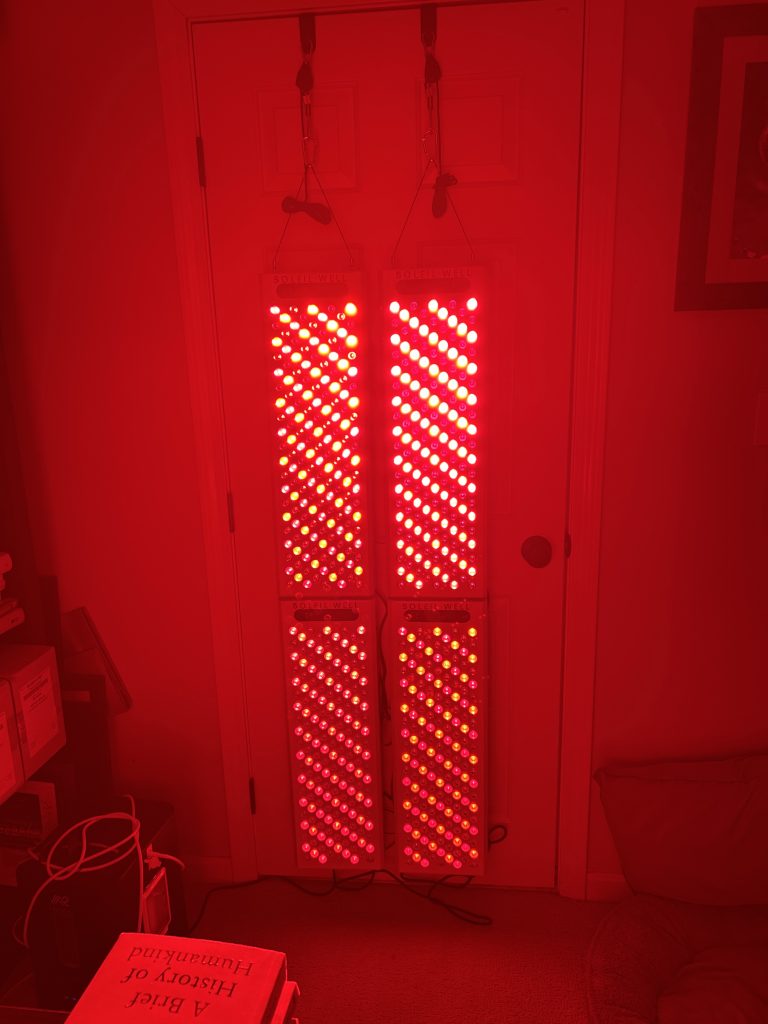 My “2×2” Standard and “Custom Wavelength” red light panel set-up on the back of my home office door
Training Adaptation: Where PBM Is Often Misunderstood
PBM is frequently categorized as a recovery tool. In elite training environments, its more impactful role may be its influence on fatigue management and training adaptation, particularly during dense competition schedules.
Studies demonstrate that appropriately dosed PBM can:
For teams managing congested calendars, travel, and veteran rosters, the goal is not simply faster recovery but maintaining availability and output over time.
Autonomic Regulation, HRV, and Readiness
One of the most consistent applied outcomes associated with properly delivered PBM is improvement in autonomic balance, commonly monitored via heart rate variability and resting heart rate.
In applied professional sport settings, systemic PBM has been associated with:
These observations align with controlled research demonstrating PBM’s influence on central and autonomic regulation, including parasympathetic activity. Importantly, these effects are observed only when delivered output is stable, verified, and repeatable. When output varies between sessions or devices, HRV trends often become noisy or inconclusive.
An Often-Overlooked Mechanism: Mitochondrial (Metabolic) Water
Beyond ATP production, efficient oxidative phosphorylation produces metabolic water as a direct by-product of electron transport.
This intracellular water:
Unlike oral hydration, metabolic water is generated inside the mitochondria, where hydration is most biologically relevant. PBM improves the efficiency of this process by enhancing electron flow and reducing mitochondrial inefficiency.
Why This Matters for Travel and High-Load Periods
Air travel reliably imposes:
Even well hydrated athletes can remain intracellularly dehydrated due to impaired mitochondrial efficiency. Systemic PBM, particularly full body application, has emerged as a practical countermeasure to support post-flight recovery and readiness.
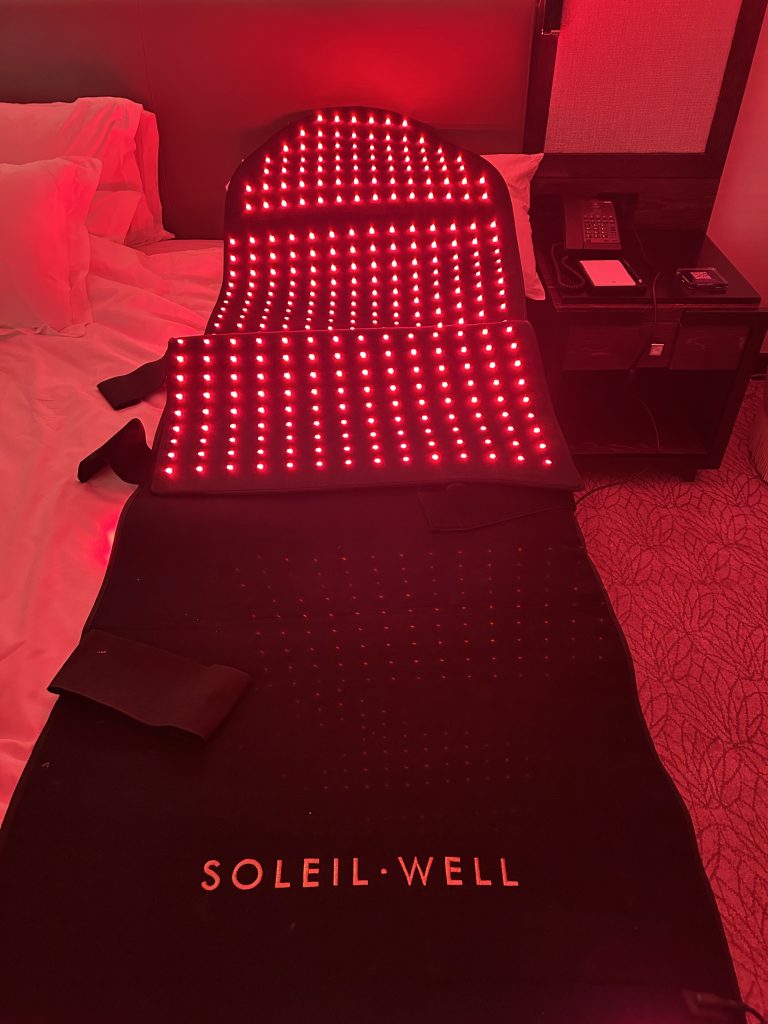 I bring my red light mat from Soleil Well on every road trip. Light weight, and easy way
to continue experiencing the benefits of red light while traveling.
The Industry Problem: Why Results Vary So Widely
The current PBM market resembles the supplement industry prior to third party testing:
Devices labeled identically can differ substantially in:
When results vary between athletes or facilities, the limitation is often not PBM itself, but irreputable products and uncontrolled dosing.
What Performance Professionals Should Look for in a PBM Device
Key variables that materially affect outcomes — and are often not tested or disclosed:
Without these, PBM becomes guesswork rather than a controllable physiological input.
Why Verification Matters in Elite Environments
In elite sport, no performance input is accepted without measurement — force plates, GPS, metabolic carts, imaging. PBM should be held to the same standard.
Why Soleil Well is Different
Soleil Well devices are practitioner designed and built around the core principles of photobiomodulation science: precise wavelength selection, verified delivered output, and repeatable dosing. Each device is independently tested and verified prior to deployment, ensuring that the light exposure programmed is the light exposure delivered. This level of verification allows PBM to be used as a true physiological input—one that can be applied intentionally, reproduced consistently, and integrated alongside other performance technologies. Soleil Well prioritizes accuracy, safety, and biological relevance so we can move beyond assumption and use light with confidence and purpose in our training facilities and programs. Reference below product comparison chart for recommended products and intended uses.
Refer to the product comparison below for recommended devices and intended use cases.
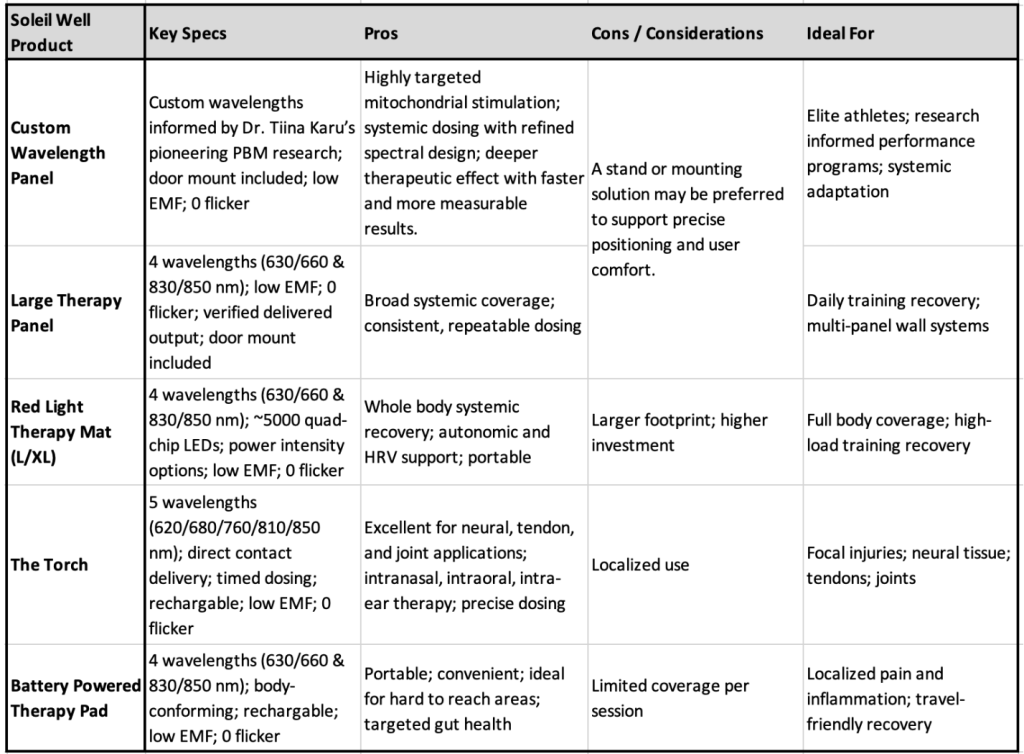
Which is best for you?
It depends on your goal – reference below table or contact me directly for consultation on product selection.
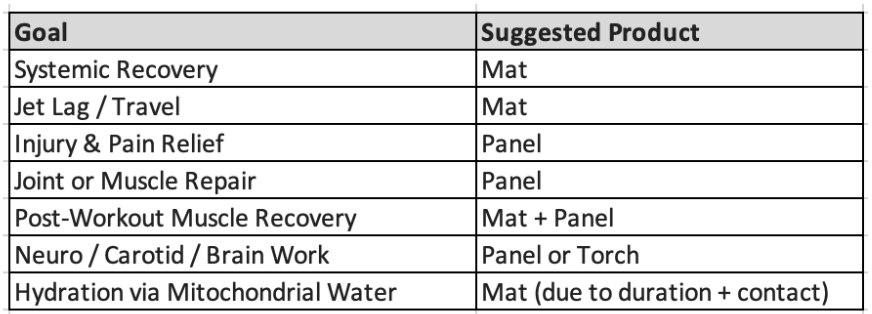
References
Karu T., J Photochem Photobiol B, 1999; Wong-Riley MTT et al., J Biol Chem, 2005; Poyton RO, Ball KA., Free Radic Biol Med, 2011; Huang YY et al., Dose Response, 2011; Leal Junior ECP et al., Lasers Med Sci, 2008; Leal Junior ECP et al., Lasers Med Sci, 2010; De Marchi T et al., Lasers Med Sci, 2012; Ferraresi C et al., Photochem Photobiol, 2015; Vanin AA et al., Photomed Laser Surg, 2016; Barrett DW et al., Neuroscience, 2014; Saucedo CL et al., Photobiomodul Photomed Laser Surg, 2020; Mitchell P., Nature, 1961; Wallace DC., Annu Rev Genet, 2012; Pollack GH., Int J Mol Sci, 2013; Hamblin MR., AIMS Biophys, 2016.

 Use CODE: "Neeld15" to save 15%