It’s been about a year and half since Ultimate Hockey Training was first released, and since that time I’ve gotten a lot of flattering feedback about the book. It’s humbling to think that UHT could positively impact hockey programs all over the world,  and I’m incredibly grateful for the continued support I receive from you and everyone that has purchased Ultimate Hockey Training.
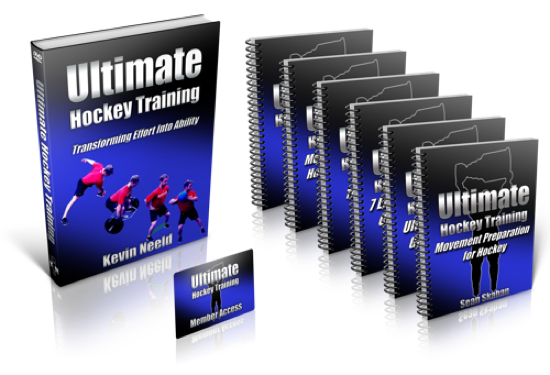
Ultimate Hockey Training

As I’ve said in the past, I take feedback from my readers into serious consideration and am constantly thinking how I can evolve to offer better information, products, services, etc. I’m aware that, while some folks in the hockey community find the underlying theories, research, and general philosophy behind effective off-ice training intriguing, ultimately people are more interested in the “what” than the “why”. This was the major reason I created the “Ultimate Hockey Training Insider”, a membership section for UHT customers that wanted access to the programs I write for our programs at Endeavor. While I’m a firm believer in the power of program individualization AND being trained by a competent strength and conditioning coach with a good eye for movement, the reality is that there are far more kids/players that DO NOT have access to these services than those that do, and following a well-written program is infinitely better than falling into the typical trap of programs passed down from a bodybuilding culture.

I realize, however, that it can be difficult to follow along with some of our programs if the exercise names are foreign to you. Furthermore, it can be a bit of a guessing game knowing whether or not you’re performing the exercise correctly or not, as we tend to coach some exercises differently than what may be considered normal. Naturally, this has led to several people asking me if I had videos of the exercises. Believe it or not, I had actually thought of that preemptively, and had a professional videographer film ~350 exercises to be included with the book…only to find out that he was either too busy or too disinterested to complete the project, leaving me incredibly frustrated and you with no videos.

Fast forward to 6 months ago, David Lasnier, Matt Siniscalchi and I compiled a list of EVERY exercise we’ve used in a program (not just the ones I referenced in Ultimate Hockey Training), and forward to 2 months ago when Matt and I filmed 750+ exercises in a 4-day time period (our bodies are just now starting to recover!), followed by me editing and exporting all the videos, and Matt building the online database. Needless to say, this was a HUGE undertaking, and one that I will not likely ever take on again in the future, but I am extremely excited that it’s done, and now ready for you!

Introducing the Ultimate Hockey Training Exercise Database!

I’ve always viewed Ultimate Hockey Training not just as a hockey training book, but as an evolving illustration of my philosophy. The “Insiders” section, then, is essentially an early access pass to see how programs are changing over time. The video database provides an incredible tool for players, coaches, and S&C professionals to try new exercises, make parallel substitutions when certain pieces of equipment aren’t available, and ultimately to train more effectively. The database is divided into 9 sections, which are further subdivided into 39 categories:

  1. Self-Myofascial Release
    1. Foam Roll
    2. Lax Ball
  2. Dynamic Warm-Up/Mobility Exercises
    1. Dynamic Warm-Up
    2. Mobility Exercises
  3. Speed Training
    1. Linear
    2. Lateral
    3. Transitional
  4. Power Training
    1. Plyometrics
    2. Med Ball Throws
    3. Olympic Lifts
  5. Lower Body Strength
    1. Pulling
    2. Pushing
  6. Upper Body Strength
    1. Horizontal Pulling
    2. Horizontal Pushing
    3. Vertical Pulling
    4. Vertical Pushing
    5. Arms Pulling
    6. Arms Pushing
    7. Forearms
  7. Core Training
    1. Anterior Core
    2. Lateral Core
    3. Diagonal Core
    4. Rotational Core
    5. Diaphragm/Inner Core
    6. Anterior Hip
    7. Lateral Hip
    8. Medial Hip
    9. Posterior Hip
    10. Scap Work
    11. Rotator Cuff
    12. Neck
    13. Carries
  8. Conditioning
  9. Flexibility
    1. Lower Body Anterior
    2. Lower Body Medial
    3. Lower Body Posterior
    4. Upper Body Anterior
    5. Upper Body Posterior
    6. Combination
    7. Band-Assisted

Get more information on Ultimate Hockey Training and the exclusive Insider section here!
>> Ultimate Hockey Training
<<

There are currently 756 exercises live in the exercise database of the Ultimate Hockey Training Insider membership section. We filmed another 50 the other day, including a lot of the corrective work we use. As we evolve our exercises, I’ll continue to build the database. I’ve also changed the layout of the site to make it easier for members to log-in and get quick access to the programs and videos.

With the off-season upon us, and new programs being continually added to the Insider section, this is the PERFECT time to grab a copy of the book and dive into the incredible collection of resources available exclusively to Ultimate Hockey Training Insiders!
Ultimate Hockey Training-Membership Card Insider Small

Get more information on Ultimate Hockey Training and the exclusive Insider section here!
>> Ultimate Hockey Training
<<

To your success,

Kevin Neeld
UltimateHockeyTraining.com

Please enter your first name and email below to sign up for my FREE Athletic Development and Hockey Training Newsletter!
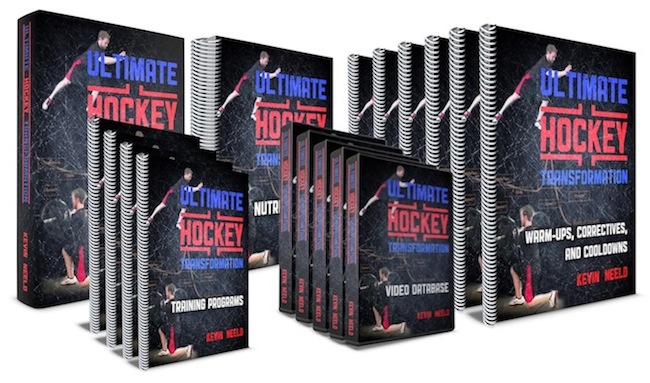

Ultimate Hockey Transformation Pro Package-small

Ultimate Hockey Transformation is the follow-up training program series to Ultimate Hockey Training, and features year-round hockey-specific off-ice training programs for players at the U-14 age level and above.  The Ultimate Hockey Transformation system includes:

  1. In- and off-season training programs for players at the U-14, U-16, U-18, and Junior/College levels totaling 120 weeks of programming!
  2. 228 high quality videos demonstrating how to perform every exercise in the program with perfect technique
  3. A 65-page manual outlining everything you need to know to successfully use the Ultimate Hockey Transformation system!
  4. Specific warm-ups, corrective exercise, and cooldowns to help you maximize your training preparedness and recovery
  5. A Performance Profiling Sheet so you can track your progress over time
  6. The UHT Recovery Monitoring Log so you can prevent overtraining before it occurs!

Simply, following the RIGHT training program can completely alter the course of your career. Propel your game to the next level by following training programs proven to deliver game-changing results!

Results backed by 100% Money Back Guarantee!

Today I’m excited to let you know that we have a guest post from my friend Maria Mountain. I’ve known Maria for a few years now and admire her work. In fact, her newsletter is one of the only ones that I’m still subscribed to and one of even a smaller list that I read every time! She was kind enough to offer some tips on goalie-specific training for you today. Enjoy!

Enter Maria…

This one is for the goalies and it focuses on post-to-post power, which is the key ingredient to speed.  I know it is often referred to as post-to-post speed but I think the term ‘power’ is better suited because it is typically a single effort.

There may be repeated efforts within a short time span but typically you are not scrambling back and forth between posts in succession (hopefully not anyway).

So when we talk about power we are talking about the rate of force production.  How quickly can you fire your muscles and direct force into the ice?  There are two ways you can improve your power 1) you can increase your strength 2) you can increase the rate of force production.

Today I am going to give you some exercises for both, but make sure you start with a good foundation of strength.

I do appreciate that not every lateral push in the crease is a maximum effort, but if we can increase your power capacity, then even when you are pushing side-to-side at 75% of your top speed, you will still be using a relatively lower percentage of your max effort.  Does that make sense?  In other words, by improving your post-to-post power you will be using less energy throughout most of the game, leaving more gas in the tank for those extended penalty kills.

The exercises in the video are not meant to be a workout unto itself; that would be overkill.  Instead, add one or two of the exercises to you regular workouts, twice per week.

The volume will stay low for these exercises because you are either trying to build strength or power, so you do not want to work to fatigue.  Here are some guidelines, but remember, these exercises should be added to your existing base of strength…

  1. ½ Kneeling Crease Push – 2-3 sets of 8 reps each
  2. Bottom Up Lateral Lunge – 2-3 sets of 4 reps each side
  3. Lunge Lateral + Lateral Bound – 2-3 sets of 3 each way
  4. Leap Frog Lateral Bound – 2-3 sets of 4 each side


Hope that helps – happy training.

For Kevin’s readers only! A free copy of the Goalie Stretch Solution – a follow along flexibility routine for hockey goalies and a complete dynamic warm-up so you are ready to play from the second the puck drops.  Just click HERE, register as a new user and get instant access for FREE.

Strength and conditioning coach Maria Mountain, MSc is the owner of Revolution Sport Conditioning in London, ON and the founder of www.HockeyTrainingPro.com.  Her training systems have helped athletes from recreational to Stanley Cup and Olympic Champions maximize their potential while reducing their risk if injury.

To your success,

Kevin Neeld
UltimateHockeyTraining.com

Please enter your first name and email below to sign up for my FREE Athletic Development and Hockey Training Newsletter!
Finding the “optimal stride” is important for hockey players at all levels. It helps ensure they’re maximizing their range of motion and power, and not compromising skating efficiency. Because this is such an important topic, I’ve written several articles in the past on frequently overlooked factors that dictate what may be optimal for any given individual. You can read a few of those at the links below, but I’d encourage you to do a quick search on the site for “stride length” if you’re interested in reading more on the topic.

  1. 3 Keys to Developing Optimal Skating Technique
  2. Limitations to Optimal Skating Performance
  3. Breakaway Hockey Speed Q&A

Assuming the player does in fact have the requisite bony structure and strength capacity to sustain a low position while skating, the two keys to retraining a player to maintain a deeper skating depth are to:

  1. Remove soft-tissue limitations to deeper skating depths
  2. Practice skating specific patterns in a deeper stance

I suspect, in comparison to some of the topics referenced in previous articles, these are two training components that many people in the hockey world are familiar with, and are probably the two that people gravitate towards. That said, I think there are different ways to approach this than simple groin stretches and continually cuing players to skate lower or bend their knees more.

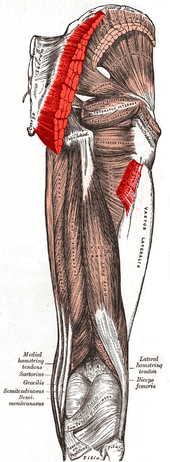
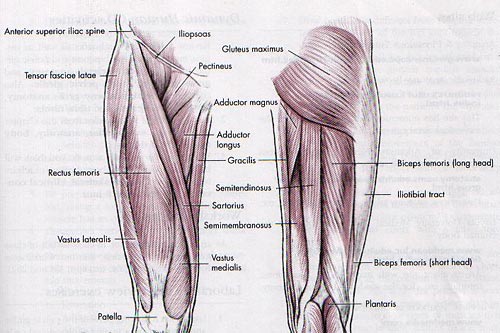
When our players come back to us at Endeavor, two extremely common limitations I continue to notice are generalized stiffness in the posterior hip (posterior hip capsule, hip external rotators and glute max), and poor relative motion between the medial hamstrings and the posterior adductor magnus. Both of these can limit depth on the stance leg by interfering with smooth hip flexion, as well as causing some problems on the stride leg.

 Posterior Hip Musculature

An image of the posterior hip (from wikipedia.com) with the glute max cut, illustrating many of the underlying structures than tend to become stiff in hockey players.

Hip Musculature

An image of the hip and thigh musculature (from T-Nation.com). Note the adductor magnus on the inside of the image on the right, and it’s proximity to the two medial hamstrings: semitendinosus and semimembranosus.

While addressing posterior hip capsule stiffness could be an entire post in itself, I’ve found that restoring relative motion between the posterior adductor magnus and medial hamstrings is fairly easily accomplished with some basic Active Release work. Of course, not everyone will have access to an A.R.T. provider, so it’s helpful to have some ways to troubleshoot this on your own. I’ve found that players respond pretty well to “treating” this area themselves with a lacrosse ball placed on top of a box/table (preferably a hard surface). Instead of just rolling around, I encourage players to take a more “seek and relax” strategy, slowly rolling to find sensitive/dense areas, and then just slowly let their leg sink deeper onto the ball as they try to relax and let the tension dissipate. Once they’ve been able to ease some of the tension, I’ll instruct them to slowly straighten their knee, which will slide the hamstrings past the posterior adductor and help restore some relative motion between the structures.

Self-Myofascial Release for Posterior Adductor

You can then follow that up with some self-mobilizations to help reinforce hip adduction range of motion through a large arc. This is one we use fairly frequently. You can modify this slightly by turning the extended leg so that the toes point more toward the ceiling.

Lateral Kneeling Adductor Mobilization

As you may suspect, improving hip mobility takes a multi-faceted approach and there are dozens of “self-myofascial release”, mobility, and stretching exercises than can be used to accomplish this. The examples above are simply two powerful ones that many people may not be aware of.

Once you’ve established adequate range of motion, the next stage is to reinforce a lower skating position. This is best accomplished on the ice and can also be reinforced on a slideboard, but I’ve also gotten a lot of mileage out of an exercise I call the “2-Way Skater”. While skating naturally requires a propulsive action from the stride leg, skating depth (and therefore stride length) is largely influenced by the position of the stance leg. Also, the ability to transfer the force from the stride leg through the stance leg is dependent upon stance leg stability. For these reasons, the 2-Way Skater is an outstanding exercise to reinforce optimal skating depth, stance leg stability, and full stride leg extension. Check out the video I filmed for HockeySC.com several months ago that dives into how to perform the 2-Way Skater and what we’re looking for with the exercise:

Dissecting the 2-Way Skater

This is a simple 3-step off-ice approach to improving stride length in hockey players:

  1. Remove the soft-tissue restriction
  2. Mobilize the joint in a movement specific pattern
  3. Reinforce proper depth with a movement specific exercise

If you’re a young player that needs to work on maintaining a deeper skating depth, I’d encourage you to try these things, as well as follow a comprehensive training program as outlined in Ultimate Hockey Training. As always, please feel free to post your comments below!

To your success,

Kevin Neeld
UltimateHockeyTraining.com

Please enter your first name and email below to sign up for my FREE Athletic Development and Hockey Training Newsletter!
If you’ve been reading my work for a while you know I’m a big fan of Precision Nutrition. It’s an outstanding, very user-friendly nutrition resource that makes eating better as simple as possible. You may also know that I’m a big fan of Brian St. Pierre’s, who started working for PN relatively recently. Brian and I met while he was still working at Cressey Performance and I was interning there. Brian won me over as my go-to “nutrition guy” almost immediately because he:

  1. Clearly kept up with current research
  2. Could trap bar deadlift 500+ lbs (a nice change of pace from an overwhelmingly endurance-based profession)
  3. Forced me to drink a beer when we went out to celebrate my internship completion

In short, he knows his stuff and he “gets it” in terms of understanding how to work with people and not just following unnecessarily advanced and laborious text book recommendations. In fact, I respect Brian so much I asked him to write the nutrition manual to accompany my book Ultimate Hockey Training. I strongly believe Ultimate Hockey Nutrition is the best hockey nutrition resource available today; it continues to get great feedback.

Ultimate Hockey Nutrition

Yesterday, in the midst of a crazy-productive day for me, I learned that Brian’s presentation from an event at Cressey Performance was recently posted on Precision Nutrition’s website. The presentation, titled “Food Freakshow” discusses the future of our food supply, for better or worse. Some of the topics include:

  1. Putting fish in milk
  2. Cows that produce human breast milk
  3. Dinosaur Burgers
  4. The benefits of eating insects
  5. Why some scientists are weary of the FDA’s support of genetically modified food

Brian’s presentation covers a very controversial topic, and to his credit, he did an outstanding job of highlighting the potential pros and cons of each situation, as well as not confusing his opinion for fact. You can watch the entire presentation (or download the audio files) at the link below. Enjoy!

Watch the presentation here >> Food Freakshow

To your success,

Kevin Neeld
UltimateHockeyTraining.com

Please enter your first name and email below to sign up for my FREE Athletic Development and Hockey Training Newsletter!
Use CODE: "Neeld15" to save 15%