This was a post from Endeavor’s website that got such a great response that I wanted to share it with you.
As you know, I’ve recently teamed up with Michael Boyle (Boston University), Sean Skahan (Anaheim Ducks) and Mike Potenza (San Jose Sharks) to launch an incredible hockey training website: HockeyStrengthandConditioning.com.
On the site, U of Minnesota Strength Coach Cal Dietz shared an interesting article with us. The article outlined research with groundbreaking results. If you value your hockey career, you’ll read carefully!
This article outlined a study that took MRI’s of the hips of 39 NHL and NCAA Division I hockey players. Of the 39 players, twenty-one (54%) had labral tears, twelve (31%) had muscle strains, and 2 (5%) had tendinosis (degeneration of the tendon) of the hips. Overall, 70% of the players had irregular findings on their MRIs. Interestingly, the majority of these players were considered “healthy” at the time of the study, meaning they were okay to play.
As shocking as these results may appear, I wasn’t at all surprised. Similar results have been found in the shoulders of baseball players, and hockey players completely abuse their hips. Most players spend no time doing the stretches they need to (because they’re either too lazy or don’t know which ones they should do), have poor motor control of muscles around the hips (which tears up the joint and labrum!), and spend WAY too much time on the ice.
A couple weeks ago, I was on the phone with Mike Potenza (San Jose Sharks); he mentioned that in over 90% of cases, the players he sees that have sports hernias do little to nothing in terms of training. Everyone at the collegiate and professional strength and conditioning levels understand that good training can improve a player’s performance, lengthen their career, and keep them out of the surgeon’s office. Hopefully youth players and parents will get the message.
To your continued health and success,
Kevin Neeld
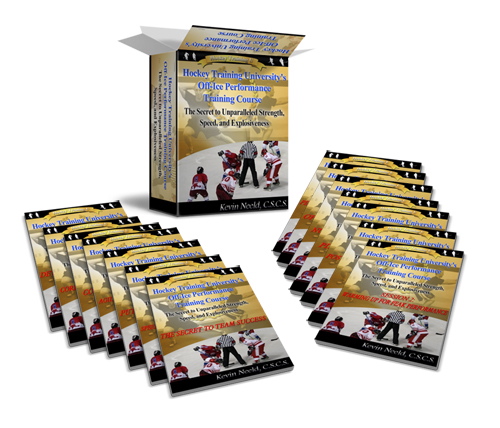
P.S. If you’re looking for a step-by-step training system to use this off-season, check out my Off-Ice Performance Training course. I continue to get incredible feedback about the exercises and progressions in the course, from NCAA D1 Strength and Conditioning Coaches down through parents of youth players (e.g. peewees). Download your copy today!
Please enter your first name and email below to sign up for my FREE Athletic Development and Hockey Training Newsletter!
Preventing Ankle Sprains Part 2
On Wednesday, we had a great post from David Lasnier. If you missed it, you should definitely check it out. Link below:
The first tip David made about keeping your hips inside of your outside foot when you transition is a huge point that all athletes should learn. Think of it as keep your center of gravity within your base of support. EVERY rolled ankle I’ve seen during a cutting maneuver is because of a failure to control hip position. For the hockey crowd, this is also the #1 reason people fall over the edge of a slideboard. It’s important that athletes are taught to load their hips during transitional movements. Not only will this decrease their risk of ankle sprains, it will also make them more efficient and explosive.
2) Strengthen your gluteus medius
As David noted, having sufficient strength in your hip abductors (muscles on the outside of your butt) will help you control your hips during ALL movements (linear, lateral, and transitional). Having sufficient strength in these muscles also helps minimize your risk to several knee injuries. If this muscle group isn’t strong enough and if the strength isn’t trained in proper movement patterns, your knees will cave in during landings and transitional movements. If nothing else, it will be excessive stress on various structures throughout your knee (e.g. lateral meniscus). Maintaining sufficient hip abductor strength is essential for all athletes.
3) Get rid of Nike Shox and other high-heeled shoes
My friend Eric Cressey once joked that everytime someone bought Nike Shox, a baby seal was clubbed. Of course, that’s ridiculous. We now know that TWO baby seals are clubbed for each Nike Shox purchase. Three reasons why:
1) They put you into a significant amount of ankle plantarflexion. Over time, you could LOSE dorsiflexion range of motion, which has significance for a ton of athletic movement patterns, including sprinting, lunging, and squatting.
2) Related to David’s point, they make your foot-to-ground contact less stable and therefore increase the risk of you rolling an ankle. Related to my above point, the ankle joint is significantly less stable in plantarflexion than dorsiflexion. This simply gives your ankle an easier path to roll when cutting.
3) If I told you to squat as much weight as you could and gave you the choice to do it while standing on an Olympic lifting platform or on couch cushions, what would you choose? Humor me. You’d choose the olympic platform (I hope). The couch cusions would make your surface less stable and would dampen the force you produce downward. Both of these things result in a decreased ability to express force production (e.g. make you weaker). David and I like Nike Frees. If you’re doing a lot of running, it may be worth picking up a pair of shoes with slightly more cushioning, but NOT a huge heel lift!
To your continued health and success,
Kevin Neeld
P.S. My very good friend and old teammate Pete Gross is running in the Boston Marathon this year. As you may know, most competitors need to raise some cash in order to run. Pete was an outstanding hockey player and one of the best captains I’ve ever played for. If you’re feeling giving and can spare a few bucks to help out a member of our hockey world, I’d consider it a personal favor if you donated to Pete’s cause here: www.firstgiving.com/petergross. Thanks!
Please enter your first name and email below to sign up for my FREE Athletic Development and Hockey Training Newsletter!
3 Tips to Prevent Ankle Sprains
Since I was away this weekend, I asked David Lasnier to put together another post for us. He has three great tips for you on how to prevent ankle sprains while performing movements that involve cuts or sharp direction changes. This is really one of those areas where a lot of people get hurt WHILE training, which is generally unacceptable. The first point in particular is a simple coaching cue that we use A LOT at Endeavor that athletes understand and can almost instantly reduce their risk of ankle sprains.
3 Tips to Prevent Ankle Sprains by David Lasnier
Ankle sprains are unfortunately a very frequent injury in a number of sports. There might be a variety of reasons why they happen. I am not here to tell you I can prevent every ankle sprain from happening or that I can explain the origin of each and every one of these injuries. However I can give you 3 tips that you can start applying today to lower the risk of that injury happening to you.
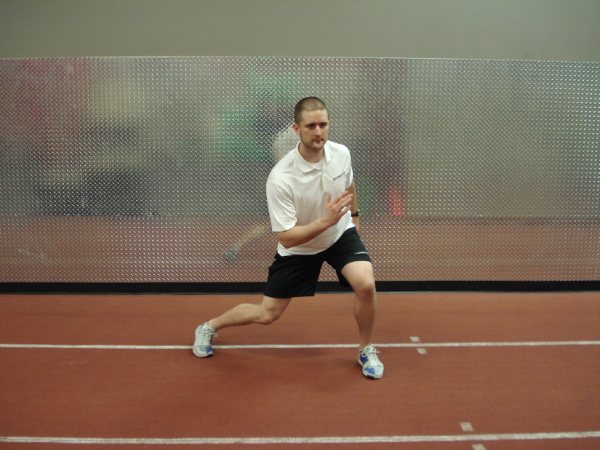
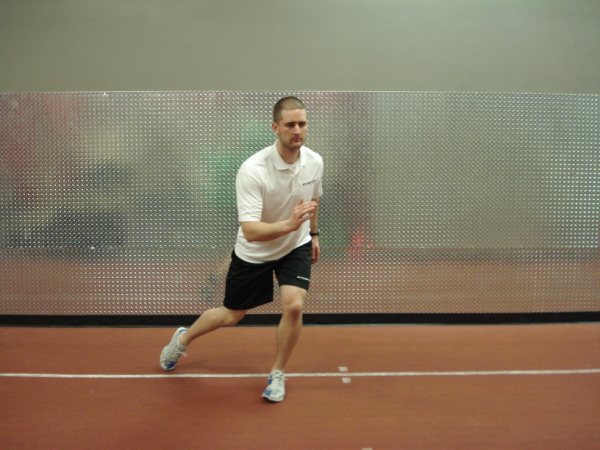
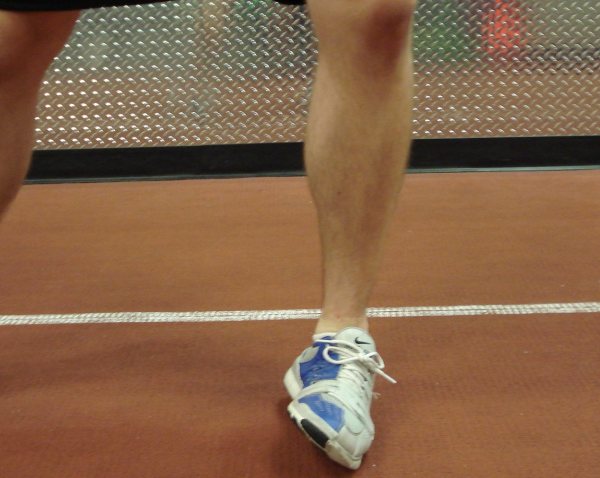
1) Keep your hips inside of your outside foot. When making a cut on the field or on the court, you are generally loading your outside leg before pushing off that same leg in a different direction. Doing so, you want to make sure that your bodyweight doesn’t travel outside your support leg. That means you want to stay low and you want your outside hip to stay inside of your outside ankle. The picture below shows how you want to keep your base of support (your hips) inside your ankle.
When your hips do travel over your ankle, it shifts your weight to the outside of your foot and increases the chance of your ankle going into inversion (rolling your ankle). The majority of ankle sprains happen with inversion at the ankle.
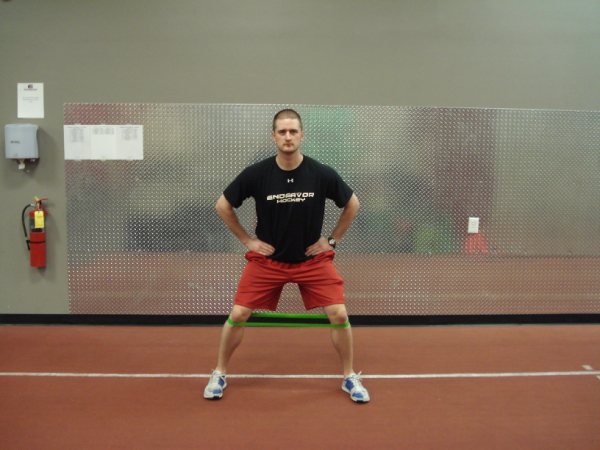
2) Strengthen your gluteus medius. Your gluteus medius is one of the most important hip abductor muscles and in most people it is fairly weak. You may think: what the hell does my gluteus medius have to do with changes of direction in sports? When you plant your foot in the ground to make a cut, the momentum continues to make your body travel in the same direction you were going. So, at some point you need to decelerate your bodyweight first, in order to transition that speed and momentum in a different direction. The gluteus medius, along with the other abductors at the hips, are going to be responsible for decelerating your body and prevent your hips and upper body from travelling past your ankles. If your gluteus medius is not strong enough to prevent that deceleration, your hips have more of a chance of going past your ankle and therefore, your ankle going into inversion. One of the best exercises to strengthen your gluteus medius is the lateral mini-band walk, which we use quite a lot at Endeavor.
3) Get rid of those Nike Shox (or any other high heel sneakers you’re wearing). With these kinds of sneakers, your heels are elevated over an inch off the ground. What happens when you plant your foot in the ground for a cut and the momentum of your body continues to travel in the same direction when your heel is elevated more than an inch in a sneaker? The momentum will make your foot move in your sneaker and off that high sole, which is going to take your ankle into inversion and increase the risk of sprain. Your best bets include: Nike Frees, Vibram 5 fingers or any cross-trainer shoes with a thin sole.
Hopefully if you’re not already applying these tips, you will start today. These 3 simple tips will greatly decrease your risk of ankle sprain.
Please enter your first name and email below to sign up for my FREE Athletic Development and Hockey Training Newsletter!
Developing Proper Breathing Patterns
A couple months ago I came across Carson Boddicker’s site and was blown away. He’s a really bright coach and has a lot of unique ideas about training athletes. I asked him to write something for you on the importance of developing proper breathing patterns, which is probably the most overlooked aspects of sports performance training and can have a huge impact on your health and performance.
Enter Carson:
Breathing is a critical piece of the movement equation and is one that has been almost ignored until recently. Many people simply breathe, and call it “good” if they do not suffocate, unfortunately this is far too simplistic as there is a “right” and a “wrong” way to breathe.
Unfortunately, we know that the majority of people fall toward the “wrong” way and incorrect breathing patterns lead to a gamut of movement dysfunctions. Improper breathing can lead to dysfunction as high as the TMJ (though some osteopathic physicians see proper breathing as having a mobilizing effect on the skull) and as low as the hips. In between, breathing plays a powerful role in cervical posture, carpal function, shoulder health, thoracic spine mobility, and lumbo-pelvic-hip stability via intra-abdominal pressure mechanisms. Better control at the pelvis, leads to more favorable mechanics of the joints above and below, making breathing a powerful ally in preventing lower extremity injury common in hockey players like sports hernia and athletic pubalgia. Restoration of proper breathing patterns can reduce tone in the majority of cervical muscles, aid in the reduction of forward head posture, and reduce tone of the hip flexors.
The biochemical effects of hyperventilation have powerful effects on fascial constriction and there are primary and/or accessory muscles in each and every fascial line presented by Thomas Myers. As we understand from the concept of tensegrity, it then stands to reason that breathing limitations alter all fascial lines, and ultimately lead to movement dysfunction. One could go as far as to say that due to the relationship between the obliques and intercostals of the lateral line, improper breathing can result in reduced function of the “anterior X” that controls and produces torque, and subsequently running, walking, and skating mechanics can be altered. An inability to check torques appropriately though the LPH complex is yet another risk factor for hockey related hip and groin dysfunction.
Proper breathing certainly provides great benefit to the athlete, is inimitable, and is of huge benefit to a vast array of movement dysfunction. Thus, there is little question that breathing must be a core competency. As the great neurologist Karel Lewit said, “If breathing is not normalized, no other movement pattern can be.”
So how does one go about normalizing breathing patterns as Dr. Lewit suggests?
First, before we go about correcting anything, we need to understand if something needs to be corrected at all.
Proper breathing involves the diaphragm contracting to compress the abdominal cavity, making more space for the lungs to expand. The best way to assess this is simply have the athlete in a seated position, palpate the lower ribs, the sides of the abdomen, and the iliac crest, and have him breath. Ideally, the athlete will expand his ribs into your hand with minimal elevation of the ribcage until late in the breathing cycle if at all. If he is unable to do so in seated, I suggest regression to supine positions (like in the first exercise below.
Once the player’s breathing proficiencies are identified, proper correction can commence.
I typically begin my athletes’ training at level where they first demonstrated poor patterns. If patterns look good in supine, but not prone, I will start them in prone. If they look fine in prone, but not seated, then training begins in seated positions, etc. Below are a few of my favorite breathing exercises.
Supine breathing is a great first step for many and can be progressed quickly. Ideally the bottom hand will rise vertically, and the top hand will demonstrate minimal movement.
Once the supine breathing is well patterned, I often progress to prone prayer position to work on facilitating posterior and lateral ribcage expansion. According to physical therapist Diane Lee, she finds posterio-lateral expansion to be most restricted in those with lumbo-pelvic-hip dysfunction like SIJ pain, groin strains, and sports hernia. It is one of the harder positions to master, so providing some feedback by springing on the posterior rib cage at the end of expiration and cuing the athlete to “breathe into my hands” often help solidify patterns.
While there are some exercises designed simply to focus upon breathing and breathing only, it is critical to be able to breathe effectively thorough an abdominal brace, so I challenge athletes in a number of positions and exercises that are traditionally seen as “rotational stability” and “anterior core” exercises. One of my current favorites is the breathing bench dog with hip flexion as it provides a great rotational stability demand, is lower level, and the contraction of the psoas develops a strong fixed point for diaphragmatic contraction.
Remember as with all we do as coaches, we should be constantly assessing and thinking about ways to help our athletes succeed. Understanding, coaching, and integrating breathing pattern work is no exception.
With the off-season upon most of the hockey world, I’m getting a lot of questions from players about how to add muscle mass. A few others want to shed some fat this off-season. I’m glad I’m getting the questions. The off-season is really the time where hockey players can make HUGE changes to their bodies and nutrition is a big part of that.
With that in mind, I want to introduce the best sports nutrition resource out there. Now, I’ll preface this by saying that Brian and I have plans to write a Hockey Nutrition Manual sometime in the near future. Unfortunately, the project keeps getting pushed back because Brian has “more important things” to do like “getting married” and “taking care of his new puppy” (which did a depth jump off a couch and broke it’s leg in the first week they owned it…the puppy was quick to learn Brian’s high intensity training mentality, picture below).
We WILL finish the Hockey Nutrition Manual before 2010 ends. In the meantime, there is an absolutely amazing nutrition resource that I think every coach, parent, player, and water bottle should own: Dr. John Berardi’s Precision Nutrition!
I’m still blown away that there are people out there that don’t own this. It’s the single best nutrition resource ever. It amazes me that people hesitate to spend money on this, but they’ll gladly spend hundreds of dollars on supplements. Precision Nutrition isn’t a weight loss guide. It’s not a muscle gaining guide. It’s a SYSTEM that teaches you how to manipulate your diet to achieve ALL of your health, performance, and body composition goals. If you need to gain muscle mass this year, Precision Nutrition will help. If in a couple years you need to shed some fat, Precision Nutrition will help.
The PN System includes: The Success Guide, The Diet Guide, The Quick Start Guide, The Super Shake Guide, 5-Minute Meals, The Individualization Guide, The Measurement Guide, The Plant-Based Diet Guide, The Maintenance Guide, and The Support Guide. It also comes with Gourmet Nutrition, my favorite cookbook!
Check out Dr. Berardi’s Precision Nutrition “Executive Summary”:
Covers everything you need to know about nutrition. Precision Nutrition contains everything you need to get the body you want.
Teaches you how to eat for your goal and your body. We teach you how to develop a custom nutrition plan unique to your physiology.
Written in plain English. We make advanced nutrition research easy to understand – and easy to use, right away.
1 year of 24/7 online support on our private member forum. You’ll need help, and with PN you get it – from our expert coaches and nearly 40,000 fellow members from around the world.
1 year membership to our online library of articles, e-books and software. Access our complete Exercise Video Database and thousands of pages covering every conceivable fitness and nutrition topic in the Member Zone.
Includes more than 25 goal-specific exercise programs by world-class coaches. We had the top coaches in the world develop exercise programs specifically for Precision Nutrition members.
Includes the PN cookbook, Gourmet Nutrition Volume 1. Good, healthy food can be delicious, and in Gourmet Nutrition we show you how.
Results 100% guaranteed. We put our money where our mouth is. If PN doesn’t work for you, we’ll not only give your money back, we’ll buy you another book of your choosing!
$50 off before April 15th! Order today for an unbeatable deal.
If you have questions about this system, please do not hesitate to contact me. This is the exact nutrition system that many of the top strength and conditioning professionals in North America use, and I know hockey players up through the pro levels that use it as well.
Make the smartest investment of your life and check out Precision Nutrition now!
To your off-season success,
Kevin Neeld
Please enter your first name and email below to sign up for my FREE Athletic Development and Hockey Training Newsletter!



 Use CODE: "Neeld15" to save 15%