A couple weeks ago, my colleague Dr. Jeff Cubos told me to check out a relatively new assessment protocol called the Bunkie Test. I had never heard of it before so I took a look and found some interesting stuff. We haven’t integrated these “tests” into our assessment protcol at Endeavor, but I am integrating a few of the concepts into our hockey training programs.

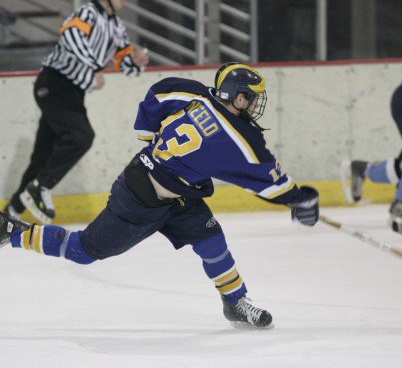
The whole idea behind the Bunkie Tests is to assess the performance of different functional lines within the body. As an example, there is a well established connection between the external obliques and contralateral (opposite side) hip adductors (“groin” muscles). They frequently serve integrated functions in athletic movements. If you look at this picture of me taking a slap shot while at Delaware, you’ll see that my upper body is turning to the left, while my right leg extends and external rotates. This means that my left external oblique and right hip adductors are decelerating the movement. On the opposite side of things, my right external oblique and left hip adductors are both shortening.

Slapshot

This is just one illustration of this connection between the trunk and hip “core” musculature. Below is a video of an advanced core training exercise we’ve been using with a lot of our athletes recently.

There is also a lateral connection between the obliques and same side hip abductors. A great core training exercise to strengthen this functional path is:

To your continued success,

Kevin Neeld

Ice Hockey Training
Hockey Strength and Conditioning

Please enter your first name and email below to sign up for my FREE Athletic Development and Hockey Training Newsletter!

Last week at Endeavor Sports Performance, my boss left a copy of the 2003 NHL Pre-Draft Combine packet with the test results in my office. I don’t put too much stock in absolute testing numbers (how many future NFLers have been studs at the combine and flopped in the show!). I think it’s more important to look at improvement within an individual. Having said that, I’ll never turn down an opportunity to see how the world’s elite level players are performing.

Other than how archaic some of the tests are, two things really caught my eye:

Average Bench Press (150 lbs): 9 reps
Average Bench Press (Total Weight Lifted/Body Weight): 7.2

Average Vertical Jump Height: 23.6 inches

Compared to other professional athletes, these numbers are alarmingly mediocre.

On a personal note, I’ve never been the best jumper. I remember doing a vertical jump test in a Physiology of Activity class as an undergrad at U of Delaware. In the peak of my hockey shape  I jumped 24″. On a Just Jump Mat at Cressey Performance a couple years back, I peaked at 28.5″, by far my best showing ever.

During my last year in grad school at UMass a professor from another department that also trained at the school gym asked me to do a bodyweight bench press test for as many reps as I could. I was somewhat tired and sore going into the test (if you’ve ever been in grad school, you know that sleep is a commodity infrequently enjoyed). I was around 171lbs at the time, so I did the test with 175lbs, just to be fair. I did 21 reps.

Naturally, it’s not fair to characterize an athlete by two tests, but rest assure that the majority of the other test results were equally as mediocre (with the exception of the average 9% body fat). I think it’s interesting that I’d test in the upper echelon of NHL prospects off the ice.

What’s the point?

Don’t put too much stock in absolute testing values. Your goal should be improvement. I remember a conversation Nick Tumminello and I had a couple weeks ago where he said something like, “It doesn’t matter how strong and fast you are if you suck at your sport.” Those words may be surprising to you coming from a highly respected strength and conditioning coach that has made a career out of training athletes, but he’s right.

You should always be training, but be realistic. If your speed or strength isn’t your weak spot, spend MORE time learning to play the game (power skating, puck handling, seeing the ice, etc.). Hockey development programs need to include a balance of off- and on-ice training.

To your continued success,

Kevin Neeld

P.S. I’m weeks away from launching my new hockey development program. You’ll be blown away by the quality of the content. Stay tuned.

Please enter your first name and email below to sign up for my FREE Athletic Development and Hockey Training Newsletter!
Over the weekend I was sifting through some articles to see if I could find a good one to write a review on for Fitness Research Review Service.

I came across an interesting article assessing differences in flexibility improvements comparing active and passive stretching and wanted to share the results with you.

I still go back and forth on stretching. Part of me thinks it’s completely necessary. Part of me thinks that spending 30s a couple times a week stretching a muscle isn’t going to undo the hours we spend in bad positions. The time numbers just don’t add up. I also think there’s something to be said for manual therapy and myofascial release as a mechanism of improve tissue length/extensibility.

With all that said, I think it’s important that you contract the antagonistic muscle whenever possible during your stretches. For instance, if you’re doing a half kneeling hip flexor stretch, squeeze your butt on your back leg while you perform the stretch. There are two reasons to do this:

1) Contracting the antagonist muscle inhibits (read: relaxes) the stretched muscle due to a neural mechanism.

2) Contracting the antagonist muscle promotes muscular control and stability in the improved range of motion.

In line with the second point, a study by Meroni et al. (2010) compared active stretching (using antagonist contraction to pulling the joint into its endpoint and holding it there) with passive stretching (typical static stretching method). In this study, despite the total passive stretching session duration lasting longer than the total active stretching session duration (12 mins vs. 8 mins, respectively), the active stretching group’s ROM improved significantly more than the passive groups after 6 weeks of performing the stretches 2 times a day for 4 days per week (8.7 degrees versus 5.3 degrees).

A subset of the initial group was re-assessed 4 weeks after the conclusion of the study. Interestingly, the active stretching group maintained a 6.3 degree ROM improvements, whereas the passive stretching group only maintained a 0.1 degree ROM improvement. Maintenance was better in both groups for the individuals that participated in sports. Interestingly, those participants in the passive group that didn’t participate in sports actually LOST 2.7 degrees of ROM over the 4 weeks following the study.

This study definitely questions the long term efficacy of typical static stretching protocols and provides evidence that static stretching may induce only short-term changes in the musculotendinous complex.

Interesting stuff to say the least. I think one of the big take homes here is:

If you’re going to perform static stretches, contract the antagonist muscles during the stretch!

-Kevin Neeld

Reference:
Meroni, R., Cerri, C.G., Lanzarini, C., et al. (2010). Comparison of Active Stretching Technique and Static Stretching Technique on Hamstring Flexibility. Clinical Journal of Sports Medicine, 20(1), 8-14.

Please enter your first name and email below to sign up for my FREE Athletic Development and Hockey Training Newsletter!
What a week. Things have been really chaotic as I get ready to launch my new hockey training project and as our Tier I youth and Junior players return back to Endeavor for their off-season training.

I wanted to let you know about a special opportunity I just found out about. In January I mentioned that my friend Joe Heiler from SportsRehabExpert.com was putting together a “Sports Rehab to Sports Performance Teleseminar”. If you missed that post, you can check out it here: Sports Rehab to Sports Performance

In a nutshell, Joe compiled an absurdly prestigious list of the top physical therapists, athletic trainers, and strength and conditioning coaches in the world and interrogated them for their best information.

Contributors included:

Gray Cook and Shirley Sahrmann
Robert Panariello
Stuart McGill (bonus interview with Chris Poirier from Perform Better)
Craig Liebenson and Clare Frank
Mike Reinold
Greg Rose
Mike Boyle
Gary Gray
Eric Cressey

The interviews were done so well that I actually emailed Joe afterward and (politely and respectfully) asked him what he was thinking giving them away for free. If you didn’t register for the teleseminar, you really missed out on an incredible opportunity to here some of the most brilliant people in human performance history speak.

Luckily, Joe has put together all of the presentations (including bonus presentations by Nick Tumminello and Charlie Weingroff) into one great package for a more than reasonable investment.

Click here for more information: Sports Rehab to Sports Performance

Let me take a second to say that this is NOT for everyone. I know a lot of the people that read my site are youth hockey players or coaches that have no interest in this aspect of things. If this includes you, then do NOT buy this. A lot of the science talk will be over your head and you won’t get a ton out of it.

If you ARE a physical therapist, athletic trainer, or strength and conditioning coach, this is definitely information you should hear. It’s unlikely that you’ll ever get this type of line up again, and you really can’t beat the price tag: $29.99. Think about the travel, food (for me this would probably exceed $100 itself…but I eat a lot), hotel and admission costs associated with attending a weekend seminar to get this SAME information. I still think Joe is crazy for giving this away at this price, but he’s really dedicated to making quality information easily accessible, and I have a ton of respect for that!

Click here for more information: Sports Rehab to Sports Performance

To your continued success,

Kevin Neeld

Please enter your first name and email below to sign up for my FREE Athletic Development and Hockey Training Newsletter!

Hockey conditioning is all about training your body to work at a high intensity for extended periods of time and then recover rapidly. Basically, conditioning in any sport comes down to delaying or minimizing fatigue.

Fatigue is truly an amazing thing. Few people realize how complex fatigue can be. To really wrap your mind around what causes fatigue, it’s important to understand that fatigue is movement specific (direction, involved musculature, type of contraction, intensity, etc.) and involves every major body system: nervous, muscular, endocrine, and cardiorespiratory.

Over the weekend I spent some time reading Neuromechanics of Human Movement by Roger Enoka.

Static Contraction Fatigue

One of the things that stuck out in my mind is how different the cause of fatigue can be between isometric and dynamic contractions. For instance, during isometric contractions fatigue can result from occlusion of blood flow to the working muscle, that results from an activity-induced increase in intramuscular pressure. This both impedes nutrient delivery, and activates Group III-IV afferents (muscle receptors) which can decrease motor neuron excitability (think less force production).

Dynamic Contraction Fatigue

This differs from dynamic contractions, which do not result in the same amount of occlusion of blood flow as isometric contractions.  Compared to isometric contractions, dynamic contractions result in a more significant depletion of energy substrates such as Phosphocreatine and ATP, lower blood pH to a greater degree and produce more blood lactate.

Hockey Conditioning

If you’re not interested in the underlying science, stay with me. The take home message here is that fatigue mechanisms are different for static (isometric) and dynamic (concenctric/eccentric) contractions. Hockey involves both. Even when players aren’t actively skating, many times they’re gliding with their knees and hips flexed. Goalies can sometimes spend minutes in a “crouched” position. While nothing in hockey is as cut and dry as the strictly dynamic or strictly static contractions that are used in neuroscience labs, we can still learn from the light those studies have shed on our understanding of fatigue mechanisms.

In order to improve your capacity, you need to create an overload. Regarding “dynamic conditioning”, hockey players should use a mix of shuttle runs, slideboards, and sled drag variations. What many programs lack is an integration of “static conditioning”. This can be done in the form of squat, split squat, or back leg raised split squat iso-holds, progressing both in time and with weight.  As your training progresses, you can begin to combine the two forms of conditioning by alternating static holds with explosive actions.

For example, a goalie could stand by the edge of a slideboard and hold a squat for 15 seconds. Maintaining a good squat position, they would then explode back and forth on the slideboard 10 times, then return immediately to the static hold positions for another 15 seconds. Cycling through this 3 times (15s hold, 10 rep slideboard, 15s hold, 10 rep slideboard, 15s hold, 10 rep slideboard), would constitute one repetition. As your off-season progresses, start to add static contraction conditioning to your ice hockey training program. You’ll be thankful you did when the season starts!

To your success,

Kevin Neeld

Please enter your first name and email below to sign up for my FREE Athletic Development and Hockey Training Newsletter!

Use CODE: "Neeld15" to save 15%