Shoulder injuries are a serious concern for hockey players. More and more these days I’m seeing “high level” hockey players walk through our doors at Endeavor that strike me as shoulder injuries waiting to happen. This is one of my favorite pictures:
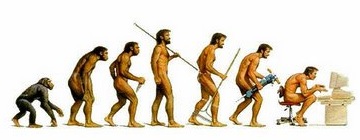
Note the hockey player on the far right.

If you notice, we’ve completely devolved back into having terrible posture. With most hockey players spending all day sitting (whether at school, watching tv, or stalking people on facebook), this posture of thoracic kyphosis (rounded upper back) and forward shoulders is becoming the norm. This is a SERIOUS problem for hockey players for two reasons:

1) An inability to extend at the thoracic spine (e.g. reverse this rounded curve) will limit rotation through this area. If you don’t believe, put your hands on each one of your shoulders and rotate as far as you can with your upper back hunched, then with your upper back extended as much as you possibly can. You’ll see that there is a significant difference in your ability to rotate through your upper spine. This has a number of performance implications, most visibly limiting your ability to generate rotational power while shooting.
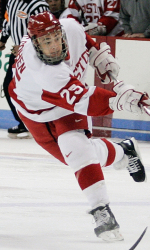
Former BU and current Endeavor athlete Colby Cohen taking a slap shot.
I just assume this went in.

2) This rounded posture moves your shoulder blades out to the side which forces your shoulders forward (see guy on right below).
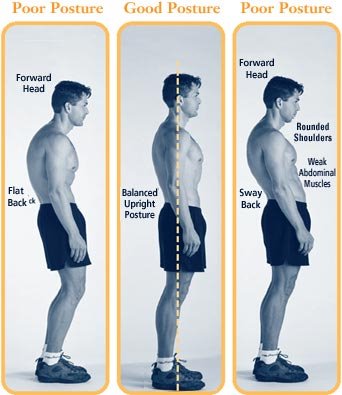
Do you see how his palms are almost facing backwards? This drastically increases your risk of suffering a shoulder dislocation. Imagine what would happen to that shoulder if a strong force was sent to his shoulder from a slightly backward angle. This happens almost every time a hockey player is hit from the side or into the boards (especially if the same side arm is raised to help “brace” for impact). In the middle picture, a hit from the side would result in the shoulder being pushed into the glenoid activity (shoulder socket), which could be absorbed by the entire upper body/rib cage. In contrast, the guy on the right would need to rely entirely on the long and weak posterior shoulder muscles, and the anterior glenohumeral ligaments.
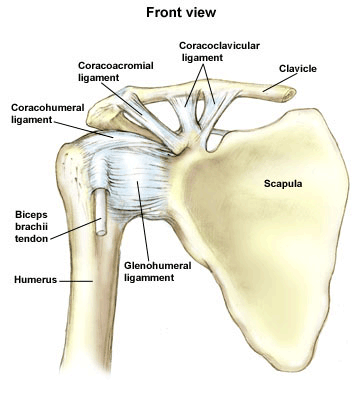
I don’t know if this is really a hockey training tip or not, but one of the most effective ways to prevent shoulder injuries is to improve your posture. Creating and maintaining a good posture ensures appropriate balance in muscle length (and consequent strength) across the shoulder joint and creates more structurally stability to common hockey impacts. You don’t have to walk around with your chest puffed up like an idiot, but you should pay attention to how slouched you are throughout the day and make an effort to stand up and stretch out regularly.

One of the best ways you can reverse the sitting posture (and hockey posture for that matter) is through a common yoga position known as “lie on your stomach and push your chest off the ground”.

Doing this for 30s a few times a day and making a conscious effort to slouch less and be “taller” will help minimize your risk of shoulder injuries. Remember, you can’t out-do 23.75 hours of bad posture with 15 minutes of quality shoulder exercises.

Kevin Neeld

Please enter your first name and email below to sign up for my FREE Athletic Development and Hockey Training Newsletter!

I think the greatest display of pure bliss the human race ever encounters is when a young kid is handed a tall cone of delicious ice cream on a hot day. You see their eyes get bigger as the cone approaches their hands, and after a couple licks they get that sugar-enhanced look of psychotic happiness.

But from time-to-time, this happens:

and third-party bystanders get to observe the rapid reversal of the aforementioned progression of joy and the inevitable hysteria-driven water works and siren-like harmony that emerge from the kid.

This circumstantial description closely resembles the emotional roller coaster I went on recently when I found out about the 2010 Midwest Performance Enhancement Seminar.

Check out the presenters/schedule for this event:

9:00 – 10:00 – Brian Grasso: We’re Killing Kids! Why Current Sports Performance Training Methods are Stupid

10:10 – 11:10 – Lee Taft: How to Load the System for Functional Speed

11:20 – 12:20 – Mike Robertson: The Single-Leg Solution

12:20 – 1:30- Lunch

1:30 – 2:30 – Pat Rigsby: Finding Hidden Opportunity in Your Fitness Business

2:40 – 3:40 – Bill Hartman: Energy System Training for Field Athletes

4:30 – 5:30 – Brett Jones: Kettlebell Basics: How to Integrate Kettlebells Into Your Strength & Conditioning Program

With a list like this, the big question is “How much?” Incredibly, the seminar only requires a $149 investment (that is-if I registered before July 24th…plenty of time). Before reading any further about the seminar I opened up my go-to barrage of flight tabs to price shop on the cheapest flight possible from Baltimore to Indianapolis.

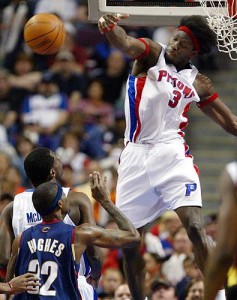
Full of ice-cream induced child-like excitement, I returned to the 2010 Midwest Performance Enhancement Seminar page to see when it was so I could book my flight and that’s when it hit me. The schedule gods batted that cone out of my hand like Ben Wallace protecting his net.

Unfortunately for me, the seminar is on August 28th, which is the weekend Emily and I are moving from Baltimore to Philadelphia (fortunate for me). Yes, after 15 months of commuting two hours from our place in Baltimore to Endeavor in South Jersey, we’re making the move to save my hips and sanity, and to move closer to where Emily wants to go to grad school. It’s just bad timing.

I’m pretty bummed I can’t make it…but that doesn’t mean you can’t! The list of presenters is really amazing; you’d have to be crazy (or moving) to miss this. Check out the link below for more information.

=> 2010 Midwest Performance Enhancement Seminar <=

To your continued success,

Kevin Neeld

Please enter your first name and email below to sign up for my FREE Athletic Development and Hockey Training Newsletter!

Hopefully you’ve taken a chance to check out the review I did of Mike Robertson’s new manual/DVD The Single-Leg Solution. I asked Mike if he’d go into some detail for you about some of the differential benefits between single- and double-leg exercises. Check out what he had to say:

Now that I’m officially pegged as the “single-leg guy” (right there with Mike Boyle, anyway) I figured this would be a great opportunity to highlight the single biggest benefit of bilateral lifts, or two-leg, lifts.

To be blunt: Squats, deadlifts, power cleans and the like are your best option if you’re looking to get bigger, stronger, and more powerful.

Can you improve strength, power or mass while training exclusively on one leg?  To some extent, sure.

But you’re not going to see the same kind of changes without some big, compound lifts in your programming.  It really comes down to two key factors:  Base of support, and the amount of stability you have.

Let’s examine both.

When we’re talking strength, powerlifters know how to maximize their results.  Want to know why you see very few powerlifters squat with a narrow stance?

Simple – because a narrow stance minimizes their base of support.

With a wider base of support, you’re more stable.  When you’re more stable, you recruit more prime movers.

But I’ll get back to that.  Let’s take this in the opposite direction.

Hopefully we can all agree that you could lift more/heavier weights from a split-stance position (like a lunge or split-squat), than you could a single-leg squat.  Why is this?

Again, it’s due to your base of support.  Even in a split-stance, you still have a better “base” than you do in a true single-leg stance.

The narrower you go with your stance, or when you take one leg off the ground, you take stabilizer function through the roof.

And this is one of the truest benefits of single-leg/split-stance training – you force all those little guys, your stabilizers, to do the work.

The problem, herein, is this – the more you call upon and recruit your stabilizers, the less you recruit your big prime movers!

To some degree, there’s an inverse relationship between stabilizer activity and prime mover activity.  The more stabilizer function your body needs to stay upright (and off your face!), the less worried your body is about recruiting the big muscle group to move big weights.

The other key ingredient to strength is stability.  Stability is the name-of-the-game when we’re talking about developing big, strong prime movers.

Think about leg pressing for a second.  I’m not saying this is a viable option for many of you out there, but think about the benefits of the leg press for a second.

Your back is stabilized by a pad.

Both feet are on the press.

The movement is purely sagittal plane – up and down.

At the end of the day, maximal stability plus a very basic movement pattern lets us use very heavy weights.  And with very heavy weights come big, strong legs!

But my intent is to argue for the inclusion of leg pressing in your workouts.  If you’ve read anything from me before, you know I pretty much despise the leg press and machine training as a whole.

Instead, my goal is to illustrate a point:

Bilateral lifts, due to their improved base of support and increased stability, are superior to single-leg lifts with regards to developing strength and power.

They aren’t the only way to skin that proverbial cat, but if your goal is to develop strong and powerful athletes, please don’t forget about the big lifts you may have thrown out of your toolbox.

Mike Robertson is a strength coach and personal trainer from Indianapolis, Indiana.  With a focus on not only injury prevention but performance enhancement, Mike has made a name for himself as one of the foremost authorities in strength and conditioning. Mike Robertson has helped clients and athlete from all walks of life achieve their strength, physique and performance related goals. Mike received his Masters Degree in Sports Biomechanics from the world-renowned Human Performance Lab at Ball State University. Mike is the president of Robertson Training Systems, and the co-owner of Indianapolis Fitness and Sports Training which was recently named one of America’s Top Ten Gyms.

Please enter your first name and email below to sign up for my FREE Athletic Development and Hockey Training Newsletter!

I hope you enjoyed a relaxing 4th of July weekend…and/or recovered fully from your celebrating. Emily and I took off at the end of last week for Denver to go spend the weekend with her brother. I love it out there. If the Avalanche ever gave me a call I’d make the move out there in a heartbeat!

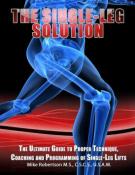
A couple weeks ago, I picked up a copy of Mike Robertson’s new DVD and manual set: The Single-Leg Solution

As you know, I’m a huge supporter of single-leg exercises for building lower body strength. I think hockey training programs should be based around single-leg lifts. In fact, I think training programs for all athletes should be based around single-leg lifts. With my hockey players, I followed what I think of as an inverted exercise model, whereby the traditionally thought of main lifts (which are all double leg squat and deadlift variations) are performed secondarily, if at all, following the traditionally thought of accessory lifts (single-leg lifts).

With that said, it’s easy to see why I’d be interested in the first ever product created to detail everything about the benefits (or lack thereof) of single-leg training, how to perform the lifts, and where they should fit in your program.

Single-Leg Solution Pros

The first thing I noticed about the product was that the cover is absolutely sick. I don’t know how Mike has doing his graphics, but I’m jealous.

After reading through the 96-page manual and watching the hour long DVD, I was really impressed with the comprehensive descriptions of the exercises. As I watched, I was thinking about how much I’d like every athlete I work with to have access to the DVD so they came to me knowing EXACTLY how I wanted them to perform the lift. For that matter, I wish every intern/job applicant also came equipped with that knowledge.

Mike’s DVD brilliant breaks down exactly how to perform the single-leg lifts (and their variations), common undesired movements, and how to coach athletes out of undesired movement into correct alignment, using both cues and reactive neuromuscular training. He also shows a few great ways to “unload” people that may not be able to hop right in to the more advanced variations (due to weakness, injury, etc.).

Other “pros” of The Single-Leg Solution were Mike’s unbiased breakdown of the benefits of single-leg training and where he fits the lifts into his program. Nowadays, it seems like the majority of people pitching the benefits of single-leg training or preaching about how they’re unnecessary and we should all stick with the “main lifts” are either regurgitating arguments they’ve heard from other people (not always a terrible thing) or just flat-out uneducated. It was refreshing to see Mike take an unbiased approach.

Single-Leg Solution Cons

First off, I want to make my position on these “cons” very clear. Mike is a brilliant guy, and (through emails and his products) has been an invaluable resource for me. “Cons” of the product aren’t so much “cons” as much as a couple things that I wanted more information on. After reading through the manual, two things really stood out to me regarding how double-leg lifts may still be superior to single-leg lifts in certain areas:

Point 1: A study presented in the 2005 NSCA National Conference by Chiu et al. found that “The magnitude and direction of forces in a SLS were significantly different when compared to running to cut, backpedal and cutting to the left for both the hip and the ankle. In fact a bilateral squat was much closer to these movements than a SLS.Joint contact forces during athletic movements may be more similar.”

I’ve looked everywhere and can’t find the publication of this information. I’d really like to know more about why they chose a single-leg squat (opposed to any other single-leg exercise like reverse lunges or back leg raised split squats) and if there was NO sigificant difference between the athletic movements and double leg squats or if the double leg squats were just less dis-similar (which essentially means nothing). I wouldn’t necessarily expect the magnitude of forces to be similar between athletic movements and a stationary squatting movement so I’m somewhat unclear on the strength of this argument IF it’s used as anti-single-leg (again-Mike doesn’t present it as one way or another, just presents the evidence).

Point 2: The implication was made that double-leg movements can be loaded more heavily and therefore provide a greater stimulus to the muscle. From a scientific standpoint, it’s hard to quantify exact muscular contributions during movements. To spare the semester-long discussion on why that is, I’ll move on to point out that many of our hockey players at Endeavor are doing back leg raised split squats and reverse lunges with very similar loads as they front squat (in some cases more). Coach Boyle has said the same thing about his hockey players. With that observation, I’m curious if I’m misunderstanding something about the loading argument, because it seems like you can load the involved muscles to a greater extent with single-leg lifts.

Overall, I think this is one of those products that should be in the library of every strength coach or trainer. Depending on your background, you may be familiar with some of the exercises, but the cuing/coaching, progressions, and programming are worth the investment.

Click the link or image below to check out more information about The Single-Leg Solution:

=> The Single-Leg Solution <=

To your success,

Kevin Neeld

Please enter your first name and email below to sign up for my FREE Athletic Development and Hockey Training Newsletter!

Last weekend I finished the last of 3 neuroscience text books I had been working for about the last year, which FINALLY freed up some time to read some other stuff.

“What do you mean that’s not cool?”

After I finished, I was going back through some old articles that I read a while back and came across an interesting one on hockey testing. The authors took 30 hockey players that were currently competing at the high school and junior levels through a battery of tests listed below.

Off-Ice Tests:

  1. 40-yard sprint test
  2. Concentric Squat Jump w/ Arm Swing
  3. Drop Jump
  4. 1-RM Leg Press
  5. Sit-and-Reach
  6. 30-Second Wobble Board Test

On-Ice Tests:

  1. Unanticipated Stop Test
  2. Forward Max Skating Speed
  3. Short-Radius Turns Test

After running a correlation-based analysis, the authors determined that there was a significant relationship between maximum skating speed and the 40-yard sprint test and the “Balance Ratio” (a measure determined from the wobble board test). However, the relationship wasn’t very strong, as each of these variables only explained about 25% of the variance in on-ice maximum speed.

Interestingly, the relationship between balance and maximum skating speed was stronger for players under the age of 19 than it was for older players.

Overall, these results aren’t that surprising. The same parameters that affect speed off the ice (lower body strength/power, core control, full body coordination, etc.) will logically improve speed on the ice. The finding that the wobble board balance test (a measure of reactive neuromuscular control) was more highly correlated to skating speed in younger players is further evidence of “natural” development (and the enhanced coordination that should come with age and experience).

I still don’t think it’s appropriate to compare players to each other using off-ice tests, but I’m excited by the effort that people are taking to find off-ice tests that are actually predictive of on-ice performance. I recently spoke with Mike Potenza (San Jose Sharks Strength and Conditioning Coordinator) , and he said that he was planning on spending more time analyzing various off-ice tests and seeing if any stuck out as influencing on-ice production (goals scored, +/-, etc.). The results from these efforts will be really interesting. If strong correlations can be found between select off-ice measures and any on-ice measure (even games played/missed), that will be a huge step for hockey testing. In the meantime, off-ice testing is still a great way to monitor improvement within a player.

To your continued success,

Kevin Neeld

Reference:

Behm, Wahl, Button, Power, & Anderson. (2005). Relationship Between Hockey Skating Speed and Selected Performance Measures. Journal of Strength and Conditioning Research, 19(2), 326-331.

Please enter your first name and email below to sign up for my FREE Athletic Development and Hockey Training Newsletter!

Use CODE: "Neeld15" to save 15%